Newsletter
Power Mad
A weekly review of the rogues and scoundrels of American politics

The Democrats’ Case for Reelection: Order Over Chaos

The biggest contrast the Democrats can draw over the next two years is that while they have passed a slew of major legislation, the Republicans have further descended into mayhem.

Demetrius Freeman/Getty Images
President Joe Biden signs the Inflation Reduction Act into law.

As I noted last week, the FBI’s raid of Donald Trump’s Florida redoubt spurred Trump’s defenders into a frenzy of hot anger, the onrush of which, as my colleague Matt Ford noted, may have been a wee bit premature, given the revelations that quickly emerged. But the reaction has been just as exuberant from the left. Merrick Garland, who’d up until then been a fixture of impatience and discontent among liberals hoping he’d apply a more Javert-like zeal to his pursuit of Trump, was suddenly an unlikely meme hero. After an interminable wait for the Justice Department to put Trump in a legal bind, Dark Merrick had finally did it on’ em.

But while the outpouring online is understandable, I’d urge Garland’s newfound fan base to follow his lead. As I previously noted, the straitlaced, even dull, persona he’s created for himself hasn’t lent itself to spectacle or emotional catharsis. But it’s been a great tone for the leader of an agency in bad need of a restoration to set. This is an excellent opportunity to embrace the Garlandian virtues of dull normalcy. Between now and the next presidential election, Democrats should do whatever they can to Make America Bored Again. What was the point of a Biden administration, anyway, if not the total assertion of a dull, normie, incremental political aesthetic as one of the better alternatives to four incompetent and cruel years under Trump?

Order is not something that Biden has always successfully established or maintained: His withdrawal from Afghanistan was more haphazard than it should have been; the road out of the pandemic has been and continues to be rocky. In recent weeks, however, Biden’s manifested a more serene vibe: His party, at long last, came together to pass a legislative agenda after a year of discord. The Inflation Reduction Act may be the balm for what’s ailed a fractious party that sparred over the Build Back Better Act.

Compared to Build Back Better’s top lines, the IRA looks like a picture of moderation. But as TNR’s Michael Tomasky notes, it’s also quietly revolutionary at its core. Newly signed into law, the IRA “begins to turn 40 years of bad economic conventional wisdom on its head by asserting that the government has a role in structuring markets, promoting growth, and guiding industrial policy,” Tomasky writes. The ship of state is being gently steered into better waters; those Democrats who fought for better and more generous policies now have a much firmer foundation from which to make new demands as a result. Coupled with Biden’s throwback views of the labor market, this means Democrats now look like a more cohesive and united party, and they’ll be able to campaign on an economic message with real possibilities.

Meanwhile, the GOP has embraced an all-havoc, all-the-time platform. Post-Roe America is turning out to be a nightmare in all the ways that liberals warned. Political violence is becoming more prevalent and more obviously a product of right-wing ideology. GOP candidates are growing stranger and more alien by the day. Conservatives are banning books and threatening children’s hospitals. And the party of Lincoln has torn down its monuments to the sixteenth president and erected busts of Hungarian autocrat Viktor Orbán in their place. Stem to stern, the GOP is sailing with a full complement of unreconstructed chaos agents.

Naturally, one of the ideas that those chaos agents are raising right now, as the investigations into the former president’s dealings advance on multiple fronts, is that the very act of bringing Trump to justice could plunge the country into turmoil. It’s an argument that Trump, in particular, hopes will be convincing, if only to save his own skin. And as The Washington Post’s Paul Waldman and Greg Sargent report, it’s also an argument that’s finding some purchase in the discourse, as media elites wonder if Garland shouldn’t try to tamp down the tense situation.

But as Sargent points out, those tensions exist only because of “GOP demagoguery,” and it’s not Garland’s “job to shape the legal response around GOP noisemaking.” Besides, the long-term chaos caused by creating a culture in which no one is held accountable outstrips the short-run chaos of a news cycle in which the dumbest pundits in the land demonstrate how susceptible they are to right-wing propaganda.

Democrats have the opportunity to draw an important contrast to the Republican vision of America, and the calm sobriety that Garland has recently projected is a model for Democrats to follow. Not long ago, I proposed that Democrats should promise voters that they’ll fight for the Good Life—a pledge to deliver more shared prosperity, more widely distributed political power, more political stability, all to allow all Americans to have more time to spend with the people they love. Chaos is the enemy of this agenda. This is a ripe time for Democrats to make a big bet that there are more people out there who want a calm and prosperous country instead of an unruly one.
Editor’s Pick of the Week

The Slandering of Merrick Garland

The right’s spent the better part of the week trying to paint the attorney general as a despot. Those charges won’t stick.

Evelyn Hockstein/Getty Images
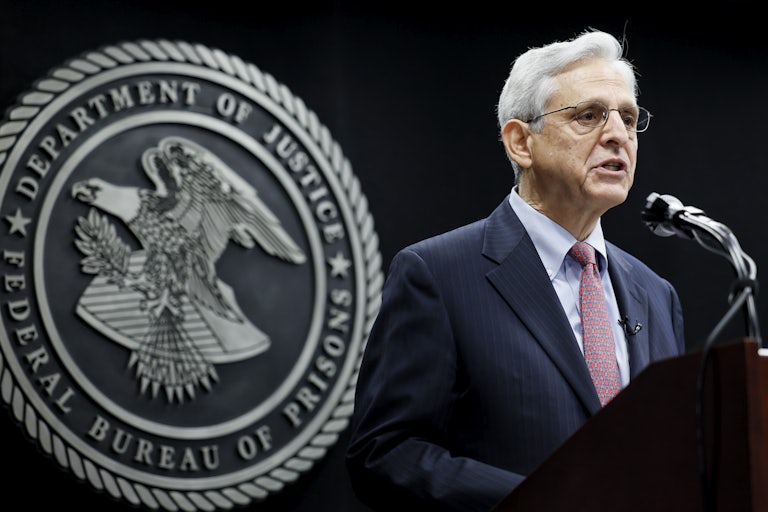
U.S. Attorney General Merrick Garland

One of the most compelling things about Merrick Garland is how fundamentally uncompelling he is. Back when then-president Barack Obama nominated him for the Supreme Court, he was tapped because he was an uncontroversial choice, all the better to win some votes from Republicans. (Things, obviously, didn’t go according to plan.) Now, he’s possibly the least charismatic member of the Biden Cabinet. The least photogenic as well: I can tell you firsthand what a struggle it is to find an interesting photograph of him. None of these traits seemed to be particularly advantageous—until, perhaps, this week, when the unassuming figure signed off on a warrant for federal agents to search Mar-a-Lago, President Donald Trump’s post-presidential way station.

It wasn’t immediately clear what exactly the Department of Justice was looking for at Trump’s resort. Most of the reporting on the matter suggested that the warrant pertained to the president’s alleged mishandling of classified materials, which The Washington Post later reported included “documents relating to nuclear weapons.” Garland confirmed this on Thursday afternoon and proceeded to ask for the warrant to be unsealed; The New York Times reported earlier in the day that the DOJ sought to recover those materials with a subpoena long before the warrant was executed. It’s also worth remembering that just because a warrant gets served, that doesn’t mean arrests or indictments are necessarily in the offing.

But what the subpoena news demonstrates is how unlikely it is that Garland or other high-ranking federal law enforcement officials would escalate in this manner without a good reason—and remember, a judge must also agree that there is just cause to serve a warrant. If those who sought and issued this warrant don’t have their ducks in a row, then the blowback will be intense. At the same time, even if everything was done by the book, the politicization of the whole fracas means that blowback is inevitable regardless.

But it’s here where Garland’s bland persona may serve him. There are many things you can say about him, but it’s a real challenge to characterize him as some sort of partisan firebrand. Indeed, for the bulk of his tenure, his seeming lack of passion for pursuing Trump with a Tommy Lee Jones-like zeal has left liberals vexed. Last October, California Democrat Adam Schiff, who played a leading role in Trump’s impeachments, said that he was in “vehement” disagreement with Garland’s seeming reluctance to hold Trump accountable.

As TNR’s Matt Ford has pointed out more than once, Garland never promised to be a Democratic avenger, nor has he at any time cultivated such a persona. What he has successfully communicated is that the Attorney General’s office would not be defined by some monomaniacal pursuit of Trump. The biggest task for Garland when he assumed office was the revival and restoration of the DOJ as a functional and independent institution after the wayward tenure of his predecessor, Bill Barr, during which time it really did seem like the DOJ could become a private tool of executive branch retribution.

It won’t be possible to escape the politicization of a DOJ investigation into Trump; some matters are beyond Garland’s control. But let’s note how Trump’s allies are responding: They’re foaming at the mouth about Garland being a corrupt autocrat whose actions are like unto dictatorships. As MSNBC’s Steve Benen pointed out, the seeds of this Garland smear campaign were planted long before federal agents descended on Trump’s resort. The GOP anticipated the possibility of further and more serious legal tribulations for Trump, probably because they have intimate knowledge of just how bad his misdeeds were.

But it’s going to be hard to make such a characterization stick to Garland. In dictatorships, government officials don’t serve search warrants or seek the permission of judges to carry out seizures; they don’t offer you a chance to amiably resolve the dispute in advance; they don’t give the people they’re trying to suppress a chance to make their case in public; they don’t assert the presumption of innocence or provide a forum for the accused to prove their case. More to the point, they don’t wait years to punish their political opponents. Indeed, Iraqi dictator Saddam Hussein, who Republicans might recall, undertook a violent purge of his government six days after taking power in what’s colloquially remembered as the “comrades massacre.” That’s a far cry from how Garland behaved, no matter what Republicans might allege.

What’s more, the only people talking about purges and political violence are Republicans. Trump is the one planning a mass dismissal of government bureaucrats if he’s reelected. And if you want to hear someone promising the dawn of autocracy, look no further than Florida Senator Marco Rubio, who in the wake of l’affaire Mar-a-Lago issued a not-so-vague threat: “What comes around goes around. And here’s what’s gonna happen now—one day they won’t be in power. And whoever is in power, there’s gonna be a lot of pressure on them to do it back to the other side. And now we do become a banana republic.” This is a pre-confession; in this scenario the “whoever is in power” is—according to Marco Rubio—Marco Rubio.

I almost feel bad for Trump’s allies, all of whom have spent the past half decade in a ruthless, backstabbing reality show about the sunk cost fallacy. But here’s the scoop: The guy is a corrupt dude who does crimes. By now, if you’re backing him, it’s because you’re itching to serve under the thumb of a caudillo; you are actively seeking political bloodshed and the disintegration of the Founders’ ideals. There are plenty of people on hand, right now, scratching and baying to become handmaidens to autocracy. Merrick Garland isn’t one of them.

This article first appeared in Power Mad, a weekly TNR newsletter authored by deputy editor Jason Linkins. Sign up here.

Low Unemployment Is Good. Bank of America Disagrees.

Time to put the kibosh on all this corporate talk about how workers have to sacrifice their labor market leverage to fight inflation.

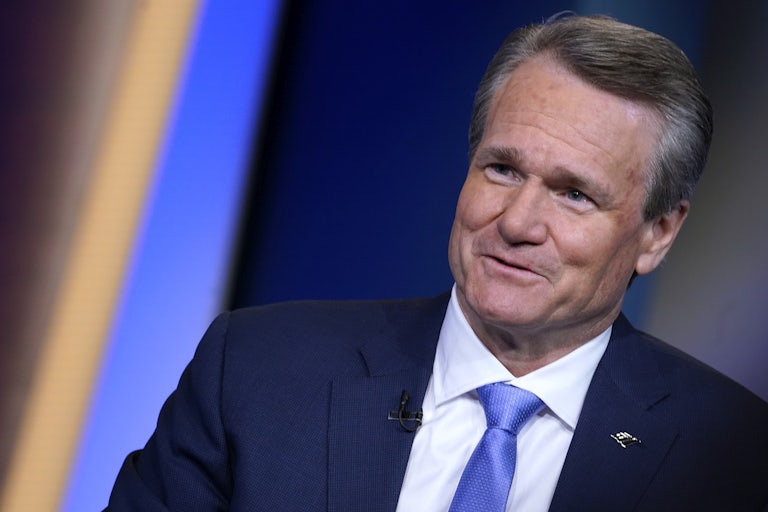
Bank of America CEO Brian Moynihan on Fox Business
John Lamparski/Getty Images
Bank of America CEO Brian Moynihan on Fox Business in 2020

With a few months remaining before voters go to the polls for the midterm elections, no one should be under the illusion that the economy is offering Democrats many political advantages. Elites are arguing about whether we’re in a recession. Maybe we are, maybe we aren’t, but the very existence of that debate is not a great sign. Meanwhile, after a long period in which they didn’t seem to want to talk about inflation, beyond halfheartedly pinning the blame for it on Russia’s invasion of Ukraine, the Democrats have only belatedly realized they can’t run from the issue and have renamed the Build Back Better Act as the Inflation Reduction Act (the bill itself got quite a reduction, too).

While these factors are far from ideal for Democrats, there are economic conditions worth highlighting—especially where the labor market is concerned. Federal fiscal relief helped engineer a swift recovery relative to the 2008 recession. The unemployment rate is low and employers are competing for talent rather than batting away job applicants. According to the Bureau of Labor Statistics, there are 0.6 unemployed persons per available job, which means there are about two job openings available for every unemployed person. And the recent boffo jobs report suggests that this part of the economy is still cooking with gas.

This is the sort of labor market that President Biden wanted to create, and for good reason: During his vice presidency, the Great Recession sent that ratio as high as 6.5 workers per job opening. It was a time of real despair for American workers, who largely shouldered the losses of Wall Street’s irresponsible gamblers. That workers took it on the chin was hardly celebrated as an act of patriotism. In fact, in the first midterm election after the recession began, the long-term unemployed were being regularly maligned by Republicans such as Senator Rand Paul, who on the campaign trail characterized the unemployed as people who needed to accept “a wage that’s less than we had at our previous job” in order to get off the dole. “Nobody likes that,” he said, “but it may be one of the tough love things that has to happen.”

And yet, here we are twelve years later, with workers off the dole and in jobs, and they’re still being maligned for their insufficient fealty to the demands of capital. Where their biggest sin was once nursing from the government teat, they’re now under the gun for coasting along in a market that’s suddenly become favorable to worker interests. The fact that workers might now be able to move more freely from a bad job to a better one, and command a better wage than they did at their previous place of employment, is somehow also seen as a problem in some quarters.

Last week, The Intercept’s Ken Klippenstein and Jon Schwarz obtained a private memorandum from a Bank of America executive who rather bluntly stated that his hopes that conditions for American workers might get materially worse.* The memo—which its author, Ethan Harris, characterized as a “mid-year review”—expressed grave concerns over the leverage that workers have at the moment. “By the end of next year,” Harris wrote, “we hope the ratio of job openings to unemployed is down to the more normal highs of the last business cycle”—that is, a ratio more conducive to employers having the leverage again.

As Klippenstein and Schwarz note, the memo “tells us what we suspected all along: The most powerful economic actors in the U.S.—entities like Bank of America and its clients—do not like working people to have power.” But this should probably come as no surprise: Intermittent presidential advisor and capital-class amanuensis Larry Summers has, in similar terms, endorsed the idea that American workers must give up their labor market gains in order to end inflation.

But in a speech during a recent conference on “Inclusive Populism,” author and TNR contributor Zach Carter was singularly unsparing in his critique of this anti-worker position:

Anyone who calls double-digit unemployment a solution to anything does not belong in politics. But the reasoning in play here should simply horrify people who believe in democracy. The most important cost-of-living issue for families this year is housing—in many cities, rent has exploded. Ask yourself: if the goal is lower rent, should we a) build more houses, or b) indiscriminately fire a large number of people from their jobs? The latter is the serious contention of this newly revived austerity brigade.

To contemplate engineering a spike in unemployment, at a moment where our republic is in genuine peril, is truly deranged. We need more stability and social cohesion right now, not less. And for the Democratic Party, which happens to be the only major party that wants to preserve the American experiment in multiracial democracy, there is a desperate need to connect better with voters outside of the affluent college-educated Americans they’ve already won over. They won’t get there if they allow workers to once again be thrown to the wolves without fighting for them.

More often than not, Biden’s age and experience is treated as a liability from the same pundit class that doesn’t seem to understand why it’s beneficial for workers to have the leverage they do. But it seems likely that a battle royale between labor and capital is starting to hover into view. Here, Biden’s belief that employers should compete for workers and his affinity for labor organizers is an example where his old-school thinking truly is aligned with our present needs. Taking up this fight may not save the Democrats’ bacon in the midterms, but there is another election just around the corner where victory may be even more necessary. Biden should go to any length to win it; his vision of a labor market that works for ordinary people will put him on favorable terrain.


This article first appeared in Power Mad, a weekly TNR newsletter authored by deputy editor Jason Linkins. Sign up here.

*This article originally reported that The Intercept was the first to report on the memo.

Corporate America Doesn’t Really Care About Your Abortion Rights

Democratic governors are pitching their states as havens for companies that want to protect their employees’ reproductive rights, but Big Business has never been a reliable ally of such causes.

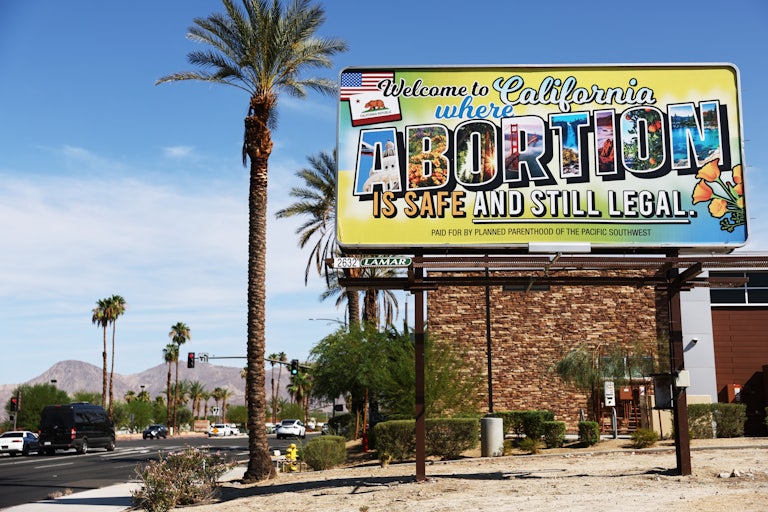
A billboard reads, “Welcome to California where abortion is safe and still legal” on July 12 in Rancho Mirage, California.
Mario Tama/Getty Images
A billboard reads, “Welcome to California where abortion is safe and still legal” on July 12 in Rancho Mirage, California.

In the last month, the Supreme Court’s conservative majority has unleashed a tidal wave of political power to secure a plethora of long-standing ideological goals, including leveling the administrative state, tearing down the barrier between church and state, and gutting reproductive freedoms that Americans have enjoyed for generations. With the right mounting up for ever more destruction in the not-too-distant future, it’s only natural that the people who have gotten screwed by all of the Supreme Court’s wheeler-dealings might seek out some equal or opposite societal energy that might be harnessed to push back in the other direction. One such force that’s recently emerged as a ray of hope is corporate America.

Those who look to Big Business for succor in these trying times might have been uplifted by The New York Times, which reported this week that the Supreme Court’s Dobbs v. Jackson Women’s Health Organization decision is “threatening to reshape the lines of economic competition between conservative and liberal states.” As Alexander Burns reports, the loss of reproductive freedom could cause a “disruption to the calculus” that has made some Republican-run states attractive to businesses—the idea being that as more onerous restrictions come online in various states, it will be harder for firms to attract talented potential hires to move to places where they’ll have fewer rights.

As the Times reports, some Democratic governors have acted upon this premise—North Carolina’s Roy Cooper, for instance, has vowed to veto any abortion ban on the grounds that it would hurt the state economically. Commerce Secretary Gina Raimondo has, in similar fashion, maintained that “the states imposing rigid abortion bans were all but certain to suffer economically.”

It’s understandable why people might look to corporate America to be a corrective force. A brain drain is certainly possible as young and talented workers avoid states with abortion restrictions or choose not to attend big state universities where top firms recruit. And there’s some logic in the idea that stability is good for business and upheaval is bad. We’ve even seen corporate America step forward to play a role in tempering such upheaval, when business leaders joined the campaign to get President Donald Trump to hew to the peaceful transfer of power. Perhaps the end of Roe’s protections are, in a sense, bad for business.

Since the Dobbs decision, we’ve been hit with a tidy barrage of stories about certain major firms, from Amazon to Citigroup, offering to help affected employees cover travel costs in order to get abortions out of state if necessary. It’s easy to talk a good game about these commitments in these early days, when nothing is certain but that the nerves of employees need to be calmed.

But even now, not every firm is speaking with encouraging words about reproductive rights: Facebook, Amazon, Twitter, and Snapchat have been guarded in their responses about whether they’ll hand over private data to police investigating recriminalized abortions. Some firms have already initiated crackdowns on their employees talking about their rights in both public and private fora.

I’ve expressed skepticism about corporations being a reliable ally of reproductive rights because sooner or later, all roads lead to corporations’ monomaniacal goal: increasing profits to shareholders. What’s going to happen when the cost of transporting the employees affected by abortion bans, and the possible legal expenses that accompany recriminalization, start cutting into bottom lines? I have some personal experience with this situation: In 2014, the company I worked for—AOL—attempted to rook its employees by reducing the generosity of our benefits packages on the grounds that two employees covered by our health insurance plans had “distressed babies” that imposed onerous expenses on the firm. AOL was certainly no model of corporate excellence. But if two employees’ medical bills can rattle a firm to that extent, imagine what happens when it’s hundreds of employees incurring new expenses.

If you’re feeling sinister, I suppose you might note the dark irony of how, in this narrow instance, two abortions would have been more cost-effective to AOL than two “distressed babies.” But that’s not the world we should be seeking to build. And frankly, neither is a world where some companies celebrate themselves for making less-than-ironclad commitments to workers about providing reproductive health care. As Today in Tabs’ Rusty Foster noted, while “eliminating the right to abortion unless you work for a certain employer” certainly “brings abortion in line with the rest of our national health care policy, where only the submissive employee has a right to any health care at all,” this is not the future for which we should be fighting.

As it stands, we might be kidding ourselves about this imagined future. Even if every rosy assumption becomes reality—liberal states outcompete Republican-run states for talent, workers relocate to reclaim lost rights, red states suffer economically—we should remember that if the national abortion ban conservatives are pushing for now comes to pass, none of that will matter. And as corporate America continues to fund the campaigns of anti-abortion politicians, you shouldn’t presume that they haven’t already thought of this.


This article first appeared in Power Mad, a weekly TNR newsletter authored by deputy editor Jason Linkins. Sign up here.

How Safe Will We Be on Election Day?

As gun violence and political intimidation increasingly push into the public square, our polling places loom as vulnerable targets.

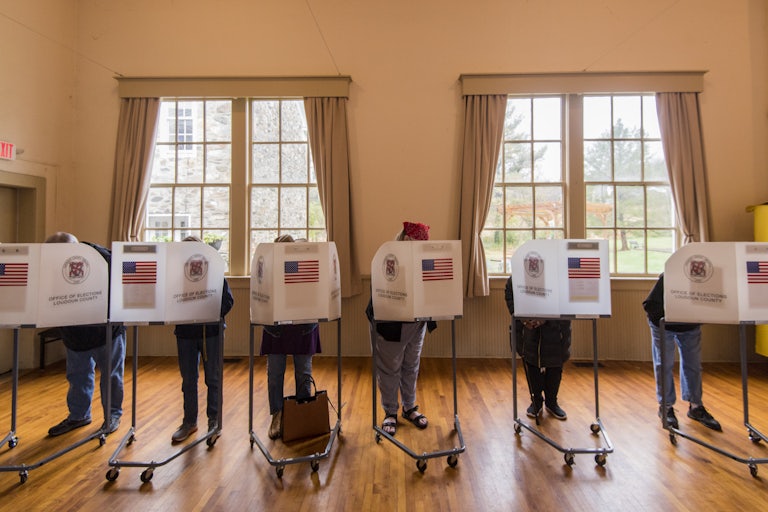
Voters fill out their ballots at the Old Stone School polling location in Hillsboro, Virginia.
Bill Clark/Getty Images
Voters fill out their ballots at the Old Stone School polling location in Hillsboro, Virginia.

There was a sense in the days running up to the Independence Day holiday that something bad was brewing—that people just felt less safe. As Gothamist’s Matt Katz reported on July 2, New Yorkers were feeling apprehensive about being out in public because the prevalence of mass shootings in America was causing a similar prevalence of panic-inducing false reports of violence. As psychiatrist and sociologist Jonathan Metzl told Katz, it’s a problem that extends well beyond New York City: “I do feel like our entire country right now is traumatized by the fact that it feels like a mass shooting can happen anywhere at any time.” 

Clearly, those fears were well founded: As CBS News reported, there were 11 mass shootings over the weekend, including the Highland Park shooting that claimed seven lives. In the wake of another fresh round of mayhem, the usual social media admonitions to get out and vote in the midterms circulated urgently—some more ham-fisted than others. These were of course followed by an equally robust fusillade of calls to do more than simply vote. 

Obviously voting is an essential ingredient to political change. But a lot of politics happens between election days—something conservatives often seem to understand better than liberals. Still, for those hoping for high turnout, it’s worth asking: Will it actually be safe to go out and vote?  

We live in an age when being out in the public square increasingly seems like a frightening prospect; it no longer feels like there’s safety in numbers. And standing in a line to vote at publicly demarcated polling places very much requires us to venture into a space that now feels vulnerable—where we might find ourselves under attack.

As Georgetown professor Heidi Li Feldman explained on Twitter, “Anti-democracy institutions and people” propagate fear and vulnerability by making “more guns available to more people”—the single condition that accounts for America’s unique problem with gun violence. “By making it dangerous for people of diverse backgrounds to gather in public, gun mongers promote fear and suspicion of one another,” Feldman notes. “By making public space so vulnerable to deadly violence, those who promote and push guns strike at the civil fabric.” What gets lost as that fabric frays is a sense of a “civil society” that we can all share.

And what we gain is more fear. As Amy Spitalnick, the executive director of Integrity First for America, points out: Sowing fear is “why mass shooters [and] extremists directly target public events—from neo-Nazis attacking Charlottesville community members who were protesting, to attacks on Pride events and abortion protests, to the targeting of public officials. The violence is key to undercutting democracy.”

As the right continues to plot its path toward permanent minority rule, it is making political violence more mainstream, alongside the GOP’s massive voter-suppression project. It’s hard to deny how violence has become an essential ingredient of the plot to deconstruct democracy. Since the 2020 election and the disputes that arose from President Donald Trump’s Big Lie, election workers have quit in droves because of the constant violent threats they receive. Two Georgia election workers, Ruby Freeman and Shaye Moss, recently provided harrowing details to the January 6 commission about the ways their lives were “upended” by a nonstop firehose of “harassment and racist threats.”

Meanwhile, right-wing militias that once vowed to “protect the polls” have only increased their presence in our politics and our civic life, where they’re massing in the public square and taking orders on who to intimidate. After the most recent evidence surfaced by the January 6 commission, it’s no longer hard to imagine such thugs receiving instructions from on high to shut down Democrat-heavy polling places by any means necessary. 

Wasn’t the 2020 election supposed to be a rebuke of the culture of political violence Trump and his ilk famously promulgated? Apparently not: “Far from reducing violence, the 2020 election and its aftermath heralded a step-change in the mainstream acceptance of violence as a political tool,” writes Rachel Kleinfeld at Just Security. “Why would a faction of Republicans still in power or running for office at the federal, state, and local level make common cause with violent criminals? Because violence and intimidation are already bolstering their power.” 

What is to be done? Unfortunately, we remain stuck in the “vote harder” endless loop; we aren’t likely to pass a law protecting voters at the polls, for the same reason we’ve not enacted any voter protections in spite of these threats to democracy—not enough Democrats believe these measures are more important than preserving the filibuster. Democrats who feel otherwise must elect additional senators who are willing to change these rules. To get there, Democratic voters must feel safe enough to go to their polling places, and cross their fingers that their votes get counted.

This might be one occasion when less skittish Democrats should try their luck at passing a bill to make our polling places safe, force Republicans to take a hard vote, and then get them to explain why the ostensible party of law and order opposes ensuring safety and security at the polls. If that’s the only thing that can be accomplished in the short term, Democrats can at least distinguish themselves as the guardians of stability in the public square, thus advancing the Good Life agenda in a small but meaningful way. And if something unthinkable happens on Election Day—well … we will at least be able to name and shame the lawmakers who enabled it. 

This article first appeared in Power Mad, a weekly TNR newsletter authored by deputy editor Jason Linkins. Sign up here.