It’s a quiet Tuesday morning in Sacramento. On any given weekday this past year, the City of Trees is normally bustling with state workers heading to their offices, construction workers hammering away at the new Capitol Annex, or City Parking Enforcement Officer Grant Nakamura breaking his previous record of having handed out 22,000 parking tickets in 2025.
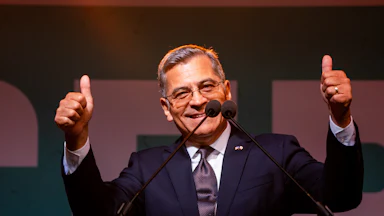
But, with last week’s primary results still being counted, the state is now reeling from one of the most unpredictable primary elections in recent history. For the past six months, Californians have witnessed a parade of gubernatorial candidates who have vied to replace Gavin Newsom as the state’s next governor. In what many have called a turbulent election, the primary has seen everything from the cataclysmic downfall of Representative Eric Swalwell to the close race between three candidates from across the political spectrum—Xavier Becerra, who experienced a historic rise from among the last to being the front-runner; Steve Hilton, a wannabe Trump in California with the blessing of the Trump himself; and Tom Steyer, a billionaire and political outsider who courted progressive voters with his vision of environmentalism.
Several other candidates, including Elizabeth Warren acolyte Katie Porter and former Los Angeles Mayor Antonio Villaraigosa, fell short. This was the most expensive election in California history, with $316 million spent. Two hundred million of that came from Steyer tapping his personal war chest, along with a myriad of corporate donations for Becerra and Hilton.
In any case, Californians will have to wait a few more days for the primary dust to settle, and then it’s on to November to decide on who will replace the presumably presidential primary–bound Gavin Newsom and sort out the myriad challenges he’ll leave behind: skyrocketing costs of living, a lack of housing, an increasing number of climate change–driven wildfires, and the constant animosity of the Trump administration.
With Becerra already called as one of the candidates, and Hilton leading by several percentage points over Steyer, it looks as if the final showdown will be between Becerra and Hilton. If so, Becerra, the sole Democrat in the race, will likely take the state. Why that matters nationwide is that Becerra, like many veteran Democrats, is a poster child for much of the Democratic leadership—experienced but moderate. While I would like to give Becerra a chance to prove himself, as he stands, he will be much like—well, Gavin Newsom.
Becerra has a deep résumé. He is the former secretary of health and human services under the Biden administration, a former state attorney general, and former member of Congress who represented the heart of Central and East Los Angeles. As state attorney general, he defended DACA and the Affordable Care Act during Trump’s first term and sued the administration over fracking. The son of Mexican immigrants, who grew up in Sacramento, he was the first in his family to attend college when he enrolled at Stanford University.
On paper, his portfolio would make him an ideal Democratic candidate—experience in both Sacramento and Washington, from a working-class background, the son of immigrants. After Swalwell, the first mainstream Democratic contender, fell from grace, Becerra positioned himself as a steady choice for many Democrats. And it paid off: By late May, polls showed Becerra leading beyond the other contenders by a safe margin, beating back earlier fears of a Republican shutout from earlier in the election.
Becerra’s rise can also be understood in the context of the state’s racial politics. Back in March, Becerra protested the exclusion of himself and other candidates of color from the ABC7-USC debate. As he said in an open letter to USC’s President Beong-Soo Kim: “My father used to tell me of the days when he would encounter signs posted outside establishments that read ‘No Dogs, Negroes or Mexicans Allowed.’ USC’s actions may not seem so transparent. But, you have deliberately chosen to selectively filter the voters’ view of the field of gubernatorial candidates in what all observers characterize as a wide-open race.”
The move helped cement his connection to Latino politics in the Golden State, where 41 percent of California’s population is Latino. Communities are not monoliths—as the 2024 election demonstrated, the Trump campaign received a significant number of Latino votes. But Becerra, who is the first in his family to attend university, who fought against ICE in his time as attorney general during the first Trump administration, and would be the first Latino governor and governor of color in California history since Romualdo Pacheco in 1875, does appeal as someone who understands the immigrant experience at a time when immigrants are under attack.
At the same time, Becerra’s emergence as the front-runner brought a wave of corporate backers. If money talks, then Becerra can be expected to give lip service to Chevron, Meta, Uber, and PG&E. It’s no wonder Becerra has received the most scrutiny for his anticipated catering to groups that inflame issues important to many California Democrats: climate change, the rise of AI, and affordability.
Becerra described this as pragmatism—as he said in one debate statement: “You need Chevron. I need Chevron. My people of the state of California need Chevron … Chevron wants to give me a check, that’s—that’s their prerogative.” While he cited his lawsuits against oil companies and his support for green energy, he said in the end that Chevron remains an important employer to the state. But it is worth noting that Chevron’s contribution to a Becerra PAC was the first time it had donated to a California gubernatorial election in a decade.
David Dayen of The American Prospect has noted how the final days of the primary were defined by Becerra’s corporate backers. In his article on Becerra’s inaction on pharmacy benefit managers, or PBMs, Dayen pointed out that as attorney general Becerra sought to rein in PBMs. He rolled back his stance once appointed to the Biden administration (in parallel with his change of heart on the single payer option).
Becerra’s rise, to Dayen, has been a credit less to his talent as a policymaker than to a lack of accountability from the California Democratic Party. While Becerra proposed seizing patents for medication made with government research as a means of cutting down on pharmaceutical price gouging during his time as state attorney general, he later backtracked on the plan when he became health and human services secretary. “Governing matters less than internal power positioning,” said Dayen.
This accounts for the potent challenge mounted by Tom Steyer, the billionaire former head of investment group Farallon Capital who used his personal fortune to combat climate change and take on the oil industry. As Joe Hagan outlined, in his profile of Steyer for Men’s Journal back in 2017, Steyer seemed nothing like a billionaire in his lifestyle or interests. That may be why he has enjoyed some success in an era when billionaire is a dirty word. Steyer has enjoyed endorsements from some key progressives, including former U.S. Secretary of Labor Robert Reich and Representative Ro Khanna.
A Becerra-Steyer matchup may offer a more interesting election than a race between Becerra and right-wing blowhard Steve Hilton. But, based on the current AP results, we are likely facing a November election between Becerra and Hilton.
California was doomed to have a chaotic election. In 2009, Republican state Senator Abel Maldonado authored what would become Proposition 14, a measure that would amend the state constitution to create the current open primary system. Then-Governor Arnold Schwarzenegger championed the measure as a staple of his legacy and in 2010 promoted Maldonado to be lieutenant governor.
At the time, some pundits viewed the measure as a means of preventing extreme candidates from winning an election. Others saw it as a system that limited the power of third parties to compete in the jungle primary. But what stands out most of all is the fact that, in California at least, it was a solution in search of a problem: Before 2010, most elections—save the explosive recall election of Governor Gray Davis—were relatively tame.
As The New Republic’s own Timothy Noah previously noted, California’s electoral problems are down to the stagnation of the state Democratic Party, which has changed very little since the Clinton years. As Republicans have moved increasingly rightward as part of capitulating to Donald Trump, their importance in state politics has dwindled to a few conspiracy theorists and as foil to Gavin Newsom. Whoever the next Democratic governor is, they would do the party a favor by eliminating the open primary.
California Democratic politics have been increasingly defined by the party’s centrism, which has become more deeply rooted even as the state’s biggest problems—affordability, environmental devastation, the seemingly intractable housing crisis—have become equally entrenched. There are no outside forces strong enough to shake this status quo. Few have challenged the main Democratic establishment at the statewide level. Since 2006, no Republican has been elected to statewide office. The Democratic Party in California has maintained a steady grip on statewide policy to the point that many within the party seem mostly concerned about maintaining its monopoly. And moderate Republicans fleeing MAGA’s corruption in tenuous alliance with the Democratic Party’s center have only more deeply instilled the party’s corporate bent, seen most vividly in the way state Democrats tend to cater to major business interests like Silicon Valley.
As Dayen put it to me: “I think the party has generally evolved a mild antipathy to governing, which is poisonous in the current environment where voters are disappointed at the lack of follow-through on campaign promises. Wanting to be liked more than wanting to get things done creates a slow, painful toxicity that emerges in approval ratings of the Democratic Party.”
Outside the governor’s race, some challenges to the established order have bubbled up. The Los Angeles mayoral race has received the most attention for the fact that former reality-television fixture Spencer Pratt channeled anger over the L.A. wildfires and slung AI campaign videos left and right to become the first major Republican mayoral challenger in decades.
But it is not only challenges from the right that are rocking city politics. Nithya Raman, a onetime ally of incumbent Mayor Karen Bass, entered the race against her, blasting her former colleague for her handling of programs supporting the city’s significant unhoused population.
Elsewhere, anti-establishment figures are doing more than merely rattling some cages. In San Francisco, State Senator Scott Weiner will face off against City Supervisor Connie Chan to replace Democratic legend Nancy Pelosi. Although Chan received endorsements from both Pelosi and former San Franciso Mayor Willie Brown, she finished second in the primary. Weiner, a Democratic state senator with a long track record of authoring legislation on issues ranging from LGBTQ+ rights to housing, has received praise as the brains behind the No Secret Police Act, which required federal agents to demask, and one of the earliest bills to regulate artificial intelligence (it was vetoed by Newsom). Since then, Weiner has authored several AI regulation bills that have been signed by the governor, and some speculate his state legislation being a template for federal oversight on AI.
East of the Bay Area in Sacramento, Representative Doris Matsui of California’s 7th congressional district has faced a significant challenge from Sacramento City Council member Mai Vang. Matsui and Vang will face off in the November election, in what will be a standoff between different generations of the Democratic Party—in some ways a microcosm for party politics writ large. Matsui is part of a family political dynasty that began when Robert Matsui was elected to California’s 3rd district in 1979. Until his death in 2005, he worked on legislation that included blocking the privatization of Social Security to shepherding the Civil Liberties Act of 1988, which offered redress to Japanese Americans formerly incarcerated in camps during World War II. That same year, Doris, his wife, ran successfully for his seat in a 2005 special election. Since then, Doris Matsui has been a longtime advocate for women’s and LGBTQ+ rights.
But while in previous years Matsui’s reelections have been relatively calm and certain, this year the race has been contentious. Vang and Matsui have attacked each other on a personal level, often pointing to their generational differences. Matsui has been criticized for her age (she is 82) and her slow response to ICE’s predations. Vang, who was elected to the City Council in 2020, has been criticized for lacking the experience needed to serve in Congress.
As with the governor’s race, money played a crucial role in this election. Matsui raised $1 million to Vang’s $600,000, and Matsui later took out a $1.4 million loan to finance her campaign (Matsui’s second husband is billionaire Roger Sant).
The Sacramento Bee ultimately endorsed Vang after Matsui declined to speak with the paper’s editorial board. In the board’s words: “Mai Vang embodies today’s Sacramento. Doris Matsui does not. The Bee endorses Vang for a much-needed and historic changing of the guard for Sacramento in Washington.” The Bee’s Robin Epley also accused Matsui of platforming Zachariah Wooden, a college student running as the Republican, in order to pull votes away from Vang.
When I asked Dayen what he saw in this primary, he described it as an important moment where a lack of strong leadership left many voters uncertain about their future—a sentiment with which The New Republic’s Perry Bacon concurred. “I think there is a strain of restlessness in California,” Dayen said. “The governor’s race didn’t have a locked and loaded establishment figure for the first time in 20 years. The late redistricting unsettled the House races to a degree, and there’s a real questioning of what it takes to win in swing-district territory.” However, as demonstrated by the wealth of support for Becerra from companies like Chevron and Meta, Dayen says the influence of corporations still influences state politics: “The money thrown around continues to frustrate public desires.”
For decades, Californians have seemed to want calm and easygoing elections, preferring familiar faces to firebrands. And they’ve largely gotten their wish, even at the top of the ballot in this current cycle. As longtime Los Angeles Times columnist George Skelton put it, Becerra offered something that has, with some exception, dominated California politics: “Nothing flashy, just plain but comfortable.”
But what remains are the underlying problems—environmental disasters like wildfires, rising housing costs, and anxiety over the AI industry, to name a few—that have plagued California residents and have made life anything but calm and easygoing. And while challenges to the status quo have been more a trickle than a flood, it’s a warning sign to those who’ve clung to power in the established order that they must start delivering solutions. At some point, something’s got to give—or else MAGA’s next Golden State savant might successfully convince voters to give them the reins. Democratic leadership should pay attention to the rumblings out west; California will be a bellwether for what could happen to the party across the nation.
* This article has been updated.