Life in a Warming World
A weekly reckoning with our heated planet—and the fight to save it

I Wish I Were Joe Manchin

What is your personal Mountain Valley Pipeline? What would it be like to force your co-workers to pretend it’s a good idea?

Joe Manchin grins and points as he walks.
Bill Clark/Getty Images
Senator Joe Manchin, living his best life

Can you imagine what it must be like to be Joe Manchin? Seriously, picture it for a second. Imagine anytime your co-workers were on deadline to deliver a project, you could just toss in a line funding your pet obsession: if TNR’s editorial team were about to launch an expanded Supreme Court desk, for instance, and I said, “Welp, in exchange for my very titular support for this project, you must also fund my plan to plant Charentais melons around the Washington Monument.”

Now imagine that instead of saying, “Absolutely not, what are you smoking, this has nothing to do with fruit,” my bosses and colleagues stared at me blankly for a few seconds, said, “OK, we can work with that,” and issued a press release announcing their support for small-scale heirloom melon agriculture in downtown D.C.

This is pretty much how things have been playing out over the past year with Joe Manchin and the Mountain Valley Pipeline—the cursed imbroglio that has now made it into this week’s debt ceiling deal.

The melon seeds of this week’s news were sown last summer, when the West Virginia “Democrat” finally agreed to provide his vote for Democrats’ flagship piece of legislation, the Inflation Reduction Act. For his support, Manchin secured a promise from Democrats not just to speed up federal permitting in general but specifically to “require the relevant agencies to take all necessary actions to permit the construction and operation of the Mountain Valley Pipeline and give the DC Circuit jurisdiction over any further litigation.”

The follow-up to this came in September, when Manchin introduced his Energy Independence and Security Act, a bill purportedly to reform the U.S. permitting system for energy infrastructure but especially to issue any new permits the Mountain Valley Pipeline might need, and which had been repeatedly blocked by the Fourth Circuit over environmental concerns, including the pipeline’s threat to at-risk species.

The White House duly issued its statement of support, despite 70 House Democrats pointing out that gutting the National Environmental Policy Act to please Manchin was maybe not the best idea, and Majority Leader Chuck Schumer tried unsuccessfully to get it into September’s continuing resolution to keep the government funded. When that failed, he attempted in December to attach the bill to the National Defense Authorization Act—with Biden’s blessing—before giving up on that plan as well.

Imagine how frustrated you’d be if you were Manchin at this point. After all, you provided a crucial swing vote on a piece of legislation that could save households thousands of dollars and help cut the emissions contributing to an existential crisis on Planet Earth, and your co-workers still haven’t delivered on their promise to ram through your ill-conceived, ill-executed little scheme that undermines that entire effort.

The Mountain Valley Pipeline is, to use the technical term for something that would comprehensively flunk any rational utilitarian analysis, a bad project. The idea is to run a pipeline over 300 miles from northern West Virginia to southern Virginia, perhaps even including an extension into North Carolina, and fill it with fracked gas, which we now know is fueling a spike in global methane emissions, warming the planet at a much faster rate than earlier projections.

It’s been unclear from the get-go what demand this pipeline will allegedly be meeting, given that the region already gets gas from the existing “Transco” pipeline system. But Manchin likes the MVP, presumably, because it’s in his state and theoretically promises jobs and economic development to communities in dire need of them. He has repeatedly asserted that the MVP somehow enhances the country’s energy security. (He might also just like it because he gets a bonkers amount of money from the fossil fuel industry, but hey, let’s not be cynical.)

If the MVP is like other pipeline projects, the actual benefit to local communities is wildly inflated. But given what’s being promised, it’s impressive how much local opposition the pipeline has provoked, from environmental activists to landowners concerned about accidents and irritated about the seizure of their property via eminent domain.

It’s not just the pipeline’s projected emissions—equal to those of 26 coal plants—that have raised eyebrows, as TNR’s Kate Aronoff pointed out last year. Since 2018, the project has racked up hundreds of water quality violations. And as Inside Climate News reported last fall, there’s a particular concern about the safety and stability of pipeline sections that have been left outside for long periods of time. In April, the Fourth Circuit took a look at the pipeline’s copious water violations and ruled that West Virginia had “failed to provide a reasoned explanation as to why it believes MVP’s past permit violations will not continue to occur going forward.” Last week, the D.C. Circuit ruled that the Federal Energy Regulatory Commission needs to either prepare a report on the MVP’s possible effects on erosion and sedimentation or explain why it hasn’t.

In short, there are a lot of reasons to let this questionable project die. And really, it would be sensible at this point for Schumer and Biden, after multiple attempts to honor last summer’s deal with Manchin, to mothball the thing. Instead, the long-awaited bill text to avoid a default on U.S. debt gets released, and what do we see? Round Three of “let’s try to insert special treatment for this bogus piece of mega-plumbing into must-pass legislation.”

Although Virginia Senator Tim Kaine immediately announced his intention to haul the MVP expedited approval back out of the bill text, on the grounds of it being “completely unrelated to the debt ceiling matter,” the Senate rejected his amendment late Thursday and passed the bill with the MVP provision intact.* Manchin, meanwhile, issued a statement early this week saying, “I am proud to have fought for this critical project and to have secured the bipartisan support necessary to get it across the finish line.”

And hey, why wouldn’t he be proud of himself? If you had managed to send your co-workers on a nine-month masochistic mission to insert your personal idée fixe into every big-ticket item that crossed their desks, wouldn’t you be pleased? Wouldn’t you be drunk on cantaloupes and power? Truly: What must it be like to be Joe Manchin?

Good News

The National Oceanic and Atmospheric Administration hurricane outlook for 2023 predicts a “near-normal” year of 12 to 17 named storms.

Bad News

“Recycling has been promoted by the plastics industry as a key solution to the growing problem of plastic waste,” The Guardian’s Karen McVeigh reports. “But a study has found recycling itself could be releasing huge quantities of microplastics.” Specifically, the wastewater from a “state-of-the-art” recycling facility in the U.K. was found to contain 13 percent of the plastic processed in the plant. Installing a filter reduced that to 6 percent. Nevertheless: yikes.

Stat of the Week

1,579

That’s the number of climate protesters arrested by police in the Netherlands this past weekend, following a highway demonstration against fossil fuel subsidies.

Elsewhere in the Ecosystem

Regulators Want Fashion Brands to Pay for Their Textile Waste

Numerous countries and states are now considering making fashion companies pay fees—part of an “extended producer responsibility,” or EPR, approach—to help tackle the growing clothing waste crisis:

Fashion industry waste is a growing and largely unchecked problem. In the EU, textile waste totals about 4 million tons each year, while in the US it hit 17 million tons in 2018, up 80% over 2000. Garments that don’t end up in local landfills are often shipped in bulk to countries in the Global South. In Ghana, as many as 15 million discarded garments arrive every week, according to the Or Foundation, which advocates for fashion waste reform.… Supporters of EPR programs for textiles hope they will curb overproduction, lead to recycling innovations and encourage companies to make higher-quality products. It’s also likely that EPR fees would be passed on to consumers, whose thirst for cheap clothing is exacerbating overconsumption.

Read Olivia Rockeman’s report at Bloomberg.

This article first appeared in Apocalypse Soon, a weekly TNR newsletter authored by deputy editor Heather Souvaine Horn. Sign up here.

* This piece has been updated.

What Fossil Fuels Have Done to Summer Is Unforgivable

There’s nothing fun about deadly heat.

Dishes of crab, baked beans, vegetables on a skewer, salad, and condiments sit on a table alongside plastic cutlery and paper plates.
Bethany Lafrenier/Getty Images
A Memorial Day cookout in 2013

Ah, Memorial Day: the time to haul out the grill, peruse those make-ahead salad recipes, and throw your back out dragging your aging air conditioner out of the closet, because it’s going to be a heck of a summer.

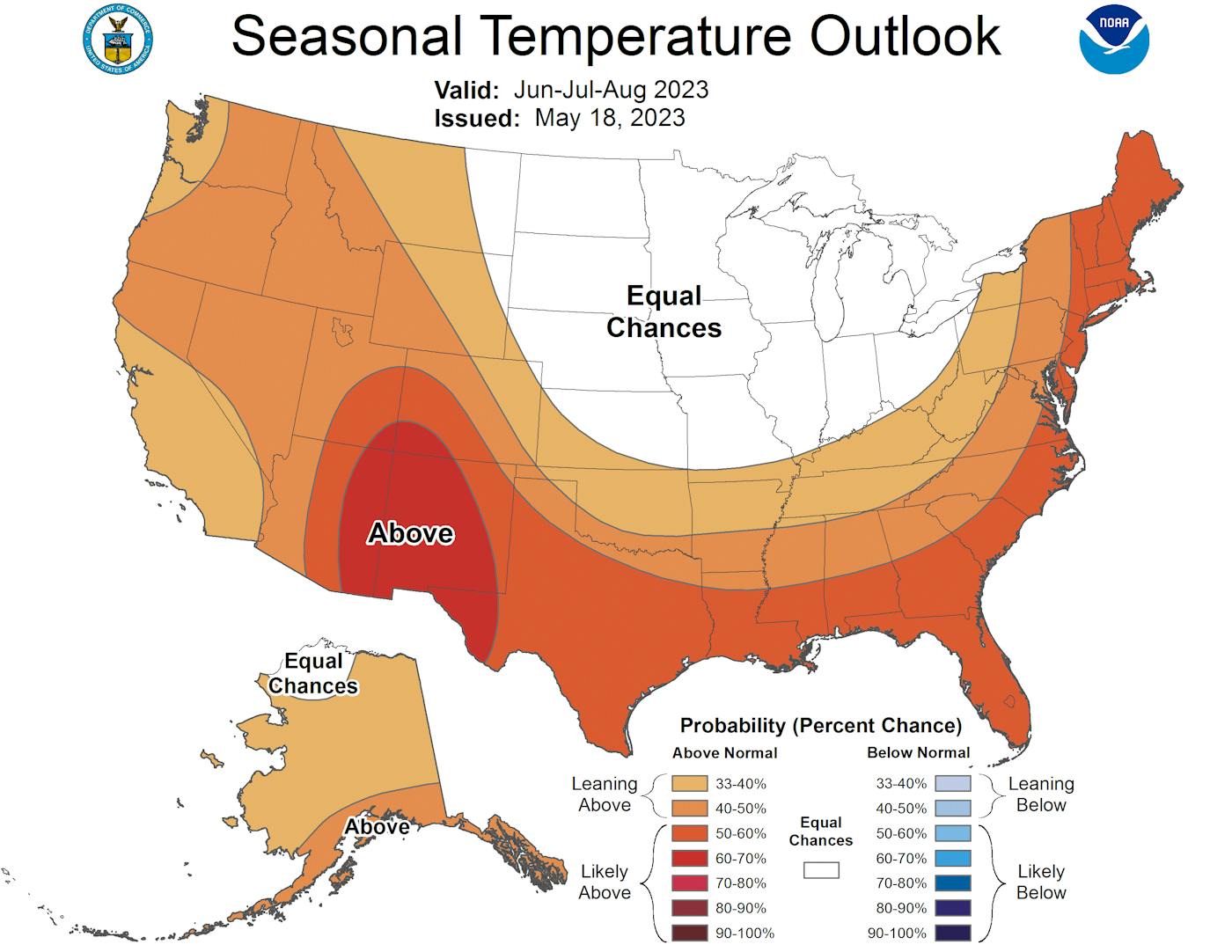
The National Oceanic and Atmospheric Administration recently unveiled its seasonal temperature outlook, which estimates most of the United States is likely to experience above-normal temperatures this summer. The probability of that outcome depends on where you live, ranging from 33–40 percent in West Virginia and central Montana to 60–70 percent in parts of the Southwest.

Source: NOAA

NOAA also released its Seasonal Precipitation Outlook, which predicts that much of the Midwest, South, Southeast, and Mid-Atlantic may experience above-average precipitation, while the Southwest—already in crisis due to an ongoing drought—is likely to suffer from below-average precipitation, which could also hit the Pacific Northwest. (The 2023 hurricane season outlook will be announced at a news conference later this week.)

Global warming gives us different things to mourn in different seasons. The changing climate, for example, can make people nostalgic for the autumns and winters of yesteryear—you know, when leaves changed color on schedule and drinking hot cider in October didn’t just make you sweat, or when backyard skating rinks didn’t melt into vernal pools in January.

But climate change’s effect on summer feels simultaneously more subtle and more foreboding. It doesn’t make summer less summery. But it does make summer less fun and more dangerous, in a variety of insidious ways.

At the more prosaic end of the spectrum, 75-degree days turning into 85- or even 90-degree days is just an unpleasant hassle, making it harder to enjoy the outdoors and more costly to keep the indoors comfortable; air conditioners are expensive and a pain to deal with, and heat screws up people’s sleep.

Then there are the deadly waves, whose toll is probably undercounted in this country. “The Centers for Disease Control and Prevention,” Eric Margolis previously wrote for TNR, “only counts deaths where heat illness is explicitly noted, so the official CDC count of heat-triggered deaths sits at just around 600 per year. Epidemiologists estimate that the real figure may be closer to 12,000—20 times higher than the official count.”

Those numbers could soon rise. For a while, heat deaths were decreasing—probably due, the CDC has surmised, to “better forecasting, heat-health early warning systems, and increased access to air conditioning.” But there are a few reasons that trend might not hold. For one, the number of dangerously hot days in many areas is growing. Here in D.C., for example, the “baseline” number of heat emergency days is supposed to be 11. But by the 2050s, even under a “low emission scenario,” that number will more than double, to 25—and could be as high as 45. (Already, this decade, the city is expecting the number of heat emergency days to range from 18 to 20.)

The second reason is that air conditioners, which are hardly evenly distributed across society to begin with, aren’t much help if the electrical grid fails. In the 2021 heat wave that hit the Pacific Northwest, over 6,000 people lost power in Portland alone during a 112-degree-heat weekend. As Vox reported that year, the U.S. power grid is dangerously underprepared for these kinds of scenarios, and not just because of overall energy capacity: “If the weather gets hot enough, power lines start to sag—a result of the metal inside them expanding—and risk striking a tree and starting a fire. At the same time, power plants are highly dependent on water, which they need to cool down their systems,” but which isn’t necessarily available in some areas during drought.

And that’s to say nothing of work-related heat deaths, for both outdoor workers in fields like agriculture, construction, and delivery and indoor workers in poorly ventilated warehouses. It’s to say nothing of the increasingly plausible link between heat and derechos, or the dangers of drought, fire, or flash floods—all of which climate change is making more likely in various regions in the summertime. It’s to say nothing of the well-documented annual spike in violent crime, which researchers show is particularly likely on days above 85 degrees.

As a fall and winter person myself, I spend a lot of time mourning what petro-hegemony is doing to those seasons. But what rampant emissions are stealing from summer people—and all of us—is arguably worse. Climate change isn’t simply removing what’s enjoyable about these months (like snow in winter). Instead, it takes those enjoyments and dials up the temperature until the fruits of the season start to rot—until the former beach days, al fresco park gatherings, and mornings in the garden just aren’t very pleasant, or even carry the risk of heat stroke, and “scorchers” turn into multiday death traps.

Happy unofficial start to summer. It’s a lovely time to get angry and demand better.

Good News

California, Arizona, and Nevada have come to an agreement on water cuts to address the crisis in the Colorado River basin. It’s not final, and it’s absolutely not enough to resolve the situation permanently. But after an incredible amount of stalling, it’s a start.

Bad News

The G7 meeting in Hiroshima over the weekend failed to result in a commitment to coal phaseout and included explicit praise for natural gas: not a great outcome for the climate.

Stat of the Week

That’s what the top fossil fuel companies (think BP, Shell, ExxonMobil, Total, Chevron, and more) would owe in regular reparations for the cost of extreme weather, sea level rise, and other climate disasters, according to new hypothetical calculations.

Elsewhere in the Ecosystem

She’s Out to Save Rare Wildflowers, but First She Has to Find Them

One of the upsides of California’s torrential rain earlier this year has been a “super bloom” of wildflowers. That gives botanists a brief window in which to locate rarer species and possibly save them from extinction, Jill Cowan reports:

This spring and summer, Dr. Fraga and other rare-plant biologists are in an exhilarating race to find wildflowers before they disappear again.

The botanists’ ultimate goal is to secure endangered or rare species designations for the most threatened plants. That can lay the foundation to legally force land managers to make accommodations for threatened species. (For instance, the Center for Biological Diversity has made wildflower protection a key piece of its lengthy fight against development of the Tejon Ranch, where almost 20,000 new homes have been proposed north of Los Angeles.)

In order to get endangered or rare species designations, Dr. Fraga and her colleagues must first prove that the plants still exist.

Read Jill Cowan’s report at The New York Times.

This article first appeared in Apocalypse Soon, a weekly TNR newsletter authored by deputy editor Heather Souvaine Horn. Sign up here.

The Real Reason Americans Are Addicted to Lawns

“People don’t like lawns. That’s the irony.”

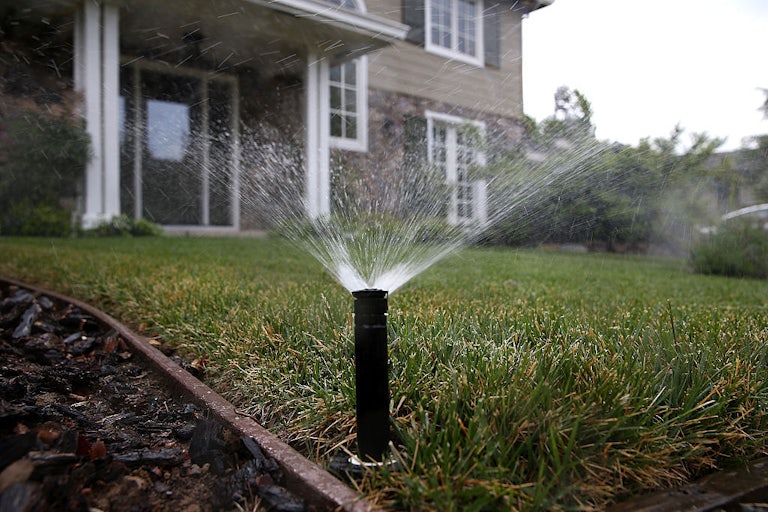
A sprinkler sprays water over a lawn with a house in the background.
Justin Sullivan/Getty Images
A sprinkler waters a lawn in drought-stricken California.

What’s the best way to make your yard more environmentally friendly? Articles on the topic abound this time of year. We’re now halfway through “No Mow May,” an interesting initiative that began in the U.K. and is spreading in the United States. Abstaining from lawn maintenance for a month to help bee populations is certainly easier than ripping up your lawn and planting native wildflowers—which can be pretty expensive and time-consuming. But No Mow May doesn’t solve the broader issues of water use, pesticides, and fertilizer runoff. And it might even be counterproductive.

To help me make sense of all of this, I called up Paul Robbins, dean of the Nelson Institute for Environmental Studies at the University of Wisconsin-Madison, who literally wrote the book on lawn culture. His advice wasn’t what you typically hear in these conversations. Instead of encouraging individuals to plant wildflowers to save the bees or guilting people for their front-yard greenery, he said, we might be better off chipping away at some of the industry issues that make lawns so pervasive in the first place.

This interview has been edited and condensed for length and clarity.

We’ve known for quite a while that lawns aren’t the most environmentally friendly option for a variety of reasons, but they remain the overwhelming norm in this country. What do you feel are the top factors in that?

There’s a really simple answer to this: Most of the houses that people live in have already been built. This is deeply structural: The actual housing stock, the lot size, the footprint of the house, the landscaping choices made by developers—which are all value-engineering choices—have all already been made. No one puts in a lawn; they buy a house and it has a lawn, which puts the burden on them to somehow get rid of it, which is actually an enormous undertaking. It takes more work than just leaving it where it is.

Having said that, people don’t like lawns. That’s the irony; more and more people don’t want them, but nothing has changed. The reason it hasn’t changed is that everything that has nothing to do with lawns would have to change first.

It sounds like you’re saying, at least in part, it’s an industry problem.

As in the housing industry, yes. I’m not even talking about the fact that there’s a $10 to $40 billion lawn industry that’s actually invested in keeping them. There’s a deep investment in maintaining your need for lawns and to off-load the pain that they are to you by providing services—massive amounts of service provision.

And they tell people that they have problems. Scotts won awards for telling people to ask for such and such a product: “You have a problem, go ask for that.” You would never have done that back when it was a mom and pop hardware store in the 1980s. If you had a problem with your lawn, you might go and ask somebody at Ace Hardware, but to go and say, “I need this chemical, this product”?

The press is constantly saying lawns are about “American culture—we have this weird anomalous culture, and aren’t Americans odd?” when in fact it’s all rather obvious: We’ve got a really weird housing market, once you get outside the urban core, and you’ve got an industry that needs to sell this stuff. And most people really don’t want to have them and would love to replace [them] with something else.

But presumably that’s incredibly labor intensive, because it’s much easier to pay someone to mow your lawn.

Yeah. Well, it’s possible people are more interested in DIY culture in general terms. You know, The New York Times is filled with stories about beekeeping. But how many people keep fricking bees? Not that many. So that’s great that some hipster in Brooklyn is keeping bees—I think that’s wonderful. But am I counting on hipsters in Brooklyn to save the planet? No. Nor am I counting on busy, middle-class people pulling up their lawns. It’s unfair to burden them with this problem because they can’t solve it. So: Could we come up with an industry that somehow can make margins by replacing your lawn with something that takes less struggle and supports pollinators? Yeah, I actually think we can.

Really?

Well, I don’t have much confidence in capitalism. But having said that, yeah, there’s enough people out there who are interested in alternatives that if you squeeze a little you can start getting some options. In Canada, when we started studying this stuff, bans were being placed on the sale of certain chemical products—pesticides in particular. That’s something you can put tighter controls on. Once you pull pesticides out, that opens out all kinds of alternatives to lawns, because you’ve got to have something, and you’ll pay for it. So there might be some regulatory action to open the opportunity for that.

So there are a couple ways bans and regulations are starting to enter the American system. One, with water use.

Yeah, water’s going to kill it west of the hundredth meridian. East of the Mississippi, it’s a little harder to imagine. We’ve got plenty of water here, and it’s only going to get wetter.

And then, two, with bans on gas-powered either leaf blowers or lawn mowers, which is starting to happen. To what extent do these things make a difference in terms of the viability of lawns, or are we going to need something much bigger?

Banning these engines is a good thing in and of itself for air quality, to say nothing of like, carbon. But it’s not going to make the lawn go away. Everything’s just going to be electric.

The pesticide market could be regulated better I think, by a long shot. I do see room for regulatory interventions here.

Well there might be political support for that, given the research about what pesticides are doing in terms of cancer risk.

Cancer risks, and God knows what they’re doing to reproductive health. I’m not a public health expert, but we’re all buying organic cause we’re so worried about all these chemicals in the system, and people are dumping this shit on their own lawns! And it tracks into the house—I’ve seen the organic chemistry—it’s all over. It tends to decay in sunlight, but once it’s in your house dust, your kids are eating it, curtains—man, it’s everywhere. It’s in your body. We’re covered in this stuff. See, homeowners, they have no margin, so homeowners will always use more pesticides than they need, cause they’re not a farmer. No farmer would ever use a drop more Roundup than they have to, whereas a homeowner will use about 50 times as much because the marginal cost is so small relative to their other expenses.

That could have some regulatory legs. I think people don’t want that.

So maybe going the human health route rather than the “save pollinators” route might be more effective?

Yes, and I say that as someone who runs an environmental studies program. Environmental justice comes first. Most of these things are totally unnecessary cosmetic pesticides, as opposed to growing food for millions of people.

So when you do see these lawn clashes come out—I’m thinking of a suit in Maryland involving a homeowner association—is it because people are worried about home value? Because as you say, people don’t love lawns so much, but there’s something going on here.

HOAs are fascist about everything. I mean, have you ever seen what a homeowners’ association code looks like? There are still racial covenants on some people’s property—they’re inactive because of the Fair Housing Act, so they’re trumped by federal law. But then why are they still on there? There’s a lot of reasons that HOAs operate the way they do, and they are about property values, without question—resale value. And of course it’s a kind of moral economy that comes with that that enforces all these things, and lawns are just one tiny piece of that.

It sounds like you’re saying that regulating input is going to be more effective than regulating behavior or giving people some kind of marginal incentive for planting native plants or something like that.

I’d like to think that positive incentives work, I’m willing to be proven wrong. I haven’t studied it, so I’m not here to say it’s a bad idea. But you’ve got to offset the cost, because coming up with alternatives is a pain; it’s really difficult.

In Madison we also have a law on the books—I call it a freedom-to-farm law because that’s the only correlate in the law books that I know, but it’s not a freedom to farm, it’s a freedom to let your lawn go to shit. It makes it harder for you to be sued by your neighbors if you choose alternatives like prairie grass. It’s not a law that tells you to do something or even pays you to do something; it just keeps you from being sued for doing something. Even that would be a good step from a regulatory point of view.

Good News

Rooftop solar, if installed aggressively, could potentially meet a third of the U.S. manufacturing sector’s power needs, according to a study from Northeastern University researchers.

Bad News

We’re now on track to hit the threshold of 1.5 degrees Celsius (2.7 degrees Fahrenheit) of warming by 2027, thanks to climate change and the added effects of El Niño.

Stat of the Week

That’s how much air pollution from oil and gas production costs in terms of health effects across the U.S., according to a new study. States with higher oil and gas production had correspondingly higher health costs.

Elsewhere in the Ecosystem

​​What the EPA Can’t Say About Its New Power Plant Rules

Last week, the Environmental Protection Agency proposed regulations to cut almost all the emissions from the power sector by 2040—understandably making headlines. But as Emily Pontecorvo and Robinson Meyer point out at Heatmap, the EPA has to strike a delicate balance between climate goals and a Supreme Court ruling last year that said the agency has relatively limited authority to regulate greenhouse gas emissions from power plants and would have to restrict itself to things taking place “within the fenceline” of the plants themselves:

The EPA’s new proposal tries to hew within those guidelines. The agency has determined that the best available technology to reduce emissions directly from fossil-fuel-burning power plants is to install carbon-capture equipment. Carbon-capture-and-storage technology, or CCS, is now affordable and feasible, the agency asserts.

“There’s a 100% chance that this will be challenged in court,” Michael Gerrard, a Columbia Law professor and the director of the Sabin Center for Climate Change Law, told us. “The debate will largely be about if CCS is ‘adequately demonstrated.’”

At stake, too, is the question of whether the rules represent a Trojan horse—that although the proposal appears to comply with the Court’s guidelines, the expense and hassle of installing carbon-capture equipment is meant to force utilities to shift to renewables anyway. That could in fact be the rules’ practical effect. (Some environmentalists will admit—although not on the record—that they like the rules for this reason.)

Read Emily Pontecorvo’s and Robinson Meyer’s article at Heatmap.

This article first appeared in Apocalypse Soon, a weekly TNR newsletter authored by deputy editor Heather Souvaine Horn. Sign up here.

Why Do Republicans Hate Something That Creates Jobs and Saves Consumers Money?

This is your brain on fossil fuels.

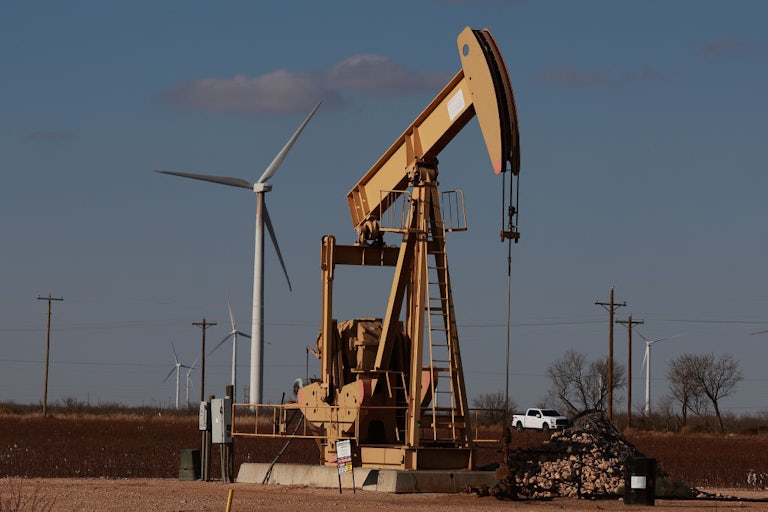
An oil pump jack with wind turbines in the background
Joe Raedle/Getty Images
An oil pump jack surrounded by wind turbines in the Permian Basin oil field in Stanton, Texas.

Investing in renewable energy has long been politicians’ favorite solution to the political difficulties of weaning society off fossil fuels. If we just stimulate the renewables market, the thinking goes—an easier policy to implement than forcibly shuttering fossil fuel plants, which Republicans and others would try to block—eventually renewables will outcompete oil and gas and the country will gradually switch over without the need for sacrifice.

That thinking is misguided for the simple reason that our window to slash emissions or suffer catastrophic consequences is too brief for investing in renewables to save the day. But recent news stories show why it’s also not a viable political solution.

As renewables start to overtake fossil fuels in the United States, the GOP is fighting to reverse that progress: House Republicans are sticking to their proposal to only agree to raise the debt ceiling in exchange for spending cuts that include most of the clean energy incentives in the Inflation Reduction Act, the Democrats’ signature legislative achievement this term.

Taken at face value, this is a nonsensical position for two reasons totally unrelated to climate change. First, as TNR’s Kate Aronoff pointed out several weeks ago, these tax credits overwhelmingly will benefit Republican districts because that’s where most renewable energy installations are located. (Analysis published Sunday by the Financial Times finds that, since last summer alone, Republican districts have secured over five times the investment in clean energy projects that Democratic ones have.) Second, if fiscal responsibility were really the point, then it would make sense to cut some of the biggest federal spending categories—like defense, next to which energy spending is minuscule. The Republican plan exempts defense cuts.

The GOP’s crusade against renewable energy goes well beyond Congress. Republican legislators in Texas are proposing a variety of regulations to hamper renewable energy installations—from a difficult approval process to a yearly fee, and even mandating wind turbines be situated more than half a mile from property lines. This last one is particularly ironic given that it’s oil wells and fracking waste injection, not wind turbines, that stand accused of poisoning nearby properties and water supplies. (The mandated distance of a new oil well from a property line, by contrast, is 467 feet.)

These kinds of regulations could change the course of energy generation in Texas, which leads the nation in wind generation and has the second most solar installations, as of 2022. Supporters of these new regulations have their reasons—or at least reasons that they give others. “While some landowners have cited environmental concerns,” The Washington Post reports, “others have claimed that nearby renewable projects are lowering their property values.” Both these things are arguably more true of fossil fuel installations than renewables. (Other reasons cited are a little wilder, for example billionaire Dan Friedkin reportedly arguing that an electric transmission line on his property would “lead to increased illegal drug trafficking.”)

This war on renewables, a recent Texas Monthly piece argued, has the potential to really hurt residents, a majority of whom “support greater access to green energy”:

One recent estimate found that renewables lowered the cost of electricity to Texans by $11 billion last year, or $423 for every customer served by the state’s predominant power grid. Over the past five years, Texas has added 2,800 jobs to support wind and solar power generation at the same time that the state has lost 44,000 oil and gas extraction jobs, in part because automation has allowed producers to drill more wells while employing fewer roughnecks.

The people who profit from trashing renewables, the piece notes, are less numerous. There are the fossil fuel executives who donate heavily to Republicans, of course. And then there are right-wing politicians who are either ideologues or who think portraying themselves as lone warriors against the fictitious forces of “woke” investment is the key to electoral success.

Right now, all evidence suggests that policies to stimulate renewable energy growth are working about as well as or even better than their proponents hoped. They’re creating jobs and saving consumers money. They’re giving both red and blue America a reason to care about wind and solar power.

And now the GOP wants to roll them back.

Good News

Skepticism of the liquefied natural gas industry’s expansion in recent years (read TNR’s coverage of how the war in Ukraine benefited the industry) is going mainstream: On Monday, 44 Democratic lawmakers pressed the White House’s Council on Environmental Quality to “include greater scrutiny on the entire LNG supply chain” in its forthcoming guidance on existing environmental laws.

Bad News

Food crops in the U.S. aren’t just loaded with pesticides, a new study finds: Those pesticides are in turn contaminated with PFAS, termed “forever chemicals” because they take so long to break down.

Stat of the Week

That’s how much home insurance premiums increased nationwide from 2021 to 2022—a trend that’s expected to continue, with much higher increases in especially disaster-prone areas, Benjamin Keys observes at The New York Times.

Elsewhere in the Ecosystem

Climate Still Changes Everything

While the Inflation Reduction Act represented a huge victory, Alyssa Battistoni writes for Dissent, it also seems to have lulled a lot of people into a false sense of security, believing that climate policy is on the right track. We’re not out of the woods yet—in fact, we’ve barely entered.

While climate is far more central to mainstream politics than it was fifteen years ago, carbon emissions have continued their steady rise. Recent models suggest that temperatures are more likely to stabilize somewhere between 2–3ºC of warming than at 3º or more. But if this has prompted a surprisingly optimistic turn amongst some commentators, it hardly counts as good news. Even this ostensibly “moderate” level of warming significantly exceeds the demand of “1.5º to stay alive” long made by small island states and other vulnerable countries—a goal that a new Intergovernmental Panel on Climate Change report has stated is all but out of reach.… The struggle to decarbonize is just beginning. So too is climate change itself, which will spur novel political developments of its own.

Read Alyssa Battistoni’s article at Dissent.

This article first appeared in Apocalypse Soon, a weekly TNR newsletter authored by deputy editor Heather Souvaine Horn. Sign up here.

Why a Big Climate Victory in New York Matters Everywhere

After two years of last-minute failures, a groundbreaking bill made it into the state budget—providing a blueprint for climate activists in other states.

Kristen Gonzalez speaks at a podium.
Erik McGregor/Getty Images
New York State Senator Kristen Gonzalez, who campaigned on the Build Public Renewables Act

“The biggest Green New Deal win in US history.” So said the New York City chapter of the Democratic Socialists of America after the Build Public Renewables Act made it into the state’s budget on Monday evening. Readers who haven’t been following this battle may not appreciate why climate watchers were so giddy about the workings of a state legislature this week. They might, for example, instead focus on New York passing the first statewide ban on new gas hookups, starting in 2025. And that’s a big deal, but there’s a reason activists are even more worked up about the BPRA. So let’s unpack it.

The Build Public Renewables Act hides a revolutionary idea behind a wonky title: “that the state should be empowered to provide clean energy if the private sector fails to,” as TNR columnist Liza Featherstone wrote last month, calling it “the boldest challenge yet to the fossil fuel industry.”

In practice, the BPRA would require and empower the New York Power Authority to rapidly build renewable energy infrastructure to meet the goal of 100 percent clean energy by 2030. It’s easy to underestimate what a big step that is in a country that has overwhelmingly adopted a privatized model of energy generation. “The bill is therefore seen by proponents and detractors alike as a possible foundation for socializing and centralizing control of all energy in order to effectively address the climate crisis and keep energy affordable and accessible to all,” Liza explained. “It provides a way of ensuring that public interest, rather than the profit motive, dominates energy generation.”

But that’s not the only reason the BPRA has generated this outpouring of emotion. The act previously failed twice in New York. After the failure in 2021, TNR staff writer Kate Aronoff wrote,

its backers within and without the legislature worked on expanding their coalition, opening up conversations with environmental justice and labor groups, among others. New language added as a result of those conversations aims to safeguard low-cost power for low-income New Yorkers and those who live in disadvantaged communities and ensure that projects don’t violate Indigenous sovereignty. The bill also provides project labor agreements for the construction of clean energy projects and would democratize the process by which NYPA approves and locates new projects. Strengthened labor provisions … helped to move labor groups from oppositional to neutral, and some from neutral to supportive.

So when, after all this work, the legislative session ended in June 2022 again without the proposal making it to law (despite passing the state Senate), this was seen as a particularly depressing signal for U.S. climate policy—all the more so because it wasn’t “Republicans to blame,” Kate explained, “but Democrats ostensibly committed to climate action.” If Democrats couldn’t manage to pass a policy to reconfigure energy generation and make good on their 2019 climate goals in New York while controlling the Senate, Assembly, and the governorship, Kate reasoned, it’s hard to imagine them making much progress anywhere else.

All of which brings us back to this year’s drama. Legislators at long last managed to finalize and pass the 10-bill series for the state’s budget, including the BPRA in the package, on May 1, a full month after the original state budget deadline of April 1. As of early April, it wasn’t at all clear that the BPRA was going to make it in—at least not in anything like its original form. And it seemed that Democratic Governor Kathy Hochul might be one of the people standing in the way. “If New York finally does start passing bills to make good on its four-year-old climate law,” Kate wrote in an update on the fight, “it’ll be the result of near-constant pressure from outside groups and having certain kinds of Democrats—those who’ve sworn off fossil fuel cash, for instance—making the case and whipping votes on the inside.”

The passage of the BPRA on Monday without one of the loopholes that was under discussion (letting municipalities opt out) is therefore credited as a victory not just for climate activists in general but for the specific progressive organizers and their legislative allies who refused to give up on this policy. It’s likely to be considered proof of concept for battles in other states. TNR will have more on this shortly.

Good News

The U.N. climate summit in Dubai, United Arab Emirates, in November, known as COP 28, will dedicate a day to the health implications of climate change.

Bad News

Researchers are increasingly concerned about record ocean temperatures, which might be explained by a cyclical shift from the La Niña weather system to the El Niño weather system in the Pacific—but might also indicate the ocean is warming much faster than previously anticipated. That would be very bad for both ocean carbon storage and marine ecosystems, including fisheries.

Stat of the Week

$18 billion

That’s how much ExxonMobil and Chevron made in profits in the first quarter of this year, despite lower gas prices. (Read Kate’s coverage of what the companies plan to do with the cash.)

Elsewhere in the Ecosystem

Google Promised to Defund Climate Lies, but the Ads Keep Coming

Well, you knew it couldn’t be all sunny headlines this week. Back in 2021, Google pledged to pull the cord on climate deniers trying to make money on YouTube. The follow-through leaves something to be desired, The New York Times reports:

If you recently clicked on a YouTube video titled “who is Leonardo DiCaprio,” you might have found a ramble of claims that climate change is a hoax and the world is cooling after a Paramount+ ad for the film “80 for Brady,” starring Lily Tomlin, Jane Fonda, Sally Field and Rita Moreno.…

These are not aberrations, according to a coalition of environmental organizations and the Center for Countering Digital Hate. In a report released on Tuesday, researchers from the organizations accused YouTube of continuing to profit from videos that portrayed the changing climate as a hoax or exaggeration. They found 100 videos, viewed at least 18 million times in total, that violated Google’s own policy.

Read Nico Grant and Steven Lee Myers’s report at The New York Times.

This article first appeared in Apocalypse Soon, a weekly TNR newsletter authored by deputy editor Heather Souvaine Horn. Sign up here.