Newsletter
Fighting Words
What got me steamed up this week

Tim Scott’s Stated Willingness to Crush Democracy Is an Ominous Moment

We crossed another Rubicon this week with these veep wannabees parroting Donald Trump’s line about not accepting election results.

Tim Scott speaks at a podium, with Donald Trump beside him and others in the background.
Victor J. Blue/Bloomberg via Getty Images
Senator Tim Scott, a Republican from South Carolina, speaks during an primary election night watch party in South Carolina with former U.S. President Donald Trump on February 24, 2024.

As many have observed, democracies don’t die overnight. There’s no One Big Event that does it. It happens bit by bit. Noticing it requires paying very close attention and connecting the dots as you go along, and most people don’t have the time or dedication to do that.

So I draw your attention to a new and ominous development this week: It’s now basically settled that Donald Trump’s running mate will be with him 1000 percent on denying unfavorable election results. Doing so became a litmus test this week. South Carolina GOP Senator Tim Scott is chiefly to blame, but of course it’s also Trump, and the entire cast of craven jellyfish who are today’s Republican Party.

As you’ve probably read, Scott was on Meet the Press Sunday and, under questioning from host Kristen Welker, refused six times to say he’d accept the election results. The things he did say were ludicrous: “This is an issue that is not an issue so I’m not going to make it an issue.” “I’m not going to answer your hypothetical question when, in fact, I believe the American people are speaking today on the results of the election.” “This is why so many Americans believe that NBC is an extension of the Democrat Party.”

The same day, North Dakota Governor Doug Burgum ran for the hills when CNN’s Jake Tapper asked him about potential political violence after the election. He spat out some evasive nonsense about how the important thing about the election is that “both sides feel good about how it was counted.” We all know what that means: If one party (gee, which one?) doesn’t “feel good” about the vote count, then violence might be justified.

These are, in one way, dismissible men. But these are not dismissible comments. This is new. And it’s worth thinking about.

In 2016, Trump went around saying things like, “I will totally accept” the election results “if I win.” But it wasn’t yet holy scripture. In fact, that fall, Trump’s running mate avowed that the GOP would play by the rules. “We will absolutely accept the results of the election,” Mike Pence told Chuck Todd on Meet the Press on October 16.

This was very important at the time. It allowed people to think Trump was just blustering, wasn’t to be taken seriously. And his position was seen as a clear liability. Three days after Pence’s Meet the Press appearance, Trump debated Hillary Clinton. Trump refused to affirm to moderator Chris Wallace that he’d accept the election results. Even Republicans asked by Politico agreed that it was Trump’s worst moment of the debate. Said an Ohio Republican: “His answer on not accepting the results of the election [is] disqualifying—and that’s not an ‘elite’ position.” Added a New Hampshire GOPer: “Refusing to accept the outcome of a legitimate American election and refusing to commit to the peaceful transition of power is disqualifying. Stunning.”

Those Republicans reflected a consensus then among the Republicans Politico asked, and to some extent among rank-and-file Republicans too—53 percent of Republicans even told Politico that Clinton won that debate. The idea that a major party candidate would reject election results was disqualifying, or seemed to be.

Of course, Trump won, so the proposition wasn’t tested then. In 2020, he did the same thing, casting doubt on the veracity of the pandemic-era results throughout the campaign. And we know what came of that: January 6. On that day, remember, 139 House members voted against certifying the election results, while 72 voted to certify (or were absent). Eight GOP senators voted not to certify, while 43 voted to certify Joe Biden’s victory.

Those voting results were depressing enough, but it must be asked: Would we get similar results today? Or will we next January 6, if Trump is declared the loser and contests the results, as he all but inevitably will?

I think this time it would be worse, maybe far worse. As Scott’s and Burgum’s dodges testify, conventional wisdom has changed. Now, it is assured that Trump’s vice presidential choice will, instead of offering Pence’s 2016 reassurances, be right there with Trump in threatening not to accept the results. The new Trump-installed chair of the party, Michael Whatley, is a 2020 election denier whose chief appeal to Trump was that he’s “a Stop the Steal guy.” And the new co-chair, of course, is Lara Trump. Around 60 RNC employees were handed their papers in March. The new application process includes asking job-seekers whether they think the 2020 election was stolen.

The upshot here should be clear enough. This November, the entire party will be armed to fight an adverse election result. This is new—worse, even, than 2020 and 2021. Scott and Burgum helped cement this posture as the new conventional wisdom this week. But really, they were shaping conventional wisdom far less than they were allowing themselves to be shaped by it. If they hadn’t said what they said, they’d be instantly tossed from Trump’s short list.

And the rest of the party? Please. They’ll fall into one of two camps. They’ll enthusiastically parrot the accepted line. Or they’ll use the “It’s not an issue, because Donald Trump will be elected our next president” dodge. And those in the latter camp know very well that the road is littered with the political carcasses of Republicans who defied Trump.

So, again: If January 6, 2025 comes around, and Congress is confronted with a situation similar to that other January 6, how many Republicans will stand up for democracy this time? Jellyfish may not have backbones, but they can still sting.
A Dem’s Principled Opposition to a Grandstanding GOP Antisemitism Bill

Why Jerry Nadler and four other Jewish Democrats voted “no”

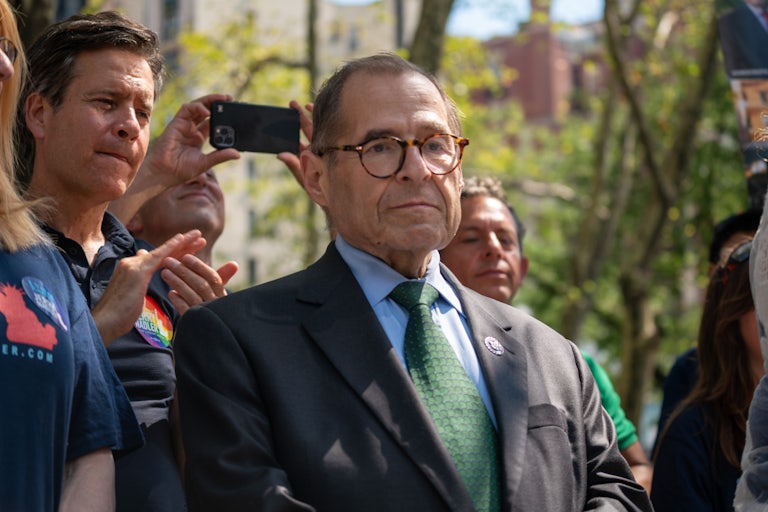
Rep. Jerry Nadler
David Dee Delgado/Getty Images
Representative Jerry Nadler in 2022

It’s always worth taking note when a legislator casts an unexpected vote. So it caught my eye Wednesday morning as I was scanning the House roll-call vote on H.R. 6090, the Antisemitism Awareness Act.

It passed by a wide margin, 320–91; 187 Republicans and 133 Democrats voted for it, and 21 Republicans and 70 Democrats against. I scrolled down to look at the “no”s, because votes like this one—which right and left approach, let us say, from different moral universes—always offer an amusing coalition of the unwilling. GOP “no”s included hard-rightists like Lauren Boebert, Paul Gosar, Matt Gaetz, and Marjorie Taylor Greene. Democratic “no”s mostly all came from the Progressive Caucus, even the progressive wing of the Progressive Caucus—Alexandria Ocasio-Cortez, Cori Bush, Rashida Tlaib, and more.

Then a surprising name caught my eye: Jerry Nadler of Manhattan. And another: Jan Schakowsky of Evanston, Illinois. These are both liberal Democrats, of course. But they’re also both Jewish, and they represent heavily Jewish districts. This was interesting.

Thursday, I spoke with Nadler about his vote. I should say that I’ve known and respected Jerry for many years. We met (can it be?) in 1987, when I was a young reporter covering New York politics. Before I get to the matter at hand, a quick story from those days that made me realize that Nadler was willing to take unpopular positions.

There were neighborhood political clubs in those days in Manhattan (they still exist, but their heyday was long ago). In Greenwich Village, there were two clubs: an older and more established one that opposed Mayor Ed Koch, very unpopular by the late 1980s among progressives, and a newer, pro-Koch club. An issue arose at some county Democratic meeting I was covering, I don’t even remember what it was exactly, but I do recall that Nadler, then a state assemblyman, rose to speak in defense of the pro-Koch club’s First Amendment rights. He was booed. I was no Koch fan then, but I thought it was kind of a gutsy thing to do.

Flash-forward. Why did a Jewish congressman from the most famous Jewish district in America (the Upper West Side) oppose an antisemitism resolution? “It’s violative of free speech,” Nadler told me, “and it’s totally unnecessary.”

H.R. 6090 would require the Department of Education’s Office of Civil Rights to use the definition of antisemitism adopted by the International Holocaust Remembrance Association in 2016 when investigating complaints of bias at institutions that receive federal funds. That means college campuses (even private universities like Columbia receive federal grants and so on).

The IHRA definition, debated for years, has been adopted by around 20 countries, including the U.K., Canada, Germany, and more. Its definition is mostly nonproblematic, but to Nadler, one aspect of it threatened to squelch free speech on campuses. “You could read it as saying that criticism of Israel is antisemitic,” he said.

And this is where we get to the question of the Republicans’ motivation in introducing this bill. The IHRA definition is not without controversy, precisely because of some language about criticism of Israel that many consider blurry. Two other definitions of antisemitism have been promulgated—the Jerusalem Declaration on Antisemitism and the Nexus Document. Choosing to rely solely on one of the three definitions struck some critics as concerning. Even the author of the IHRA definition, Kenneth Stern, has become a sharp critic of using it with respect to speech on college campuses, and Nadler told me that Stern opposed this bill.

But: The IHRA definition did have a notable champion in the United States: Donald Trump. As president in 2019, he signed an executive order to protect Jewish students under the Civil Rights Act, using the IHRA definition. Sounds good and uncontroversial, but numerous critics, including progressive Jewish groups, worried about its potential chilling effect on campuses. Stern, writing in The Guardian, argued that his definition “was created primarily so that European data collectors could know what to include and exclude.… It was never intended to be a campus hate speech code, but that’s what Donald Trump’s executive order accomplished this week.”

The Biden administration never rescinded that executive order. However, Biden did launch a different approach. In May 2023, he unveiled the first-ever national strategy to combat antisemitism. The 60-page plan outlined 100 steps that federal agencies committed to complete within a year and was based on input from 1,000 stakeholders.

Biden also proposed increasing the 2024 budget of the Department of Education’s Office of Civil Rights by 25 percent. Republicans proposed cutting it by 25 percent. The ultimate compromise, says Nadler, is that it was flatlined. That battle is being repeated for 2025. House Republicans could shift their position on that, if they want to show that they wish to combat antisemitism in a real way. There’s also a House bill, sponsored by North Carolina Democrat Kathy Manning, that would codify the Biden administration’s approach, and it has an impressive 15 Republican co-sponsors (and 24 Democrats).

Speaker Mike Johnson could put his weight behind that. But as we see on an hourly basis, he (while pretty extreme himself) is dealing with a whole different universe of crazy. Marjorie Taylor Greene explained her opposition to the bill by saying that under it, Christians could be convicted “for believing the Gospel that says Jesus was handed over to Herod to be crucified by the Jews”—an age-old and classic antisemitic fable.

I’m not sure this bill is dangerous. A lot of solid liberals voted for it. I just think it’s worth noting that some Jewish members opposed it (there were three more, in addition to Nadler and Schakowsky: Sarah Jacobs of California, Jake Auchincloss of Massachusetts, and Rebecca Balint of Vermont), in part out of concern that criticism of the policies of Israel could be construed under law as antisemitic.

Antisemitism is certainly all too real, on college campuses and across the country, and obviously, there are times when criticism of Israel can and does include antisemitic tropes. But the laws of the United States should help clarify the difference between antisemitism and criticism of Israel, not obscure it.

This article first appeared in Fighting Words, a weekly TNR newsletter authored by editor Michael Tomasky. Sign up here.

Samuel Alito’s Resentment Goes Full Tilt on a Black Day for the Court

The associate justice’s logic on display at the Trump immunity hearing was beyond belief. He’s at the center of one of the darkest days in Supreme Court history.

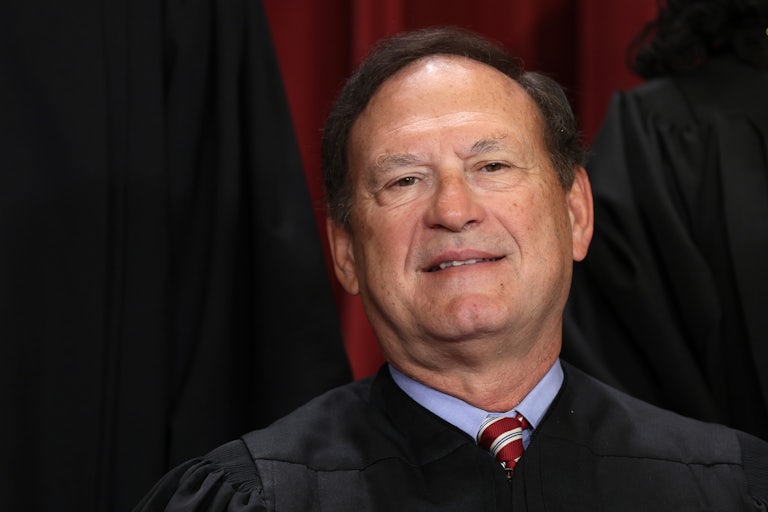
Samuel Alito
Alex Wong/Getty Images

On the day Donald Trump took office in January 2017, pondering what he might do to the country’s democratic norms and institutions, I wrote these words: “Trump will destroy them, if keeping Trump on top requires it. Or try to. He might not succeed. And that is where we rest our hope—on conservative judges who will choose our institutions over Trump. Mark my words: It will come to this.”

That hope seemed not misplaced back in 2020 and 2021, when a number of liberal and conservative judges, some of the latter appointed by Trump himself, handed Trump 60 or so legal defeats as he attempted to unlawfully overturn the election results. But after Thursday at the Supreme Court? That hope is dead. The conservative judges, or at least most of them, on the highest court in the land are very clearly choosing Trump over our institutions. And none more belligerently than Samuel Alito.

His line of questioning to Michael Dreeben, the attorney arguing the special counsel’s case, was from some perverse Lewis Carroll universe:

Now if an incumbent who loses a very close, hotly contested election knows that a real possibility after leaving office is not that the president is going to be able to go off into a peaceful retirement, but that the president may be criminally prosecuted by a bitter political opponent, will that not lead us into a cycle that destabilizes the functioning of our country as a democracy?

Let’s look to something I’d have thought lawyers and judges took seriously: historical evidence. American democracy has existed for nigh on 250 years, and power has been transferred from a president to his successor a grand total of 40 times (not counting deaths in office). On 11 occasions, a challenger has defeated a sitting incumbent—that is, a situation that creates the potential for some particularly bitter and messy post-election shenanigans.

Now, if Alito’s question really spoke to a malign condition that had hobbled American democracy throughout history and that loomed as a real problem that we had to take very seriously, it would stand to reason that our history suggested that these power transfers had had a wobbly history—that maybe, say, 12 of 40, and four or five of the 11, had been characterized by violence and unusual threats of retribution against the exiting executive.

But what does the record show? It shows, of course, that there is only one case out of the overall 40, and one case out of the more narrowly defined 11, in all of U.S. history where anything abnormal and non-peaceful happened. That, of course, was 2020.

And there was a lot of bad blood in previous transfers of power. You think John Adams loved the idea of handing power to Thomas Jefferson? John Quincy Adams was popping champagne to turn things over to Andrew Jackson? Grover Cleveland and Benjamin Harrison, who traded wins, weren’t bitter in defeat? These people couldn’t stand each other. But they did what custom required—a custom never questioned by anyone until Trump came along.

So in other words: Alito throws all that democratic history out the window and treats Trump as the new normal, assuming that the American future is ineluctably strewn with a series of lawless Trumps. Alas, with respect to the Republican Party, there’s a chance time will prove him right about that (but only a chance; my cynicism about the depths to which this GOP will sink is almost limitless, but even I think that Trump is most likely sui generis in this respect, and that your average Republican, even the neofascist ones like Tom Cotton, should we be cursed with a Cotton presidency someday, would probably yield power peacefully if he lost).

But think about what it says about both where Trump has delivered this country, and about Alito’s assumptions about democracy. On the former point: Have we now reached a place where challenges to election results are going to be the norm? Where an opposition party can be counted on to find some legal technicality on which to prosecute a former president, rather than leaving him or her in peace as we have throughout our history?

This is another twisting of reality. Trump, his defenders would protest, is the one former president who has not been left in peace. Well, that is true, I confess. But maybe there’s a reason for it! Actually, there are two. Trump has not been left in peace because a) it was always obvious he was not retired, and b) he’s the only ex-president who tried to foment a coup against the United States of America and who declassified sensitive national security documents with his beautiful brain.

And on the latter point: When George W. Bush named him to the court in 2005, experts told us—of course—that Alito was conservative, yes, but not an extremist (interestingly, Maryanne Trump Barry, Donald’s sister under whom Alito had worked as a prosecutor, was among those recommending Alito’s nomination). As The New Yorker reported in a 2022 profile, Alito was asked in 2014 to name a character trait that hadn’t served him well. His answer? A tendency to hold his tongue. Well, that problem’s been solved, eh? As writer Margaret Talbot noted of the justice, who ignored Chief Justice John Roberts’s importunings to strike a balance in the Dobbs decision, which he wrote: “He’s holding his tongue no longer. Indeed, Alito now seems to be saying whatever he wants in public, often with a snide pugnaciousness that suggests his past decorum was suppressing considerable resentment.”

And this week, he told us, in essence, that in his view democracy depends on allowing presidents to commit federal crimes, because if ex-presidents were to be prosecuted for such things, the United States would become a banana republic. That’s a Supreme Court justice saying that. And while Neil Gorsuch, Brett Kavanaugh, and even Clarence Thomas didn’t go that far Thursday, it was obvious that the court’s conservatives are maneuvering to make sure that the insurrection trial doesn’t see the light of day before the election—in other words, that a sitting president who very clearly wanted Congress to overturn a constitutionally certified election result (about this there is zero dispute) should pay no price for those actions.

When I wrote seven years ago that we rested our hope on conservative judges who will choose our institutions over Trump, trust me, I wasn’t saying I was confident that they would. I was terrified that that day would eventually come. It came yesterday. The conservative jurists chose Trump. It will stand as one of the blackest days in Supreme Court history.

This article first appeared in Fighting Words, a weekly TNR newsletter authored by editor Michael Tomasky. Sign up here.


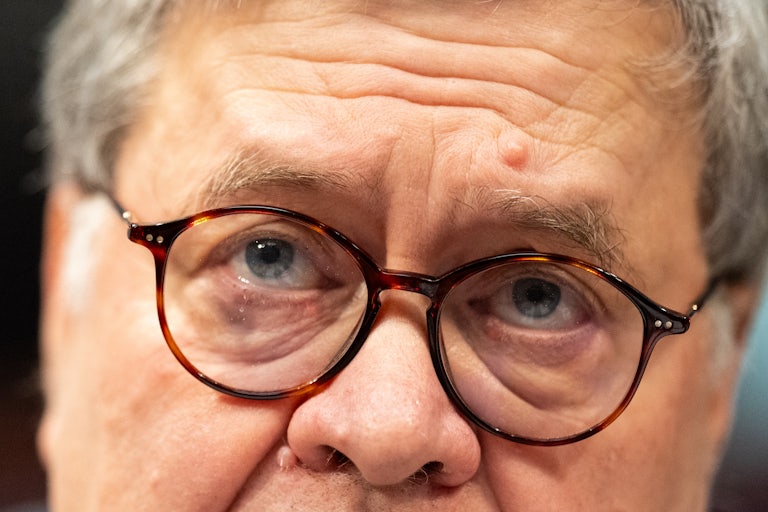
Bill Barr Basically Agrees With Donald Trump About Us Vermin

Has everyone forgotten about Barr’s 2019 Notre Dame speech? Well, I’m here to remind you.

Barr testifies at a hearing on Capitol Hill
Bill Clark/CQ-Roll Call, Inc via Getty Images
Barr testifies at a hearing on Capitol Hill on April 16.

Surprised by Bill Barr? Don’t be. Oh, yes, it’s shocking that he said on Fox News on Wednesday night that if push comes to shove, he’ll be voting for what he euphemistically referred to as “the Republican ticket.” I’m not denying that it is. The frequency and ferocity with which Barr has attacked Donald Trump—a “consummate narcissist” whose second term would be “chaos” and a “horror show”—has led many people to believe that there was no way on God’s earth he’d endorse Trump.

Barr hates disorder and all the rest of it. But he hates something else more: liberalism. And when I heard the endorsement news Thursday morning, my mind raced back to October 2019, and a speech Barr gave at Notre Dame University on government, religion, and the perceived assault thereupon. It was shocking to me at the time—as extreme (though evidently quite honest) a profession of fears and lamentations about modern secular society as you’re likely to hear at an Opus Dei convention, let alone from a sitting U.S. attorney general.

The speech’s, and the man’s, core philosophy were laid out in these sentences:

No society can exist without some means for restraining individual rapacity.

But, if you rely on the coercive power of government to impose restraints, this will inevitably lead to a government that is too controlling, and you will end up with no liberty, just tyranny.

On the other hand, unless you have some effective restraint, you end up with something equally dangerous—licentiousness—the unbridled pursuit of personal appetites at the expense of the common good. This is just another form of tyranny—where the individual is enslaved by his appetites, and the possibility of any healthy community life crumbles.

Barr reaches into his hat to grab a few statistics that allegedly make his point about the sewer into which we have descended. First up, out-of-wedlock births, which have indeed gone up since the 1960s from under 10 percent to around 40 percent. Is the main culprit here that society has lost its religious moorings? Some would put that spin on it, sure.

But specifically, social science seems to have settled on these explanations: wider availability of birth control and abortion (things that Barr laments but are available in just about every developed nation in the world) and the ending, starting in the 1970s, of shotgun marriages. Barr surely thinks this an evil. I would imagine a lot of Americans consider it not a bad thing at all that two immature and incompatible 19-year-olds aren’t forced to marry out of a social convention that traps them in a probably unhappy marriage where the wife may end up the victim of some kind of abuse.

He also cites “record levels of depression and mental illness, dispirited young people, soaring suicide rates, increasing numbers of angry and alienated young males, an increase in senseless violence, and a deadly drug epidemic.” Again, all true. But the society for which he pines didn’t even measure many of these things and locked mentally ill people away in facilities where we wouldn’t put dogs today. And is the answer to these ills greater piety, or maybe more opportunity in the places that forge all these alienated young men?

It was a very revealing and, as I say, honest speech. He regrets pretty much everything that has happened in America since Elvis. He uses the phrase “moral chaos” twice. And he clearly believes we are in an age of secular tyranny.

So you see, Barr is against Trump, but not in the same way that you and I are. He eventually took a stand against Trump, but let’s recall that it did take him a long time. It wasn’t until Trump’s election denialism after the 2020 election that it all became too much for Barr to swallow. Until then, he was with Trump all the way: through the Muslim ban, through the family separation policies, through the Putin love, through the climate denialism, through the various expressions of racism, through the relentless dividing of the country into an Us and a Them, through the reactionary response to George Floyd’s killing, through the famous walk across Lafayette Park to use a Bible as a prop for the cameras, in which Barr, I remind you, was a happy participant—through every bit of it.

But he objected when Trump tried to overthrow democracy. And good on him for doing so. His was a necessary voice at a crucial, brittle time.

But now we see the real nature of Barr’s Trump opposition. Many conservatives have beheld Trump, contemplated how the GOP could have come to this, and become pretty different people than they used to be—Stuart Stevens, Nicolle Wallace, Jennifer Rubin, many others. That the party and the movement of which they were once proud members was so easily captured by Trump made them see the hollow core of its belief system, and they took on a new belief system instead.

Barr has had no such revelation. Trump the election denier was a danger to the republic. Everything else, though, was jake.

So let’s not kid ourselves. There are a lot of Barr Republicans out there, and it’s clear how they’re going to vote. “A continuation of the Biden administration,” Barr said on Fox, “would be national suicide.” The tyranny of licentiousness. He laid it all out for us back in South Bend.

Trump’s Abortion Gambit Proves He’s Bad at Politics

Backing a 15-week ban would have been the “smart” play. Instead, he took the strategically dumbest position.

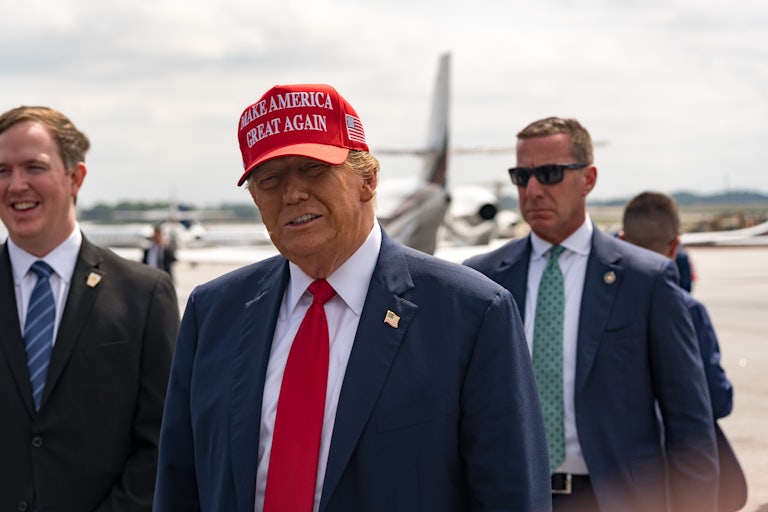
Trump at Atlanta's international airport
Megan Varner/Getty Images
Trump at Atlanta's international airport on Wednesday

It’s been pathetic over these recent years to watch people impute certain skills to Donald Trump. Oh, he’s very smart politically. He’s charismatic. It’s all nonsense. It’s political commentators trying to assess him in normal political terms, which only ends up presenting him as a normal politician, which he decidedly is not.

He isn’t smart. In fact, about politics, he’s quite dumb. He has precisely one skill: He knows how to sniff out people’s worst qualities—weakness, envy, anger—and bring them to the fore. That’s it. I’ll grant that this skill got him elected president once and may again. But that doesn’t make it admirable, and it doesn’t mean we should ascribe to him qualities he doesn’t remotely have.

He proved again this week how dumb he is about politics with his new abortion rights position. Earlier this week, I published a column based on the assumption that he was going to back a national 15-week ban. I wrote it on Sunday. It posted Monday at 6 a.m. Then, at around 7:20 a.m., he released his video that made my column moot: no 15-week ban from Trump, but an announcement that it should be up to the states.

Backing a 15-week ban would have been smart politics. He could have sold that as a “moderate” position, even though it isn’t. But fifteen weeks polls well. A February survey showed 48 percent of people backing a 16-week ban, with only 36 percent opposed. And more generally, of course, about two-thirds of Americans in poll after poll say abortion should be generally available with some restrictions.

The embrace of a 15- or 16-week ban would have left plenty of space between Trump and his party’s anti-abortion extremists. It would have enabled him to say, when some deep-red state passed some draconian ban, “No, I don’t agree with that at all; here’s my position, 15 weeks.”

But now? I remember thinking Monday morning that hypothetically, his new “states’ rights” position meant that any extremist position adopted by any state could now be hung around his neck.

The gods sure have a sense of drama because barely 24 hours passed before we went from hypothetical to all too real, when the Arizona state Supreme Court turned the clock back to General Sherman’s march to Atlanta. The decision, reinstating a near-total abortion ban passed in 1864, nearly a half-century before Arizona became a state, was politically shocking and morally repulsive to millions of Americans and Arizonans.

A Trump who’d come out for a 15-week ban could have credibly distanced himself from the decision. Everyone would have bought it. But a Trump who says, as he did on Monday, let’s let the states decide it, owns what the Arizona court did. He later tried to insist, in speaking to reporters Wednesday on the Atlanta tarmac, that he found the position too extreme. But he had just said two days before that states should set their own laws.

So he’s going to get absolutely pounded on this, and deservedly so. Vice President Kamala Harris is headed to Arizona today for a campaign event. According to Playbook, here’s what she is expected to say: “We all must understand who is to blame. It is the former president, Donald Trump. It is Donald Trump who, during his campaign in 2016, said women should be punished for seeking an abortion.”

Boom. Trump just made a huge target of himself—especially with that part of the video where he bragged about putting the justices on the Supreme Court who overturned Roe.

With his position, Trump has tacitly endorsed every severe anti-abortion law in the country. Fourteen states have made abortion illegal since the Dobbs decision. Trump owns every one of those laws. Suppose between now and November, a doctor in Texas is prosecuted for having performed an abortion—a felony punishable by up to life in prison. That will be Trump’s creation every bit as much as the prosecutor who brought the case.

And paradoxically, Trump also owns the positions of the 10 or so states that have liberalized their positions since Dobbs. Some states have enshrined reproductive freedom in their state constitutions. Trump owns that now too.

His pathetic tarmac performance this week showed that he barely knows what he’s talking about. My guess is that the position he took came from two imperatives. One, he heard from abortion rights foes in the GOP and the evangelical world that a 15-week ban was squishy and RINO-ish. Two, someone told him to say “states’ rights” because the phrase lands gently on the conservative ear, and a substanceless person like Trump just thinks that saying a phrase takes care of everything.

He is going to get slaughtered on this issue because of this new position. He says he won’t sign a federal ban. Fine. But that’s not much comfort to the large majorities who want reasonable abortion laws. And there are all those film clips of him bragging about ending Roe. And he’s a liar, so his word is as dependable as a share of Truth Social stock. He has spent his life contradicting himself, saying one thing Tuesday and the other thing Wednesday, and denying he ever said things he said a hundred times. But he’ll learn this year that people have memories.

This article first appeared in Fighting Words, a weekly TNR newsletter authored by editor Michael Tomasky. Sign up here.