Newsletter
Fighting Words
What got me steamed up this week

It’s Time to Check Back in, Liberals—Trump 2.0 Will Be Far, Far Worse

Most people I know—even me, to an extent—have been avoiding it. Well, we don’t have that luxury anymore.

Donald Trump
Rebecca Noble/Getty Images

After the election, nearly all my friends, those who are political junkies and those who are only casual users (and no, I’m not friends with anyone who isn’t at least a casual user, which is something I should perhaps think about), said: “I need a break. I’m checking out for a while.” The idea that the country would ignore everything it had seen and elect Donald Trump again was just unprocessable.

We saw this manifest itself in a number of ways, notably MSNBC’s lower ratings, which right-wingers crowed about on social media. As Governing magazine put it, “When a sports team loses, its fans don’t hang around for the postgame show.” I did this myself. I took nearly three weeks off work and read relatively little news. It was kind of great.

Folks, it’s time to reengage. Trump will take the oath of office at noon on Monday. Soon thereafter, this parade of misfit toys we’ve been watching testify this week will occupy their Cabinet positions. Orders will start percolating out—from Stephen Miller, Russell Vought, and other Trump deep staters—to start doings things differently. Trump already knows certain leverage points in the federal bureaucracy that took him months or years to locate the first time around. And he’ll have one big thing that he didn’t have in 2017: a pliant and willing establishment that signals a desire to be 100 percent on his side and that will give him every benefit of every doubt as he pulls at the republic’s threads.

It blows my mind, and ought to blow yours, that the three richest men in the world will be on Trump’s inaugural podium. It’s significant because, whatever their other powers and properties, they are three of the country’s most powerful media titans. Elon Musk owns the country’s most prominent news-oriented social media platform. Mark Zuckerberg owns the largest social networking service. And Jeff Bezos owns a newspaper that isn’t the ubiquitous behemoth that X and Facebook are, but even so, The Washington Post, at least to people on the broad left in the nation’s capital, means far more emotionally than the first two.

It’s worth staying with the Post for a paragraph here. Bezos bought the paper with seemingly good intentions in 2013 and poured a lot of money into it. Maybe, in retrospect, he went on too big a hiring spree. But that doesn’t excuse what’s been happening there lately. It’s a tragic mess, with its Murdoch-tainted publisher causing many excellent staffers to head for the exits. Bezos not long ago declared himself “very optimistic” and “very hopeful” about Trump’s return. This week, Post executives voted to adopt a new tag line/mission statement: “Riveting Storytelling for All of America.” Wow. This statement commits the paper to … what, exactly? I guess it’s quaint and hopelessly antique of me to mention that newspapers were once meant to be the people’s eyes and ears against corruption and assaults on the civic weal. The Post decided to keep “Democracy Dies in Darkness” for now. At least they didn’t vote to add, “Hey, if it happens, it happens.”

We are in an odd sort of waiting room at the moment. Trump and all his minions and enablers have told us many times what his administration will set out to accomplish: Project 2025, sweeping out the vermin, all the rest. At the same time, Trump himself has sent occasional mixed signals, indicating that it won’t really be that draconian, and every so often we read stories in the press meant to reassure us that, for example, rounding up and detaining 10 million people is literally not possible in four short years.

Well … call me cynical, but I sense a lot of people trying to convince themselves that it won’t be as bad this time around. I mean: Were you reassured by Pam Bondi’s testimony, for example? When Adam Schiff asked the attorney general nominee if she would pursue an investigation into Liz Cheney on Trump’s behalf, she said, “Senator, that’s a hypothetical, and I’m not going to answer it”—before lecturing Schiff that what he really ought to be concerned about is crime in California. But the maximum-cringe moment came when Chris Coons asked her what she’d do if Trump ordered her to do something “outside the boundaries of ethics or law.” Bondi’s reply: “Senator, I will never speak on a hypothetical, especially one saying that the president would do something illegal!” Senator Coons, how dare you!

We’ve been navigating a hall of mirrors in this country ever since George W. Bush and Dick Cheney et al. convinced America that we had to invade a nation that had done nothing to us, possessed no weapons of mass destruction, and, deplorably as it may have treated its own people, had no serious imperialist designs on its region (unlike the country—Iran—that our invasion ended up strengthening). Twenty years on, the mirrors are just stranger and more relentless and pitched at more confounding angles. And it won’t stop.

And the main point: There are more and more people in positions of power telling us, “Mirrors, what mirrors? You’re imagining things.” Goldman Sachs CEO David Solomon said this week: “There has been a meaningful shift in CEO confidence, particularly following the results of the U.S. election.” The data would suggest that he meant a shift to the negative, since the president who oversaw the creation of 16 million jobs is leaving and the former president who oversaw a net loss of jobs is returning. But that is not of course what he meant.

So here we are. On Inauguration Day eight years ago, I was at a liberal confab down in Florida (as it happened, just a few miles from a Trump property). That morning I ran into James Carville. So, I asked, are you going to watch him take the oath of office? The only-from-Carville reply: “Are you kiddin’ me? I’d rather watch my uncle’s colonoscopy.”

A great line. But I watched that day, and I’ll be watching Monday. I still feel that the more of us who witness him swearing to defend and protect the Constitution, the better. And I want to see what he has to say in his address, and you should too. You can’t tune him out, even if you wanted to. It’s time to reengage.

This article first appeared in Fighting Words, a weekly TNR newsletter authored by editor Michael Tomasky. Sign up here.

We’ve Never Been Here Before: The Zero-Accountability Presidency

The only institutions that will try to hold Trump accountable are powerless, while the only ones with the power to punish him will never do it.

Trump
Craig Hudson for The Washington Post/Getty Images

So here we are, at another one of those Trump moments that by now can only be called boringly surreal: The president-elect was sentenced Friday in New York in the hush-money trial, 10 days before taking the oath of office. He was given an “unconditional discharge.” At least he had to appear. Amazingly, the Supreme Court, this once, did not bail him out, although four justices were ready to.     

Nothing is shocking anymore. Trump refused to rule out invading Denmark (to take Greenland). Well, of course he did. What else should we expect? That he also wouldn’t rule out invading Panama (to take the canal) took me by surprise, I admit. But only for about three seconds. By the fourth second, it made perfect sense: Jimmy Carter’s decision to give the canal to Panama has been a festering boil on the right ever since it happened.

To say we’re in an unprecedented place is vastly understating it. We are in a place where no proper democracy has ever been or should ever be. We are about to have a president for whom there are utterly and literally no expectations. No one expects him to behave well. No one expects him to uphold normal standards of decency. If he muses one day about bombing London, or bombing Vancouver, or for that matter bombing Detroit, he will surprise no one. The panelists on The Five will just joke that there are certain sections of Detroit that a good bombing would only improve. Ha ha.

Trump will enter office facing no accountability, and with virtually no chance that he will ever be held accountable. You think I’m exaggerating? OK. Let’s play out a hypothetical. Let’s say President Trump gives nuclear secrets to North Korea. The New York Times breaks the story, let’s say. What would happen?

We know all too well what would happen. One of two things. Either he’d lie and call it fake news, in which case the right-wing agitprop machine would grind its gears in his defense. They’d unload on the Times. They’d snoop around and find out that the reporter on the story cheated on an algebra test in tenth grade. Fox and the others would have the story “debunked” within about two days, and the Times and the rest of the mainstream media would be overpowered.

Under scenario two, Trump would simply admit that he did it and explain why it was a very stable-genius-y thing to do, how everybody’s saying so, and Fox et al. would immediately take up that drumbeat. And over at the Times and on MSNBC and CNN (and I originally added The Washington Post to this list, but these days, one isn’t so sure, alas), everyone would be in high dudgeon about a sitting president sharing nuclear secrets with a regime that has repeatedly stated a deep hostility to the United States, but none of it would matter.

Meanwhile, on Capitol Hill? We’d see the same pattern. Democrats would be up in arms, while the only thing the Republicans would be doing with their arms would be to lock them. A few of them would express “concern” (hi, Susan Collins), but in time, they’d announce their faith in the president’s sound judgment.

And in the event someone sued and it got to the Supreme Court? The court may not have interceded for the prepresidential Trump, but it has already held that the presidential Trump can do anything.

Trump will be a completely unaccountable president, then, for this very simple reason: The only three power systems capable of holding him to account—the right-wing media, Republicans in Congress, and the Supreme Court—have no interest in doing so. The mainstream media will try to hold him to account, or at least we hope it will; but the mainstream media means nothing to Trump, his party, and his base. Ditto Democrats in Congress.

I can’t imagine a single scenario in which the right-wing media or the GOP Congress or the high court will show backbone or independence. In the meantime, these three entities, especially the right-wing media, have by now been trained to immediately and reflexively aim their fire at Democrats and liberals for every single thing that may go wrong during Trump’s presidency.

We’re getting a little taste of that now. Once upon a sweet old time, the barely imaginable horror of the Los Angeles fires would have been given a little time to marinate before us as a merely human tragedy. It’s entirely appropriate to ask questions and hold leaders accountable—of course. But historically, we tend to get a few days of unified mourning before we get to that. And those days of unified mourning serve a civic and national purpose of reminding us that we are one people.

No longer. Within hours or even minutes of the fires spreading, conservatives took to social media to let the world know that there was nothing accidental or capricious about any of it—it was all the fault of Governor Gavin Newsom and Mayor Karen Bass and, most of all, DEI, which stripped the LAFD of the kind of manly white men whom the fires would have taken one look at and retreated back to the hills in fear.

As I said, obviously, it’s necessary to ask questions of leaders (which the GOP will never do with Trump). But it’s equally necessary not to instantly and excessively politicize events that obviously have nonpolitical elements to them. Newsom, Bass, and fire chief Kristen Crowley aren’t in control of the winds, or of the climate change that’s making these wildfires more common and more severe.

This is what the new Trump era will be like, and it’s what Democrats need to know they will be up against. There is a powerful disinformation and propaganda apparatus (1) for which Trump can do no wrong and (2) which, in all cases of conflict, will instantly advance a narrative, whether true or false or somewhere in between, that it’s the fault of Democrats, liberals, or the woke left. Thus the paradox of the new Trump era: The only institutions that will try to hold Trump accountable are powerless to do so, while the only ones with the power to punish him will never do it.

Powerlessness does not, however, imply surrender. Quite the contrary. The republic is in the hands of Democrats and mainstream and progressive institutions. They, we, must fight harder than ever. It’s just going to be maddening, watching a convicted felon president tell lies and corrupt our values. We have to believe that a day of reckoning will come. Without that belief, he wins.

This article first appeared in Fighting Words, a weekly TNR newsletter authored by editor Michael Tomasky. Sign up here.
The Trump Era Came Into Sharper View This Week. God Help Us.

Corporate tax cuts! Threatening Republicans! Arresting Democrats! Rethinking the polio vaccine?! People are about to find out what they voted for.

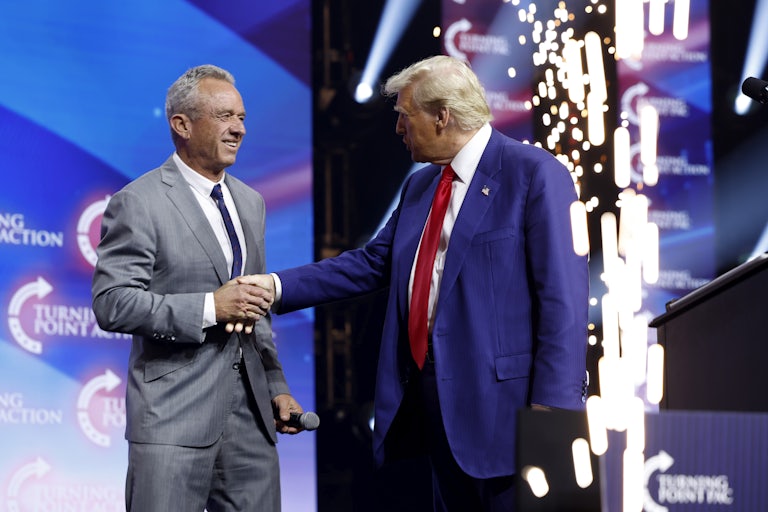
Donald Trump welcomes Robert F. Kennedy Jr. to the stage at a rally in Duluth, Georgia.
Anna Moneymaker/Getty Images
Donald Trump welcomes Robert F. Kennedy Jr. to the stage at a rally in Duluth, Georgia.

Where do I even begin in describing what the events of the week have told us about the coming Trump era? Four developments this week, in entirely different realms, have done much to illuminate what life under Donald Trump is going to be like.

Let’s begin with a piece of news that you may have missed. This was good news: The Biden administration’s Federal Trade Commission won a big one in a Portland, Oregon court when, after a three-week trial, a judge ruled against the proposed Kroger-Albertsons grocery store merger. The stores argued that the merger would give them more leverage over suppliers, thus enabling them to lower prices. The government argued that it would reduce competition, allowing them to both raise prices and reduce the power of their unionized work forces. The judge ruled for the government.

What does this tell us about the Trump era? A couple important things. One, it’s extremely unlikely a Trump FTC, under nominee Andrew Ferguson (who will not require Senate confirmation), would try to block such a merger. You see, the Biden administration announced merger guidelines a year ago that made effects on the labor market a more central factor in considering mergers. In other words: It took a stand for the working class. Two, Judge Nelson was appointed by Joe Biden.

The Trump FTC will surely revisit—that is, toss—those Biden-era guidelines. It would also look more favorably on mergers like the Kroger-Albertsons one. Ferguson, and Trump’s other antitrust appointments, do want to do a certain amount of cracking down, but to the extent they’re prepared to swing a big stick at corporate consolidation, it will be in pursuit a narrow interest: Big Tech’s alleged (and mostly phantasmal) suppression of right-wing speech. And if a future merger like Kroger-Albertsons comes before a Trump-appointed judge, count on it getting approved. But remember, the Republicans are the party of the working class!

Item two: Trump rang the opening bell on Wall Street Thursday, to thunderous applause and chants of “USA, USA!” He announced there that he’ll lower the corporate tax rate to 15 percent for companies that make their products in the United States. It would stay at 21 percent for companies that do not. That sounds very MAGA. But what about corporations that don’t make anything at all? Here are the 10 largest companies in the United States by revenue: Walmart, Amazon, Apple, United Health Group, Berkshire Hathaway, CVS, Exxon Mobil, Alphabet, McKesson, and Cencora (the last two are pharmaceutical distributors). Only a couple of them make things. Let’s guess what these companies’ new rate will be.

The great avatar of the working class will stop considering workers’ interests in antitrust enforcement and will lower corporate taxes again. But hey, he went on Joe Rogan. He’s a tough guy tribune of the working stiff.

A third development of the week that opens a window onto what Trump 2.0 will be like was the open declaration by Elon Musk that he’ll finance primaries against Republican senators who vote against Trump’s Cabinet nominees. “How else? There is no other way,” Musk wrote on X. Marjorie Taylor Greene, chasing approval and relevance, chimed in: “Elon and Vivek talked about having a naughty list and a nice list for members of Congress and senators and how we vote and how we’re spending the American people’s money.”

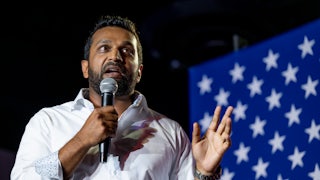
In other words, Republican senators: You better vote to approve Pete Hegseth and Tulsi Gabbard and Kash Patel and RFK Jr., or you’re going to have a primary challenger on your hands financed by Elon Musk—who, thanks to the right-wing Supreme Court, can throw as much dark money at a primary as he wants. Twenty GOP incumbent senators are up for reelection in 2026, including Mitch McConnell (if he runs) and that sometime troublemaker Joni Ernst. This is hardly different from Putin’s Russia, or an Americanized version thereof. The billionaire president had better get his billionaire Cabinet just as he wants it, or the world’s biggest billionaire will destroy your career.

Those confirmations will include, as I mentioned above, Patel, who as of this week looks like he’s on a glidepath to confirmation. So reassuring, in a week that started with Trump telling Kristen Welker that the members of the House January 6 committee belong in prison. It’s another marker of how grotesquely Trump has debased American political culture that a president-elect can dangle the threat of jail time in the faces of incumbent elected representatives and it’s barely even news.

It was news, however, that FBI Director Chris Wray will be throwing in the towel, and rightfully so. Wray chose not to go submit himself to the abasement that he knew he and bureau faced, the endless smearing of his reputation in the right-wing media, if he tried to defy Trump’s wishes and stay on. The precedent this sets will reverberate plenty over the next four years and beyond. So Patel, the man who promised to explode the FBI and whose enemies list is three times longer than Richard Nixon’s, will probably take over the agency.

Fourth and finally, let us not forget Robert F. Kennedy Jr. There’s so much craziness and corruption and incompetence that it’s impossible to keep it all front of mind, which is of course part of the plan. So, when we manage to direct our attention to the future of the nation’s public health, we must think not only about Kennedy. We are introduced to figures like Kennedy’s attorney Aaron Siri, who in 2022, The New York Times tells us in a scorching piece, petitioned the government to revoke the polio vaccine. The polio vaccine! Literally one of the great triumphs of the human race. Hey, Siri, is polio on the rise again? Why yes, it is. Lower rates of vaccination are part of the reason.

Trump expressed skepticism about polio vaccine revocation, so at least he’s apparently that sane. But the signal is clear: If Kennedy is confirmed, it’ll be open season on vaccines in general—maybe even modern medicine writ large. Siri is advising Kennedy on people to fill the top positions at his agency should he win confirmation. Feel better?

I know. Voters were angry about the price of eggs. And we can’t blame them. But soon enough, they’ll start to see what they voted for. And as Trump finally admitted this week, after lying for a year on the campaign trail, there isn’t really much he can do to bring down prices, either. So now we’ll have five-dollar eggs and a corrupt oligarchy and political opponents under arrest and new outbreaks of once-defeated diseases. But remember, Trump was the working-class candidate.

Trump Has Handed Democrats a Fast Way to Build Some Working-Class Cred

The party can use the upcoming confirmation hearings to start to restore its class identity.

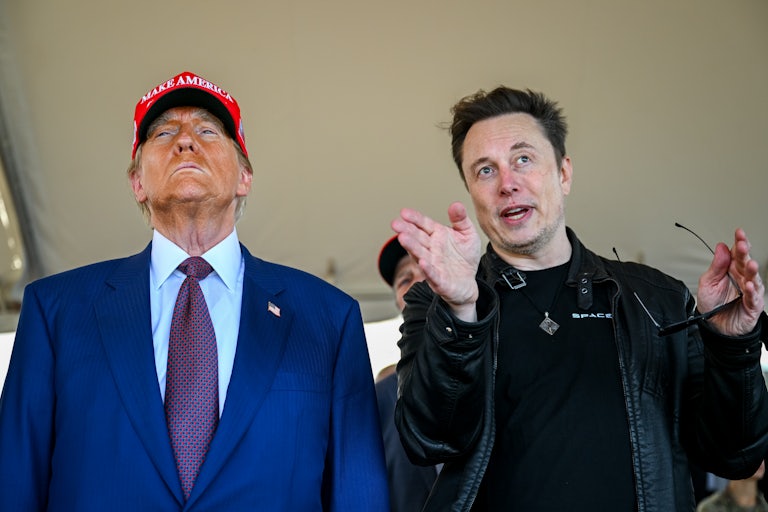
Trump and oligarch Elon Musk at a SpaceX event
Brandon Bell/Getty Images
Trump and oligarch Elon Musk at a SpaceX event in November

One important point that gets lost in the avalanche of coverage about Donald Trump’s appalling Cabinet nominees is that they’re all (except the ones who withdraw) going to have to undergo confirmation hearings next year. Those hearings are a long way away—they’ll be held in February or March, mostly. By nominating all these people faster and earlier than usual, Trump has given Senate Democrats a long time to prepare and plot strategy.

The Democrats are not going to block any nominees. They don’t have the votes or the power to do that. But they can still ask tough questions; they can still command the stage with national attention focused on them. And there is an obvious way they can use that spotlight to do the one thing most observers think is their top priority: to rebuild some credibility with working-class voters.

Let me start by asking you this question: Looking over Trump’s nominees, what is the great unifying theme? No, it’s not that they’re all Trump loyalists. That’s true, but it was a given and is thus uninteresting. No, it’s not that they’re awful toward women. That’s true of some of them, but only some. No, it’s not that they’ve said and promised to do shocking things. That’s true too, and they should be questioned aggressively on those matters, but that still isn’t the great theme.

The great theme is how many of them are massively rich. I saw on Alex Wagner’s show Thursday night that the combined net worth of Joe Biden’s Cabinet was $118 million. That’s not chicken feed, and no doubt if we went back to late 2020–early 2021 we’d find a bunch of Fox News segments on what a bunch of hypocritical plutocrats Democrats are.

But the total net worth of Trump’s Cabinet? It’s at least $13.3 billion, and that’s not because there are just one or two really wealthy picks. Just-named Small Business Administration nominee Kelly Loeffler and her husband, for instance, are worth $1 billion. By Axios’s count, at least 11 billionaires “will be serving in key roles in the administration” if they’re all confirmed. That’s not even counting Vivek Ramaswamy and Elon Musk, who won’t be official Cabinet members. If you throw them in, the total is $360 billion (the vast majority of which is Musk, the world’s richest man). And then, of course, there’s the billionaire presiding over all of them.

But let’s stick with the roughly $14 billion net worth of those nominees who’ll appear before the Senate. It’s a staggering figure. It’s often forgotten that one of the core characteristics of authoritarian regimes, along with extremism and nativism and so on, is corruption. Authoritarians are corrupt and self-dealing, from Hermann Goering’s art collection to Imelda Marcos’s shoes. And, accountability being a bourgeois democratic concept, it’s something they laugh at. It’s in their nature.

I don’t know how all these people made their money. I don’t quite agree with Balzac that there’s a crime behind every fortune, and of course there are certainly ways in which people who build large companies are to be admired because of their contributions to technological innovation or their communities or both. But I do believe two things.

One: The vast majority of great fortunes in this country in this day and age are made with a helping hand, somewhere along the way, from the federal government—a favorable agency ruling, a soft plea deal with a federal prosecutor for something or other, a government loan. Indeed, Tesla in 2010 got a whopping $465 million loan from the Department of Energy. Tesla, I should note, repaid the loan quickly, but still, the company apparently wouldn’t have been able to launch its successful Model S without Uncle Sam’s help.

Two: There may not be a crime on record, but there’s bound to be some kind of skeleton in almost any rich corporate closet. Labor violations, hiring discrimination, failure to pay certain fees or fines, price collusion or manipulation, lack of required legal transparency with consumers. Many companies—maybe most companies—engage in this kind of behavior to one degree or another. And the documentation is always there, for those with the capacity to dig.

So this tees up the Senate Democrats’ big job at these hearings. They have to make sure, when these hearings are over, and whether the nominees are confirmed or not, that America sees them through one lens only: as a bunch of out-of-touch plutocrats. They’ll need to pick their shots well, but surely they’ll be able to find three good cases in which these nominees have in some way made consumers’ lives a little harder than they needed to be. 

Senate Democrats need to bring that out fearlessly and plainly. We live in a country where, thanks to Fox News and the rest of them, your average person believes that the elitists in this country are people like Alexandria Ocasio-Cortez. Well, AOC doesn’t even have a net worth to speak of (needless to say, the right spread rumors not long ago that she was worth $29 million). The real elites are the kinds of people who’ll fill Trump’s Cabinet. If the Democrats use the hearings to advance this argument with evidence and put some of these people in uncomfortable positions with respect to their corporate track records, either because they hypocritically took government handouts of some kind or because they weren’t straight with consumers, they can start to reframe the debate in this country about who is an elitist and who is not.

Will they do it? The Democrats’ track record, alas, suggests they don’t have the stomach for this. But they’d better realize that they are in a precarious position. Kamala Harris lost more working-class voters than Biden. Among non-college voters overall, Trump beat Biden by just 50–48; he beat Harris 56–43. Among non-college, nonwhite voters, Harris still won with 64 percent, but Biden won with 72 percent. 

Maybe Harris just lost working-class support because of inflation. I think that’s probably the case. But is that an assumption Democrats can afford to make? One more presidential election like this one will constitute a pattern that will be hard to break. Democrats must show voters between now and 2026 and 2028 that they are on the side of working- and middle-class people. Being in the minority, they’ll have few opportunities to show that. Confirmation hearings of nearly a dozen billionaires are a golden opportunity, Democrats. Go seize it.

Does the Gaetz-to-Bondi Transition Count as a Win? Maybe. For Now.

It’s great that Matt Gaetz will not be our attorney general. But this may be an example of the Senate saving Trump from himself.

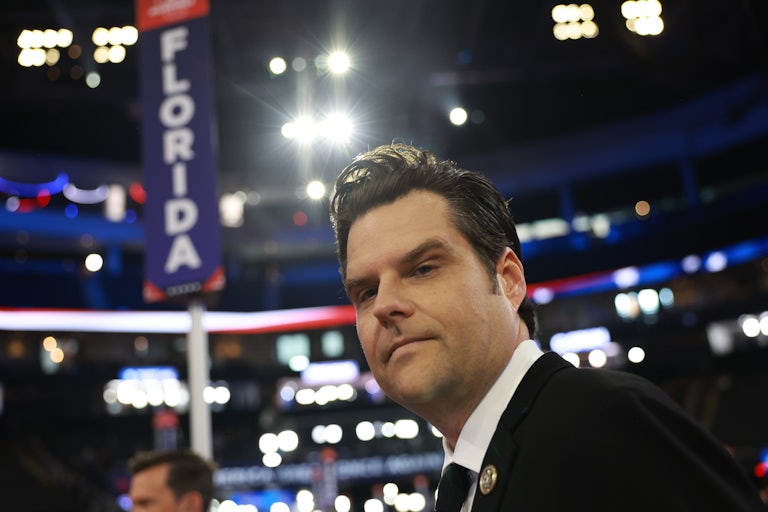
Matt Gaetz
Joe Raedle/Getty Images
Matt Gaetz at the Republican National Convention in July

You know the old leftist phrase “the worse, the better”: It’s said to date to the early days of revolutionary Russia, and it means that the worse social conditions become for the proletariat, the better things will be for the left, because people will be more sympathetic to revolution. It’s a plausible idea, I guess, although it hasn’t usually worked out very well for the leftists—often, the worse just keeps getting worse and the revolution never comes; at other times, the revolution does come but things don’t get any better and arguably get far worse, as was the case in the Soviet Union itself, where Joe Stalin probably butchered or imprisoned or starved to death more proletarians than all the czars put together.

So now, here at home, we have our first scalp of the not-yet-extant second Trump administration. Matt Gaetz is out as attorney general. I wrongly thought he’d make it. Senate Republicans may have a little more backbone than many of us thought. At least four GOP senators told their colleagues they would vote “no” (including Senator-elect John Curtis of Utah; could be worth keeping an eye on him). Of course, it didn’t come to a vote, or anywhere near that, but it certainly looked like Gaetz would go down in flames, so he did the sensible thing (for once!).

Is this a win for the opposition? Sure. Any setback for Donald Trump is a win for the other side. Plus, more substantively, it’s hard to imagine how awful Gaetz would have been as attorney general.

But now we have Pam Bondi stepping into the job. No one can seriously question her credentials on paper—a former assistant state attorney who served as Florida’s attorney general for eight years—so she will probably sail through confirmation. Is this so much better? She’s been a MAGA loyalist for a decade. She dropped an investigation into Trump University after Trump donated $25,000 to her campaign (no charges were brought against her).

In a normal world, that would be pretty controversial. But in Trumpworld, it’s jaywalking. Bondi will presumably do whatever Trump wants her to do, and more cleverly than Gaetz would have done. We’re left hoping that those 18 years as a prosecutor have inculcated in her some modicum of respect for the law, such that if Trump calls her and orders up an arrest of someone he doesn’t like, she may slow-walk it.

It’s roughly the same with all the other absurd appointees. What Pete Hegseth, Trump’s pick to run the Department of Defense, is alleged to have to done to that woman in 2017 is repulsive (he denies the charges and says it was consensual). His views are beyond extreme. But if he becomes so toxic that he, like Gaetz, has to withdraw, it won’t be because he believes liberalism must face “utter annihilation,” but because of the sex scandal. On the one hand, that’s good—it would tell us that even Republican senators draw a line on sexual assault. On the other, it means that all Trump has to do is nominate someone else who isn’t charged with sexual misconduct but is cool with the annihilation of liberals, and that nominee will sail through.

We could run through several more of Trump’s nominees in a similar vein. Tulsi Gabbard, his pick for director of national intelligence, may be the most outrageous choice of all. I mean, if you were Germany or France, would you share intel about Russia with her? She may get bounced, but again, she’d likely be replaced by someone just as ferociously loyal to Trump and roughly as reactionary and objectionable, just less histrionically so. Ditto Linda McMahon, a truly nutty choice for education secretary, although she seems likely to get through. Matt Whitaker to NATO? His main qualification is trying to interfere with the Mueller report. Federal Communications Commission chair nominee Brendan Carr wrote the relevant section of Project 2025 and has recently suggested that his FCC will look closely at the broadcast licenses of the major networks, which no administration has done in decades.

And don’t ever forget the most alarming of them all, the man who has faded from the headlines somewhat because his elevation does not require Senate confirmation. Border-czar-to-be Tom Homan has nevertheless been out there talking to right-wing news outlets about doubling the number of ICE agents in sanctuary cities and states: “Sanctuary states said they’re not allowing any detention facilities in their state—fine. Then we’ll arrest them. We’ll fly them out of the state and detain them outside the state, again, away—away from their families, their attorneys. That’s what you want, that’s what you get.”

So it’s good that Matt Gaetz won’t be attorney general. Yet somehow it’s hard to think of this as much of a victory. Bondi looks to be a slight improvement. But she’s likely to do the job better than Gaetz would have. How much of a win is that?

If anything, the Gaetz episode shows that the Senate will save Trump from himself. They’ll block some of his most obviously problematic and indefensible appointments and, once he becomes president, thwart the occasional policy move, but they’ll rubber-stamp 90 percent of the Trump agenda and even help him by making it all look more palatable to those not paying close attention. And overall, the worse will not get better.

This article first appeared in Fighting Words, a weekly TNR newsletter authored by editor Michael Tomasky. Sign up here.