Life in a Warming World
A weekly reckoning with our heated planet—and the fight to save it

Trump 2.0’s Deregulation of Chemicals Has Begun

The appointment of two industry insiders to the Environmental Protection Agency revives familiar arguments about regulation harming the economy.

Trump grasps a microphone at a lectern.
Mandel Ngan/Getty Images
Donald Trump delivers remarks at the House Republican Members Conference Dinner on January 27.

Last week, Trump appointed two veterans of his first administration, Nancy Beck and Lynn Dekleva, to lead chemical regulation at the Environmental Protection Agency. Beck is a chemical industry lobbyist. Dekleva is currently senior director at the American Chemistry Council, an organization whose positions include opposing the EPA’s recent, arguably belated ban on noncritical uses of methylene chloride—a chemical so toxic that it has been shown to poison even trained workers using protective gear. These appointments, while buried beneath the landslide of other headlines out of the White House over the past week, served as a critical indicator: Specifically, they dashed the (limited) hopes some advocates were nursing that right-wingers’ newish preoccupation with environmental health—embodied primarily in the chaotic figure of Trump’s Health and Human Services nominee, Robert F. Kennedy Jr.—might make the second Trump administration marginally more environmentally friendly on chemical and plastics regulation than the first one.

The Washington Post, covering the appointments, highlighted the typical rationale for appointing industry insiders to such posts: that the EPA’s chemical approval process needs reform. “The EPA’s flawed decision-making process has consequently inhibited American innovation and our ability to compete in the global market,” according to Republican Representative Brett Guthrie of Kentucky. The Post also quoted lawyer Dimitri Karakitsos, who has represented chemical companies, arguing the approval process for new chemicals is actually impeding environmental progress: “A lot of these new chemicals tend to be greener and safer, and we want that innovation on the market,” he said.

Is that true? It’s a counterintuitive take, given that the EPA has come under heavy criticism in recent years for failing to ban even chemicals that dozens of other countries have chosen to ban over links to severe health damage. I called two experts to get their perspectives on the matter.

“I actually do think that there are tremendous innovations and discoveries of new chemicals happening today,” Yale School of the Environment professor and former director of the U.S. Green Chemistry Program Paul Anastas told me. “And yes … when you can demonstrate these things—that it’s safer, greener, performs better—there should be a more effective way of fast-tracking these innovations into the marketplace so that they can make their positive benefits.” At the same time, he said, “the role of science at EPA is fundamental, and everything that the EPA does must be science-based.”

A key part of the industry position, however, is that U.S. regulatory procedures are somehow exceptionally obstructive, particularly in an international context. Those with experience in this international context say that argument doesn’t hold up.

“The idea that U.S. chemical regulation is so advanced that it hinders and slows down U.S. competitivity is preposterous,” said David Azoulay, director of environmental health at the Center for International Environmental Law, or CIEL, over the phone from Geneva. The U.S. has “the least stringent, least efficient, and least protective legislation compared to any of the other major economies—and that includes economies like the EU of course, which is the most often mentioned, but also includes Korea, Japan, even China.” The EU, for example, “regulates or bans over 1,300 chemicals in cosmetics. The U.S. bans less than two dozen.”

The anti-regulatory argument also rests on the assumption that regulating to prevent environmental harm slows innovation. But when CIEL investigated this in 2013, Azoulay said, using patent applications as a proxy for innovation, “every time there was a new type of regulatory control measure being put in place around phthalates, we saw a spike in a number of patents being filed for new products or new substances or new applications that didn’t use phthalates.” He also pointed to a wealth of recent research showing that, contrary to the assumption that regulations hurt the economy, under-regulating harmful chemicals can cost billions of dollars.

These studies probably aren’t going to prevent people from arguing that EPA regulations harm American companies’ ability to compete. “An additional perspective that’s useful to consider,” Azoulay added, “is that, contrary to some simplified beliefs, the chemical industry is very much a global industry. All of those major chemical producers are multinationals that have production bases in the U.S., in Europe, in China, in the Gulf, in other places, that try to take advantage of being closest to the primary materials or the markets or whatever.” And the arguments everywhere seem to be the same: “Those rules in that particular jurisdiction are hindering competitivity. But because it’s the same companies making the same arguments, what they’re actually doing is trying to bring the floor down, and trying to lower the level of protection of health and the environment.”

If the track record of the first Trump administration is any indicator, those companies may be pleased by what happens next at the EPA. Then again, maybe they won’t. When the first Trump administration tried to weaken methylene chloride regulations, for example, they were quickly and repeatedly sued. Rushed, poorly evidenced environmental rollbacks in the first Trump administration were what allowed groups like the Natural Resources Defense Council to boast that “on average, we sued once every ten days for four years, and we won victories in nearly 90 percent of the resolved cases.” As these battles play out, however, many fear the toll—to insufficiently protected workers, to the people passively absorbing toxic chemicals in their environment, and to ecosystems—may mount.

Good News/Bad News

A new study pushes back against earlier ones suggesting that the Atlantic Ocean’s system of currents is slowing down. This study finds no evidence of the system weakening at all—very good news, given that, as previously discussed in this newsletter, a lot of agriculture depends on the weather systems that depend, in turn, on these currents.

Maryland’s renewable energy program isn’t working, a new report suggests. Inside Climate News’s Aman Azhar explains the findings and talks to the report’s authors, who say this is a “well-known problem in the state that people don’t want to talk about.”

Stat of the Week
35%

A previous edition of this newsletter noted that a so-called attribution study of climate change’s contribution to the L.A. fires might take time. Only two weeks later, a report from the World Weather Attribution group calculates that climate change made the hot, dry, windy conditions that helped the fires spread 35 percent more likely.

What I’m Reading

Kentucky’s Mountaintop Mines Are Turned Into Neighborhoods

Old coal mines that blew the tops off mountains have left lots of manmade plateaus in Kentucky. While these “ecological graveyards” may not be as lush as the landscape they’ve replaced, Austyn Gaffney writes, they may prove to be a lifeline in a state struggling to adapt to increasingly severe floods:

In 2022, apocalyptic flooding swept across eastern Kentucky, killing 45 people, destroying 542 homes and damaging thousands more. Now, instead of rebuilding in the floodplain, the state is permanently lifting residents onto safer land. Officials are more than two years into a nearly $800 million plan to reclaim these landscapes again, turning them from deserts into developments.… Seven communities across four counties, with aspirational names like Skyview and Olive Branch, have been designed for 665 brand-new properties, some of which will run on solar. Fourteen houses have been completed and about a dozen people have moved in to two communities called Thompson Branch and Wayland, according to the state.

Read Austyn Gaffney and Jon Cherry’s feature in The New York Times.

This article first appeared in Life in a Warming World, a weekly TNR newsletter authored by deputy editor Heather Souvaine Horn. Sign up here.
Trump Is Accidentally Making a Great Case for the Green New Deal

Trump and his billionaire oligarchs are standing between us and a cleaner, more equal world.

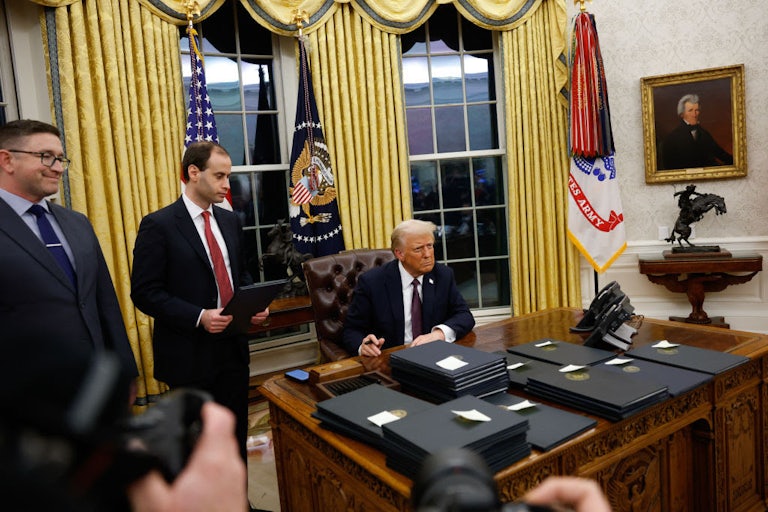
Trump sits at the presidential desk in the Oval Office with a stack of folders bearing executive orders in front of him, as two others look on while standing.
Anna Moneymaker/Getty Images
Donald Trump signs executive orders in the Oval Office on January 20.

In the first hours of his second term, President Trump signed executive orders re-withdrawing the United States from the Paris climate agreement, rolling back incentives for electric vehicles, pausing approvals for wind farms in federal waters, and declaring a “national energy emergency” to expedite drilling and open up more land and sea for drilling. He also withdrew the U.S. from the World Health Organization, signed an unconstitutional order trying to end birthright citizenship, attempted to set a national two-gender policy, ordered federal workers back to the office while making it easier to fire them, rescinded a Biden order lowering prescription drug costs, and pardoned those who stormed the Capitol on January 6, 2021.

You may remember this pattern from 2016—the “throw everything at them, plus a kitchen sink and ferret, ideally at 3 a.m. on Twitter” approach to politics. Trump’s first term was characterized by multiple news bombshells per day, a bewildering number of unrelated proclamations, crises, and scandals per week, and each Friday closing with politicians, media workers, and news readers struggling to remember what had happened just a few days prior. It’s no wonder a book urging digital detox and bird-watching as a form of radical political action became a breakout hit. This time around, people have announced they’re tuning out; essayists (including at TNR) have mused what ethical retreat and rest might look like during Trump 2.0; and leftists on Bluesky are urging fellow activists to “find your lane” and focus on that, rather than trying to track every last move the administration makes on the environment, reproductive autonomy, trans rights, immigration, etc.

The downside of choosing a lane, though, is that it makes it harder to see the themes emerging in Trump’s second presidency. And there are already some through lines on the climate front that aren’t perceptible in the catalog of his executive orders alone.

The three richest men in the world watched from prominent seats—in front of Cabinet nominees—as Trump was sworn in on Monday. As the president bragged about the country’s oil and gas reserves, promising to “export American energy all over the world,” applause broke out not just in the Capitol Rotunda, The New York Times reported, but “at the Hay-Adams hotel in downtown Washington, where some of the country’s leading oil and gas executives popped champagne and ate mini Pop-Tart pastries with Mr. Trump’s image,” hosted by fracking magnate Harold Hamm, who personally donated $4.3 million to pro-Trump PACs. Since April 2024, when Trump promised fossil fuel execs at Mar-a-Lago favorable policies in exchange for campaign donations, top fossil fuel billionaires’ wealth has grown by $40.2 billion, the Climate Accountability Research Project recently reported.

I remember a time when I didn’t really “get” the Green New Deal: A lot of the policies associated with it, like affordable housing and single-payer health care, seemed like good ideas but sort of orthogonal to the primary goal of lowering emissions. But it’s a political strategy as much as an ideological statement, and the political strategy rests on two core insights: first, that not only is it hard to disentangle inequality and the climate crisis, but the unchecked power of the wealthy is in fact driving rampant emissions and obstructing the progress of policies to curtail them. Second, climate policies and the politicians supporting them will not succeed without the ability to demonstrate material benefits in people’s everyday lives. In other words: For long-term success, climate policies can’t just be about lowering emissions. They need to show people that low-carbon life can be fun. They need to be defanging the culture war.

If the spectacle of ring-kissing billionaires at Trump’s second inauguration doesn’t show once and for all that Green New Deal supporters have a point, I’m not sure what will. Because these executive orders aren’t coming from the electorate: Outside the pro-petroleum Pop-Tart crowd at the Hay-Adams, these policies just aren’t that popular. Wind power is still backed by 72 percent of the population, per a Pew poll last year, while only a minority support further offshore drilling and even fewer back fracking. That’s hardly a ringing endorsement for the platform Trump announced at a Sunday rally—that “we’re going to drill, baby, drill and do all of the things that we wanted to” but “aren’t going to do the wind thing.”

The policies’ political currency comes instead from their culture-war status, i.e., their ability to motivate a core group of voters and a lot of money. Culture wars, as several writers at TNR have pointed out in recent years, are a deft bit of political theater that more often than not turn out to serve corporate interests. Per Green New Deal thinking, the way to combat that—aside from taxing billionaires out of a few of their zeros—is to enact policies that provide people with a more material benefit on a regular Tuesday than the fossil fuel industrial complex does.

Who knows whether this theory will ultimately be proven correct? (This week, Liza Featherstone wrote for TNR about one intriguing but vulnerable policy currently testing it: New York City’s congestion pricing.) But as Trump’s inaugural spectacle shows, we’re way past the point where his opponents can afford to ridicule this progressive strategy as “the green dream or whatever”—as Pelosi did during Trump’s first term. Socialists shouldn’t be the only ones noting the reactionary role “capital” has played in this election and inauguration. And there’s a message here for ordinary news consumers too: Whatever approach you take in processing the incoming onslaught, keep an eye on the oligarchy of it all. If you’re staying in your “lane,” remember that these lanes are often connected—and what connects them is often money.

Good News/Bad News

Not all of Trump’s attempts to scrap pro-environment policies will hold up in court or have the effect he’s promised supporters that they will have. Meanwhile, America’s second withdrawal from the Paris climate agreement has so far mostly drawn criticism and pledges from other countries to stay the course.

Things aren’t looking good for the endangered right whale. After much hemming and hawing, the Biden administration in its final days ultimately dropped a proposal to tighten speed limits to prevent deadly ship strikes.

Stat of the Week
1/3 of the Arctic

That’s the portion of the once-great carbon sink that, as the ground thaws, is now adding emissions to the atmosphere rather than subtracting them, according to a new study.

What I’m Reading

What happens when the California fires go out? More gentrification.

Climate disasters don’t level the playing field, this piece suggests: They just clear it for bigger buildings, mortgages, and rental bills. This could be what happens in Los Angeles in the wake of recent fires:

When a natural disaster strikes a community, housing prices almost always rise. In the short term, the reason is obvious: Apartments and houses have been damaged or destroyed, so there are fewer of them, and that decline in supply causes rents to spike.

But as rebuilding efforts drag on, many middle- and low-income people never return to their neighborhoods because they can’t afford to.

“One of the reasons gentrification happens is that everything just becomes more expensive,” said Jennifer Gray Thompson, founder and CEO of After the Fire, a nonprofit that helps communities prepare for and recover from wildfires. One reason is the high cost of building, but there are others, including landlords taking advantage of high demand to raise rents and real estate investors buying up properties to try to profit off of them later.

Read Abdallah Fayyad’s full report at Vox.

This article first appeared in Life in a Warming World, a weekly TNR newsletter authored by deputy editor Heather Souvaine Horn. Sign up here.
What If the Los Angeles Fires Were a Turning Point?

A widely praised novel several years ago foretold some of what we’re witnessing today—but got the political response very, very wrong.

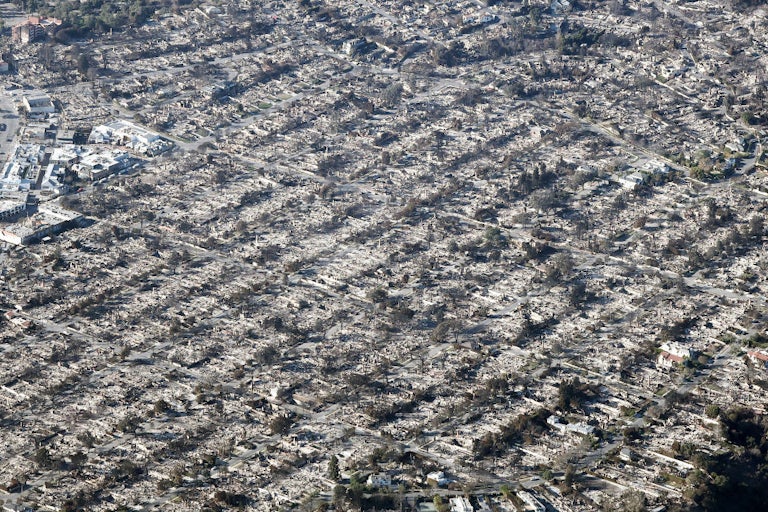
Block after block of homes lie in ashes from the Palisades fire.
Mario Tama/Getty Images
An aerial view of homes destroyed in the Palisades fire

In Kim Stanley Robinson’s widely acclaimed, Obama-praised climate novel, The Ministry for the Future, the climate crisis is already well underway when catastrophic rains drown Los Angeles in water. Recreational kayaks and motorboats become crucial rescue vehicles, thousands die in the floods, and early projections suggest some $30 trillion in damage.

“So now,” the main character muses, “one could imagine that the American people might support action on the climate change front. Better late than never! But no. Already it was becoming clear that LA was not popular in Texas, or on the east coast, or even in San Francisco for that matter.” Despite these public sentiments, “California’s government, one of the most progressive in the world, and the US federal government, one of the most reactionary in the world—both were making efforts to help.” And the devastation of a famed city shocked just enough elites to make a difference: “If it could happen to LA, rich as it was, dreamy as it was, it could happen anywhere. Some deep flip in the global unconscious was making people queasy.” Los Angeles’s disaster becomes one of the key turning points leading to a global carbon coin.

Right now, Los Angeles is burning. But so far, the incineration of over 40,000 acres in America’s second-largest city doesn’t seem poised to be any kind of turning point. The Wall Street Journal published an editorial ridiculing the idea that climate change could have driven both the exceptionally wet winters in 2023 and 2024 and the recent dry spell. (While a full so-called attribution study on climate change’s contribution to the fires will take time, there’s already a lot of research suggesting climate change can, in fact, increase both flooding and fire risks, and early analysis out of UCLA suggests climate change did play a role here.) Georgia congresswoman and renowned random-number-generator Marjorie Taylor Greene asked why “they” didn’t use geoengineering to dump rain on the fires. Donald Trump, days away from his second term as president, blamed the destruction on Democratic California Governor Gavin Newsom and a tiny fish called the delta smelt, outlandishly claiming that policies to protect the endangered species had deliberately deprived Los Angeles of water. (This whopper was universally panned by fact-checkers.) And Trump’s pick for energy secretary has previously denied that climate change has anything to do with wildfires.

One line in Robinson’s novel rings particularly true: A lot of people seem to dislike L.A.—or at least a lot of right-wingers seem to dislike its image as haven for California liberals. The Journal also blamed the fires on Democrats: Newsom, the state legislature, and “the mayors of Los Angeles,” in that order, for spending money on climate policy that could have been spent directly on wildfire prevention (wildfire prevention also received funding). Republican Representative Warren Davidson, from Ohio, suggested on Fox Business last week that California should only get federal disaster aid “if they change their policies.” He was a little vague about which California policies needed to be changed. Elon Musk, right-wing actor James Woods, former Fox host Megyn Kelly, and conservative CNN commentator Scott Jennings all blamed the unchecked blazes on diversity hiring within the Los Angeles Fire Department. Another favorite target has been the environmental review process, which can delay risk-reduction practices like thinning or prescribed burns. (Libertarian Reason magazine—not a typical defender of regulation—was an unexpected voice debunking the notion that environmental review was to blame.)

The fires in L.A. have thankfully not yet reached the level of devastation Robinson portrayed in his novel. But the cascading effects of this type of disaster also make the scale of the destruction larger than it might seem from any one news story: Not only have at least 24 people been killed, but the smoke hazards threaten thousands or even millions more. The damage from smoke inhalation—not just in terms of immediate respiratory problems but in terms of increased cancer, respiratory disease, cardiovascular disease, and even dementia risk—may only be tallied years later.

Measuring destruction in terms of the number of homes burned can also be misleading, as if the fires’ effect on individual people and households can be reduced to “Did your home burn down or not?” and “Did you have insurance or not?” Being displaced is expensive, particularly if it means missing work as well. Those who have homes to return to but find their workplace has burned down, or their child’s school or daycare building has burned down, also face significant disruption and expense. Tap water could remain unusable for a while, multiple experts have emphasized. You can’t have destruction at this scale and not face a bottleneck of builders, repair workers, and materials afterward—affecting timelines not just for rebuilding but, most likely, unrelated repairs as well, both for renters and owners. Housing will get even more expensive than it already is. Without massive regulatory intervention, home insurance will get even patchier and less affordable—in a state already plagued by sky-high premiums and cancellations. Beneath the many headlines about how celebrities or Hollywood filming schedules are faring, the reality is that any of these factors alone can spell serious disruption or even financial catastrophe for vulnerable households, and even less vulnerable ones.

Despite this massive upheaval, there’s little sign that the wildfires are serving as a turning point even for policymakers who are trying to address the disaster. A one-year moratorium on insurance cancellations and nonrenewals, recently issued by the state’s insurance commissioner, won’t help much unless state and federal policymakers use that time to come up with a more durable solution. Newsom’s decision to suspend the environmental review process for homeowners and businesses trying to rebuild isn’t a panacea, either.

“For many Angelenos, this is our most jarring confrontation yet with global warming,” Los Angeles Times’ Sammy Roth wrote this week. “But hundreds of millions of Americans have faced fossil-fueled disasters, and the politics of climate obstruction have hardly budged.” Time will tell whether that eventually changes. For now, the turning points of Robinson’s novel feel a long way off.

Good News/Bad News

Can ants help fight the crop diseases that climate change seems to be intensifying? Read Ayurella Horn-Muller’s intriguing story at Grist about this new research.

While advocates have hoped that states could be a bulwark against the new administration’s anticipated assault on climate policy, early signs from Maryland are not entirely encouraging, Aman Azhar reports for Inside Climate News. Governor Wes Moore has already announced his intention to cut some climate spending—particularly in programs receiving federal support that may soon be slashed.

Stat of the Week
30%

That’s how much average homeowners’ insurance premiums rose nationwide between 2020 and 2023, even prior to recent catastrophes like Hurricane Helene and the Los Angeles wildfires.

What I’m Reading

In a First, the EPA Warns of “Forever Chemicals” in Sludge Fertilizer

If you haven’t already read Molly Taft’s remarkable story about PFAS in so-called biosolids fertilizer, made out of human waste—and the people who realized the connection and are now fighting to limit the damage—read that first. Then read the striking update that came on Tuesday. Finally, the Environmental Protection Agency released a study confirming what Maine officials have been warning people about for years: that this type of fertilizer can result in crop contamination wildly exceeding EPA safety thresholds.

​​The E.P.A. has for decades encouraged the use of sludge from treated wastewater as inexpensive fertilizer with no limits on how much PFAS it can contain. But the agency’s new draft risk assessment sets a potential new course. If finalized, it could mark what could be the first step toward regulating PFAS in the sludge used as fertilizer, which the industry calls biosolids. The agency currently regulates certain heavy metals and pathogens in sewage sludge used as fertilizer, but not PFAS.

Read Hiroko Tabuchi’s full report at The New York Times.

This article first appeared in Life in a Warming World, a weekly TNR newsletter authored by deputy editor Heather Souvaine Horn. Sign up here.
How Can Religion Help the Climate Fight?

At an especially fraught time, some religious leaders see a role for the faithful in advocating for climate policy.

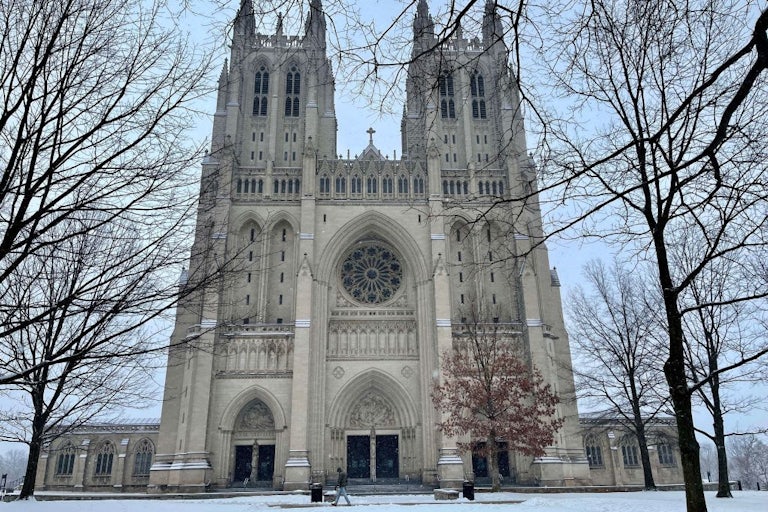
This picture shows Washington National Cathedral in winter, surrounded by bare trees and a thin dusting of snow on the ground.
Daniel Slim/Getty Images
Washington National Cathedral

It’s a weird time for religion in the United States. Christians are on track to become a religious minority in the country within a few decades but also, soon, to wield incredible power in a second Trump administration—thanks not least to a neo-Crusader defense secretary nominee, Christian nationalists likely leading the Office of Management and Budget as well as the House of Representatives, and an array of powerful Christian judges appointed in Trump’s first term whose numbers will only grow in his second.

Meanwhile, amid a devastatingly grim Advent season for other communities, Latino Christian leaders interviewed by Axios “say they will unpack the Holy Family’s immigration plight during Christmas services to offer hope for immigrants” facing ICE raids and deportations in the new administration. White Protestants and Catholics voted by large margins for Trump; Black Protestants, Jews, atheists, and agnostics voted overwhelmingly against him. Muslim voters outraged by Biden’s support for Israel’s slaughter in Gaza abandoned the Democrats at striking rates, many voting instead for Jill Stein.

So while the ranks of the religiously unaffiliated or even nonreligious may be growing, the relevance of religion to politics clearly persists. And that means religion is relevant to climate change too.

The Pew Research polls in 2022 found that moderately or highly religious people were much less likely to rate climate change as a serious problem than atheists were. But the surveys also showed huge numbers of religious people to be concerned. Growing numbers of religious leaders and groups—even among white evangelicals—are pushing for policies protecting the climate and environment.

To learn about the contours of the growing religious advocacy for climate and environmental protection, I called up the Reverend Susan Hendershot, an ordained minister in the Christian Church (Disciples of Christ) and president of Interfaith Power and Light, a group focused on engaging people of faith in environmental causes and climate action. This conversation has been edited for length and clarity.

How do you perceive your job in terms of engaging religious communities in climate advocacy?

Interfaith Power and Light started in 2000 because our founder was seeing a disconnect between what she was hearing from environmental organizations, in terms of climate change and care for the earth, and the fact that she was not hearing that in her place of worship. For her, it became a mission to say that as faith communities, we are called to care for creation and we need to find ways to live that out: It’s not just talking about it, it’s doing something.

From the start, there was a focus on greening houses of worship as an act of faith. So everything from energy efficiency upgrades to installing solar in houses of worship. And the other side of that has been the focus on policy advocacy, to say personal action is important and it gets us a certain way down the road as part of civil society, but unless we have the right policies in place, we can’t actually make the progress that we need to make. It’s centered on spiritual values and on the moral opportunity to take action—to say people of faith are and should be leaders in working for climate and environmental justice.

But this is focused on people from many different religious backgrounds, right?

We say we work with people of all spiritual traditions and no spiritual traditions, recognizing that there are a lot of spiritual but not religious folks that are out there and that is a growing percentage. We want to make sure that there’s a big tent out there that’s for everyone who wants to take action from a place of spiritual values.

Climate anxiety is on the rise. What does the lens of faith or spiritual values have to offer the climate fight, in your view?

I see faith communities and leaders having three roles in the climate movement. The first one is pastoral, because there’s a lot of climate anxiety and grief out there, whether it’s people who have suffered from a climate disaster who are recovering and need a support system or young people who are considering whether they even want to have a family because do you want to bring children into a climate-changed world? So that pastoral role is really, really important. Faith leaders are trained to work with people who are suffering, grieving, in trauma.

The second role I see as the practical role, which is offering leadership within their own faith community, working to move climate solutions forward in their houses of worship: renewable energy systems, energy efficiency, electric vehicles. Just serving as models in the community of what’s possible.

The third role is the prophetic role. We have to talk about this. One of the things Katharine Hayhoe says as a climate scientist and person of faith is that the most important thing you can do for climate change is to talk about it, because part of the problem is it’s not being discussed enough. Pastors are called to use their prophetic voices in their places of worship to move people to action.

How does the fragmentation of religious groups right now complicate your work? I’m thinking about the very prominent evangelical voices allied with Trump who see fossil fuels as part of a kind of a nationalist vision.

I like to use Yale Climate Communication’s “Six Americas” study as an example. If you compare when they first started doing those studies to now, over time there has been an increase in the people who are alarmed and concerned about climate change and a really big decrease in those who are what we would call doubters. There are folks who have a lot of influence and power who are pushing fossil fuels and looking to continue to have an “all of the above” energy strategy—we see that in the news media every day now—but the reality I think is that for most folks on the ground, they are grappling with the real climate challenges that they’re facing every day. It used to feel sort of far away, like you’re talking about polar bears and ice caps. Now we’re seeing floods and droughts, and farmers are seeing changes in their growing seasons for their crops. That makes it more real to people. I think those powerful voices pushing fossil fuels will be drowned out by the realities on the ground.

So how do you envision people of faith being mobilized for climate policy advocacy?

The Inflation Reduction Act was the result of many years of advocacy amongst people from all walks of life across the country, and this money is starting to make a real difference on the ground. There’s a lot of money going into nonprofits, including houses of worship, who are installing solar and other energy efficiency systems and getting rid of their gas appliances and so on. One of the things that we found in our recent solar survey is that there are about 2,500 communities of faith around the country that have installed solar, with more coming through the direct pay mechanism with the IRA. We have a few congregations that have received their payment for direct pay, and many many more that have applied, and others that are in the exploratory phase. This trend is competitive with businesses like Starbucks and Walmart and all these other businesses that get a lot of attention around their solar installations.

That’s also happening on the consumer level—faith communities are made up of people, many of whom have homes, and they’re also looking for ways they can adapt, use this federal funding to make these improvements in their own homes that improve their lives, their bottom line, as well as the health of their families.

The next piece of work is to protect what those incentives are and have done so that they won’t be rolled back or clawed back. There’s a lot of personal connection to that for folks, whether that’s because they live near drilling sites and they don’t want to see methane rules rolled back because it’s improving the health and air quality in their community, or folks who are saying we don’t want to roll back the direct pay portion of the IRA funding because that’s a way that’s helping faith communities install solar and be able to put more money into the mission and serve their communities. I think part of the opportunity here is to make those connections for individuals that are personal for them—whatever that means for them or their family.

Good News/Bad News

The BBC has put together a list of “seven quiet breakthroughs for climate and nature in 2024.” They include the U.K. finally closing its last coal-fired power plant and deforestation in the Amazon rainforest in Brazil falling to a nine-year low.

Driven by the climate crisis, the country’s home insurance problem is growing. Nonrenewal rates (that’s when an insurance company drops a home that was previously covered) rose in 46 states in 2023, according to data obtained by the Senate Budget Committee. Read The New York Timesfeature on this or check out their accompanying data visualization to see where insurers are dropping coverage in your state.

Stat of the Week
$100 per year

That’s the possible extra cost to American consumers of increasing liquefied natural gas exports (as the Trump administration plans to do), according to a new study released by the Department of Energy this week. It also found that the LNG exports could lead to an extra 1.5 gigatons of greenhouse gases by 2050.

What I’m Reading

As Clock Ticks to Act on the Climate Crisis, N.C. Activists Target a ‘Carbon Plan’

At Inside Climate News, Lisa Sorg profiles the activists fighting a longtime
villain in the environmental justice movement, Duke Energy, which has released a “carbon plan” that involves building numerous natural gas plants while keeping their coal plants open for years, completely missing the company’s 2030 emissions-reduction goals. Some of these activists, like 74-year-old Bobby Jones, have been fighting Duke Energy for years.

“I know my children and grandchildren will not be the ones who can afford clean water and clean air,” Jones said. “They will be the ones relegated to cancer alleys. So I’ve got to fight. And I’ve got to encourage others to fight. Because we already see climate change. We don’t have to wait for it to happen.”

Jones often thinks of the final words of [environmental justice advocate] John Gurley, as cancer had hollowed out his body. “The last conversation we had, we were talking about Duke Energy. And he said, ‘Bobby, hold them accountable.’”

Read Lisa Sorg’s full report at Inside Climate News.

This article first appeared in Life in a Warming World, a weekly TNR newsletter authored by deputy editor Heather Souvaine Horn. Sign up here.

Data Centers Are the Next Big Front in Environmental Wars

A fight over a data center in Fayetteville, Georgia, follows patterns previously seen in fights over pipelines or fracking.

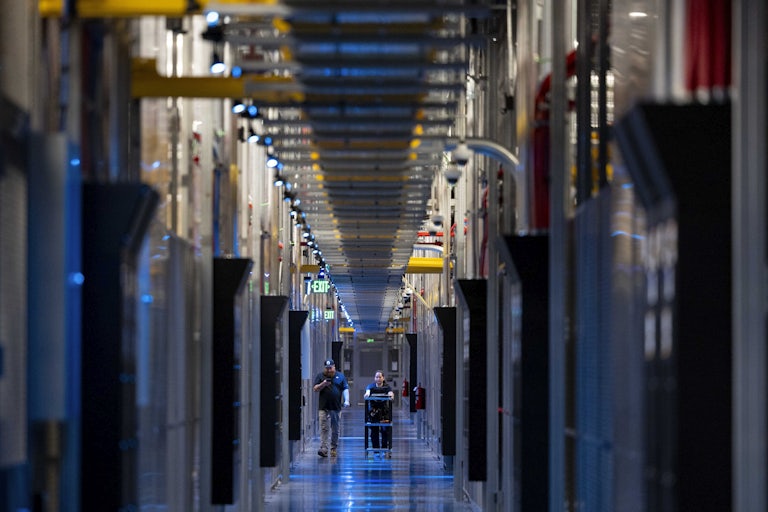
Two people walk down a corridor with columns of electronic equipment on either side. One pushes a cart.
The Washington Post/Getty Images
Equinix Data Center in Ashburn, Virginia

Two weeks ago, I wrote about the underappreciated and outsize significance of local environmental battles: small-town fights over development plans whose outcomes affect both the health of the community in question and the broader tallies of the energy transition. What do those look like in practice? This week, Bloomberg’s lengthy feature on a fight over a new data center in Fayetteville, Georgia, offers a reminder that new iterations, new industries, and new face-offs are always right around the corner.

Pipelines are some of the more famous and recognizable examples of how local fights come with national ramifications: The protests and legal challenges to the Dakota Access Pipeline have become an iconic symbol of Indigenous resistance to the fossil fuel projects that are damaging culturally and religiously significant sites and endangering water supplies. The cancellation of the Atlantic Coast Pipeline in 2020 due to rising costs, after numerous marginalized communities along its planned route challenged the project in court and through protests, likewise became a case study in how local battles over the health and safety of a given community can affect emissions at the national level, as well: Some estimates suggested the ACP would have been responsible for emissions roughly equivalent to 20 new coal plants, while Clean Water for North Carolina calculated that the unintentional, leaked methane from the pipeline alone might increase the atmosphere-warming effect of national methane emissions by over 13 percent.

Pipelines are far from the only example. For a different type of local environmental fight—and one that confounded expectations of ordinary red-blue divides—read Colin Jerolmack’s piece a few years ago about predominantly conservative Grant Township’s efforts to restrict fracking-related pollution, which escalated to the point that it put residents in conflict with state authorities.

There have long been similar efforts underway against petrochemical plants. Larger philanthropic organizations and national nonprofits have only recently begun supporting the tireless efforts of local groups in Louisiana’s “Cancer Alley,” where numerous refineries, as well as chemical and plastic plants, are situated perilously close to the low-income, majority-Black communities where cancer rates are estimated to be 95 percent higher than in the rest of the country. New measurements taken this summer in southeastern Louisiana found levels of carcinogenic ethylene oxide in the air that were as much as 10 times higher than EPA-recommended limits.

Then there are fights over concentrated animal feeding operations that, again, disproportionately pollute low-income, nonwhite communities while also contributing to land use problems, biodiversity crises, emissions, and more. Here too, the contours of environmental justice battles are ever evolving: The current hype around biogas—a way for industrial meat producers to make money selling animal waste by-products for fuel—and the tax incentives supporting it, have spawned new twists on old environmental fights over industrial agriculture. In May, NC Newsline reported a former mayor’s dismay that, despite his town of Turkey, North Carolina, banning hog farms within city limits, a biogas plant using the very same hog waste the town had wanted to keep out was setting up shop just east of him: “I never imagined they’d bring the manure to us.”

On first glance, community opposition to a new data center might seem much different from these battles: The primary reason for opposition is not the near certainty of pollution that you get with these other installations. (As Nick Martin wrote at TNR in 2019, reviewing pipeline spill data, “The simple fact is that it is a matter of when, not if, a series micro-fractures or a loose bolt or a lightning strike will send the pipe’s contents into the ground.”)

Yet look a bit closer, and familiar dynamics emerge. Data-center developer QTS and its new asset manager–owner Blackstone, Inc., came in promising rural Fayetteville something simple: money. It’s the same way that pipeline or biogas pitches to towns tend to start: with promises of economic benefit, including via jobs—although the promised number of jobs often turns out to be exaggerated or only refer to temporary positions. In the case of Fayetteville’s data center, “the portion of QTS’s taxes going to the county board of education this year will cover the equivalent of some half a dozen teachers’ salaries,” Bloomberg’s Dawn Lim and Josh Saul report.

But in a manner similar to how these negotiations have played out with pipeline or fracking plans, the residents of Fayetteville quickly began to feel they had been misled. They say they were told the data center wouldn’t need more electricity than what was already available from the local grid and could use “existing transmission lines.” (QTS disputes this.) The actual power needed turned out to be about twice what one report suggested, with new power lines needing to be built. That’s where the problems started.

The power company serving the area, Georgia Power, then tried to secure new land for power lines, but residents weren’t wild about being paid a couple grand in exchange for trees being cut down and giant new transmission lines being installed on their property. Georgia Power accordingly started offering much larger, six-figure sums of money. Now residents fear their neighbors are being bought off and that their lands could be “seized” by eminent domain if they themselves refuse.

This small fight is part of a larger national—and even global—battle over the giant environmental costs of big tech and, specifically, new forms of artificial intelligence. The data center, Lim and Saul report, is part of Blackstone’s quest to become “the largest financial investor in AI infrastructure.” Microsoft, which like many tech companies is betting big on AI, will reportedly be one client for the new data center.

Liza Featherstone wrote earlier this year about the enormous energy and water demands from AI data centers “endangering the energy transition” that is desperately needed to avert climate catastrophe. There’s already evidence that AI energy demands are keeping high-polluting coal plants running past their planned retirement dates. While tech companies and their advocates have been quick to argue that AI tools could help meet environmental goals rather than derail them, an estimate this fall from Bain & Company suggested data centers for AI could make up 44 percent of U.S. electrical growth in coming years, requiring utilities “to boost annual generation by up to 26% by 2028.” Tech companies have been keen to insist that this demand can be met with new nuclear energy. But there isn’t much evidence to suggest that this can be done in the short term—and when it comes to the climate crisis, every additional day burning fossil fuels comes with steep costs.

As Bloomberg’s feature indicates, data centers are worth watching as a major emerging field for environmental battles, much like power plants and pipelines have been for decades. And while the industries may differ, these fights are likely to follow familiar patterns.

Good News/Bad News

Five young Hawaiian crows—extinct in the wild—were recently released in Maui, after careful raising and “anti-predator training” using cats and owls.

The once-frozen Arctic tundra is now releasing more carbon than it stores, due to thawing.

Stat of the Week
3,400

That’s how many fewer premature deaths per year we might have in this country if all households were to switch from fossil fuels to heat pumps and electric appliances, according to a new study. (This would also save $60 billion in energy bills each year and cut 400 million metric tons of greenhouse gas emissions, according to The New York Times write-up, but it’s the 300,000-ton drop in fine particulate matter that would make the big difference in saving lives.)

What I’m Reading

CNN’s Leah Dolan profiles Barbie-loving photographer Anastasia Samoylova, whose “subtle, anxiety-inducing images of Florida’s collapsing pastel-pink landscapes” are suffused with an acute awareness of climate change.

Samoylova moved to Florida in 2016, where she was struck by the state’s severe weather events and aging infrastructure.… The insidious, blink-and-you’ll-miss-it approach to her observational photography is intentional. Several years of capturing political extremism, gentrification and environmental disintegration has given Samoylova time to think about how to package disastrous messaging. “How do you communicate these very complex subjects and make them relatable?” she asks. “The trickiest part is to not make them off-putting.” Come for the pink sidewalks that characterize the streets of Miami—as many tourists do—and stay for the subsequent feelings of existential dread. It’s a spoonful of sugar to help the medicine go down, she says. “(Climate change) is stigmatized, and it’s become divisive, at least where I live in the US, especially in Florida. And who knows, it’s likely going to be erased from the conversation again.”

Read Leah Dolan’s full profile at CNN.

This article first appeared in Life in a Warming World, a weekly TNR newsletter authored by deputy editor Heather Souvaine Horn. Sign up here.