Newsletter
Fighting Words
What got me steamed up this week

Trump Just Did the Most Corrupt Thing Any President Has Ever Done

He’s using the White House to get rich from anonymous investors—and it’s hardly even a news story.

Trump in tuxedo
Samuel Corum/Sipa/Bloomberg/Getty Images

Imagine that Joe Biden, just as he was assuming office, had started a new company with Hunter Biden and used his main social media account to recruit financial backers, then promised that the most generous among them would earn an invitation to a private dinner with him. Oh, and imagine that these investors were all kept secret from the public, so that we had no idea what kinds of possible conflicts of interest might arise.

Take a minute, close your eyes. Let yourself see Jim Jordan’s face go purple in apoplexy, hear the moral thunder spewing out of Jesse Watters’s mouth, feel the shock (which would be wholly justified) of the New York Times editorial board as it expressed disbelief that the man representing the purported values and standards of the United States of America before the world would begin to think it was remotely OK to do such a thing. The media would be able to speak of nothing else for days. Maybe weeks.

Yet this and more is what Donald Trump just did, and unless you follow the news quite closely, it’s possible you’ve not even heard about it. Or if you have, it was probably in passing, one of those second-tier, “this is kind of interesting” headlines. But it’s a lot more than that. As Democratic Senator Chris Murphy noted Wednesday: “This isn’t Trump just being Trump. The Trump coin scam is the most brazenly corrupt thing a President has ever done. Not close.”

Trump announced this week that the top 220 buyers of his $Trump (strump, as in strumpet) meme coin between now and mid-May will be invited to an exclusive dinner on May 22 (“a night to remember”) at his golf club outside Washington, D.C. The Washington Post and other outlets have reported that in the days since the announcement, “buyers have poured tens of millions of dollars” into the coin; further, that the holders of 27 crypto wallets have acquired at least 100,000 coins apiece, “stakes worth about a million dollars each.” Holders of crypto wallets are anonymous, if they want to be, so the identities of these people (or businesses or countries or sovereign wealth funds or whatever they might be) are unknown and will presumably remain so until the big dinner or, who knows, maybe for all time.

It’s also worth noting that Trump launched this meme coin just a few days before inauguration. Its value quickly shot up to around $75. It steadily declined through the first month of his presidency, and by early April, as Americans grew weary of a president who was tanking the economy, it had fallen to $7.14.

Mind you, a meme coin is a thing with no intrinsic value. It’s just some … thing that somebody decides to launch based on hype because they can get a bunch of suckers to invest in it. As Investopedia gingerly puts it: “Most meme coins are usually created without a use case other than being tradable and convertible.” It should come as no surprise that some meme coins are tied to right-wing politics. Elon Musk named his Department of Government Efficiency after his favorite meme coin, dogecoin (which, in turn, was indeed named after an actual internet meme in which doge is slang for a Shiba Inu dog).

So, to go back to my opening analogy—this isn’t even like Joe and Hunter Biden starting a company from the White House. A company is a real thing. It makes a product or provides a service. It files papers with the Securities and Exchange Commission. It pays taxes. It employs people. Assuming that it’s a good corporate citizen and that it exists at least in part to solve some problem or offer the public some innovation, it contributes to the general welfare.

Not so a meme coin. It’s just a hustle. It may make certain investors rich, but it does the world no good whatsoever.

So stop and think about this. First, Trump, preparing for the presidency, purportedly busy thinking about how many millions of people he’s going to deport and how he’s going to bring “Jina” to its knees and how he’s going to hand eastern Ukraine to Putin and how he’s going to cut Meals on Wheels, for Chrissakes, takes time out from all that to stop and think: Now, how can I profit from returning to the White House? So he launches, naturally, the griftiest Christmas present ever.

It starts out great. Then its value drops by 90 percent. So in April, while he’s illegally deporting legal U.S. residents to El Salvador and roiling the world’s financial markets, he stops and takes the time to think: Hey, what happened with my meme coin? I had better figure out a way to goose this grift. So he comes up with this dinner. As well as showing just how tawdry his mind is, how he just automatically and intrinsically thinks it’s his right to make a buck from the presidency, it’s unspeakably corrupt. (One small silver lining here is that after peaking Wednesday at almost $15, it’s now under $12.)

Who knows who these “investors” are? Will we ever know? Inevitably, on May 22, people will be invited to that dinner. Will we know the guest list? Will the list be sanitized? Will a few Russian oligarchs be among the top 220 but send surrogates to keep their identity hidden?

This doesn’t create the “appearance” of corruption or set up the “potential” for conflict of interest. It is corruption, and it’s a standing conflict of interest. Patently, and historically. Chris Murphy is right: This is the most corrupt thing any president has ever done, by a mile.

What are the others? Watergate? It was awful in different ways, but of course Trump is worse than Richard Nixon in all those ways too. Teapot Dome? Please—a tiny little rigged contract, and it didn’t even involve Warren Harding directly, just his interior secretary. Credit Mobilier? Run-of-the-mill bribes by a railroad company, again not involving President Grant directly, just his vice president.

And yes, I’ve been thinking this week of the Lincoln Bedroom scandal. In 1995–96, the Clintons invited a lot of people to spend a night in the famous chamber. Many of them made large donations to the Democratic Party. It was unseemly. But it wasn’t illegal. And it certainly didn’t line the Clintons’ personal pockets. But if you were around at the time, you remember as I do the swollen outrage of Republicans about how relentlessly corrupt the Clintons were.

Today? Crickets.

Finally: Before we leave this topic, I want you to go to GetTrumpMemes.com and just look at those illustrations of Trump. There’s a big one in the middle of him with his fist raised, echoing the image from his attempted assassination. Then off to the right, there’s Trump seated at the head of a dining table.

In both, he looks about 50. The artist has airbrushed a good quarter-century off his face, in terms of jowl fat and wrinkles and accumulated orange pancake. And in the dominant, middle image … what do we think Trump’s waist size is, about 46, 48? This Trump is about a 34. Maybe even a svelte 32. It’s hysterically funny. These are probably the most creepily totalitarian images of Trump I’ve ever seen, and yes, I understand, that’s a big statement. But even Stalin’s visual hagiographers didn’t try to make him look skinny.

I digress. Let’s keep our eyes on the real prize here. This May 22 dinner is a high crime and misdemeanor. A president of the United States can’t use the office to enrich himself in this way, from potentially anonymous donors for whom he might do favors. This is as textbook as corruption gets.

New York Times and Washington Post, put your best investigative reporters on this and place their stories on your front pages. MSNBC, hammer on this—you haven’t been. Democrats, talk about this every day, several times a day. Do not let Trump’s sewer standards jade us. Make sure the people know.

This article first appeared in Fighting Words, a weekly TNR newsletter authored by editor Michael Tomasky. Sign up here.
Hello, John Roberts. America’s D-Day is Coming. Whatcha Gonna Do?

From Kilmar Abrego Garcia to birthright citizenship and more, the moment of truth is arriving for the chief justice. Trump, or the republic?

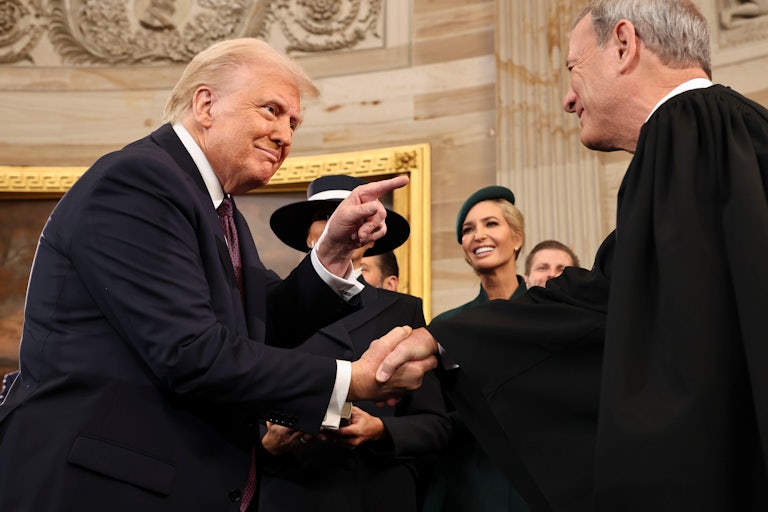
Trump and Chief Justice John Roberts at the 60th presidential inauguration
Chip Somodevilla/Getty Images/Bloomberg/Getty Images
Trump and Chief Justice John Roberts at the sixtieth presidential inauguration, in January

As we approach the 100-day mark of Trump 2.0, we see, Lord knows, much to worry about. But one reassuring development has been that, by and large, the judicial branch has stood tough against the administration’s lawlessness. Federal judges James Boasberg and Paula Xinis are early heroes of the second Trump regime. I’m sure there are more who’ve escaped my notice.

I’m old enough to remember when the name J. Harvie Wilkinson III made me shake. He was elevated to the federal bench by Ronald Reagan, was affiliated with the Federalist Society, and he always, on lists of possible Supreme Court nominees, occupied one of the hard-right slots. But now Wilkinson too has become a voice of sanity, writing the three-judge ruling handed down Thursday night that rebuked the Trump administration in the Kilmar Abrego Garcia case.

The ruling is unequivocal and, as we shall see, went out of its way to alert Americans to the constitutional threat the administration poses. But it does something more important: It returns the spotlight to the Supreme Court, and specifically to Chief Justice John Roberts, pressuring them to stand up to this madness. And so, one of the key controversies roiling our democracy, from this case to others, is this: What will Roberts do?

We’ll return to that. But first, let’s review Wilkinson’s judgment. Here are the money quotes:

“It is difficult in some cases to get to the very heart of the matter. But in this case, it is not hard at all. The government is asserting the right to stash away residents of this country in foreign prisons without the semblance of due process that is the foundation of our constitutional order.… This should be shocking not only to judges, but to the intuitive sense of liberty that Americans far removed from the courthouse still hold dear.”

“The government asserts that Abrego Garcia is a terrorist and a member of MS-13. Perhaps, but perhaps not. Regardless, he is still entitled to due process. If the government is confident of its position, it should be assured that position will prevail” in court.

“Now the [executive and judicial] branches come too close to grinding irrevocably against one another in a conflict that diminishes both.”

Notice in that first quote the use of the word “residents.” Not citizens. This is a clear recognition that the language of the Fourteenth Amendment—specifically the due process clause—extends protections not to “citizens” but to “persons.” Abrego Garcia has constitutional rights. Period. His character and his immigration status are totally irrelevant.

The Wilkinson opinion will inevitably toss the matter back to the Supreme Court, which ruled on April 10 that the Trump administration must “facilitate” Abrego Garcia’s return to the United States. The court’s order was pretty mealy-mouthed. The key sentence reads: “For its part, the Government should be prepared to share what it can concerning the steps it has taken and the prospect of further steps.”

Now the court will be compelled to take a stronger stand. Can the nation’s highest court possibly allow this situation to continue? The government of the United States admits Abrego Garcia was deported by mistake and then says it’s powerless to return him, that only El Salvador can do that; and El Salvador says it’s powerless to return him, that only the United States can. If the court’s six conservative justices have any shred of dignity and respect for the role they’re supposed to play in this democracy, they cannot let this stand. It’s a fundamental issue.

Other equally fundamental issues are headed the court’s way. It is weighing what to do about Trump’s ability to fire executive agency heads unilaterally. Just recently, the court blocked the reinstatement of two executive agency officials Trump had fired—but it did so only temporarily, while the court considers whether Trump had the authority to fire them. Still, that order was a temporary win for Trump—and was written by Roberts himself.

And just Thursday, we learned that the court will hear arguments on birthright citizenship on May 15. A decision will likely follow in June or July. This, again, would seem on the surface to be as open-and-shut as the Abrego Garcia matter, and for much the same reason: The Fourteenth Amendment says “persons,” and it states quite plainly in its very first sentence: “All persons born or naturalized in the United States, and subject to the jurisdiction thereof, are citizens of the United States and of the State wherein they reside.”

We seem not to be confronted with legal questions. Those are settled. As U.S. District Judge Deborah Boardman recently ruled, in deciding against a Trump administration motion, “No court in the country has ever endorsed the president’s interpretation.”

There remain only political questions, the chief one being: What feat of originalist–unitary executive legerdemain will the court’s conservatives perform to jam the square peg of Trump’s goals into the round holes of the United States Constitution?

Whether they will do so is up to Roberts. Once upon a quaint old time, the chief justice would cajole his colleagues into consensus on matters of historical import. Earl Warren made sure that the ruling on Brown v. Board was 9–0, because he wanted the country to see that the court was united on this great historical question of segregation versus integration. One doubts 9–0 is possible on these major cases today, with these two guys hanging around. But Roberts at least should have the power to steer a majority to uphold the ideas that words mean what they say and that this is not a nation of one-man rule. Roberts’s name will live in history, either alongside brave jurists like Boasberg and Xinis or in infamy, alongside Roger Taney and, well, Clarence Thomas.

This article first appeared in Fighting Words, a weekly TNR newsletter authored by editor Michael Tomasky. Sign up here.

Stephen Miller Wins This Week’s Stalin Prize for Totalitarian Flattery

There was stiff competition this week to praise Dear Leader Trump for his market-destroying tariffs, but the White House adviser takes the cake.

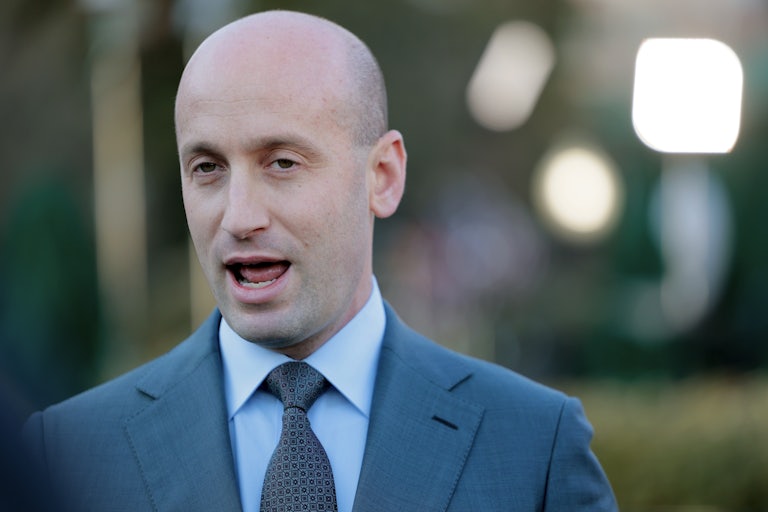
White House deputy chief of staff Stephen Miller
Anna Moneymaker/Getty Images
White House deputy chief of staff Stephen Miller in March

We don’t really learn anything new about Donald Trump anymore. He’s the same old liar and buffoon he’s been for 50 years. But sometimes we relearn the stuff we already knew in ways that are so shocking that we have to pause and take stock.

One of the old lessons we relearned this week has to do with Trump’s adolescent need for constant praise, and the abject willingness of his sycophants to provide it without his having to ask—even, or especially, when the reality screams for rebuke.

This is a crucial point that needs to be widely understood, and will be by those with a living memory of the Communist regimes of Eastern Europe. The operating principle of such regimes was this: The worse actual conditions were, the more fulsome the propaganda had to be. The crops yields were excellent, comrades! Our cars are far superior to the capitalists’! Prisons? What prisons?

Which brings us back to Trump’s America, which isn’t so different in key respects from Enver Hoxha’s Albania. Here we have a week when Trump’s bumbling, his stupidity, his willed ignorance of history, and his utter refusal to think through policy have never been more fully on display. With all this tariff flip-flopping, he very nearly launched a global economic crisis. As it is, he personally—no one else—cost investors, from large institutional ones to you and me, trillions of dollars. And the lower tariff rates he announced Wednesday as the bond market was about to explode are still the highest since the infamous Smoot-Hawley years.

It was a disaster in every way. And as such, it required an especially intense degree of obsequiousness.

Bill Ackman: “This was brilliantly executed by @realDonaldTrump. Textbook, Art of the Deal.”

Karoline Leavitt (to White House reporters): “Many of you in the media clearly missed The Art of the Deal. You clearly failed to see what President Trump is doing here.”

And the winner of this week’s Stalin Prize, Stephen Miller: “You have been watching the greatest economic master strategy from an American President in history.”

For good measure, not exactly on the topic of the tariffs but nevertheless a Stalin Prize contender, we had Pam Bondi at a Cabinet meeting on Thursday: “President, we’ve had some great wins in the last few days. You know, you were overwhelmingly elected by the biggest majority.”

Wait, what? “President”? Not “Mr. President”? Why? Because it’s a little closer to “El Presidente”? For the record, Trump won a plurality, not a majority, and he got four million fewer votes than Joe Biden did in 2020. But there’s more: In her next sentence, Bondi invoked “U.S. Americans.” I haven’t heard that one since Miss Teen South Carolina in 2007.

If these people are right that Trump was acting the whole time with great intention, then we must seriously consider the allegation that he was manipulating the market with his Wednesday morning social media post about now being “A GREAT TIME TO BUY!!!” If he knew that morning that he was going to announce a pause that afternoon—an announcement that he had to know would send the market skyrocketing—then there’s little question that his post constituted market manipulation. The best argument in Trump’s defense here is a pretty pitiful one: that he’s so incapable of thinking more than 15 minutes ahead that it’s hard to believe he knew in the morning what he was going to do in the afternoon.

Regardless, we’re in an unprecedentedly chilling era in American politics. Literally never in American history have presidential aides and supporters spoken quite like this, employing the kind of flattery one usually sees in totalitarian regimes (which are a couple ticks worse in general than authoritarian ones).

What does it tell us about the future? Trump is going to get worse. I think we can say that with confidence. Each week so far has been worse than the last, in terms of the assaults on democracy. His executive order this week concerning Miles Taylor and Chris Krebs is terrifying—perhaps the most frightening thing he’s done yet in his war on political enemies. Telling the Justice Department to investigate specific individual Americans because of their political activity arguably goes further in turning the state into an instrument of his personal will than anything else he’s done.

Bondi said we should rest assured that the Justice Department alone will make any prosecutorial decisions. But the mere fact that Justice is going to use resources to investigate these two men, who are guilty of nothing more than political advocacy Trump didn’t like, has terrifying implications for every U.S. American out there.

So, yes, things will get even worse. And as they do, the sycophancy will grow ever more insistent and unapologetic. That’s how it works. These attempts to win the Stalin Prize are so pathetic they’re almost funny—but each one of them is also another assault on democratic values and customs. We can’t forget this.

This article first appeared in Fighting Words, a weekly TNR newsletter authored by editor Michael Tomasky. Sign up here.


Donald Trump Really Is a Lot Dumber Than We Thought. Like, a Lot!

His reading of American history is shockingly stupid, even for him.

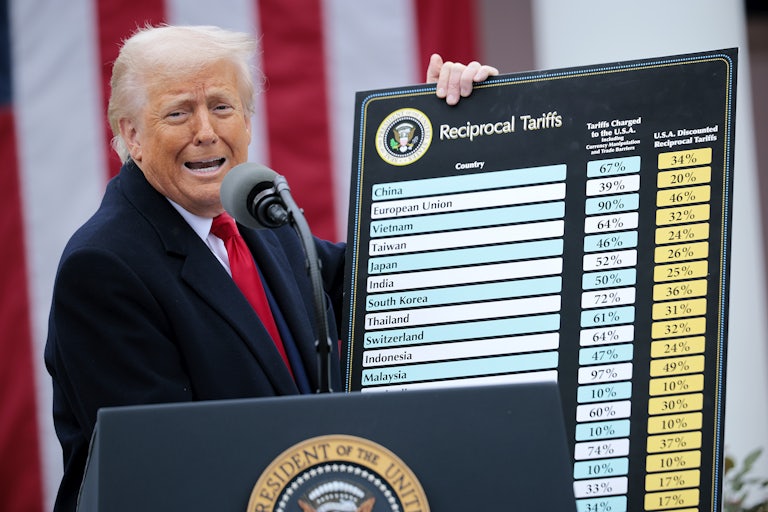
Donald Trump holds up a chart of tariffs in the White House Rose Garden
Chip Somodevilla/Getty Images
Trump’s “Liberation Day” event in the White House’s Rose Garden on April 2

You remember the Brady Bunch movies of the 1990s, whose ingenious conceit was that television’s archetypal late-1960s sitcom family was transported to the ’90s but still lived in their oblivious 1969 bubble of bell bottoms and groovy chicks and Davy Jones fandom? That’s how I’ve been thinking of Donald Trump this week, except that he’s living in an 1890s bubble that no one around him is willing to puncture but that everyone else in the world, probably including those now-famous penguins on that one island, knows is utterly insane.

There’s a lot to say about these tariffs and how destructive they are, and most of it has been said. My colleague Timothy Noah wrote about the stupidity of tariffs as policy and how Trump has already cost him personally thousands of dollars. But I want to focus on something different here. I want to focus on Trump’s understanding of history. It’s so shockingly dumb—yes, even for him—that it’s hard to believe that we have a president of the United States who is this ignorant.

Here’s what Trump said the other day, and he has said versions of it a number of times: “In the 1880s, they established a commission to decide what they were going to do with the vast sums of money they were collecting. We were collecting so much money so fast, we didn’t know what to do with it. Isn’t that a nice problem to have?”

OK. First of all. Nobody can tell what commission he’s talking about. President Chester Arthur empaneled a commission that recommended reducing tariffs by 20 to 25 percent, going hard against the conventional wisdom of the day. But Congress defied him, lowering tariffs by just an average of around 1.5 percent (and yes, that’s another thing—Congress is supposed to set tariffs, not the president, making this move, among other things, an impeachment-worthy “abuse of power,” a phrase invoked by The Wall Street Journal editorial board Thursday).

But more importantly, there’s this. Allow me to put this as Trump himself might on Truth Social: THE MAN IS AN IDIOT!!!

It is true that tariffs were the chief source of federal government revenue for most of the country’s history until the twentieth century. Tariffs and excise taxes, which are taxes on specific goods—gasoline, cigarettes, alcohol, certain amusement activities. And for a spell, a modest income tax, which President Lincoln imposed during the Civil War and that lasted through 1872. But broadly speaking, tariffs were the ball game.

Even so, they were always a political hot potato because there were powerful interests that supported them (steel, iron, and wool) and other powerful interests that opposed them (wheat, cotton, tobacco). Tariffs were at the center of some of the most heated debates of the nineteenth century.

But here’s the thing you need to know that the president of the United States does not: Tariffs supported most of what the federal government did in the 1800s because the federal government didn’t do much of anything. The government did about four things. It recruited and paid an army. It delivered mail. It ran some courts of law. And it collected duties and tariffs. That was about it. There was no need for much federal revenue.

Today, liberals and conservatives argue over what might constitute an optimal number for federal spending as a percentage of gross domestic product. Generally speaking, liberals want that number to be up around 25 percent, which indicates a robust welfare state. Conservatives prefer that it be down closer to 15 or so.

Here are some numbers from the St. Louis Fed, which go back to the Great Depression. During the New Deal, as Roosevelt was just constructing the first iteration of the American welfare state, federal spending as a percentage of GDP got up to around 10 percent. During World War II, when the government took over a number of industries, it shot up to around 40 percent. In the postwar era, it has indeed hovered around 20, indicating the liberal-conservative tug of war over federal spending. Interestingly, it rose a little under Ronald Reagan (military spending), and it reached its highest postwar point, 30.7 percent, under … Donald Trump, during the pandemic.

So that is where federal spending as a percentage of GDP has been for nearly a century—17 percent, 22 percent, 30 percent in a crisis. Want to take a guess as to what it was in 1900? Maybe 11 percent? Nine percent? Seven? Try 2.7 percent.

In other words—tariffs could cover the cost of what the federal government did because the federal government didn’t do anything!

Now, there will of course be those who say, “Well, good! We need to go back to that!” OK. Let’s go back to no Social Security. Let’s go back to no Medicare. Let’s go back to senior citizens having to fend for themselves and move in with their kids (if you’ve never seen Make Way for Tomorrow, please watch it this weekend). Let’s go back to no environmental regulation, no food inspection. Let’s just have no airline safety regulations. Flying would be so much more interesting that way! And finally, I say to those conservatives who think they want a 1900-style government, let’s go back to an army of 25,000 personnel.

So in sum, Trump is fantasizing about some America that no one, literally not a single American, wants to return to. Poverty was through the roof. Health care was abysmal. People had seizures from toothaches. Most people didn’t even use toilet paper yet (it wasn’t “splinter-free” until the 1930s!).

One more idiotic Trump quote, if I may: “Then in 1913, for reasons unknown to mankind, they established the income tax so that citizens, rather than foreign countries, would start paying the money necessary to run our government.”

What?! Well, here, we encounter a very interesting history that maybe 1 percent of Americans know. As I noted, Lincoln imposed an income tax, which disappeared in 1872. There was no income tax for 20 years. Then there was a big depression in 1893, and Congress imposed a tax on high-income people for two years. Then it went away again.

Come the twentieth century and the Progressive era, and the demand for the government to do things like inspect meat and enforce child labor laws, and liberals began pushing for an income tax. Conservatives, of course, were opposed.

So in 1909, progressives attached an income tax plank to—guess what? A tariff bill. Conservatives counterproposed that an income tax be the subject of a constitutional amendment, confident that they’d fixed the progressives’ wagon because there was no way three-quarters of the states would approve such jackbooted madness. Then they sat and watched slack-jawed as state after state approved it! In 1913, the Sixteenth Amendment took effect.

Is it Trump’s secret plan to do away with the income tax? Actually, it’s not secret at all. He has said it many times. He’s going to raise $6 trillion from tariffs and abolish the IRS.

OK. We’ll see. Even putting aside the downsides of tariffs (most obviously, higher prices), economists see nothing close to $6 trillion in revenue.

Trump is blowing more smoke out his you-know-what than a decade of California wildfires could produce. Read this, from CBS.com: “In a recent news conference, White House staff secretary Will Sharf estimated that Mr. Trump’s 25 percent tariff on vehicles and auto parts imported into the U.S. could raise ‘roughly $100 billion in new revenue.’ At the same news conference, Mr. Trump claimed moments later ‘anywhere from $600 billion to $1 trillion will be taken in over the relatively short-term period, meaning a year from now.’”

The aide says $100 billion. Trump casually ups it to a trillion. Billion, trillion; who knows. Well, even I know: A trillion is a thousand billions. That’s like the difference between 10 and 10,000. Pretty vast, in other words. But Trump knows that nobody really thinks about the difference between a billion and a trillion, so just say a trillion.

Finally, before I let you go: How much do tariffs bring in now? Around $80 billion. Sounds like a lot, and it is. But take a guess as to how much total revenue the federal government takes in, from (1) income taxes, which is half of all revenue, (2) payroll taxes, (3) excise taxes, and (4) corporate taxes.

It’s around $4.7 trillion. Know what percentage of $4.7 trillion $80 billion is? About 1.7 percent. That’s how much of our current federal revenue comes from tariffs.

Going from 1.7 percent to 100 percent sounds, um, like something that will cause vast, unknowable dislocations; and more to the point, like the fantasy of a stupid man who’s never read a book and has no effing idea what he’s talking about.

Or as Gary Cole’s Mike Brady might have put it: “Donald, when you’re trying to fool other people, you’re really only fooling yourself, and who’s the real fool then?”

This article first appeared in Fighting Words, a weekly TNR newsletter authored by editor Michael Tomasky. Sign up here.


Donald Trump Has Invented Something New and Chilling

We assumed that the destruction of democracy would be done by rewriting laws. That’s so twentieth century.

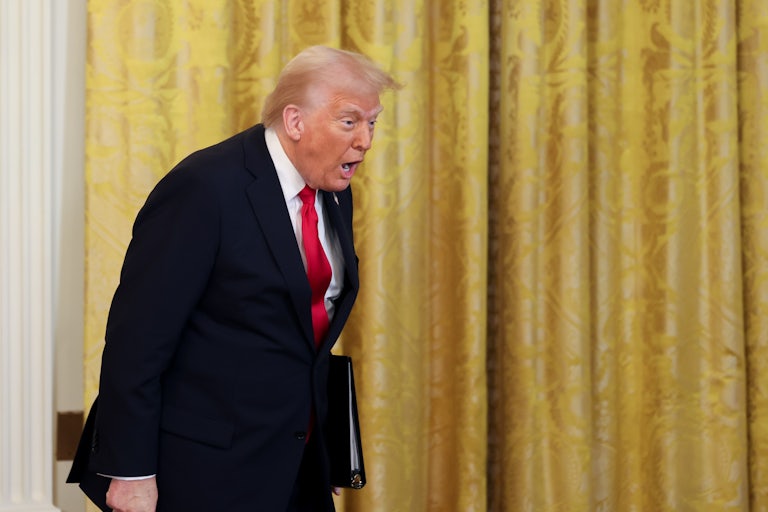
Trump scream
Tierney L. Cross/Bloomberg/Getty Images

Madness everywhere. Just glance at the headlines leading The New York Times this morning:

A Disregard for Rules Trickles Down From Trump to His Aides
Trump Takes Government Secrecy Seriously. But Only When it Suits Him.
10,000 Federal Health Workers to Be Laid Off
President Trump Moves to Punish the Law Firm Where Robert Mueller Worked

There’s more, but you get the picture.
The Washington Post adds a hot scoop: Internal White House document shows agencies preparing to cut between 8% and 50% of staff.

That’s a lot of mayhem, and it barely scratches the surface. The Social Security Administration is being destroyed. ICE is throwing people out of the country for what look to be obviously political reasons, notably a scientist at Harvard Medical School who was detained in Boston and told she’s being sent back to her native Russia. She protested Vladimir Putin’s Ukraine invasion and called for his impeachment. Wonder what’s in store for her.

Across human history, fascism has been imposed upon democracy mostly in one of two ways. First, by brute force—a military coup, that sort of thing. Second, a bit more stealthily, and legally—through legislation, executive decrees, and court decisions that hand more power to the leader.

Donald Trump is inventing a new way. Call it chaos fascism. Destroy the institutions of democracy until they’re so disfigured or dysfunctional that a majority no longer cares about them.

That’s exactly what’s happening with Social Security. The Washington Post reported this week that the SSA is breaking down: Its website “crashed four times in 10 days this month because the servers were overloaded, blocking millions of retirees and disabled Americans from logging in to their online accounts.” A Wall Street multimillionaire who probably doesn’t need his Social Security check and who has pledged that he will “100 percent work with DOGE” has already cut around 12 percent of the staff and doesn’t look like he’s stopping there.

In other words: Start by lying about the agency, with absurd and false claims about 140-year-olds cashing checks. Then wreck the agency so that its service becomes crap. Let public anger at it build. And in time, they can just dismantle it and privatize the greatest social insurance system ever devised by this government and put people’s financial fate in the hands of rich cronies. If that’s not chaos fascism, I don’t know what is.

Trump probably doesn’t have some secret plan. As we know, he doesn’t think far enough ahead. Elon Musk, however, probably does. It’s no accident he called Social Security a “Ponzi scheme.” That statement either (1) reflected his ignorance of how both Social Security and Ponzi schemes work or (2) was made in full knowledge of how both work—that is, he knew it was nonsense, but he said it anyway because his goal is to destroy Social Security.

This applies to just about everything Trump and Musk are doing.

It applies even to Signalgate. Trump has contempt for rules and procedures, and so he appoints unqualified stooges like Pete Hegseth to run the world’s largest military, who share that contempt—who think being tough means showing the world that they can do anything they want with no consequences. Again—ignore the law, trash the rules, establish that procedure is whatever you say it is. Chaos fascism.

And it will almost certainly go unpunished. Attorney General Pam Bondi said Thursday that the Justice Department wasn’t the least bit interested in looking into it. Some GOP lawmakers are making noises about the need for an investigation of some kind. But really—are the GOP’s leaders in Congress, Senator John Thune and Representative Mike Johnson, really likely to green-light an investigation? Seems pretty unlikely to me, unless it’s done with the secret, express goal of exonerating all involved.

Some senators say the Pentagon inspector general should conduct a probe. OK, we might get that. But remember that Trump has already fired 17 inspectors general, so who’d really care if he fired one more? Break the rules, and then ensure that there’s no accountability. Chaos fascism.

And if you want an image, just one image, that absolutely screams chaos fascism? Feast your eyes upon this photo of Department of Homeland Security Secretary and noted dog killer Kristi Noem at that notorious El Salvador prison this week, the prison where the Trump administration sent a couple hundred alleged Venezuelan gang members. They positioned her in front of prisoners behind bars, most of them bald and tattooed as if extras in a dystopian sci-fi movie, warning others that what happened to those Venezuelan men could happen to you. It’s a chilling photograph—to think that this is now the kind of image the United States wishes to project to the world.

And remember—those men are being held in that notorious prison in defiance of a federal court order. Wreck the rules. Chaos fascism.

Where in the world will we be six months or a year from now? What shape will Social Security be in? Veterans Affairs? What will be the impact of all these tariffs? Trump thinks he’ll force American companies to build factories here, and no doubt a few will, enough that Pravda (Fox News) can promote them as “proof” that the tariffs were a miracle. But most economists predict—well, chaos.

Trump will orchestrate no military coup. The Republican Congress will probably pass no laws that make Trump president for life. That would be too obvious. What they’ll do is make stealthier moves across the board that discredit and destroy our democratic institutions until he and his billionaire friends can strip them for parts. Chaos fascism is here to stay.

This article first appeared in Fighting Words, a weekly TNR newsletter authored by editor Michael Tomasky. Sign up here.