Newsletter
Power Mad
A weekly review of the rogues and scoundrels of American politics

The Democrats Finally Have a Plan to Attack Trump. Sort Of.

They’re organizing a summer-recess attack on the administration’s worst policies—but they’ll be playing catch up against a GOP that’s mastered the media game.

Hakeem Jeffries speaks during a news conference with House Democrats outside the US Capitol in Washington, D.C.
Kent Nishimura/Getty Images
Hakeem Jeffries speaks during a news conference with House Democrats outside the U.S. Capitol in Washington, D.C.

The first six months of Donald Trump’s second presidency have been a master class in what he truly excels at: wanton misrule. With an absence of adult minders and a determination to run roughshod over all of the democratic guardrails that have historically only been propped up by a fealty to norms and the waning spirit of fair play in Washington, Trump has moved fast and broken the government, put the economy into trauma with his constantly shifting tariff demands, perpetrated the deaths of HIV-infected children abroad, and cut the ribbon on a spanking new concentration camp in Florida.

These first six months have also featured a Democratic Party that has done what it does best: kept its stockpile of powder nice and dry. While some Democratic electeds have broken from the herd (often to the disdain of Democratic leadership) to confront Trump and his Republican minions, the party’s age-old theory of how political change happens—wait for the GOP to screw up—has remained in effect. Though now, with the passage of Trump’s big new “kick people off health care and funnel the money into an American Gestapo Act of 2025,” it looks like Democrats finally have their quarry right where they want them.

Or … almost? As it turns out, Democrats are planning to take on the GOP—in a few weeks, anyway. “House Democrats are plotting to turn the August recess into the opening salvo of the midterms, including through town halls and organizing programs,” reports Politico, as the party is experiencing “renewed bravado after months in the political wilderness.” And to think that all it took for Democrats to exit this self-imposed exile was Trump getting everything he wanted.

But come on, feel the bravado, folks. Maine’s centrist weirdo Representative Jared Golden, who is part of a group of Democrats who’ve lately decided that swearing more often makes them look edgy, shows up in the same Politico piece, bragging, “There’s almost nothing about this bill that I’m going [to] have a hard time explaining to the district. This is a giant tax giveaway to wealthy people. Everyone fucking knows it.” Can confirm! The New Republic has been covering this bill rather relentlessly over the past few months, which raises an uncomfortable question: What was stopping Golden from explaining this to his district at any point during the legislative meanderings of this bill? (Perhaps Golden, the most Trump-curious member of the Democratic caucus, was weighing whether to vote with the Republicans, as he has in the past.)

If there’s one thing that Democrats do seem committed to, it’s their August timetable for finally unleashing the spittin’, cussin’, new-look party to officially open the midterm election campaign. Over the past weekend, as Texans faced the now-familiar tragedy of mass casualties from devastating floods, House minority leader and energy vampire Hakeem Jeffries found it premature to go on an attack. Instead, he joined the Sunday morning talk show idiot parade to express his firm hope that Democrats might work productively with the party that’s hell-bent on destroying the government and wiping climate change from our brains: “I think we are going to have to figure out what happened, why did it happen, and how do we prevent this type of tragedy from ever happening again? And so the question of readiness is certainly something that Congress should be able to explore in a bipartisan way, particularly as we head into a summer where we can expect intensifying extreme weather events.”

It’s hard to fathom a Democratic leader speaking these words aloud in July of 2025. In the first place, the hows and whys of this flood should be glitteringly apparent: Trump’s executive branch misrule has led to cuts in the programs and personnel that keep people safe from these disasters, his shell of a disaster-response agency was slowed by Kristi Noem’s penny-pinching and is (as of this writing) “slow-walking the response,” and the federal government’s weather resources are being sold to his cronies. There is also ample evidence of Republican misrule closer to home, from a Republican governor who keeps presiding over these needless disasters to local officials who passed on funding a more robust emergency system so they could score partisan political points. Meanwhile, the GOP’s commitment to the promulgation of deranged conspiracy theories has the MAGA faithful engaging in the sorts of crimes that might cause the next disaster.

Therefore, the question of “How do we stop this tragedy from happening again?” has a pretty clear and obvious answer: Drive Republicans out of office. And that, I’m sorry to say, precludes the possibility of working arm-in-arm with the members of this criminal syndicate to solve the problems of the world. The scores who perished in these Texas floods deserve the finest politicization-of-their-deaths that the Democrats can muster: Take the cheapest shot, force Trump and his lackeys to defend themselves, shred their defense to pieces by demanding more and better, and then reload for the next disaster, which under Trump, as we know, will always be soon in arriving.

I agree with The New Republic’s editor Michael Tomasky that Trump’s murderous new piece of legislation will reveal how cruel and stupid the Republicans have become; how could it not? But the GOP has a distinct advantage over Democrats not just because they, as Tomasky correctly points out, have “a multibillion-dollar propaganda machine that will see to it that [their] vast audience never learns the truth about the impacts of this bill”; they are also vastly better at playing the media game with outlets outside their immediate control, where they are quicker to the punch and more relentless in bringing controversy and conflict to market. It would be a good idea to follow Delaware Representative Sarah McBride’s lead and start referring to the future Medicaid cuts as “Trumpcare.”

Until these widening strategic gaps start to close, I wouldn’t put my faith behind the belief that Trumpism will discredit itself. It’s not enough to simply vote against Trump’s bad ideas—though that is mandatory. You have to engage in full-frontal war with the GOP, relentlessly force them to defend themselves, find a way to blame them for everything that goes wrong, and use your available resources and expertise to help those who will be harmed by the GOP’s policies. This is the time for Democrats to get a lot less civil.

To bide one’s time in the hopes that a more favorable political environment might emerge is malpractice—because while you’re waiting, people are getting crushed economically and snatched off the street by masked paramilitary thugs. And to pretend that you have a productive relationship with the GOP on any level, as Jeffries asserted in the wake of more deaths by Republican hands, is simply brain-dead. I’m pleased as punch to know that in a few weeks’ time, the Democrats will supposedly be firing their powder. I hope to see some real pyrotechnics at last.

This article first appeared in Power Mad, a weekly TNR newsletter authored by deputy editor Jason Linkins. Sign up here.

How Brad Lander Lost an Election but Became a National Inspiration

The mayoral hopeful only finished third in the primary but garnered attention for his displays of courage and integrity.

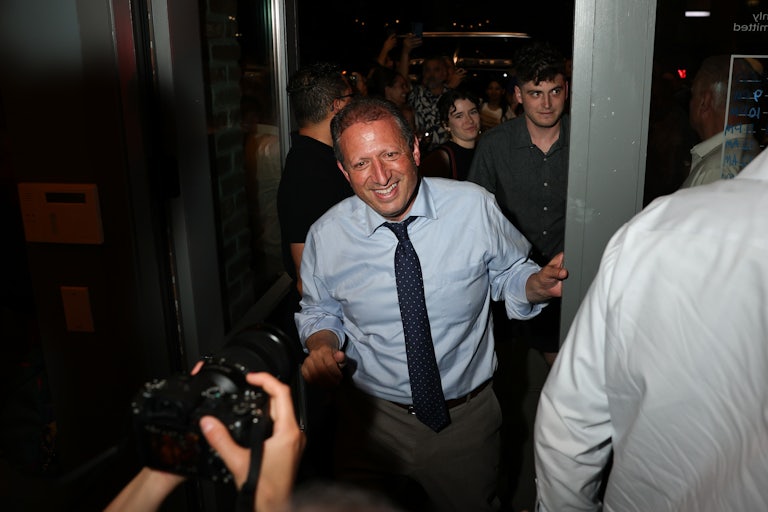
Brad Lander during an election night event with Zohran Mamdani.
Christian Monterrosa/Getty Images
Brad Lander during an election night event with Zohran Mamdani

Zohran Mamdani’s decisive victory in Tuesday night’s Democratic mayoral primary in New York City is the latest event heralding the potential end of what we frequently refer to as “politics as usual.” Disgraced former Governor Andrew Cuomo, the candidate of Big Cynicism and the broken status quo, naturally collected the biggest piles of billionaire boodle and got The New York Times edit board to hand him a sideways endorsement after they vowed to abjure such activities. We’re used to such advantages proving decisive, so Mamdani’s rocket ride through the early returns and Cuomo’s swift concession were stunning developments. It’s not every day that Michael Bloomberg, Andrew Cuomo, Bill Ackman, and The New York Times all get pantsed at the same time.

Mamdani’s true upset—he trailed Cuomo in all but a couple of polls—has given bloom to myriad “What It All Really Means” analyses in the political press. But I think it would be wrong to let the moment pass without shining a light on one of Tuesday’s also-rans: Brad Lander. The New York City comptroller may have finished third behind Mamdani and Cuomo, but during the latter half of this month he has played a pivotal role in American politics and been a warrior for his party, as he helped to elevate Mamdani while also putting a thumb in the eye of the two most venal politicians in America: Cuomo and Donald Trump.

It’s hard to imagine Mamdani putting Cuomo’s comeback bid to bed without Lander’s assistance. But you don’t have to take my word for it. Mamdani adviser Morris Katz put it best Tuesday night: “Hard to tell the story of the Election Day results without [Brad Lander,] who went all out in the closing 10 days, defending Zohran, spending nearly half a million dollars attacking Cuomo, and building momentum that could not be overcome.” You can also hear the appreciation among Mamdani’s voters, who gave Lander a hero’s welcome when he arrived at the newly crowned nominee’s watch party last night.

It’s not every day a defeated candidate walks into the winner’s campaign celebration and receives such acclaim. But two weeks ago, when Mamdani and Lander cross-endorsed each other—that is, urged their supporters to rank their rival second on the ballot to take advantage of the primary’s ranked-choice vote system—it felt like the ground was starting to shift. The pair’s affable, charming cross-endorsement video was a soothing balm to what had been a bruising war with Cuomo. Instead of cynicism, voters got to see something that looked more like a budding bromance. This is what ranked choice is meant, in part, to accomplish.

Obviously, it helped immensely that Lander, who is Jewish and a self-proclaimed Zionist, had this genial relationship with Mamdani as attacks from Cuomo-aligned super PACs amped up their anti-Muslim rhetoric in the final press of the primary campaign. It also helped that Lander was willing to lustily deride Cuomo all campaign long, frequently in defense of his fellow (non-Cuomo) nominees.

But Lander’s most important political actions in this past week had little to do with the mayoral election and more to do with the people he has worked tirelessly to serve—which brought him into direct conflict with the Trump administration when he was arrested and detained by ICE while accompanying a defendant out of an immigration court. Lander had, by then, quietly made it a habit to help defendants get into and out of the courtroom. That he had not bragged about this humble service to New York’s most vulnerable residents helped cement his integrity, and that he was taking these kinds of risks while running for office highlighted his courage. (Upon his release, he held a press conference joined by other mayoral candidates and took another jab at Cuomo for not being there.)

Most importantly, Lander joined a small pantheon of Democrats—including Maryland Senator Chris Van Hollen, California Senator Alex Padilla, and others—putting themselves in direct confrontation with Trump’s mass deportation policies. As I noted two weeks ago, conflict with Trump is inevitable and Democrats need to be more ready, willing, and able to get confrontational with the administration. And as Brian Beutler recently observed, Democrats’ willingness to fight seems to have a real yo-yo effect on Trump’s numbers. At the peak of the party’s confrontation over Kilmar Abrego Garcia’s wrongful arrest and remanding, Beutler writes, “Democrats dragged Trump’s immigration approval underwater. Instead of viewing their quick success as an invitation to continue pressing their advantage, they viewed it as the perfect time to quit while they were ahead. Once they relented, though, Trump’s numbers floated back up.”

Over the course of the last two weeks, which featured nationwide anti-ICE protests and the arrests of Padilla and Lander, Trump has lost considerable ground—so much so that CNN data maven Harry Enten recently declared, “I think we can say that Donald Trump has lost the political battle when it comes to what has happened out in Los Angeles.” Even if the confrontational tactics of Democrats like Lander aren’t directly pushing these numbers down, the fact that Trump is so underwater on what the punditocracy presumed would be his best issue in perpetuity should only embolden Democrats to keep bringing the fight to Trump and his minions. Moreover, what Lander’s derring-do shows is that you don’t have to file lawsuits or pass bills—you don’t even have to win elections—to play a vital role in the anti-Trump resistance.

Where Lander goes from here is anyone’s guess. There may be opportunities for him to lend his considerable skills to a prospective Mamdani administration, but he could also set his sights higher. He’d be a good look—and a great leader—for Democrats aiming to take back the House of Representatives. Should he want to bide his time, the 2028 cycle offers the possibility of a Senate run, where he’d be a massive improvement over Chuck Schumer, whose weak-kneed approach to confronting Trump leaves him unsuited for the moment.

At the root of all of Lander’s recent newsmaking are qualities that are often so hard to come by in the average politician. His willingness to put bigger matters ahead of his own near-term political aspirations cuts a huge contrast with Democratic members who grab political office only to play it safe and, in so doing, boost the broken status quo. But what’s truly refreshing is Lander’s innate understanding of this political moment. In a statement to Politico after the election, he said, “I don’t think the line right now is between progressives and moderates. I think the line is between fighters and fakers.” By all means, let’s get this man to his next fight.

Trump Just Expanded His Tawdry Empire of Scams

The president’s lust for self-enrichment knows no bounds—but now, he’s getting bipartisan cover for his corruption.

In this photo illustration, the Trump Mobile website displayed on a laptop screen and Trump Mobile logo displayed on a phone screen.
Jakub Porzycki/Getty Images

In the end, I was only on hold with the Trump Mobile customer service line for about 13 minutes. I’d been offered the opportunity to simply leave a number for an agent to call me back, due to “unprecedented demand,” but my extreme reluctance to give anyone affiliated with the president my contact information left me listening to a limp jazz instrumental loop for what I felt was a perfectly precedented amount of time. Maybe there is a massive number of people ready to ditch their wireless provider and follow the president on this new venture, but I’ve honestly been on hold with CVS longer.

Once on the phone with an agent, I was quick to learn that this new side hustle was at least refreshingly free of Donald Trump’s signature bombast. There was no braggadocio; no outrageous claims being made about the phone’s capabilities. Instead, I was treated to that other signature Trumpian quality: the unreadiness for prime time that those of us who lived through the Covid pandemic knew all too well. But this time, it also comes with the stink of self-dealing, if not outright corruption.

What is Trump Mobile? First and foremost, it’s a very gaudy, very gold-looking mobile device—most renderings show a screen emblazoned with the president’s name, an American flag, and the “Make America Great Again” motto. The exact model name is the “T1 Phone 8002,” and no, I don’t know why they’ve skipped “8001” but I wouldn’t be surprised if it all has something to do with obscure white-supremacist lore. The phone can allegedly be yours for $499 (they are taking $100 preorders). Trump Mobile is also a wireless service that you can join right now with your current device, if you’re so inclined, for—sigh— $47.45 a month.

The agent I spoke with wasn’t prepared to do a side-by-side comparison between the iPhone and Trump’s wares. (Strange because they were in many ways comparable—at least on paper.) She could tell me nothing about cloud storage. She knew the screen dimensions and the weight of the phone but could only add that “it looks like it had the standard thickness.” The Verge’s David Pierce (who calls the phone “bad and impossible”) reported that there was no processor listed on the website for the phone, and I was unable to get any clarification on this matter beyond the assurance that this was going to be an Android phone. Gen Z can rejoice, however, because Trump is bringing back headphone jacks.

Of course, the most important question was the one I asked first—and one she couldn’t answer: Where was this phone going to be made? After all, the major selling point of this whole enterprise is that the Trump phone was going to be made right here in America. Instead of cheerful affirmation, I got a long, suspicious pause followed by a plaintive, “I don’t know.” That’s fine. With Trump, it pays to be suspicious; you’d do well to keep yourself unassociated with his central claims. But the salient point is this: Even as he collapses the government, shreds the economy, and potentially takes us to war, the president is at all times expanding his scam empire.

My experience with Trump Mobile seems pretty typical—though I wasn’t willing to actually put my credit card at risk for journalism, sorry. The Washington Post’s Shira Ovide said that while Trump Mobile successfully charged her for joining Trump’s wireless service, it charged her more than the listed price and she hasn’t been able to use it yet. 404 Media’s Joseph Cox attempted to make a $100 down payment on the Trump phone itself (due to hit the market in September), only to be billed $64.70 and sent a cryptic confirmation email. “It is the worst experience I’ve ever faced buying a consumer electronic product and I have no idea whether or how I’ll receive the phone,” he wrote.

And experts, asked by CNBC’s Arjun Kharpal to weigh in on the likelihood that this phone will be made in the United States, respond with a resounding LOL. “There is no way the phone was designed from scratch, and there is no way it is going to be assembled in the U.S. or completely manufactured in the U.S.,” said one, adding, “That is completely impossible.” Says another, “The U.S. does not have local manufacturing capabilities readily available.” In fact, all signs point to the inconvenient truth that China’s vaunted manufacturing hubs will have to be involved.

If Trump has a magic power, it’s that no matter how much evidence you marshal in the service of letting the buyer beware, the president still manages to get fools to part with their money pretty regularly. Whether it’s for Trump steaks or the Trump presidency, the one constant is the multitudes willing to be his marks. Frankly, even Trump’s self-conception borders on the level of delusion necessary to con oneself. His own recollections of dealmaking derring-do, when probed, tend to reveal a disastrous self-pantsing.

But maybe the Trump phone is more than meets the eye. As Business Insider reported this week, Mark Cuban thinks that it has something to do with the Trump family’s emerging interests in cryptocurrency:

“I think the smart game they are probably playing is to put a crypto wallet on the phone that leverages WLF, $Trump, and their stable coins,” Cuban posted in response to the product launch. WLF is a reference to crypto firm World Liberty Financial, which is connected with the Trumps.

“Whatever transactions they can create [generate] fees for them, and there are so many ways to sell things and pre-load whatever they want,” he added.

Cuban may be onto something. Crypto has become the new, transcendent dimension of Trump’s scam empire. This week, Eric Trump announced that the family is planning to start “American Bitcoin,” a “company focused on Bitcoin mining, the business of running energy-guzzling machines to generate new coins.” Alongside Trump’s interest in WLF and his emoluments clause–busting memecoins, the president is now tightly entangled in what The New York Times refers to as a “business portfolio … fraught with conflicts of interest that have blurred the boundary between government and industry.”

Between his own up-to-the-gills involvement with the industry and his orders to have both the Department of Justice and the Securities and Exchange Commission effectively stand down on policing the industry, the president’s capacity for self-dealing and favor trading has reached steroidal new highs. As Harvard University’s go-to expert on authoritarian regimes Steven Levitsky told The Guardian this week, “I have never seen such open corruption in any modern government anywhere.”

Perhaps the most distressing thing about this is the extent to which Democrats are helping to further Trump’s ends. This week, 18 Senate Democrats helped pass the “GENIUS Act,” which is essentially the crypto industry’s version of Gramm-Leach-Bliley. As University of California-Berkeley economist Barry Eichengreen describes at length, the GENIUS Act would bring widespread mayhem in the way it would grant “hundreds—perhaps even thousands—of American companies” the power to issue their own bespoke cryptocurrencies. “Imagine Walmart issuing a Walmartcoin, and Amazon doing the same with an Amazoncoin, enabling them to bypass the banking system and credit card networks,” he writes.

While the idea may seem dizzily postmodern, Eichengreen says that these proposed arrangements bear “an uncanny resemblance to the way America’s monetary system functioned from the mid-1830s until the Civil War,” when “bank failures, personal bankruptcies and financial instability” were part of daily life. “Lawmakers should think twice before passing this piece of legislation,” he writes. Whoops!

Trump might be the nation’s biggest problem right now, but the crypto industry ranks high on the list. As The New Republic’s Paige Oamek reported last September, Washington has lately been flooded with crypto cash: “Crypto companies spent over $121 million to sway elections during [the 2024 election] cycle,” she wrote. “By comparison, since the Citizens United ruling in 2010, the fossil fuel industry has collectively spent $176 million over 14 years of election cycles.”

With that kind of filthy lucre sloshing around, it’s not hard to buy off some Democrats. As The Lever reported this week, the crypto industry has purchased key allies, in the form of scheming strategists who’ve spun through the government-to-private-sector revolving door, now coaching Democratic lawmakers in the art of offering “symbolic anti-corruption amendments” knowing that they would, in the end, be “dead on arrival, since the language would likely be voted down by Republicans.” I suppose that in this way, Trump has done the impossible: He’s brought both parties together in a rare demonstration of bipartisan comity. Too bad, then, that it’s all in the furtherance of the president’s corrupt self-enrichment.

This article first appeared in Power Mad, a weekly TNR newsletter authored by deputy editor Jason Linkins. Sign up here.

What the Democrats Must Learn From the People of Los Angeles

Conflict with Trump’s lawlessness is inevitable—and the fight cannot be ducked.

A protest against ICE immigration raids in Los Angeles, on June 11
Tayfun Coskun/Anadolu/Getty Images
A protest against ICE immigration raids in Los Angeles, on June 11

The only real surprise about the clashes in Los Angeles is that anyone is surprised by them. Of course Donald Trump, in an attempt to get his moribund deportation numbers up, sent masked goons to indiscriminately snatch undocumented immigrants from their workplaces; he long ago made clear that this was part of his plan. And of course the people of Los Angeles have erupted with fury, seeing their loved ones and co-workers hauled away for swift deportations to unknown destinations. It would be shocking if they hadn’t.

There’s little about this presidency that a majority of Americans support, and Trump seems uniquely uninterested in changing their minds. This is his m.o. His entire reelection platform was basically, “They can’t throw me in jail if I’m the president,” and the only thing he’s done since his return is to use the office to mete out vengeance on everyone who he believes has wronged him—just as he said he would. That’s why the biggest lesson of the unrest in Los Angeles is simply this: We are, at all times, hurtling toward conflict with the Trump administration, and the future of our democracy depends on understanding this and fighting it head-on.

Angelenos know the score and have responded in kind. As TNR’s Melissa Gira Grant wrote this week, “What we are witnessing in Los Angeles is not only a protest; it is self-defense.” When indiscriminate ICE raids ramp up in other metropolitan areas, I’d expect the same level of citizen resistance. But the protests have been a vital counteroffensive to Trumpism, as well: As TNR’s Matt Ford explains at length, they have done much to expose the weakness of the president and the fakery behind his anti-immigrant crackdown. Over at The New York Times, Jamelle Bouie concurs, wryly noting that “strong, confident regimes are largely not in the habit of meeting protests with military force, nor do they escalate at the drop of the hat.”

The Trump administration is angry and humiliated—and grossly unprepared. They have not done the planning necessary to pacify a city, and they don’t have the numbers to do it either. The National Guard members they have activated are famously sleeping on floors and complaining about how the administration is using 29-day deployments to avoid having to pay for active-duty benefits. And the president’s coalition is starting to fracture: Florida state Senator Ileana Garcia, who helmed Latinas for Trump during the election campaign, denounced the president’s crackdown this week. Another California Republican issued a statement urging the administration to “prioritize the removal of known criminals over the hardworking people who have lived peacefully in the Valley for years.”

The protest movement, meanwhile, is in the ascendance. Polls indicate widespread disapproval of the president’s actions in L.A. It’s having somewhat of a magnetic effect. California Governor Gavin Newsom—who’s spent the year running a clout-chasing podcast themed around the virtue of conceding political arguments to right-wing weirdos—finally put his instincts for self-aggrandizement to good use. His daring the president to come and arrest him was an excellent moment of bluff-calling. And much to my astonishment, The New York Times editorial board managed to get through an entire essay excoriating Trump without also slagging the protesters. The days for that sort of bothsidesism are over: Studies show that a robust civil resistance movement is absolutely necessary to stem the slide into authoritarianism. The forces that are mobilizing against Trump fit the bill.

While these displays of courage should be celebrated, there are still too many Democrats in Washington who are hesitant to step up—and who mirror the administration’s lack of preparedness. This week, California Senator Alex Padilla demonstrated that he was up for the fight, disrupting a press conference from Homeland Security Secretary Kristi Noem and getting manhandled and briefly detained as his reward. Still, many of his Capitol Hill colleagues seem to not understand the moment at all. Even as Angelenos were putting themselves in harm’s way to stop ICE raids and humiliate the Trump regime, 75 House Democrats were signing their name to a resolution expressing “gratitude to law enforcement officers, including U.S. Immigration and Customs Enforcement personnel, for protecting the homeland.” Beyond that, I’m seeing the same basic reluctance among Beltway Democrats to recognize that they’re in a content-creation war. Republicans are still much quicker to grab a microphone or position themselves in front of a television camera. And even Trump understands that the biggest virtue of deploying Marines to California is that he’ll get the media to report it.

But this is precisely why Democratic reluctance to frontally confront Trump, in the hopes that some more favorable political terrain might reveal itself—or the president might finally, fatally, shoot himself in the foot—is dangerous. Like I said, we are at all times hurtling toward a conflict with this administration. And the number of people carrying guns to this conflict continues to go up. At some point, someone is either going to be ordered to fire one of those guns on a civilian or they are going to refuse the order to do so, and we’ll be knee-deep in the big muddy of a turbocharged crisis. At that point, pivoting to the price of eggs isn’t going to be sufficient.

As Brian Beutler explains in a recent Off Message newsletter, Democrats have been having an almighty struggle with the basic concept of forethought. We have, for a long time, been operating under the ambient threat that the administration was going to provoke the public into a spectacular anti-administration response, whereupon Trump would do something like invoke the Insurrection Act or otherwise activate some militarized rejoinder. People have long been anticipating the need for blue-state governors to get out in front of the threat. “We knew he’d wield immigration enforcement cruelly, in a manner designed to draw protesters into the streets, and we knew he’d be eager to deploy troops once protests began,” Beutler writes.

For all of Newsom’s recent exploits, Beutler believes that he might have done much better if he had “prepared for wide-spectrum confrontation with Trump, instead of brushing aside almost all hot-button issues as perilous distractions.” It’s hard to fathom that anyone anticipated that Trump’s anti-immigrant animus could have been hand-waved away with rhetorical tricks or a strategy of avoidance: Trump’s pledge to deport millions of people was his only noteworthy policy proposal on the campaign trail. The day to start preparing to confront the inevitable abuse of power was, thus, the day after Trump was elected. As Beutler notes, “I’m pretty sure all of these questions were ponderable and answerable in November of last year—but only by leaders who understood what was coming and [were] determined to fight it.”

At any rate, the time for anticipating what Trump might do has long passed. The conflict has arrived, and we are in a perilous moment. That said, I’d worry more if the people were mirroring the reticence and timidity of many of our political elites. But as we’ve seen in Los Angeles—and are likely to see as anti-Trump protests spread across the nation this weekend—no one is waiting for politicians to step in and be the grand marshal of this growing dissident movement. Democratic leaders may still be waiting for the “time, place, and manner of our choosing” to take the fight to Trump. But Angelenos have countered, “What better place than this? What better time than now?”

This article first appeared in Power Mad, a weekly TNR newsletter authored by deputy editor Jason Linkins. Sign up here.

Joe Biden Is the Least of Democrats’ Problems

Some commentators say the former president’s age and acuity will be a litmus test for 2028 candidates. They are embarrassingly wrong.

Former President Joe Biden takes his hand to his heart during the National Anthem.
Allison Robbert/Getty Images

Well, folks, the Democratic Party really went through it this week. Last weekend, it was disclosed that former President Joe Biden was diagnosed with a particularly aggressive form of prostate cancer that had metastasized to his bones. Coming smack-dab in the center of the hype cycle from Jake Tapper and Alex Thompson’s book about how Biden’s inner circle kept his infirmity out of sight, the episode only magnified the party’s gerontological problems. On Wednesday, like a rush delivery from the coda store, all of this was underscored by the passing of Virginia Representative Gerry Connolly, who recently was named the ranking member of the House Oversight Committee despite his own cancer diagnosis.

The Democrats’ Biden reckoning is a real choose your own adventure. To my mind, this was a case of elite failure: not just from the fabled “politburo” troika of Biden insiders that led the charge to keep Biden’s struggles from the limelight, but also from the party elders who engineered this mishap in the first place. They slaughtered their younger candidates in the 2020 presidential primary, mercilessly took down the one among them who dared to suggest Biden was too old, and forced a party-wide acclamation of Biden’s nomination following the South Carolina primary, which put us irrevocably on the path to his subsequent 2024 candidacy. This was, indeed, the Original Sin.

While there’s no end of atoning to do, some commentators have stretched this melodrama to the breaking point by suggesting that Biden’s “age and mental acuity” will be a litmus test for the party’s 2028 candidates. Let me just say this: I truly hope that it will be one, because if voters in three years still care a whit about Biden then that would mean the economy did not end up in shambles, the constitutional order and the rule of law are still very much intact, and the decimation of the civil service has been reversed. This is what a lot of pundits don’t understand: The only way Biden would have salience as a “litmus test” issue in 2028 would be if his successor governed through wisdom and competence.

Naturally, that will not be the case because Biden’s successor is Donald Trump—an omnidirectionally corrupt fuckup and criminal. If anything, Trump has provided a new avenue for those journalists who maybe neglected the story of Biden’s mental infirmity to redeem themselves, by hopping on the story of Trump’s own mental infirmity. Though oddly, few seem to be working that beat, and many of the voices that admonished the Biden-era media for these failings have fallen curiously silent. (TNR, I should note, is all over the story of Trump’s cognitive decline.) That’s too bad: The scandals at the core of the Tapper-Thompson tome remain live issues in American life. Gather unto you some scoops, reporters! This is low-hanging fruit!

Meanwhile, as the entire political journalism industry dithers, Republicans are using the story as a heat shield to skate on their bad plans for the country and their worse abuses of the Constitution. Flying under the radar this week is a report from the Cato Institute that included detailed profiles of 50 undocumented immigrants whom the Trump administration sent to a prison in El Salvador even though they were not guilty of any crimes while stateside. The administration ran afoul of another federal judge after shipping another group of migrants to South Sudan, a nation that’s on the verge of a renewed civil war.

In Washington, Republicans are trying to bring a budget bill to term that will slash programs for the needy to furnish a one-time payout for plutocrats, throw millions off their health insurance, and explode the budget deficit. Beyond that, we have the ongoing crimes of the administration that I laid out last week, up to and including the needless deaths that will occur at the hands of Elon Musk’s destruction of critical aid agencies and Robert F. Kennedy’s lethal grotesqueries of public health. All of which is to say: There will be no reason in the world for any Democrat worthy of office to be on any kind of apology tour by the time 2028 rolls around.

That doesn’t mean there won’t be critical litmus tests for Democrats—or that all of them will pass with flying colors. Right now, the most important way that the Democratic leaders of the future are going to distinguish themselves will be the extent to which they devote their lives to fighting Trump, tooth and nail. As Talking Points Memo’s Josh Marshall wrote this week:

The overriding problem Democrats have today is a general belief that they’re not effective at fighting for what they believe in or what the country needs to be protected from. There’s a related, but secondary issue that they worry that Dems are most focused on issues that are obscure or not connected to the lives of the great majority of people struggling to make ends meet. That lack of fight is shattering for self-identified Democrats as well as highly damaging for genuine independents and low-information voters who genuinely flip from party to party from election to election. That is overwhelmingly the challenge Democrats have right now.

“The idea,” Marshall adds, “that up-for-grabs voters are waiting for important signals out of a bizarre intra-party score settling over Joe Biden’s age is just such unreal bubble thinking that it beggars belief.” Meanwhile, if we are looking to recent events for Democrats failing those crucial litmus tests, consider the fact that 16 of them joined Trump’s Senate acolytes in passing a crypto-friendly deregulation bill, in just the latest example of the party’s willingness to cave to that scam industry. The fact that this bill would most likely set the clock ticking on the next great financial crisis, in much the same way that the Financial Services Modernization Act of 1999 paved the way for the last one, is to my mind a more massive failure than anything that Biden’s inner circle did as they conspired to hide his enfeeblement.

At any rate, for those so concerned about Biden and his health, I’ve good news: He won’t be running for office again. The Democratic campaigns of the future can and should opt to neither hire nor rely upon the bad and incompetent advisers whose actions helped Trump get elected.

These are the easy bars to clear. More important litmus tests remain: Who fought the hardest? Who proved worthy of the public trust? Who best used the tools available to them to relentlessly discredit Trump and the GOP? Who sent packing the small army of loser pollsters and consultants that have kneecapped the party? Who successfully learned to speak to the public like someone not umbilically connected to a Beltway focus group? The road out of the Trump Dark Ages will be paved by those who pass those tests, not those who occupy the pundit-approved opinion on a prior president who, come 2028, will be … well, let us not speculate.

This article first appeared in Power Mad, a weekly TNR newsletter authored by deputy editor Jason Linkins. Sign up here.