Life in a Warming World
A weekly reckoning with our heated planet—and the fight to save it

Trump Is Now Bribing Energy Companies With Your Taxpayer Dollars

What everyone gets from a strange deal to pay a company nearly $1 billion to abandon a wind project

Donald Trump gestures with one hand while standing at a podium, in front of a portrait of Ronald Reagan.
Bloomberg/Getty Images

This week, the Trump administration announced that, after having lost every single court case over its attempt to halt East Coast offshore wind projects, it will now simply pay one of the companies roughly $1 billion to abandon ship. Crucially, however, it is not just paying France’s TotalEnergies to back off—the company will now invest in oil and gas development in Texas instead.

On its face, this would appear to be a pretty bonkers plan. “The deal is an extraordinary transfer of taxpayer dollars to a foreign company for the purposes of boosting the production of fossil fuels, a main driver of climate change, while throttling offshore wind power,” The New York Times’ Maxine Joselow and Brad Plumer wrote earlier this week. “It comes as the war in the Middle East has shocked global oil markets, prompting concerns about energy supplies.”

So let’s break this down into what each party gets out of it.

It’s not hard to see why TotalEnergies decided to take the deal. Offshore wind is extremely expensive to build, and delays and uncertainty—you know, of the sort the Trump administration has cultivated by issuing random stop-work orders—can easily make it a bad investment. Joselow and Plumer quote CEO Patrick Pouyanné as saying that they’ll still invest in renewable energy—but in the United States, specifically, “offshore wind is too expensive from our point of view.”

Then there’s the Trump administration. As I wrote in early February, there was always not just a risk but a high probability that the administration’s five-nil courtroom defeat on offshore wind would goad Trump and his underlings rather than discourage them. The president and MAGA followers have a particular hatred for offshore wind (even as some of the MAGA crowd start to embrace solar). So as long as offshore wind projects are being shuttered, they can conceivably claim some kind of victory.

Of course, being seen to fork over $1 billion in taxpayer money for this victory, after failing in court, could somewhat blunt the effect, making the administration appear weak and wasteful.

But the administration has taken pains to present the deal as doing more than saving face. “[Interior Secretary Doug] Burgum also cited national security as one of the factors motivating the agreement,” the Houston Chronicle’s Rachel Nostrant reported. “Wind turbines, even those offshore the U.S., are potential targets for drone strikes, Burgum said.” (If this was the argument featured in the classified Defense Department report that was the basis for the Trump administration’s original pause on the projects, you can sort of see why the judges weren’t convinced.)

Then there’s the matter of what else that $1 billion is buying: not just less wind power for New York and North Carolina but more oil and gas development for Texas. The North Carolina project was relatively small, projected to be able to power “around 300,000 homes and businesses starting in the early 2030s,” according to the Times. The New York one was larger, projected to power more than a million such buildings in both New York and neighboring New Jersey.

The administration seems willing to screw over some people in these states while directing money to Texas instead. And that’s not a huge surprise: As I noted last week, the administration is also softening its stance on solar projects in a way that could benefit Texas—and its crusade against offshore wind or wind turbines on federal lands doesn’t hurt Texas at all, given that Texas’s substantial wind capacity is onshore, and on private lands.

The money TotalEnergies is redirecting to Texas, from the limited details available right now, probably will benefit some people there, or at least one company. “One of the projects receiving the reallocated funds will be Rio Grande LNG,” the Chronicle reported, “a Brownsville natural gas export facility owned by Houston-based NextDecade.” Just last week, news broke that a project to expand Rio Grande LNG was going ahead. The money TotalEnergies is redirecting to Texas is also supposed to go to “conventional oil” development in the Gulf and shale gas.

None of this is likely to put a dent in the energy crisis triggered by Trump’s war on Iran. Rio Grande LNG’s new project—a so-called fourth “train,” which lets the facility increase output—isn’t projected to be completed until 2030. Also worth mentioning: Right now, shale gas in the Permian Basin is so abundant that it frequently hits negative prices, and producers burn off the gas instead, rather than paying someone to take it—simply dumping more methane into the atmosphere. Paying someone to develop more natural gas in this region isn’t an obvious win for energy market efficiency.

While this sort of deal—attack, lose, and then bribe someone to do what you want—may seem counterintuitive, particularly for an administration that championed frugality early last year, it does seem to be in keeping with the Trump administration’s negotiating strategy of late. Bombing Iran, then being caught unprepared by its control of the Strait of Hormuz, and then handing it a $14 billion windfall in eased sanctions? There are certain similarities, these days, between the administration’s foreign and domestic policy.

Stat of the Week
$3.59 billion

That’s the total amount spent building data centers last year, which—for the first time—makes it more than the amount spent building offices.

What I’m Reading

Petromasculinity Is Eating Itself and Destroying Us All

Climate journalist Amy Westervelt pens a thoughtful essay about the oil industry, war, and authoritarianism—but also about the assumption that oil is needed for the good life:

A decade or so ago I was trawling through the archive of Standard Oil of California’s (now Chevron’s) shareholder magazines and was struck by how many of them during the 1970s had been dominated by anxiety and fear—not over OPEC or access to Arab oil, but over how good Americans had gotten at conservation and efficiency. How quickly people had realized they didn’t actually need to drive so much or have such big cars or leave the lights on or crank the air-conditioning. They had realized that moderating a little bit even made their lives better sometimes—walking or biking instead of driving, being in community with their neighbors on the bus or train, saving money on electric bills. In the early 1980s, as production increased and the embargo lifted, oil executives were in an outright panic. Americans didn’t seem to be in a rush to let their new lifestyles go, what was an oil company to do? The answer was increase production, tank the price of oil to a point where people would start over-consuming again, and take the short-term financial hit in exchange for long-term gain.

Read Amy Westervelt’s full newsletter at Drilled.

This article first appeared in Life in a Warming World, a weekly TNR newsletter authored by deputy editor Heather Souvaine Horn. Sign up here.

What’s Behind MAGA’s Strange New Crush on Solar Energy?

And why is the administration and its influencer crew drawing a line between solar and wind?

Donald Trump and Melania Trump stand side by side, both looking upwards while wearing protective eclipse glasses.
Nicholas Kamm/Getty Images
President Donald Trump and first lady Melania Trump looking at a partial solar eclipse on August 21, 2017.

Is MAGA changing its tune on solar energy? Since the start of the year, a dizzying array of social media posts and news reports have pointed to the possibility, even as the administration continues to double down on its anti-wind policies and rhetoric. Why solar? And why now—especially given that President Trump continues to fulminate against its renewable energy cousin, wind power?

Let’s recap, because sorting through this is not easy.

On January 24, Trump shared a video on Truth Social that seemed to endorse rooftop solar for households as a way to free up energy for the industrial parts of the grid and help the United States compete with China. Four days later, The Daily Caller published an op-ed from Newt Gingrich declaring that “American energy must not pick winners and losers,” that the energy market could use “more of everything,” and that “solar and wind power are popular, with 80 percent and 74 percent respectively backing local construction.”

On February 4, Axios reported that a new poll from a Trump-aligned polling firm, commissioned by First Solar, found that a majority of Trump voters support solar. Katie Miller, Stephen Miller’s wife and former press secretary to Mike Pence, promptly retweeted it on X, saying, “Solar energy is the energy of the future.… We must rapidly expand solar to compete with China.” A little over a week later, Miller posted a chart on X, noting, “Solar is now the dominant source of new U.S. power capacity and is on track to surpass coal in total installed capacity before the end of 2026.”

A week after that, on February 19, Semafor reported a poll from Kellyanne Conway’s firm showing that Trump voters support solar. And the following week, Politico’s Greenwire reported “three agency career officials” confirming that the Interior Department was now “reviewing at least 20 commercial-scale projects that have languished in the permitting pipeline since President Donald Trump took office in January 2025.” Specifically: solar projects. Greenwire noted that this coincides with “the artificial intelligence boom—and the electricity demands helping hike consumer power bills,” and that “some congressional Republicans” have objected to Trump’s complete rejection of renewables.

The next day, February 27, Politico finally shed some light on what might be driving this: The outlet obtained access to a “confidential memo” from early February from renewable energy group the American Clean Power Association, outlining a new strategy to “engage Conway and conservative influencers like Miller” on behalf of solar energy. “As part of the campaign, ACP is working with a series of conservative influencers to secure opinion media placements authored by conservative columnists, former Republican lawmakers, and other credible Republican voices in conservative outlets,” the memo stated. Politico also noted that Conway’s poll had been commissioned by American Energy First, an advocacy group founded by ACP. (Not mentioned in the Politico piece, but notable: AEF first created accounts on X, Instagram, and Truth Social in January. This campaign has ramped up very quickly.)

Miller denied to Politico that she was being paid for her solar advocacy. But four days later, The Washington Post published a piece in which she declined to comment on the payment question. (She did double down on her advocacy, saying that solar “solved” Australia’s “rolling blackout issues” and that solar “should be a driver of the solution” to rising energy costs.)

The Post story pointed to other signs that MAGA may be pivoting. “Among the loudest” of the MAGA solar advocates, it noted, “may be on-again, off-again Trump adviser Elon Musk, whom Miller worked for as he designed and executed the president’s initiative to slash the federal workforce. Musk is now throwing his influence behind a moonshot effort to wrest solar manufacturing away from China.” There are signs of broader adoption too. “In Virginia, a coalition of conservatives pushing for more solar power is printing ‘Make Solar Great Again’ hats.” And a “Richmond-based group funded by industry and philanthropists called Energy Right,” led by an alum from the first-term Trump Interior Department, “has been working with conservatives there to push solar forward in the statehouse and local communities.” Interestingly, the Post reports, Energy Right recently founded the “America First Energy Project” in Louisiana—seemingly unaffiliated with ACP’s American Energy First, but a striking linguistic echo.

Throughout this multi-month saga, the president has been on a more or less constant tirade, interrupted only by breath, sleep, and distraction, against offshore wind—his January speech in Davos being a prime example. This week, The New York Times reported that the Trump administration remains so committed to sinking wind power that, after having its attempts to halt multiple offshore wind projects rejected by the courts, the administration is now contemplating buying off the companies in question: paying one energy company $1 billion not to build the wind farms and to instead invest in natural gas in Texas.

What in the Sam Hill is going on here? Successful lobbying is nothing new, but the speed with which this solar campaign seems to have succeeded is a little unusual, particularly given Trump’s doubling down on wind power as some kind of satanic scam. Nor is conservative voters’ support for solar new—it’s been showing up in other polls for years, long before Conway’s. What’s new is the leaders now embracing the cause. Is it really possible, you may wonder, that the only thing keeping prominent Trumpers from endorsing solar before was that no one had considered paying them for said endorsement?

I don’t have the answers here, but there are a few points worth considering as context. First, while Trump has demonized renewable energy in general, and financial incentives for rooftop solar got scrapped in the 2025 GOP budget bill, both Trump and others have demonized solar conspicuously less than wind, which appears to be a particular bugbear.

The MAGA figures pivoting to solar are stressing this distinction. Kellyanne Conway’s memo to American Energy First, detailing the results of the poll it commissioned, concludes by saying that “solar, unlike wind, is not viewed through a partisan lens; it is seen as a means to an end.” Since the survey summary doesn’t document any questions about wind at all, it’s hard to know where that conclusion is coming from. Independent polling finds only a slightly larger spread between Democrats and Republicans for wind than for solar: In 2024, Pew found a 27-point gap on solar versus a 32-point gap for wind, and Yale/George Mason, looking at parties’ extremes, found a 51-point gap between liberal Dems and conservative Republicans on solar, versus a 57-point gap on wind.

The U.S. solar industry, however, is about twice the size of the U.S. wind industry in installed capacity, and also larger in terms of market value. New solar installations are typically less financially and logistically fraught than new wind installations, and a lot are planned for the next few years. The solar industry may have both more money for lobbying and better stats to deploy in its favor.

There’s also another thing that might be driving the speed of this political pivot. Conway’s poll, though headlined as showing “Trump voters’” thoughts on solar energy, wasn’t interviewing all Trump voters. Instead, it was interviewing Trump voters in five specific states: Indiana, Ohio, Arizona, Florida, and Texas. The latter three are among the top five states for currently installed solar capacity, with Texas the “fastest-growing solar economy,” according to the Solar Energy Industries Association. Arizona is the third-fastest-growing solar economy, Indiana is fourth, Florida is seventh, and Ohio is eighth. SEIA also reports that Texas stands to lose 51 percent (162 projects) of new solar capacity due to new federal policies, Arizona 53 percent (15 projects), Ohio 40 percent (14 projects), and Indiana 35 percent (10 projects).

Several of these states are also home to embattled Republican congresspeople. In Texas, as Republican Senator John Cornyn and MAGA challenger Ken Paxton duke it out in a primary runoff, current polling suggests that Democratic nominee James Talarico has a decent shot at beating either of them in the November midterms. (Notably, one of the first polls showing Talarico leading the Trump-aligned Paxton came out in late November last year, just before the MAGA tide seemed to turn on solar.) In Ohio, Republican Senator Jon Husted is in a dead heat with former Democratic Senator Sherrod Brown. Either of those races could flip control of the Senate. In Florida, noted Trump acolyte Cory Mills, who seems to be even more stunningly scandal-prone than Paxton, is looking vulnerable.

Of course, several of these states are also home to significant wind power—particularly Texas, which leads the country in wind power. And you’d think that would complicate the narrative here. Then again, the Trump administration’s attacks on wind have mostly been on offshore installations—in addition to making it a bit harder to install wind power on federal lands. Texas’s wind farms aren’t offshore, and they’re mostly on private lands. So the contradiction between the position on solar and on wind, as it pertains to Texas, perhaps isn’t as significant as it might first appear.

Is Republican fear of the midterms making solar lobbying more successful than it might otherwise be? Hard to say. Pending new, more extensive reporting on the solar lobbying network, the idea can’t be dismissed.

Stat of the Week

“Earliest 100-degree temperature on record”

That’s what the National Weather Service is predicting for parts of the country this week and next, as a massive heat wave envelops the American West and Southwest.

What I’m Reading

The Latest Front in the Battle Over Climate Lawsuits: Bills Wiping Out Liability

An important update on state efforts to hold fossil fuel companies accountable for climate change, and make them shoulder some of the costs of adapting and recovery after climate-fueled disasters:

Republican lawmakers in multiple states and Congress are advancing proposals to shield polluters from climate accountability and prevent any type of liability for climate change harms—even as these harms and their associated costs continue to mount.

It’s the latest in a counter-offensive that has unfolded on multiple fronts, from the halls of Congress and the White House to courts and state attorneys general offices across the country.

Dozens of local communities, states and individuals are suing major oil and gas companies and their trade associations over rising climate costs and for allegedly lying to consumers about climate change risks and solutions. At the same time, some states are enacting or considering laws modeled after the federal Superfund program that would impose retroactive liability on large fossil fuel producers and levy a one-time charge on them to help fund climate adaptation and resiliency measures.

But many of these cases and climate superfund laws could be stopped in their tracks, either by the conservative majority on the U.S. Supreme Court or by the Republican-controlled Congress.

Read Dana Drugmand’s full report at Inside Climate News.

This article first appeared in Life in a Warming World, a weekly TNR newsletter authored by deputy editor Heather Souvaine Horn. Sign up here.
What Does Kristi Noem’s Firing Mean for a Hobbled FEMA?

Her tenure coincided with unprecedented upheaval in disaster preparedness grants and staffing. Experts would like to see her successor, Markwayne Mullin, indicate where he stands on all that.

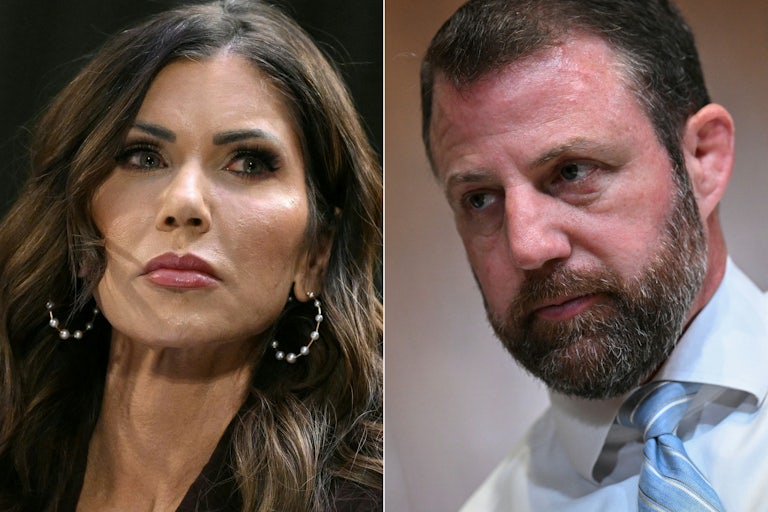
Former Homeland Security Secretary Kristi Noem and U.S. Senator Markwayne Mullin
(Noem) Mandel NGAN/AFP/Getty Images; (Mullin) Drew ANGERER/AFP/Getty Images
Former Homeland Security Secretary Kristi Noem and U.S. Senator Markwayne Mullin

In the days since President Trump announced that he was firing Kristi Noem as homeland security secretary and replacing her with Oklahoma Senator Markwayne Mullin, much of the focus has understandably been on what this means for the brutal, chaotic, and lawless immigration policy that Noem has spearheaded. But there’s another area within DHS where Noem’s departure raises rather urgent questions about a possible change in policies. And that’s at FEMA.

Noem was in the middle of a project to shrink the Federal Emergency Management Agency significantly, having announced large staffing cuts in January. She’d also floated the idea of dismantling it entirely.

Her firing last Thursday came only a day after Senate Democrats released a report showing that Noem’s policy of requiring sign-off on any expenditure over $100,000 had resulted in “at least 1,034 FEMA contracts, grants, or disaster assistance awards” being held up—among them, disaster aid for survivors of Hurricane Helene and Texas’s deadly floods last summer (which killed at least 135 people, including 27 at a girls’ summer camp). And the day after Noem’s firing was announced, a judge gave FEMA 14 days to inform states about the status of their Building Resilient Infrastructure and Communities grants, a multibillion-dollar program that a court in December ordered reinstated—with no sign of compliance from FEMA.

Meanwhile, FEMA remains largely shuttered due to the DHS shutdown. And the administration recently spent “more than half of the balance in the nation’s disaster relief fund,” according to Politico, “pointing to that dwindling aid as [a] means to pressure Democrats into yielding in Department of Homeland Security funding negotiations.”

What exactly does Markwayne Mullin intend to do about all this? I asked two experts what they would be watching for in the coming weeks to determine whether Mullin would represent a serious shift from Noem’s policies, and whether FEMA would be able to handle disasters this year.

“Shutdowns come and go,” said Bryan Koon, president and chief executive officer at global emergency management consulting firm IEM and former director of the Florida Division of Emergency. “We tend to find ways to work around whatever issues are associated with that.” But he pointed to the FEMA Review Council report that the president ordered last year to determine policy changes at the agency. “It’s been now a year of uncertainty,” Koon said. “We’ve heard ideas about what might be in it, but frankly I would like to have some certainty, some insight into what the council’s going to recommend.” He noted that Trump already extended the timeline through the end of March. “I’m concerned that the transition between Noem and Mullin as secretary, combined with the shutdown, is going to delay that even further or even potentially render it moot,” he said.

Koon would consider the release of the report as one indicator of FEMA’s overall health at present. “A second would be an actual emergency or disaster that required FEMA to be all in. We were remarkably, as a nation, pretty lucky in 2025, and thus far in 2026—I mean, we had no landfalling hurricanes.”

Tim Manning, a former deputy administrator at FEMA, agreed. “I think they dodged a bullet,” he said, regarding last year’s hurricane season. “I and most of the emergency management community have great concerns for FEMA’s readiness. It is a collection of the most selfless, dedicated people in the government,” he said, “but there’s no getting around that they’ve been decimated over the past year and a half.” He pointed to layoffs, the firing of most senior leadership, the “onerous level of review” for grants, and more. “At every turn, the Noem administration has made decisions that dramatically degrade FEMA’s readiness and capabilities.”

If Markwayne Mullin is formally nominated and sits for confirmation—a big if, given that Trump’s first administration was marked by an unprecedented number of acting Cabinet secretaries working without Senate confirmation—Manning suggested that senators ask him about that directly. “I think the question I would ask Mullin during his confirmation hearing would be a question that I’ve tried to get people to ask Noem for the last year: The law explicitly says that the secretary does not have the authority to degrade FEMA’s mission or move resources,” he said. “I would be curious to get any nominee on the record: Will you follow the Post-Katrina Emergency Management Reform Act and restrict yourself from impacting the FEMA budget?” And as a secondary question: “Will you rescind any of the policies that have prevented the deployment and travel of FEMA’s employees to disaster sites?”

In the meantime, the current readiness of state and federal emergency agencies has people worried. “I went through at least one shutdown as a state director,” Manning said. And state directors need to know of FEMA, “Will they be on the other end of the phone when I need them?”

This is also hurricane preparation season. “Most states are going to do a state-wide hurricane exercise,” said Koon. “They’re going to do a large-scale event that allows them to test their plans and processes and coordinations and look at who their partners are and contracts are and who’s going to do what in what scenarios.” In Florida, where he has experience, it’s “a weeklong event sometime in May,” which requires some advance planning.

Perhaps it’s better, Koon said, for the impact of the shutdown to be felt now, in March, rather than in May or when a hurricane hits. But there’s never an ideal time. Wildfire season isn’t a season anymore. Earthquakes and other disasters can happen at any time, Manning noted. “There’s no seasonality to disasters,” he said. “Preparedness is a year-round thing.”

Stat of the Week
0.35 degrees per decade

That’s the rate of warming we’ve been experiencing since 2015, according to a new paper. It’s almost twice the previous rate—0.2 degrees per decade. In other words, as several scientists have warned, climate change is accelerating—although exactly how much is the subject of some debate.

What I’m Reading

How Trump’s EPA rollbacks give states new tools in climate suits

The Guardian’s Dharna Noor reports on a fascinating implication of the administration’s decision to kill the so-called “endangerment finding”—it may actually help state-based climate laws in court:

Trump’s justice department has asked a judge to kill a first-of-its-kind 2024 Vermont “climate superfund” policy requiring major polluters to pay for damages caused by their past planet-heating pollution, partly on the grounds that federal law, not state law, governs greenhouse gas emissions. But last month, Trump’s Environmental Protection Agency (EPA) repealed the endangerment finding, the scientific determination giving federal officials the authority to control those very pollutants.

“They’re trying to talk out of both sides of their mouths,” said Kate Sinding Daly, senior vice-president for law and policy at the environmental legal non-profit Conservation Law Foundation (CLF).

Read Dharna Noor’s full report at The Guardian.

This article first appeared in Life in a Warming World, a weekly TNR newsletter authored by deputy editor Heather Souvaine Horn. Sign up here.

Ken Paxton Is the Face of a Sea Change in the Republican Party

Most Republicans oppose environmental regulation. But Texas’s attorney general has attacked the energy transition in a way that upends a generation of conservative consensus.

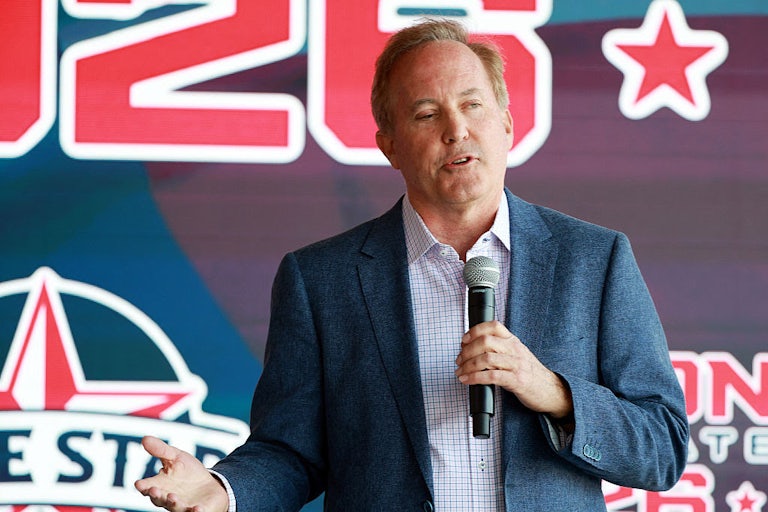
Ken Paxton speaks while holding a microphone in one hand, with a campaign poster in the background.
Richard Rodriguez/Getty Images
Texas Attorney General Ken Paxton campaigns for U.S. Senate on February 28 in Fort Worth, Texas.

As some see it, the Texas Republican primary for U.S. Senate is a battle for the future of the party: Longtime incumbent John Cornyn represents the conservative establishment, while Attorney General Ken Paxton is a rising MAGA firebrand. After Tuesday’s election, that battle will continue, as neither candidate broke 50 percent, and therefore they will face each other in a runoff in May. While Cornyn is a staunch fossil fuel ally—no one would mistake him for an environmentalist—Paxton has gone a step further, pioneering an unorthodox attack on renewable energy that upends a long-standing conservative principle.

Paxton’s ascent is notable for a few reasons. Coverage of the race typically notes his impressive array of scandals and legal imbroglios, such as being indicted for securities fraud in 2015; being successfully sued by four of his own deputies in 2020 after he allegedly fired them for reporting him to the FBI for abusing his office to help a wealthy donor; dropping $2.3 million in campaign money on private lawyers to defend him in his impeachment trial; and being accused of infidelity by his wife, state Senator Angela Paxton, who filed for divorce shortly after the launch of his Senate campaign. Paxton has also made headlines for his hard-line positions as attorney general, such as declaring in 2022 that his office would consider gender-affirming health care for trans kids to be a form of “child abuse” and threatening multiple Texas hospitals with legal consequences if they were to provide a court-approved abortion to a Texas mother of two with elevated medical risks.

But it’s arguably in his environmental actions that Paxton most clearly exemplifies the growing battle over what the Republican Party stands for. And it’s not because of the industries his work has typically championed (coal) or demonized (renewable energy, particularly wind power). It’s because of the way he’s pursued his goals.

Paxton has been one of the foremost crusaders in recent years in the growing conservative war on ESG—short for “environmental, social, and governance” principles, which may be adopted by companies or used in investing decisions. In this camp’s view, ESG is part of a “woke agenda” to discriminate against fossil fuels.

In late 2024, Paxton and 10 other Republican state attorneys general sued three large asset managers—Vanguard, Blackrock, and State Street—alleging a “conspiracy” to “artificially constrict the market for coal through anticompetitive trade practices.” As TNR’s Kate Aronoff noted at the time, this was a striking argument, given that coal use was declining for purely economic reasons and “the three financial firms Paxton is suing, moreover, have never given the impression of being all that committed to environmental goals.”

But the suit also indicated a move away from the Republican Party’s typical championing of free-market ideology. “Traditionally the conservative legal movement has been very in favor of investor choice,” said Yale law professor Joshua Macey. The “typical” conservative position on ESG investing might be to say that if corporate and personal investors “don’t like Vanguard’s approach to ESG they can go to a different fund. But Paxton decided to work with the power of the state to be incredibly prescriptive about what mutual funds and index funds can do.”

Last week, Vanguard settled the suit for $29.5 million. BlackRock and State Street continue to fight it.

Vanguard’s settlement was more likely driven by political strategy than a belief that it would lose the case, two experts I spoke to said. The suit in general “did not make strong legal arguments,” said Macey, although he noted that the case raised an “intellectually interesting problem” that academics have previously identified about when investor ownership of publicly traded corporations could potentially start to raise antitrust concerns. “To my knowledge, there has never been evidence brought that would satisfy the Sherman or Clayton acts that this is occurring,” Macey said, “but it’s the one legal argument that was both interesting and would not have been dismissed out of hand.”

This lawsuit is one of a few ways that Texas and Paxton have helped lead the conservative fight against ESG investing and the energy transition more broadly. Danielle Fugere, president and chief counsel of As You Sow, a group focused on social and environmental change via shareholder advocacy, pointed to Senate Bill 13, the state’s 2021 law banning investment and contracts with financial institutions deemed to be “boycotting” various energy companies, i.e., fossil fuels. Paxton in 2023 announced that his office would be investigating 21 financial institutions to see whether they were boycotting fossil fuels—a remarkable declaration given that the banks listed included Bank of America, JP Morgan, and Wells Fargo, all of which consistently top the lists of fossil fuel financers. A federal judge ruled last month that S.B. 13 was unconstitutional.

To Fugere, the actions of Paxton and his allies here aren’t just anti-environmental but “anti-capitalist,” in that they go against investors’ financial incentives. “As an investor,” she said, “if you care about your client’s ability to make money on the market, you’re concerned about climate change. If you’re investing in automakers that are behind in electric vehicle technology, you have to ask the question, Is this company going to be in business for the long term if it’s missing out on new technology?”

Both Fugere and Macey noted that coal is hard to defend from a free-market standpoint. “In some ways,” Macey said, “Republicans could be celebrating the Texas electricity market, which has consistently driven down costs in what appears to be the most aggressive free-market approach, and also has the most installed renewable capacity of any market in the country.”

The conservative antipathy to renewable energy isn’t new, of course, but Macey noted that the explicit rejection of free-market ideology is. “Paxton signals a shift in not even the Republican Party or conservative legal movement’s views about environmental protection,” he said, “but how they understand regulation of the corporation and the corporate form—to a more highly prescriptive approach that limits shareholder discretion.” It’s “a 180-degree shift from what they have done for the previous thirty years.”

Paxton’s face-off with Cornyn, then, will be more than merely a conflict between a scandal-ridden hard-liner and a more traditional conservative. It’s also a contest about how far the Republican Party is willing to go, overturning decades of free-market conservatism in its crusade against renewable energy.

Stat of the Week
$43.6 billion

That’s the amount of tax money estimated to be spent on tax credits for carbon sequestration. The number figures prominently in a letter recently signed by over 125 environmental groups, calling for Congress to stop extending these tax credits given to oil and gas companies that capture carbon only to use it in “enhanced oil recovery.” Read South Dakota Searchlight’s coverage of the topic here.

What I’m Reading

Noem’s spending limits have frozen millions in disaster aid, Democratic report charges

Department of Homeland Security head Kristi Noem’s policy of requiring her personal approval for expenditures over $100,000 is holding up huge quantities of disaster aid, according to a new report from Senate Democrats. The Trump administration disputes the claim, but The Washington Post notes that the report, compiled with the help of whistleblowers, “corroborate[s]” accounts the Post has independently received from “numerous current and former Federal Emergency Management Agency officials” about the funding delays:

The report identifies what it says are “at least 1,034 FEMA contracts, grants, or disaster assistance awards” that have been delayed or remain pending, including for victims of July’s deadly flooding in Texas and the catastrophic Hurricane Helene, which hit swaths of the Southeast in the fall of 2024.… It identifies a range of programs it says were affected, including leasing of rental units for Hurricane Helene survivors; urban search and rescue in North Carolina; technical assistance task orders for multiple disasters in Florida; unemployment assistance for Texas, Oklahoma and Kentucky; housing inspections for storm-battered homes; and crisis counseling.

Read Brianna Sacks’s and Brady Dennis’s full report at The Washington Post.

This article first appeared in Life in a Warming World, a weekly TNR newsletter authored by deputy editor Heather Souvaine Horn. Sign up here.

Trump Is on the Wrong Side of the Water Wars

The president’s efforts to pin a sewage spill on Democrats point to a broader vulnerability.

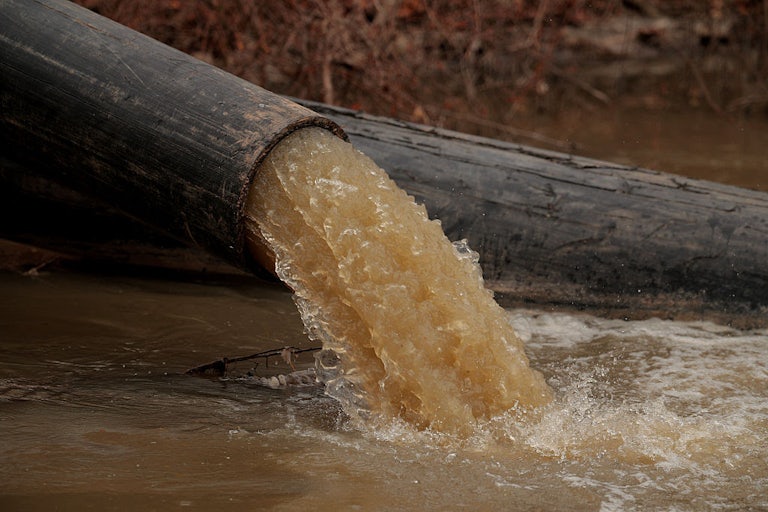
Brown water pours out of a pipe, against a riverbank.
Chip Somodevilla/Getty Images
Pipes divert raw sewage around a broken section of the Potomac Interceptor in Cabin John, Maryland.

Why is water so different from air? It sounds like the start of a joke. But it’s a fair thing to wonder after the Trump administration last week officially revoked the so-called endangerment finding, a 2009 scientific conclusion that climate change threatens human health and that greenhouse gases were therefore an appropriate subject for federal regulation under the Clean Air Act.

This move paves the way for the elimination of all federal regulation of greenhouse gas emissions. These rollbacks may kill a lot of people long before the associated climate effects kick in, though, because the emissions that the government has been regulating also reduce general pollution. The Environmental Defense Fund projects that the rollbacks could trigger an extra 37 million asthma attacks between now and 2055.

The Trump administration is not at all concerned about blowback, though, and in fact was making victory laps much of last week, with Interior Secretary Doug Burgum saying that all the extra carbon dioxide in the air would be good for plants.

Contrast that with how eagerly President Trump is trying to blame Democrats for a recent large sewage spill into the Potomac River.

“Maryland, Virginia, and Washington, D.C., who are responsible for the massive sewage spill in the Potomac River, must get to work, IMMEDIATELY,” the president posted Tuesday on Truth Social. “If they can’t do the job, they have to call me and ask, politely, to get it fixed. The Federal Government is not at all involved with what has taken place, but we can fix it,” he added. “This is a Radical Left caused Environmental Hazard.”

None of this is true, of course—as Maryland Governor Wes Moore pointed out, the federal government is actually responsible for overseeing the segment of sewer line that failed. And maybe that’s why Trump decided to weigh in.

But this is also an odd issue for Trump to highlight. Although the spill of over 200 million gallons of raw sewage is widely being referred to as the largest in the nation’s history, it hasn’t resulted in any boil-water advisories yet—and water quality is not exactly a signature Trump issue anyway. In his first administration, he scrapped the Clean Water Rule, significantly narrowing the scope of federal water protections. This time around, his administration is also attempting to roll back federal protections.

This isn’t the only story recently suggesting that clean water may have political significance that clean air doesn’t. Last week, Charlie Hope-D’Anieri wrote about the wild-card candidacy of a retired water scientist running for secretary of agriculture in Iowa. Chris Jones almost certainly will not win, Hope-D’Anieri acknowledged. But he’s upending long-standing, almost sacred conventions in Iowa politics by challenging the ethanol industry, and arguing “that farmers should be required to make basic, specific adjustments to their practices to prevent the ruination of the state’s water supply.” And, perhaps surprisingly, he’s getting some traction, including good turnout at campaign events.

On Tuesday, Inside Climate News reported a new poll that suggests Jones’s early success is not just a freak accident. “Eighty-five percent of voters in Iowa’s first and third U.S. House districts,” reports Anika Jane Beamer, “say they would be more likely to vote for an elected official who prioritizes protecting clean water, including cutting industrial agriculture pollution.” These are both “vulnerable, narrowly Republican districts,” Beamer notes. It’s not impossible that these will be some of the districts that determine whether Democrats flip the House in November.

“It’s very clear that Iowa’s water crisis has reached a boiling point,” Food & Water Action political director Sam Bernhardt reportedly said at a press conference announcing the poll results.

Now, you might be inclined to dismiss any single poll along these lines—and it’s worth noting that Food & Water Action did commission this one. But it’s also consistent with prior polling showing that water quality is a strikingly popular issue, which doesn’t seem as vulnerable to the partisan divides seen on other environmental topics. Pew polling from 2023 found that 63 percent of people thought the federal government was doing “too little” to “protect water quality of lakes, rivers and streams,” and only 7 percent said it was doing “too much”—making it the top issue when compared to air quality, climate change, protecting animals and their habitats, and protecting natural parks and nature preserves.

Regular polling from the Value of Water Campaign has also found that the number of voters calling “reliable water access” a “very” or “extremely important” issue has been rising for five years straight.

There are some caveats, of course, to how far political concern over water quality can go. The water crisis in Flint, Michigan, reached appalling levels for years, and it didn’t seem to make a huge political difference. A lot of people are comfortable ignoring quality issues with other people’s water.

Still, the political relevance of water availability and quality doesn’t seem likely to fade in the near future. It’s a key concern for the MAHA segment of Trump’s supporters. And the water crisis playing out in the American West, as the Colorado River dries up, is only getting worse, affecting both blue states and red. This past weekend, the seven states trying to negotiate a solution to this missed their deadline for a second time.

Water might not be a deciding factor in the midterms this November—there are a lot of issues that might take that prize. But as a political issue, it’s not going away.

Stat of the Week
3 degrees Celsius

That’s the level of global warming a new report says governments need to prepare for—double the 1.5 degree Celsius (2.7 degree Fahrenheit) limit that leaders agreed to in 2015.

What I’m Reading

As Trump Obliterates Climate Efforts, States Try to Fill the Gap

As the Trump administration scraps the endangerment finding, Maxine Joselow has a timely report for The New York Times about how some states are trying to step up in the climate fight.

The end of federal greenhouse gas limits is an obstacle, but not a death knell, in the fight against climate change on the state level, experts said.

Colorado helps explain why.

In 2019, Gov. Jared Polis, a Democrat, set an ambitious goal of reducing the state’s greenhouse gas emissions 50 percent by 2030, from 2005 levels. Colorado is now on track to meet this goal by 2032, a two-year delay for which local leaders have largely blamed the Trump administration’s environmental rollbacks.

Read Maxine Joselow’s full report at The New York Times.

This article first appeared in Life in a Warming World, a weekly TNR newsletter authored by deputy editor Heather Souvaine Horn. Sign up here.