Breaking News
Breaking News
from Washington and beyond

Trump Lawyer Accidentally Reveals Emails About Overturning 2020 Election to the Media

The emails show that Trump's legal team wanted Supreme Court Justice Clarence Thomas to stop the certification of the 2020 election.

John Eastman
Ting Shen/Bloomberg via Getty Images

On Wednesday, Politico published eight emails showing Donald Trump’s legal team discussing how Supreme Court Justice Clarence Thomas was their “only chance” to stop the certification of the 2020 election.

How did Politico get those emails? A Trump lawyer forgot to deactivate a Dropbox link.

The emails illuminate efforts by Trump lawyer John Eastman and other members of the former president’s legal team to challenge the 2020 election results. Trump attorney Kenneth Chesebro wrote in a December 31, 2020 email that Justice Thomas was their “only chance to get a favorable judicial opinion by Jan. 6, which might hold up the Georgia count in Congress.”

“I agree with this,” Eastman replied, writing that court action would help “kick the Georgia legislature into gear.”

District Judge David O. Carter had ordered Eastman to turn over these and other emails to the House select committee investigating the January 6 riots by October 28, determining that they showed evidence of potential criminal activity.

On the day of the deadline, Eastman’s legal team sent an email to the 9th Circuit Judge, requesting an emergency stay. But after Carter had refused a deadline extension, Eastman’s lawyers folded, sending a Dropbox link including the emails to the committee, seven minutes before the deadline.

They also requested the panel not actually read the emails until the 9th Circuit Court of Appeals ruled on the request for a stay. But Eastman’s legal team didn’t formally file for the stay until later that evening—after the email was already sent.

And so it seems by continuing to try keeping the emails away from the January 6 committee, Eastman’s team accidentally exposed them to the public. When the appeals court asked for filings from both parties in response to Eastman’s request for a stay, the January 6 committee sent over Eastman’s email, which had the for some reason still active Dropbox link.

The House general counsel did not know that the link in his emails was still active, when filing with the court:

“Some media outlets have been able to access the Dropbox link that counsel for Dr. Eastman created to share documents with the Select Committee and that was included in the attachments to the brief we filed with the Court last night in response to Dr. Eastman’s emergency motion. We were not aware that the links in Dr. Eastman’s email remained active…”

In similar fashion to Alex Jones’ lawyers accidentally leaking the entire contents of his phone as the Infowars founder was being sued for defamation, it seems that the legal team of the former president’s legal team have cast a major blunder for their client.

Read more at Politico.
Two Economists Explain the Federal Reserve’s Fourth Consecutive Interest Rate Hike

The Federal Reserve has increased interest rates by .75 percent. Economists Ryan Sweet and Dean Baker explain what that means.

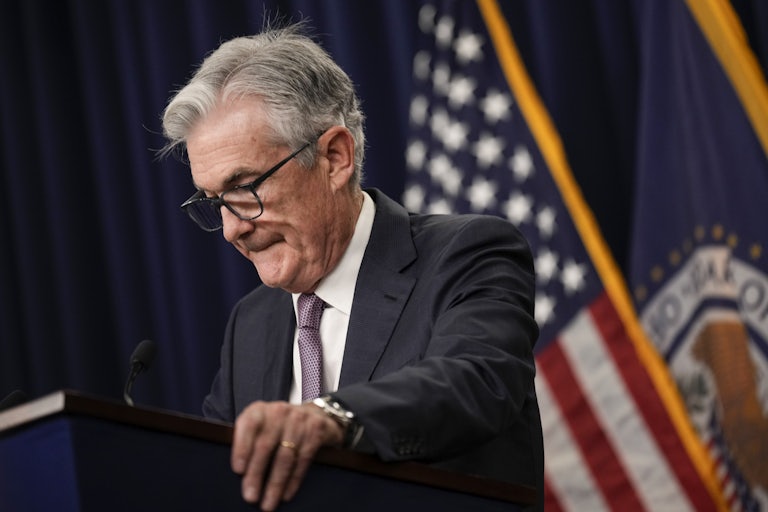
Federal Reserve Chair Jerome Powell
Drew Angerer/Getty Images

The Federal Reserve on Wednesday announced an interest rate hike of 75 basis points for the fourth consecutive time.

With inflation at a 40-year high, the Fed has been scrambling to get interest rates high enough that people stop spending money, slowing the economy down in turn. If spending goes down, then so will demand and eventually prices, too.

But the risk is that growth will slow while prices and borrowing rates stay high, sending the economy into a recession.

Ryan Sweet, chief economist at Oxford Economics, and Dean Baker, senior economist at the Center for Economic Policy and Research, answered four questions about what this means going forward.

What will the decision mean for Americans?

Both economists said that the higher interest rates will mean higher mortgage rates and higher rates on personal loans, car loans, and credit card debt.

But “it’s not all bad news as savers will receive a higher interest rate,” said Sweet.

Why is inflation still so high, even with all the rate increase?

“The issue for the Fed is that the Fed funds rate is a blunt tool and can affect the demand side of the economy, but this isn’t responsible for the bulk of the U.S. inflation issues,” Sweet explained. Supply chain snarls caused by the pandemic and Russia’s invasion of Ukraine are the major contributors to the record-high inflation.

Unfortunately, the U.S. central bank’s policies can’t do anything about the supply issues. The policies also take a long time to go into effect.

Fortunately, according to Baker, “there is a lot of evidence inflation is already slowing. The price of many items, like appliances, used cars, and TVs are already falling.”

This many consecutive rate hikes is uncharted territory for the Fed. Should we be concerned?

“Definitely,” said Baker. “The full effect of the rate hikes to date will not be felt until well into 2023. The Fed may well have gone too far.”

The Fed is scrambling to achieve a so-called soft landing, or a decrease in inflation without tipping the U.S. economy into a recession. Fed Chair Jerome Powell said Wednesday that the time to slow rate hikes “is coming,” but he did not give a time frame for when that would happen.

Sweet warned that any easing will be “contingent on inflation moderating, job growth slowing and financial market conditions.”

Given how many variables there are in avoiding a recession, it’s unclear what the Fed will do next or whether they will be successful. And unfortunately, “risks of a recession are uncomfortably high,” Sweet said.

Is a soft landing still possible?

All hope is not lost.

Sweet said that, based on his firm’s analysis, the central bank likely can’t contain economic growth sufficiently, but “the Fed still has a shot”—so long as job growth slows, indicating the economy is slowing, as well.

Baker warned that a lot will depend on whether there are “further major economic disruptions,” such as another Covid-19 wave or an expansion of the war in Ukraine.

“A soft landing is very much possible, but we really are in uncharted waters,” he said.

This article has been updated.

Tulsi Gabbard Has Endorsed At Least 12 Republicans This Election Season

The so-called “free thinker” has only endorsed Republicans since leaving the Democratic Party.

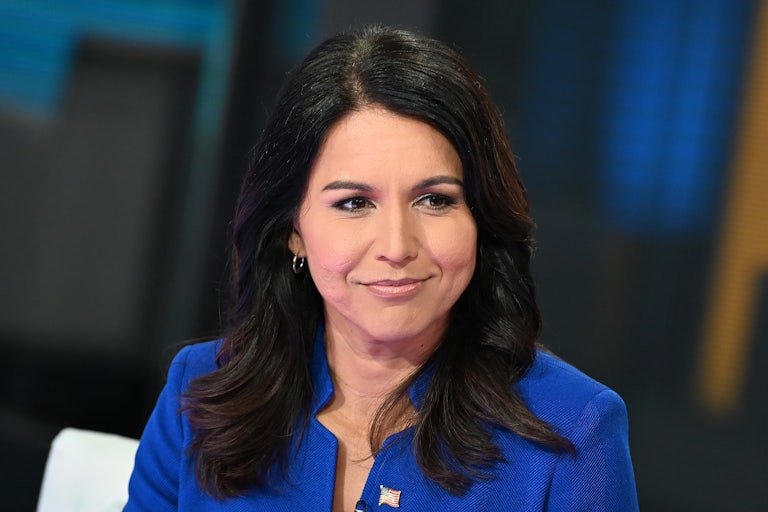
Slaven Vlasic/Getty Images

On October 11, Tulsi Gabbard proudly announced her departure from the Democratic Party. Calling on “fellow common sense independent-minded Democrats” to join her, Gabbard did not indicate where exactly she was going. Her recent activity gives enough of an idea.

The former Hawaii congresswoman and 2020 Democratic presidential contender has exclusively endorsed at least 12 Republican candidates across the country. Many of these races are high-stakes. Among Gabbard’s endorsements are several election-denialists and conspiracy theorists.

Less than a week after her announcement that she was leaving the Democratic Party, Gabbard endorsed Republican Don Bolduc in the New Hampshire Senate race. Threatening to unseat incumbent Senator Maggie Hassan, Bolduc is an election denialist who has repeatedly—and bizarrely—falsely claimed children are using litter boxes in schools. A day after that, Gabbard endorsed Republican Kari Lake, the conspiracy theorist and election denialist running for governor in Arizona.

Gabbard has also endorsed JD Vance against Tim Ryan in Ohio’s Senate race, Adam Laxalt against Catherine Cortez-Masto in Nevada’s Senate race, and Tudor Dixon against Gretchen Whitmer in Michigan’s gubernatorial election.

On Monday, Gabbard waded into the country’s most expensive House race, endorsing election denialist Tom Barrett in Michigan, rebuking Liz Cheney’s earlier endorsement of Democrat Elissa Slotkin.

On Wednesday, Gabbard tweeted a video endorsing Blake Masters, citing a need to “rein in big tech companies.” (Masters and Vance have both enjoyed financial support from the venture capital and technology industry they were a part of, including from tech billionaire Peter Thiel.) Also on Wednesday, Gabbard appeared at a rally for South Dakota Governor Kristi Noem, who days earlier she had called her “close friend.”

Gabbard has also endorsed Illinois gubernatorial candidate Darren Bailey, Utah Senate incumbent Mike Lee, candidate for Washington’s third congressional district Joe Kent, and candidate for Michigan’s third congressional district John Gibbs (an election denialist who in the past suggested that women should not have the right to vote).

Gabbard’s shift is not surprising. Beyond appearing at CPAC this year, she has found a home in right-wing media. There, she has focused less on bringing conservatives closer to her, and more on bringing herself closer to them—criticizing the impeachment inquiry into former President Donald Trump as “partisan,” complaining about “open borders,” and even filling in for Tucker Carlson on his show.

If Gabbard is just preparing for 2024, she can take comfort knowing support is already bubbling. David DePape, the man who attacked Paul Pelosi last week, has endorsed Gabbard to be Trump’s running mate.

This piece has been updated.

Arizona Judge Restricts Armed Vigilantes Monitoring Election Drop Boxes

The order prevents members of Clean Elections USA from standing within 75 feet of a ballot box or following voters after they drop off their ballots.

OLIVIER TOURON/AFP via Getty Images
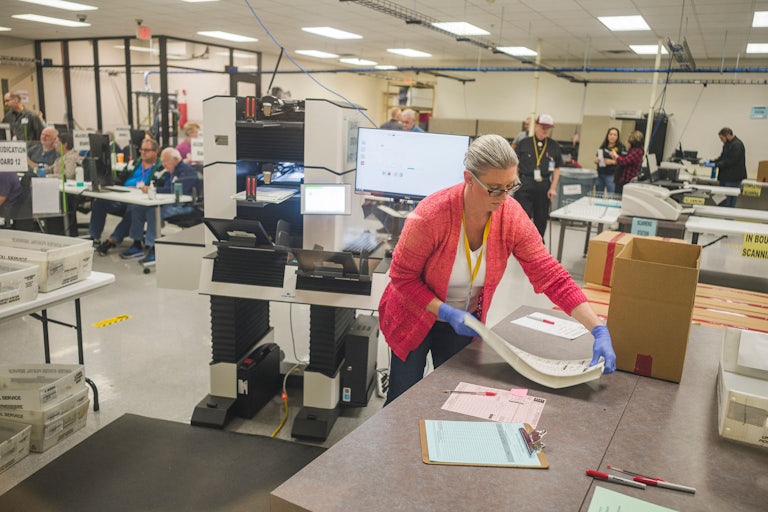
A poll worker in Maricopa County, Arizona.

In a rare piece of good news, an Arizona judge has banned people accused of voter intimidation from monitoring the state’s ballot boxes ahead of the contentious midterm elections.

U.S. District Court Judge Michael Liburdi sharply restricted the activities of a group called Clean Elections USA late Tuesday. The group says it is watching ballot dropoff locations for potential voter fraud, but it has been accused of voter intimidation

Group members cannot stand within 75 feet of a ballot box, Liburdi said in his ruling. They cannot speak to people at the boxes unless spoken to first and cannot follow voters after they drop off their ballots.

Watchers are not allowed to be armed—some of them have been—and they cannot take photos or videos of voters. Both the group and its founder Melody Jennings have to post statements on the Clean Elections USA website and Truth Social, former President Donald Trump’s social media platform, explaining they have been spreading disinformation about Arizona elections.

Arizona law enforcement has been on high alert over the past few weeks after reports of sometimes armed people showing up to watch ballot boxes. Many voters have accused the watchers of voter intimidation after they took photos and videos of people dropping off their ballots and followed voters.

The watchers could have scared off other potential early voters, or voters in general. They have received support from Mark Finchem, who is running for Arizona secretary of state.

They have apparently been inspired by widespread lies about the 2020 election result. Trump has claimed for years, with zero proof, that the vote was rigged against him.

The League of Women Voters sued Clean Elections USA last week, accusing them of voter intimidation and seeking a court order to halt their actions. During the trial on Tuesday, a man and his wife testified that they had been harassed and filmed by eight to 10 people accusing them of being “mules” for fraudulent votes.

Photos of the man and his car were published, and Jennings later spoke about them on the podcast of former Trump advisor Stephen Bannon.

Liburdi’s ruling Tuesday is both a relief and an about-face from Friday, when he refused another group’s request to ban Clean Elections USA from ballot boxes. “Plaintiffs have failed to show” their case is likely to succeed, the Trump-appointed judge said.

Arizona has struggled particularly hard with false claims that the 2020 election was stolen. Governor Doug Ducey certified the state’s result in favor of President Joe Biden, but the state’s Republican Party supported a massive recount of the votes that ultimately found no evidence of voter fraud.

Republicans are also already priming voters to reject Democratic victories in the upcoming midterm elections, particularly tight ones, as fraudulent.

Report: “Death to Arabs” Was the Chant at the HQ of the “Star” of the Israeli Elections

The Israeli elections aren't just about Netanyahu. It gets worse.

Mostafa Alkharouf/Anadolu Agency via Getty Images
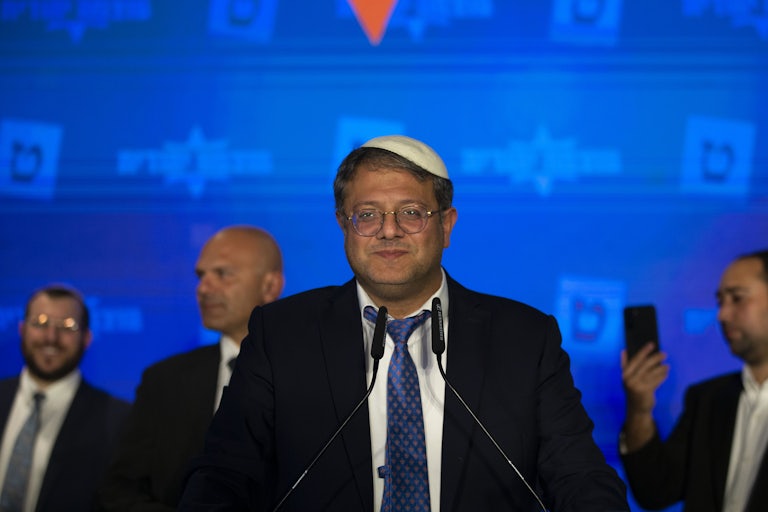
Kahanist lawmaker Itamar Ben-Gvir

The main news takeaway from the Israeli elections Tuesday is that Bibi Netanyahu is apparently lined up to be prime minister again, thus avoiding prison (which some speculated was the main, Trump-like reason he ran in the first place) and sweeping back to power. His Likud Party will lead a right-wing bloc that may hold up to 65 seats in the 120-seat Knesset—a pretty substantial margin in a deeply divided country. 

But scratch below the surface, and the real big news is even worse than a resurgent Bibi. The hard right coalition of small parties scored a huge win and will roughly double its representation in the parliament. Haaretz, the liberal newspaper, didn’t mince words. The headline on the column by Aluf Benn, the paper’s respected editor, read: “The Latest Incarnation of the Right: Kahanist Bibi-ism.”

If you don’t know anything about Israeli politics, consider this. Translating that headline into American terms, it might read something like: “The Latest Incarnation of the Right: Duke-ist Trumpism,” Duke being David Duke, the neo-Nazi Klan leader from Louisiana. That’s how bad this is. Kahanism refers, of course, to Meir Kahane, the racist, right-wing leader from the 1980s whose Kach Party was so extreme it was banned from the Knesset.

The new face of Kahanism is Itamar Ben-Gvir of the Otzma Yehudit Party, part of the Religious Zionism coalition. He has spent years spouting extremist and racist rhetoric about Arabs; last week, his party started forming an armed civilian militia in Tel Aviv to monitor Palestinian laborers. Benn referred to him as the “star” of the campaign, waving his “banner of racism and nationalism, which has also infected the Likud campaign.” Haaretz also reported that according to some witnesses, the crowd celebrating Ben-Gvir’s victory “chanted ‘death to Arabs’ alongside the more prevalent calls for ‘death to terrorists.’”

The vote is only about 85 percent complete, so if the small parties of the left and center exceed their existing count in the remaining votes, the worst extremism could yet be blocked. But it appears that Israel has taken a sharp turn toward a right that’s more extremist and hard-line than even Bibi.