Breaking News
Breaking News
from Washington and beyond

Trump-Backed Starling Bo Hines Falls in Surprise Loss in North Carolina House Race

Bines was seen as a "young star"in the Republican Party. Then, he lost.

Bo Hines
Dylan Hollingsworth/Bloomberg via Getty Images

In a major loss, Trump-backed Republican Bo Hines has lost to Democrat Wiley Nickel in North Carolina’s 13th congressional district. FiveThirtyEight had predicted Hines to have a 77 percent chance of winning.

Nickel leads Hines 51.32 percent to 48.68 percent, with all precincts reporting.

Hines, whose campaign received over $775,000 from his family’s trust fund, enjoyed support from former President Donald Trump, House Minority Leader Kevin McCarthy, and outgoing North Carolina Representative Madison Cawthorn.

Hines began running for Congress in North Carolina’s 5th district, but relocated to the 13th due in part to redistricting that changed seat maps.

The 27-year-old was advanced by Trump and other Republicans as a rising star in the party. The young Republican had adopted Trumpian classics, saying he was running because he did not want to “sit idly by on the sidelines and watch radical, Marxist leftists destroy our country for the next generation.” He said he would “not stand for cowardly, RINO Republicans that seek to dismantle the America First movement.”

Hines, an election denialist, has also called abortion murder and said exceptions should only be allowed for victims of rape and incest. Even then, in Hines’ worldview, those victims would only have access to abortion on a case-by-case basis after a “community-level review process” determined them eligible..

Nickel—a criminal defense attorney, former staffer in President Barack Obama’s White House, and member of the North Carolina state Senate—ran as an experienced moderate. While Nickel says the federal government is spending too much money, he also argues the state isn’t spending enough money on services like health care and public education.

Hines’ loss is yet another in a disappointing evening for Republicans, who were expecting a so-called “red wave.”

Brian Kemp Reelected Georgia Governor, Defeats Stacey Abrams

Kemp managed to hold onto his seat, despite a strong challenge from Abrams.

Megan Varner/Getty Images

Brian Kemp was reelected as governor of Georgia Tuesday, defeating Democrat Stacey Abrams, according to a projection from CNN.

While much of the media attention on Georgia has focused on the Senate race between Raphael Warnock and Herschel Walker, the outcome of the state’s governor race was also hotly anticipated.

Kemp, who has been a fixture of Georgia’s government since 2003, is a staunch conservative. But he has had a fraught relationship with former President Donald Trump because of his refusal to go along with Trump’s attempt to overturn the 2020 election. Georgia narrowly went for Joe Biden in that cycle, and his unexpected victory there was crucial to securing the presidency.

Democrats have been gaining momentum in the formerly deep red state, a development attributed to the growing influence of voters of color, in particular Black voters.

Abrams has been credited with playing a key role in Joe Biden’s 2020 win, having spent the better part of a decade building up Georgia’s Democratic organizing infrastructure and mobilizing the state’s expanding Black middle class.

Kemp and Abrams had previously gone head to head in Georgia’s 2018 gubernatorial race, with Kemp winning by just 54,723 votes, or about 1.4 percent. Abrams’s organization, Fair Fight Action, filed a lawsuit shortly thereafter alleging voter suppression, though a judge ruled against it this September.

Voting rights was a major point of contention in the leadup to the election. Last April, Kemp signed an egregious voter suppression law, sharply restricting access to absentee ballots and ballot drop boxes.

Abortion was another flashpoint in the race. Under Kemp’s governorship, Georgia passed one of the country’s most restrictive abortion laws, prohibiting the procedure after six weeks—before many people know they are pregnant. During a televised debate, Kemp refused to say whether he would further restrict access. Abrams promised to veto any additional tightening of abortion laws and to work to repeal the six-week ban.

MAGA Candidate J.D. Vance Wins Ohio Senate Race, In Huge Blow to Democrats

Vance beat Tim Ryan and maintained Republican control of the seat.

Drew Angerer/Getty Images

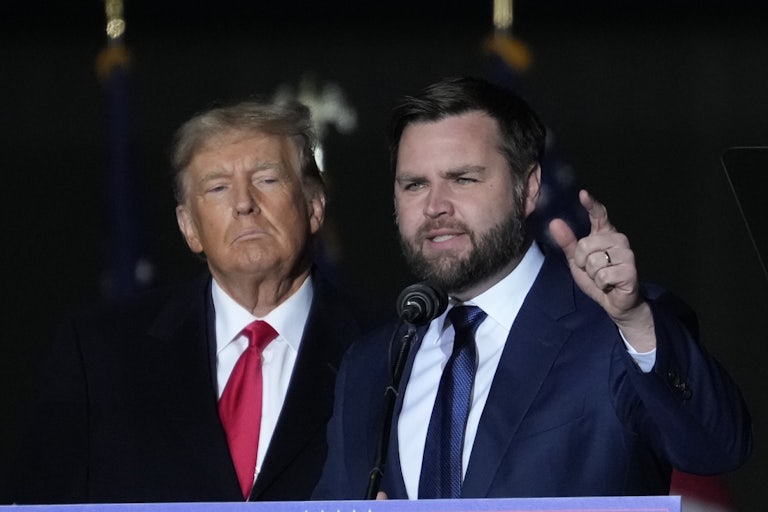
MAGA Republican J.D. Vance was elected Ohio senator Tuesday in a tight race against Democratic Representative Tim Ryan, according to a projection from NBC.

Vance leads Ryan 53.5 percent to 46.4 percent, with 87 percent reporting.

Ohio has long been viewed as a swing state, but it went solidly for former President Donald Trump in 2016 and has continued to shift farther right ever since.

But the competition between Ryan and Vance to replace outgoing Republican Senator Rob Portman was surprisingly tight, leaving many analysts unsure of which way it would go until the results came in.

Ryan had served for years as an Ohio representative. Although he is a registered Democrat, on the campaign trail, he sought to cast himself as more of an independent. He agreed with Trump on trade, but supported environmental policy, affordable health care, and legislation to codify abortion access and regulate gun ownership.

Vance, a former venture capitalist and writer, ran on an extreme right-wing platform. He was vague on his plans for issues such as inflation and energy production. But he was clear that he wanted to push back against gun control and to stop granting amnesty to undocumented immigrants.

He said he wanted to finish the expensive and ineffective U.S.-Mexico border wall started under Trump and ban all abortion.

Vance is also a 2020 election denier and wants to end mail-in voting.

His political leaning was a surprise to many, though. Vance rose to prominence with the publication of his memoir Hillbilly Elegy, an examination of the white working class, which quickly became a bestseller and was made into a movie. At the time of publication in 2016, Vance was a conservative Trump-skeptic living in San Francisco.

But when he moved back to Ohio, he made a stark and unexpected shift to the right, endorsing QAnon conspiracy theories and the lie that the 2020 election was stolen. He even traveled to Mar-a-Lago to secure Trump’s endorsement of his senatorial campaign.

This piece was updated.

Democrat Abigail Spanberger Secures Key Win in Virginia

Republicans were expected to take Spanberger's seat, but she held on to it.

Samuel Corum/Getty Images

In Virginia’s 7th congressional district, Democrat Abigail Spanberger was projected the winner in a tough and very closely watched race.

Her Republican opponent was Yesli Vega, who supported a nationwide abortion ban and other far-right positions. A Fredericksburg newspaper, in endorsing Spanberger, wrote of Vega: “Not only is Vega dangerously uninformed about rape and its consequences, she is making clear what other extremists are now pushing—a total nationwide ban on abortion in the U.S.”

Spanberger’s win is a huge emotional lift for Democrats. The GOP put a big target on her, gerrymandering her district to make it more Republican and even moving it around such that the house where she lives was no longer in the district. This was a seat the GOP fully expected to take.

Assuming this holds, Democratic incumbents end up holding two of the three seats Republicans were licking their chops about. Jennifer Wexton in northern Virginia also appears to have fought off a challenge from Hung Cao, who was advertising heavily on Washington DC TV in the campaign’s closing weeks. But it does appear that Elaine Luria of Virginia Beach will lose to GOP challenger Jen Kiggans (another extremist). Luria made her work on the January 6 committee defending democracy a centerpiece of her campaign. It would have been great to see Luria pull that out.

But Spanberger’s win is huge. And she ran in part on the infrastructure bill—that is, she didn’t run away from Joe Biden’s agenda. Two out of three in Virginia, especially when one of the two is a candidate the Republicans really thought they could take out, is a very big deal.

Arizona Judge Denies GOP Request to Extend Voting, Says There’s No Evidence People Couldn’t Vote

Conspiracy theorists are pointing to a problem with voting machines in Arizona's Maricopa County, but voters could still drop off their ballots.

John Moore/Getty Images
Kari Lake

There was a strange back and forth about voting in Arizona’s Maricopa County on Tuesday, which  resulted in a judge denying a request to extend voting in the county beyond normal hours.

It started with a problem with tabulator machines in the county that sparked worries (and some suspicion among conspiracy theorists) that voters in the country wouldn’t be able to cast their ballots. The Republican National Committee, the National Republican Senatorial Committee, Republican gubernatorial nominee Kari Lake, and Republican Senate nominee Blake Masters filed a joint lawsuit the same day seeking to extend voting by a few hours. In response, the campaign for Senator Mark Kelly, the incumbent and Masters’ Democratic opponent, filed a lawsuit arguing against extending voting in the county.

“At the eleventh hour of this election, Plaintiffs seek the drastic remedy of changing the rules of the election, while it is occurring, in the hopes of obtaining an electoral advantage,” the lawsuit wrote. “But there is no evidence that any voter who appeared to vote at Maricopa County polling places was turned away from the polls or that voting today in Maricopa County was substantially impeded.”

Indeed, the voting machine issue didn’t stop people at those polls from voting. Voters were simply told to instead drop their ballots off in a lockbox attached to the machines.

Late Tuesday night, a Superior Court judge for Maricopa County denied the Republicans’ request to extend voting by a few hours, saying there wasn’t strong enough evidence that voters were unable to vote within the original period of time.

The Maricopa voting machine problems garnered scrutiny from law enforcement and election officials, who moved throughout the day to quell fears that people weren’t able to cast their vote. Former President Donald Trump said, without evidence, “there’s a lot of bad things going on” in Maricopa County. But officials with the Department of Homeland Security’s Cybersecurity and Infrastructure Security Agency (CISA) stressed that despite some hiccups, voters were still able to vote.

“We have no indication of malfeasance or malicious activity,” a CISA official told reporters Tuesday afternoon.