Breaking News
Breaking News
from Washington and beyond

Manchin’s Last-Ditch Attempt to Save His Pipeline Deal is Unlikely to Work

Senator Joe Manchin isn’t giving up on his fight for permitting reform, even after it was removed from the annual defense spending bill.

Al Drago/Bloomberg/Getty Images
Senator Joe Manchin

The final text of the 2023 National Defense Authorization Act, or NDAA, was released Tuesday, and absent was Senator Joe Manchin’s so-called “Dirty Deal,” a set of provisions he was promised in exchange for his support for the Inflation Reduction Act (a bill he massively watered down).

Now Manchin is trying yet again to include his provisions, this time as an amendment to the annual defense spending bill. Manchin released his amendment Wednesday, with various concessions to try to appeal to Republican support instead of members of his own party. Nevertheless, he seems unlikely to garner enough support.

The bill would weaken environmental review processes and fast-track the permitting process for energy projects, including pipelines and fossil fuel infrastructure.

Manchin’s bill seeks to clear the path for the Mountain Valley natural gas pipeline, a West Virginia project opposed by several community and environmental groups, facing lawsuits in state and federal courts, and even invalidated by an appeals court.

Federal agencies would be called to proceed in issuing permits and leases, superseding citizen challenges and clearing the path for the legally and communally opposed fossil fuel project.

But the effort failed for a second time Tuesday, after Manchin previously attempted to attach the bill to the September continuing resolution that avoided a government shutdown.

Manchin’s provisions were not all inherently bad. They sought to promote construction of new electrical transmission lines, which are urgently needed in order to reach net-zero emissions. And to be fair, opposition to energy infrastructure projects can be rooted in Nimby-esque rationales; expedited permitting can help push forward the construction of urgently needed green infrastructure.

But Manchin’s approach, foregrounded by his thirst for a natural gas pipeline, did not capture  those potential benefits. Democrats don’t have to trash the entire bill, but they also ought not leave the fight for permitting reform to the most conservative Democrat in Congress.
After Losing Georgia, Republicans Are Suddenly Interested in Early Voting

After Raphael Warnock’s victory, Republicans may be rethinking their years of attacks on early voting.

Michael Kovac/WireImage
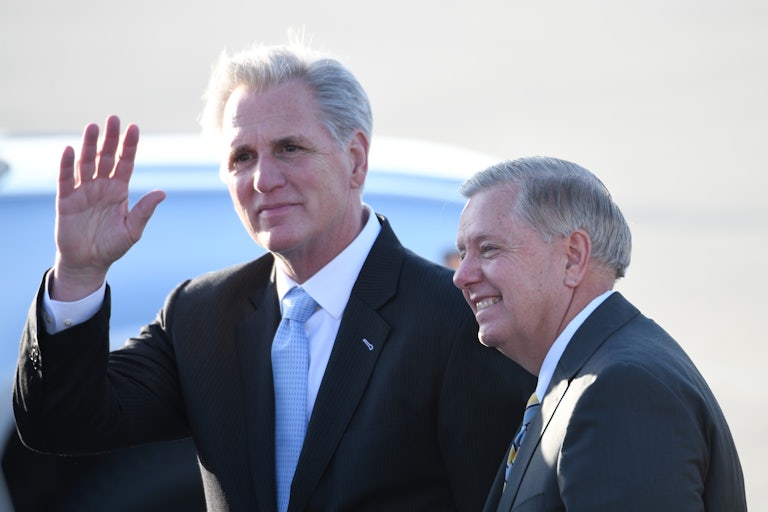
House Minority Leader Kevin McCarthy (left) and Senator Lindsey Graham

After Republican Senate candidate Herschel Walker’s loss in Georgia Tuesday night, some Republicans are conceding that maybe attacking methods of voting isn’t a good way to, well, get votes.

On his program Tuesday night, Fox News host Sean Hannity looked to Republicans including House leader Kevin McCarthy and former Speaker of the House Newt Gingrich for insight as to why “Republicans have been unwilling, for whatever reason … to vot[e] early and vot[e] by mail.”

“Republicans in the past, we had an advantage because we would vote early, we would vote by mail, and we put that away,” McCarthy said.

Gingrich, an election denialist who had previously suggested arresting election workers after the 2020 election, told Hannity that “you have to play the game by the rules that are existing,” encouraging Republicans to vote early and by mail.

On Wednesday, Senators Lindsey Graham and Rick Scott also suggested that their party could improve on its early and mail-in voting stances. Fomenting distrust in such practices “has to change because we need to bank votes like they do,” said Graham.

The reason Republicans haven’t been voting early or by mail is because Donald Trump—and his followers—all discouraged it. From January to September 2020, Trump attacked mail-in voting over 100 times, according to The Washington Post. And Republican politicians, officials, and media followed suit, leading to 18 states passing legislation that made mail-in voting harder this year.

Georgia Republicans themselves sought to block early voting from beginning on November 26.

Hannity too has shared Project Veritas videos peddling mail-voting conspiracies to his millions of followers on Twitter and has hosted segments attacking mail-in and early voting practices, sowing doubt in the integrity of such methods.

Unfortunately, Republicans still can’t outright say, “It’s good to make voting easier for people,” in the same way they can’t outright denounce Trump.

“There were many in 2020 saying, ‘Don’t vote by mail, don’t vote early,’” said RNC Chair Ronna McDaniel Tuesday on Fox News. “And we have to stop that and understand that if Democrats are getting ballots in for a month, we can’t expect to get it all done in one day.”

An RNC spokesperson later said that McDaniel apparently wasn’t talking about Trump, who has been the loudest voice on the matter and called to ban early voting when he announced his 2024 candidacy last month.

Paul Gosar Deletes Tweet Supporting Trump’s Call to Terminate the U.S. Constitution

Republican Representative Paul Gosar announced on Twitter that he agrees with Donald Trump, and then backtracked an hour later.

Anna Moneymaker/Getty Images
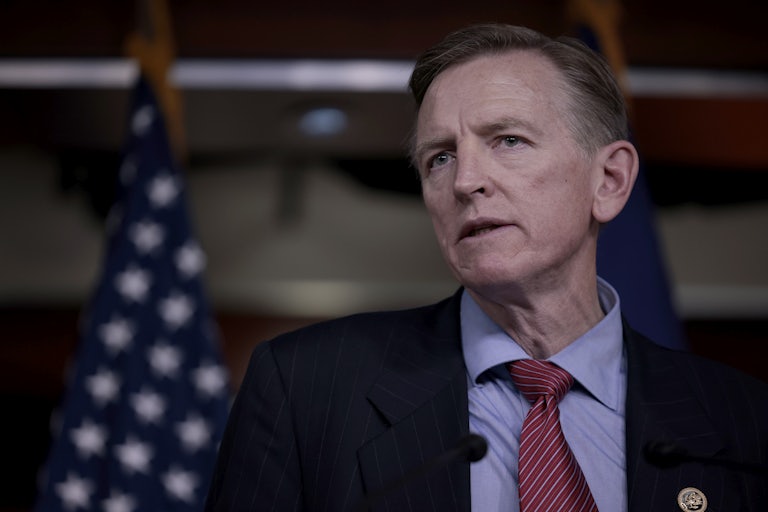
Republican Representative Paul Gosar

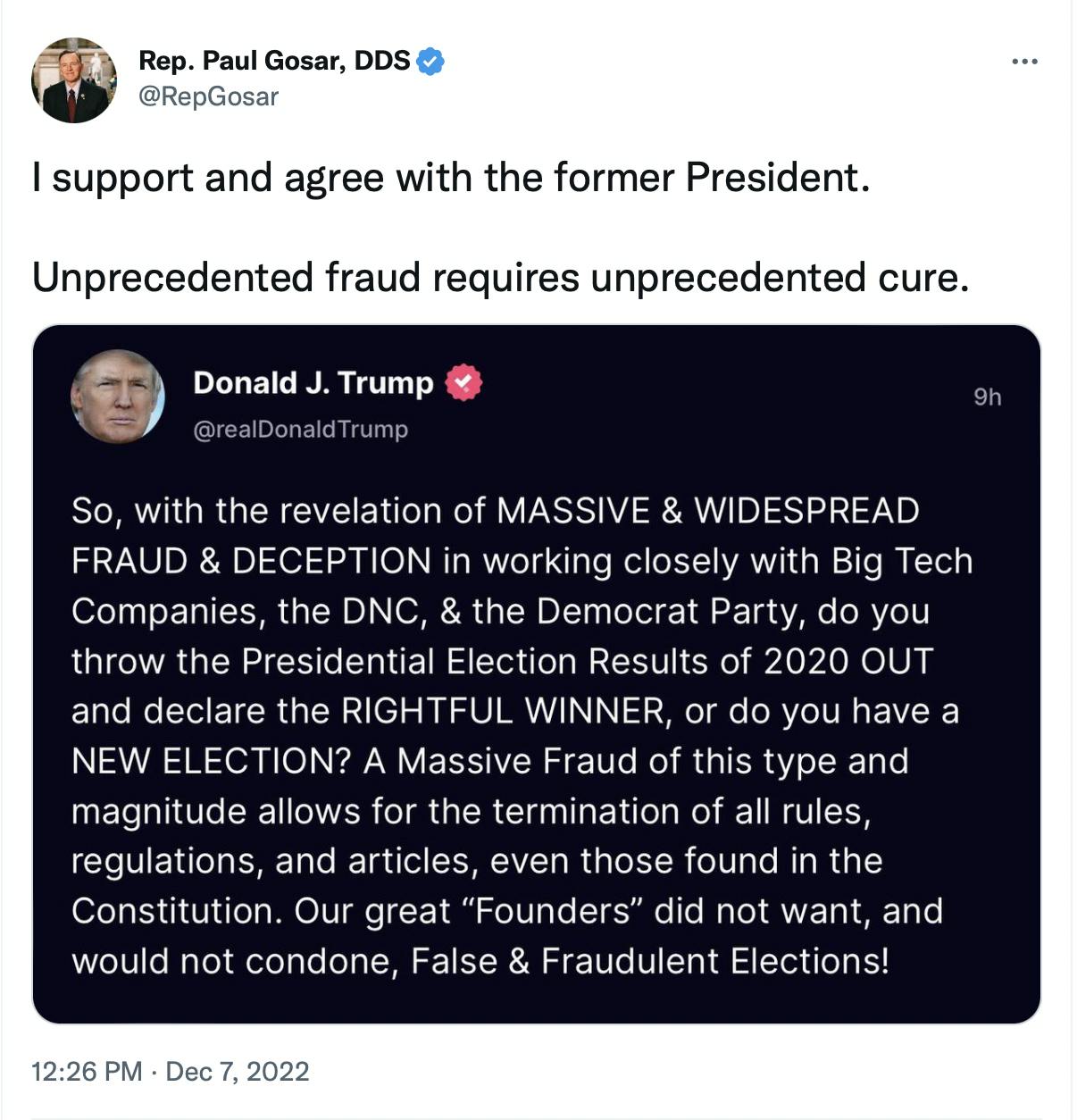
Republican Representative Paul Gosar on Wednesday endorsed Donald Trump’s call to terminate the U.S. Constitution and overturn the 2020 election—and then deleted the post an hour later.

In his latest effort to reverse his loss, Trump demanded over the weekend to terminate the Constitution, baselessly citing “WIDESPREAD FRAUD & DECEPTION” on Truth Social. Republicans have been horrifically slow to condemn him, and Gosar went a step further and publicly agreed with him on Twitter.

A few Republicans have spoken out against Trump’s demand, but they are mostly all moderates or already vocal critics of the former president. Representatives Liz Cheney and Adam Kinzinger, the only Republicans on the House January 6 investigative committee, were explicit and forceful with their condemnations, but they are both outgoing members of Congress.

Although the Republican Party at large seems to be turning on Trump, he still holds significant sway in Congress and among the American public. Anyone seen as going against him risks losing the support—and provoking the wrath—of his rabid fan base.

The list of his outrageous behavior in just the past few months continues to grow, and yet Republicans are loath to criticize him lest they lose his favor.

What Democrats Can Do With 51 Seats in the Senate

With Raphael Warnock’s victory in Georgia, Democrats can now do a whole lot more in the Senate.

Nathan Posner/Anadolu Agency/Getty Images

With Raphael Warnock’s victory in Georgia, Democrats have officially secured 51 seats and an outright majority in the U.S. Senate.

Warnock beat MAGA Republican Herschel Walker on Tuesday night with, coincidentally, almost 51 percent of the vote. His win means that Democrats now have an outright 51–49 majority in the Senate, instead of a 50–50 split with a tiebreak.

And that one-seat difference is huge: “It’s big. It’s significant. We can breathe a sigh of relief,” Senate Majority Leader Chuck Schumer told a press conference on Wednesday. “It gives us … just a great feeling, enthusiasm, unity, encouragement.”

Crucially, the Senate now has a rock-solid majority to block certain measures by the House of Representatives. Republicans eked out control of the chamber during the midterms and have already promised a raft of somewhat petty moves, such as investigating Hunter Biden and impeaching members of President Joe Biden’s Cabinet.

The Senate, which tries impeachment cases, can acquit anyone put forward. It can also block unnecessary investigations or legislation.

House Republicans have previously indicated they have some traditionally conservative plans, such as supporting tax cuts and reducing government spending. But they have also pledged to ban trans women from playing in women’s sports and to seek to restrict abortion access.

Democrats also now hold the majority of votes in Senate committees, which means investigations and legislation will move much more quickly. The Senate will also be able to approve presidential nominees, including for judges, more easily.

And last, the party no longer has to be fully unified to achieve its goals. Before, if a single senator—usually Kyrsten Sinema or Joe Manchin—broke ranks, it could tank a bill or nomination. But now Democrats have a little more wiggle room.

Most legislation in the Senate requires a 60-vote minimum to pass, though, so Democrats will still need to negotiate with Republicans in order to get bills through.

With the 2024 election cycle already approaching, it’s hugely important for Democrats to leverage their newfound power, even if it seems slim, and pass major legislation. The more they are able to accomplish in the next two years, the better positioned they will be to hold onto the Senate and maybe even retake the House.

Warnock: My Mom Grew Up Picking Somebody Else’s Cotton, Now She Picked Her Son as U.S. Senator

The newly elected Georgia senator delivered a powerful speech, and made sure to thank his mom while he was at it.

Elijah Nouvelage/Bloomberg/Getty Images

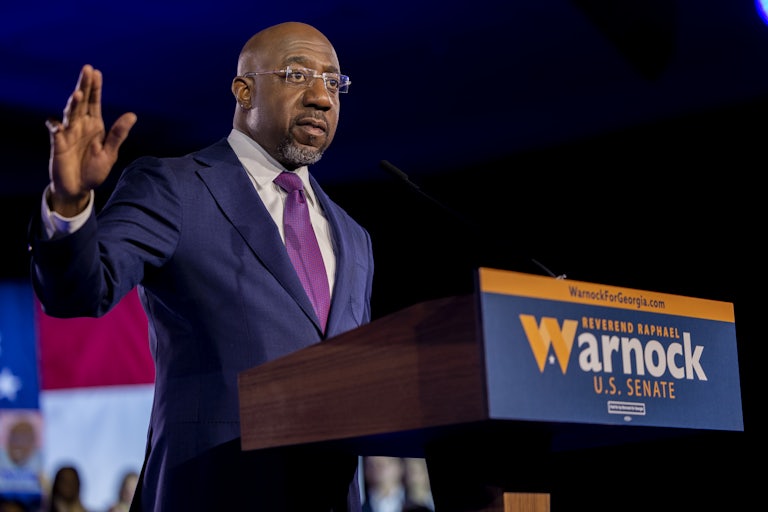
Taking the stage to roars of “six more years,” Senator Raphael Warnock delivered a victory speech Tuesday night befitting someone who may end up serving in higher office one day.

And the newly re-elected Georgia senator made sure to thank his mom for helping make it all happen.

“She grew up in the 1950s, in Waycross, Georgia, picking somebody else’s cotton and somebody else’s tobacco,” Warnock said. “But tonight, she helped pick her youngest son to be a United States senator.”

Warnock, a progressive pastor who leads the same church Martin Luther King Jr. preached at, also thanked voters for showing up in the run-off elections.

“I often say that a vote is a kind of prayer for the world we desire for ourselves and for our children.”

“Here is what I’ve learned as a pastor,” Warnock continued. “You can’t lead the people unless you love the people. You can’t love the people unless you know the people. And you can’t know the people unless you walk among the people. You cannot serve me if you cannot see me.”

Warnock later explained how his own children empower him to better the world. “You help inspire me to do my part to build a world befitting of the curiosity, the creativity and the possibility that I see in your eyes and in the eyes of all of our children.”

Warnock’s victory and spirited remarks serve to remind that Democrats actually have a wide bench for a post-Biden era.

Warnock, a man elected twice in a state that otherwise resoundingly elected Republicans statewide; newly-elected Pennsylvania Governor Josh Shapiro and Senator John Fetterman who both displayed that “social issues” are not in conflict with “kitchen table issues,” and are actually winning items; Gretchen Whitmer, who has had as much success in Michigan as media-favorite Ron DeSantis has had in Florida.

They are among Democrats who have committed to generally progressive stances, while still winning impressively. Much of that is perhaps spurred by Warnock’s simple, closing thought: “I want all of Georgia to know, whether you voted for me or not, that every single day I am going to keep working for you.”

You can watch Warnock’s full victory speech here.