Breaking News
Breaking News
from Washington and beyond

The IRS Wasn’t Auditing Trump’s “Extremely Complex” Taxes After All

Donald Trump repeatedly claimed he couldn’t release his tax records while he was president because he was under audit. But a new House report says that wasn’t really true.

Donald Trump stands in front of five large U.S. flags, wearing a suit and holding seeral red caps in his left hand. He looks like he is yelling at the camera, or perhaps a crowd not shown in the photo.
Mario Tama/Getty Images

The IRS did not audit Donald Trump’s taxes until two years into his presidency, despite his adamant claims to the contrary, the House Ways and Means Committee revealed.

The Democratic-led committee has been trying to get Trump’s tax returns for three years, after he refused to release them during the 2016 presidential election, which is not required but is precedent. Trump repeatedly insisted during the course of his presidency that he couldn’t release them because his taxes were under audit and also far too complicated for the general public to understand.

In 2017, then–White House spokeswoman Sarah Huckabee Sanders said Trump’s tax returns couldn’t be released because “the president’s taxes, no matter who the president is, actually immediately go under audit after being filed.”

Turns out that wasn’t really true.

The House Ways and Means Committee obtained six years’ worth of the former president’s tax returns in late November, despite Trump’s repeated efforts to prevent that from happening. The Ways and Means Committee met behind closed doors Tuesday and voted along party lines to release the documents. They warned, though, it could be several days before the documents are ready for release.

The committee revealed that the IRS failed to audit Trump until 2019, despite a program that makes auditing sitting presidents mandatory. Those audits are not yet completed, according to the committee.

Trump’s tax returns also show he paid $0 in taxes in 2020.

“Actually I paid tax,” he insisted in September 2020. “And you’ll see that as soon as my tax returns are—it’s under audit. They’ve been under audit for a long time. The IRS does not treat me well.”

The House committee has reviewed six years of tax returns, primarily from Trump’s time in office. The documents include his personal tax information and that of several of his businesses.

Trump has fought long and hard to prevent the release of his tax returns, raising questions about why he would do so.

He seems to be fighting a multifront war, and it is not going super well. The January 6 investigative committee on Monday unanimously recommended the Justice Department pursue criminal charges against Trump for his role in the insurrection.

His Trump Organization was also found guilty of tax fraud and related crimes, and Trump himself is also under investigation by the FBI for taking classified documents to Mar-a-Lago.

Congress Leaves Afghan Refugees Out of Year-End Deal

Tens of thousands of Afghan evacuees could be forced to leave the U.S. next year after being cut out Congress’s new spending compromise.

Anna Moneymaker/Getty Images
A mother and her son walk through the National Conference Center in Leesburg, Virginia, which has been redesigned to temporarily house Afghan nationals, in August.

Although the omnibus package of bills to fund the government expands the number of special immigrant visas to Afghan allies still trapped in Afghanistan, it does not address the plight faced by tens of thousands of Afghan evacuees settled in the United States: They do not currently have a pathway to permanent residency, and their eligibility to remain in the country expires in August 2023.

Veterans’ groups and human rights organizations had been hoping that the Afghan Adjustment Act would be included in the omnibus. The bipartisan bill would have provided additional vetting for Afghans already in the U.S.—a priority for Republicans—and then offered a path to permanent residency. However, the bill was dropped from the omnibus that was released Monday night, in large part due to opposition from GOP Senator Chuck Grassley, who worried that vetting requirements were insufficiently stringent. When I asked Senator Chris Coons of Delaware on Tuesday why the measure had been dropped from the omnibus,  he succinctly replied: “Ask Chuck Grassley.” Coons had spearheaded the effort to pass the legislation in the Senate.

“I’m hopeful that in the next Congress, we can take this up and move it quickly,” Coons told reporters on Tuesday. “I am hearing from Afghans in Delaware regularly that this harms their ability to find employment, find housing, get access to health care, [and] really fully engage in life in the United States. And I think we’re at risk of not honoring those who served alongside us for 20 years.”

Advocates are pressing for the Afghan Adjustment Act to be added to the omnibus as an amendment, but it’s unclear if that could receive sufficient support from Republicans. Meanwhile on Tuesday the Taliban announced that all women are now banned from attending universities in Afghanistan.

Biden: The Iran Nuclear Deal Is “Dead”

President Joe Biden made the comments to a group of activists in November, as seen in a newly resurfaced video. But administration officials are confirming what he said: The U.S. is not interested in a deal right now.

Joe Biden
Drew Angerer/Getty Images

The Biden administration isn’t interested in a nuclear deal with Iran, at least for now.

A newly resurfaced video shows President Joe Biden declaring the Iran nuclear deal “dead,” though he hedges and says the United States won’t formally announce it. The video was shared on Twitter by an Iranian software engineer living in the United States, who said that it was originally captured in California on November 4.

Biden is asked by a member of the crowd to admit that the Joint Comprehensive Plan of Action, the official name for the 2015 Iran nuclear deal, is dead: “Can you just announce that?”

“No,” Biden responds, adding that he couldn’t do so for “a lot of reasons.”

But after that initial denial, the president appears to change his message and goes on to admit, “It is dead, but we’re not gonna announce it.”

“We just don’t want deals with the mullahs,” the person in the crowd says. “They don’t represent us. They’re not our government.”

“Oh I know they don’t represent you,” Biden says, “but they’ll have a nuclear weapon that they represent.”

Thanks to the video’s brevity, Biden’s statements aren’t entirely clear, but Axios got an administration official to confirm the core aspects: that Biden’s administration is  not currently interested in a nuclear deal with Iran.

The JCPOA is not our focus right now. It’s not on the agenda,” a White House National Security Council spokesperson told Axios.

“We don’t see a deal coming together anytime soon,” the spokesperson added, referring to Iran’s brutal crackdown on protesters and its support for Russia in its war on Ukraine. “Our focus is on practical ways to confront them in these areas.”

In October, U.S. envoy for Iran Robert Malley also said that the administration is “not going to waste time” on trying to revive the nuclear deal. The Biden administration has voiced support for the protesters in Iran, and last week the U.S. played a large role in kicking Iran off the U.N. women’s rights commission.

The video of Biden comes at a sensitive time, as EU and Iranian officials on Tuesday met in Jordan to discuss reviving nuclear negotiations.

Iran is also in the midst of a three-day economic shutdown, which is set to end Wednesday evening. Daily protests have rocked Iran since the death of 22-year-old Mahsa Jina Amini in police custody in September. The Iranian government has cracked down on these protests with brute force. Since Amini’s death, more than 500 other Iranians have been killed, including nearly 70 children, and more than 18,000 arrested, according to figures from the Human Rights Activists News Agency.

Iranian protesters have called for an end to the Islamic Republic—and for the West to stop saving its murderers. A nuclear deal with Iran would involve some sort of sanctions relief, as it did last time around, and is seen by many as extending a lifeline to the regime at a particularly precarious time.

The Government Funding Bill Does a Lot to Prevent Another January 6

Congress’s newly unveiled spending bill includes two key reforms, which will go a long way in safeguarding the country from another attack like January 6.

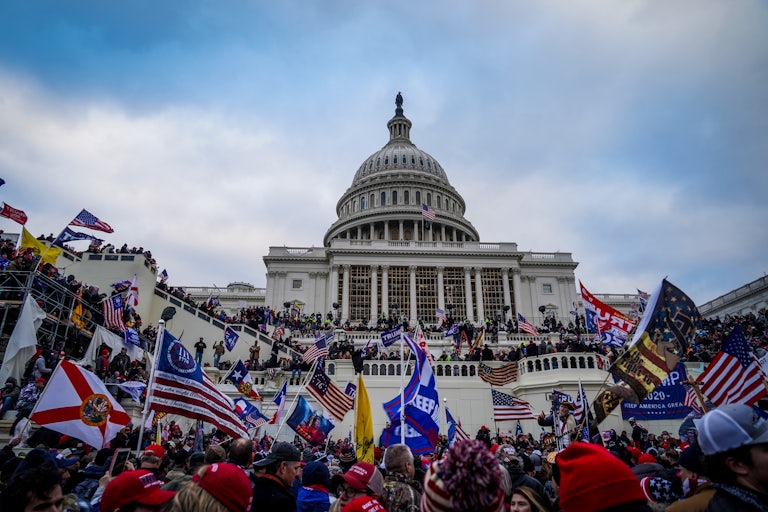
A shot of the Capitol Building from the outside, being swarmed by protesters. There are a lot of American flags, Trump flags, and "Trump 2020" banners.
Selcuk Acar/NurPhoto/Getty Images
Protesters storm the Capitol on January 6, 2021.

The newly unveiled federal budget bill contains two measures that will be crucial for preventing another attack like January 6 from happening.

The $1.7 billion omnibus spending package reforms how Congress counts Electoral College votes after a presidential election and also includes a major budgetary boost for U.S. attorneys investigating January 6 cases.

The Electoral Count Reform and Presidential Transition Improvement Act, which has bipartisan support, reaffirms that the vice president has only a ministerial role when Congress counts the Electoral College votes and cannot, as former President Donald Trump insisted, overturn the election results.

The bill also raises the minimum number of lawmakers required for an objection to the results to move forward.

The act has the full support of Democrats and the backing of many Republicans, including outgoing Representative Liz Cheney, who warned that the risk of another attempt to steal a presidential election is still high.

Senate Minority Leader Mitch McConnell has not commented on the act—or really, for that matter, the insurrection—but he did urge Congress to pass the full omnibus.

The omnibus also increases the U.S. attorneys’ budget by $212.1 million for a total of $2.63 billion in 2023. The House Appropriations Committee explained the funds were necessary “to further support prosecutions related to the Jan. 6 attack on the Capitol and domestic terrorism cases.”

The FBI has arrested about 900 people connected to the insurrection and has the identities of hundreds more. A total of about 3,000 people could be charged over storming the Capitol, when all is said and done.

NBC reported in October that the Department of Justice is critically underfunded for the January 6 investigations, so the boost from the omnibus could help locate and charge anyone who was thinking of becoming a repeat offender.

Three Incredibly Popular Things That Congress Chose to Leave Out of the Spending Bill

U.S. lawmakers unveiled a sweeping $1.7 trillion government spending bill. Still, they managed to exclude some popular provisions.

Alex Wong/Getty Images

U.S. lawmakers unveiled the massive omnibus bill early Tuesday. The spending bill lays out the federal budget for 2023.

The $1.7 trillion package is expected to pass both chambers by Thursday and then be sent to President Joe Biden’s desk for his signature the following day, just before the current budget expires.

Here are three major things that the bill has left out.

1. Drug reform

Two measures seeking to reform marijuana and cocaine policy have been left out of the omnibus, despite bipartisan support for both.

Congress had sought to allow cannabis companies to open bank accounts. Since marijuana is currently illegal under federal law, most banks won’t take a dispensary’s deposits, forcing the businesses to operate on a mostly cash basis. As a result, weed stores are prime targets for robberies.

But despite bipartisan and banking industry support for the act, senior Senate Republicans shot it down. This comes as a heavy blow to Biden’s efforts for cannabis reform. In October, the president pardoned thousands of people convicted of marijuana possession and said his administration would review how the drug is categorized.

The second measure, the EQUAL Act, was aimed at reducing the disparity in sentencing for crack versus powder cocaine offenses. Current laws for crack cocaine are much stricter: An individual needs to possess 500 grams of powder cocaine to trigger the five-year mandatory sentence, but only 28 grams of crack. These rules disproportionately affect people of color.

The act would have evened out the amount of powder and crack cocaine needed to trigger the minimum sentence, but despite having 11 Republican Senate co-sponsors, it failed to make the omnibus.

2. The Afghan Adjustment Act

The omnibus also leaves out the Afghan Adjustment Act, which would have expanded the special immigration visa program to help people fleeing Afghanistan and created a path to permanent residency for those already here.

Tens of thousands of Afghan refugees in the United States are at risk of deportation because they have a temporary status known as “humanitarian parole.” The act would have helped those people stuck in legal limbo and aided many more U.S. allies still trapped in Afghanistan. Former U.S. military officials urged Congress to pass the act.

The act had bipartisan support, but not a filibuster-proof majority, and it stalled for months in Congress. And now it hasn’t even made the mega-spending package.

Advocates are now hoping Senator Chuck Schumer will bring it for a floor vote as a standalone amendment.

3. The Child Tax Credit

The omnibus does not revive the expanded Child Tax Credit, which helped lift millions of children out of poverty over the past year.

The CTC was dramatically expanded in the first months of the Biden administration. Up to $3,600 per child was delivered to parents—including to households that were previously ineligible because they had no income—and helped cut the national child poverty rate nearly in half.

But those benefits expired last December, and roughly four million kids fell back into poverty.

The $12 billion act to revive the CTC is a tiny fraction of the overall bill and the massive defense budget that Republicans demanded. Democrats had indicated they were willing to compromise on an array of corporate tax cuts that the GOP wanted in exchange for the CTC, but Republicans were unwilling to negotiate.