Breaking News
Breaking News
from Washington and beyond

McCarthy Faceplant Watch: Five Rounds, No House Speaker, No End in Sight

Kevin McCarthy’s (failed) bid for House speaker continues.

Representative Kevin McCarthy
Anna Moneymaker/Getty Images

Kevin McCarthy cannot catch a break, losing his fifth consecutive vote for speaker of the House on Wednesday.

The California representative has been open about hoping to seize the gavel, but not only has he repeatedly lost the rounds of voting, he has lost individual votes in the process. In round five, he won just 201 votes out of his party’s 222 seats.

Democratic challenger Hakeem Jeffries again won 212 votes, making him “the lead vote-getter” in each round, as noted by Representative Pete Aguilar, who has officially nominated Jeffries for multiple ballots.

Congress cannot move forward until someone is elected speaker, so the proceedings will continue until someone wins. In Congress’s 200-year history, there have only been 14 instances in which it took more than two ballots to confirm the House speaker. The last one was exactly 100 years ago. It took nine rounds of votes to resolve that battle.

Hopefully it does not take that long this time.

This post has been updated.
McCarthy Faceplant Watch: Four Votes and Still No House Speaker

Kevin McCarthy lost the fourth round of voting for House speaker, with no clear end in sight.

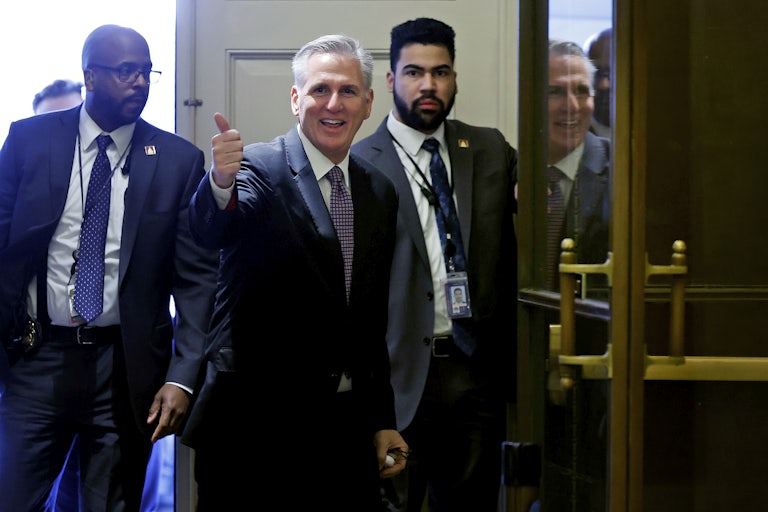
Representative Kevin McCarthy smiles and gives a thumbs up to the camera
Chip Somodevilla/Getty Images

Kevin McCarthy lost a fourth vote Wednesday to become speaker of the House, as the Republican Party struggles to reach a consensus.

The California Republican has made no secret of his desire to be speaker, and confidently predicted he would have the gavel in hand by round two of voting. But he lost three rounds of ballots Tuesday, embarrassingly receiving fewer votes than his Democratic challenger, Hakeem Jeffries, and even losing votes throughout the day, proving that the third time isn’t really the charm after all.

McCarthy won only 201 votes in the first round on Wednesday, even fewer than the day before. Nineteen Republicans have voted against him every time, and their ranks have grown by two. Representative Byron Donalds switched to the “no” camp late Tuesday, and on Wednesday, Representative Victoria Spartz—who previously backed McCarthy—instead voted “present.” Jeffries again received 212 votes, thanks to his party’s unified backing.

Unfortunately for all of us, the shambolic proceedings will continue until someone is elected speaker. Congress cannot move forward until someone wins. The House cannot approve a rules package for the new session or committee leadership. Politico also reported that if the speakership isn’t filled by January 13, committee staffers would have to go without pay.

In Congress’s 200-year history, there have only been 14 instances in which it took more than two ballots to confirm the House speaker. The last one was exactly 100 years ago. It took nine rounds of votes to resolve that battle.

McCarthy has refused to recess between votes to try to whip up more support. While he could still pull off a victory with fewer than 218 votes, it has already become an exhausting slog.

This piece has been updated.

Democrats Aren’t Willing to Give McCarthy a Win—Yet

Despite murmurings of a possible deal, they are still unified in their opposition to Kevin McCarthy’s bid for speaker.

Tasos Katopodis/Getty Images
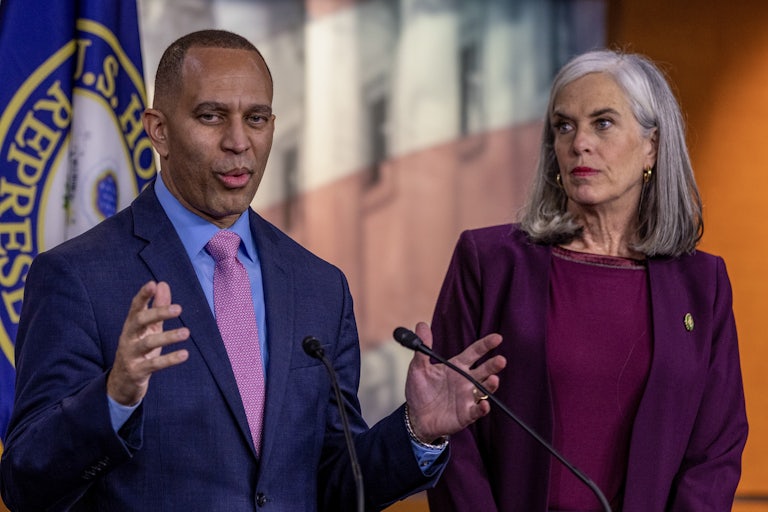
Will Democratic leader Hakeem Jeffries help resolve Kevin McCarthy's dilemma? Maybe, but not today.

Despite their newfound minority, House Democrats entered the Capitol in relatively good cheer this week, relishing the Republican disarray over who will be the next speaker. While GOP Leader Kevin McCarthy faced several defections in a series of votes for speaker on Tuesday, Democrats were united in their support for Democratic Leader Hakeem Jeffries. With no consensus, the House adjourned in the evening without a speaker—or without actually swearing in any members—ready to pick up where it left off on Wednesday.

While there has been some early speculation about how Democrats might have a role to play in resolving McCarthy’s dilemma, they’ve thus far given no indication that they are ready to offer the would-be House speaker an assist. On Wednesday, Democrats signaled that they would vote against a possible motion to adjourn brought by Republicans, a move that would keep the Republican leader in the hot seat. Jeffries assured me on Wednesday morning that the party would “remain united” and said that he had not spoken to McCarthy about a possible resolution.

“Our colleagues are committed to support Hakeem Jeffries for speaker,” Democratic Caucus Chair Pete Aguilar told reporters on Wednesday, adding that he had not heard from his Republican colleagues.

Democrats were also generally unimpressed with the notion, promoted by moderate Republican Representative Don Bacon, that they could offer some support to McCarthy. “I can’t imagine Democrats voting for somebody who accommodated an insurrection and turned his back on the American people for the speaker of the House of Representatives,” said Democratic Representative Dan Kildee after a Wednesday morning caucus meeting. But he was open to the idea of finding a so-called unity candidate: “If they want to pursue that, they know where to find us.”

“I don’t see Kevin McCarthy being a unity candidate,” agreed Representative Alexandria Ocasio-Cortez. “I do think that if there is any potential of a coalition candidate or, you know, Democrats bailing out Republicans, I think that would have to result in a much deeper and a much more profound negotiation of the structure of the House.” She offered some concessions that Republicans could make to earn Democratic votes on a speaker candidate: Granting committee chairmanships, for example, or agreeing to raise the debt limit, or a combination of multiple sweeteners. “I don’t think that would happen in a couple of hours,” Ocasio-Cortez continued.

Representative Rosa DeLauro also indicated that this was a Republican problem. “I think they have to sort it out,” DeLauro told me, adding that she didn’t think it was “likely” Democrats would take action to help McCarthy. “You don’t come to the floor of the House without the votes to be able to win.”

While Democrats may be popping the proverbial popcorn as this spectacle unfolds for their enjoyment, Kildee stopped short of saying that the new minority was having a good time. “The fact that Republicans are putting their dysfunction on full display has a lot of value. But if I wanted to have fun I’d think of some other things to do,” Kildee said with a laugh.

George Santos Caught Lying About Voting on Something He Wasn’t in Congress For?

The congressman-elect’s personal House website claimed he voted “nay” on the omnibus bill, which happened before Santos was in office.

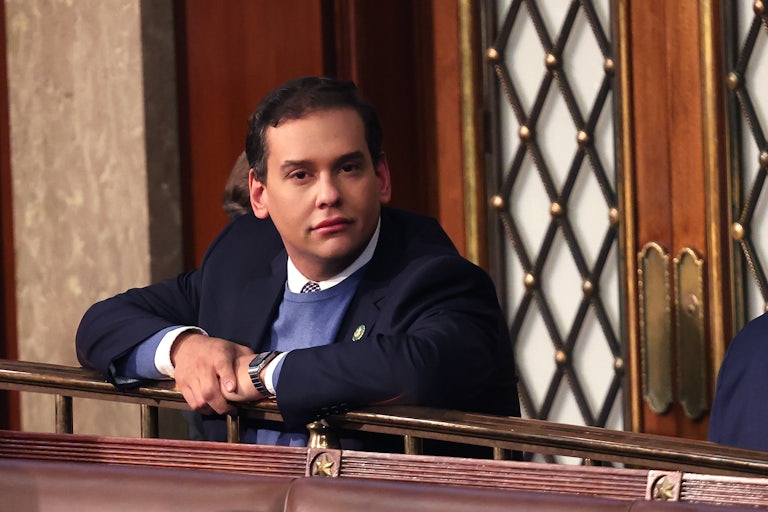
Representative George Santos leans over a railing in the House chamber and looks directly at the camera
Win McNamee/Getty Images

George Santos just had his first day in Washington yesterday. Repeat—yesterday. But as of Wednesday, one day after his first day, Santos’s website claimed he voted “nay” on the House omnibus bill, a vote that took place on December 23, 2022.

It’s not impossible for there to be clerical errors while keeping track of members’ votes. However, that is slightly less likely when the error is published on the particular website of a specific member of Congress. It is unclear why a newly elected member of Congress would choose to do this. Then again, you could say the same with regard to most of the brazen lies Santos has already told.

The bold-faced lie comes after Santos also posted a press release Tuesday evening announcing his swearing in to Congress—something that actually hadn’t happened given that the House has yet to select a speaker.

The misannouncement could readily be chalked to an accidental posting or staffer mistake. Actively marking down a vote that simply never happened is also erroneous, but much less likely to be an honest mistake. But after all, if you’re looking for honesty, Santos is not the first place you might go.

This post has been updated.

McCarthy Defectors Call Jim Jordan the “George Washington” of Our Generation

In an attempt to block Kevin McCarthy from becoming House speaker, Republicans are now comparing Jim Jordan—who doesn’t want the job—to George Washington.

Chip Somodevilla/Getty Images

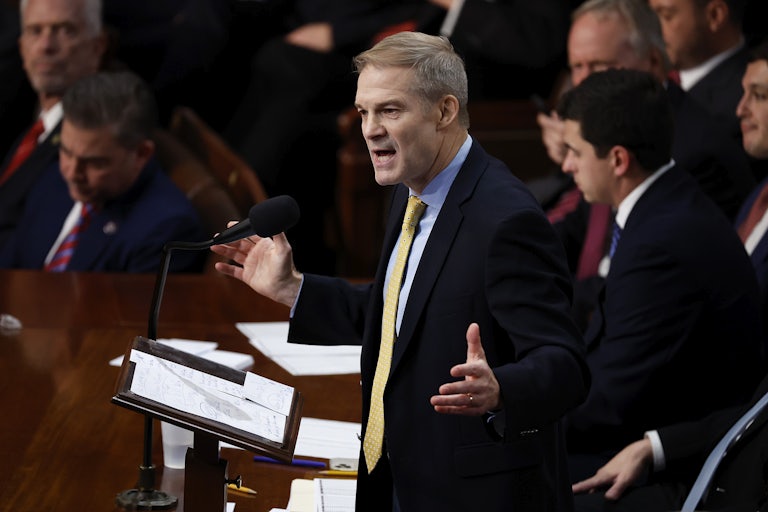
While far-right Republicans continue to block Kevin McCarthy’s bid to become the speaker of the House, they have rallied behind one man as their preferred alternative: Jim Jordan, or as Representatives Lauren Boebert and Scott Perry say, the George Washington of our generation.

“Our candidate is Jim Jordan,” Boebert said Tuesday on Fox. “He may not want it right now, but George Washington did not want to be president. He did what was right for his country.”

Perry echoed the same point a day later on Fox Business.

Representative Matt Gaetz has helped lead the House Republican defectors’ charge to keep the gavel out of McCarthy’s hands and to instead put it in Jordan’s hands. Meanwhile, Jordan purports not to want the job, having even endorsed McCarthy himself. As a result, Gaetz and company cite Jordan’s hesitancy as proof of why Jordan would be a good leader. Just as Washington didn’t really want to be president and did anyhow, the thinking goes, so this moment calls for Jordan to rise to the occasion.

Perry’s comments comparing Jordan to the first president of the United States notably came the same morning that twice-impeached former president and target of numerous investigations Donald Trump announced his full-throated support for McCarthy.

“Sad!” Gaetz told Fox News after Trump’s endorsement. “This changes neither my view of McCarthy nor Trump nor my vote.”

“Supporting McCarthy is the worst Human Resources decision President Trump has ever made,” Gaetz tweeted.

Not for nothing, John Trumbull’s painting General George Washington Resigning His Commission is on display just down the hall from congressional hijinks, in the Capitol Rotunda. The painting depicts the moment when Washington resigned from his position as commander-in-chief of the Continental Army, signifying his—and America’s—step away from militant autocracy and toward some semblance of a republic. “If he does that, he will be the greatest man in the world,” King George III is thought to have said upon learning of Washington’s resignation.

That is the kind of virtue Boebert and company are now trying to ascribe to Jordan.