Breaking News
Breaking News
from Washington and beyond

Federal Judge Rules DeSantis Violated the Constitution, Dismisses Lawsuit Anyway

A judge ruled that the Florida governor should not have suspended a Democratic state attorney—but the court will not reinstate him.

David Dee Delgado/Getty Images

A federal judge ruled Friday that Florida Governor Ron DeSantis violated the state Constitution and First Amendment when he suspended an elected Democratic state attorney last year, but the court would not step in and overturn that suspension.

State Attorney Andrew Warren sued DeSantis in August, two weeks after the governor suspended him for alleged “willful defiance of his duty.” DeSantis cited in particular a joint statement Warren signed with other elected prosecutors the day Roe v. Wade was overturned, stating “our firm belief that prosecutors have a responsibility to refrain from using limited criminal legal system resources to criminalize personal medical decisions,” such as abortion or transgender health care.

In his suit, Warren denied explicitly refusing to enforce laws and argued his suspension was political retaliation and a violation of his First Amendment right to free speech. He sought a judge’s order to restore him to office and to bar DeSantis from taking further action against him.

On Friday, U.S. District Judge Robert L. Hinkle sided with Warren that his rights had been violated, blasting DeSantis’s argument that the prosecutor had neglected his duty by making blanket promises not to prosecute certain cases.

Mr. Warren’s well-established policy, followed in every case by every prosecutor in the office, was to exercise prosecutorial discretion at every stage of every case. Any reasonable investigation would have confirmed this,” Hinkle wrote in his ruling. In his opinion, there was “not a hint of misconduct by Mr. Warren.”

But, the judge said, he was unable to restore Warren to office. He argued that the Eleventh Amendment of the U.S. Constitution, which restricts individuals from suing states in federal court, tied his hands.

“The Eleventh Amendment prohibits a federal court from awarding … relief of the kind at issue against a state official based only on a violation of state law,” Hinkle said in the ruling.

Not only is it frustrating to watch an elected official break the law and still get away with it, it is also worrying that this case will push DeSantis to go further. The Republican—and current favorite to face off against Donald Trump for the GOP presidential nomination—has gone to war with what he calls “trendy ideologies.”

He signed Florida’s “Don’t Say Gay” law and pushed the so-called Stop Woke Act, which restricts certain race-based conversations and analyses in colleges. That bill has been temporarily blocked from being implemented. This week, he banned an A.P. African American studies course in schools.

DeSantis getting away with suspending Warren without so much as a slap on the wrist could embolden him to take retaliatory measures against other public officials whom he deems too “woke.”
Kansas Republicans Introduce Bill to Ban Abortion, Even After Voters Said It Should Be Legal

Kansans overwhelmingly voted to protect the right to abortion in an August referendum. Now state Republicans want to overrule the will of the voters and ban it anyway.

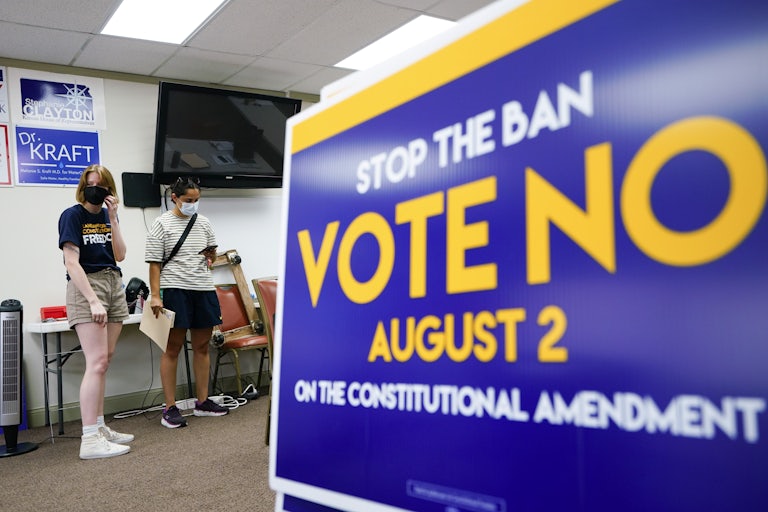
A sign in the forefront reads "Stop the Ban Vote No August 2 on the constitutional amendment." Two people stand in the background wearing masks.
Kyle Rivas/Getty Images

Republican lawmakers in Kansas have introduced a bill that would allow individual cities and counties to ban abortion, directly overriding a vote last year where the majority of state residents chose to protect reproductive rights.

Almost 60 percent of Kansans voted in August to keep the right to an abortion in the state Constitution. The result was considered—and turned out to be—a bellwether for the fight for reproductive rights after the fall of Roe v. Wade a few months earlier.

But on Thursday, Kansas state Senator Chase Blasi introduced a bill that would allow cities and counties to enact abortion restrictions, arguing he was taking the issue to “a more local level.”

Blasi apparently subscribes to the belief “If at first you don’t succeed, try, try again.” If it becomes law, his bill would undermine the voters’ decision from August.

“The irony of this bill is too much,” Anamarie Rebori Simmons, spokesperson for Planned Parenthood Great Plains Votes, told The New Republic. “The party that tried to remove fundamental protections from the state Constitution didn’t get the outcome they wanted when Kansans overwhelmingly supported abortion access. This is an attempt to blatantly disregard the will of the people. Abortion rights won in a landslide, including in the home county of the bill’s sponsor. Politicians serve as the voice of the people in the legislature, and Republican lawmakers should know better than to silence those they represent.”

Kansas allows abortion up to 22 weeks, but the state also has multiple rules aimed at discouraging people from getting abortions, such as requiring patients to receive state-directed counseling and to undergo an ultrasound before getting the procedure. The ultrasound provider must offer the patient the option to see the image.

Democratic state Senator Cindy Holscher slammed the bill as an attempt by “extremists” to “find another path” to increase restrictions on abortion and said the measure will likely go to court if it passes.

It’s not the only bill attacking reproductive rights: State Senator Mark Steffen also introduced a bill that would ban the prescription via telemedicine of abortion pills or drugs used to induce abortions.

Ashley All, a senior advisor for the reproductive freedom nonprofit Families United for Freedom, slammed the Blasi bill’s hypocrisy. “It’s important to remember that the amendment on the ballot in August specifically asked voters’ permission for politicians to further regulate abortion and voters said NO,” she told The New Republic. “These extreme anti-abortion politicians are ignoring the will of Kansas voters and attempting to eliminate our constitutional rights.”

Neither bill is likely to become state law. Kansas Governor Laura Kelly supports abortion rights and thus will probably veto them both should they make it to her desk. But the legislation is an indication that the attempts to limit reproductive freedom are only getting more intense.

This post has been updated.

After World’s Worst Investigation, Supreme Court Says It Can’t Find Who Leaked the Abortion Ruling

Here are all the holes in the Supreme Court’s effort to find who leaked the decision overturning Roe v. Wade.

Anna Moneymaker/Getty Images

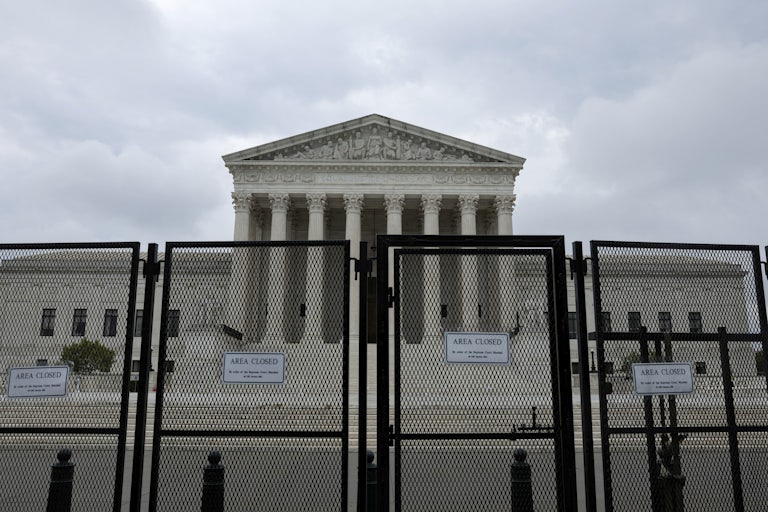
The Supreme Court has spent months investigating who might have leaked the draft opinion overturning Roe v. Wade, and the results released Thursday can best be paraphrased as such: “IDK, bro.”

The leaked draft last May caused widespread outrage, both in and outside the highest U.S. court. Protesters took to the streets, demanding the justices protect the right to abortion, but Chief Justice John Roberts was more concerned about the sanctity of the court, calling the leak a “betrayal of the confidences of the Court.” He assigned the marshal of the court and her team to investigate the source of the leak.

After a months-long investigation, the team announced Thursday it is “unable to identify a person responsible by a preponderance of the evidence.”

The court also consulted Michael Chertoff, a former secretary of homeland security, who confirmed the marshal “undertook a thorough investigation.”

Except … maybe not so much.

Investigators conducted 126 interviews of 97 court personnel, many of which were reportedly short and not exactly in-depth. Employees were asked to turn over the call and text logs from their personal cell phones, but investigators found “nothing relevant” in the records. Investigators also examined employees’ search histories to see if anyone was essentially stupid enough to Google, “Is it illegal for me to leak a Supreme Court draft opinion?” It appears no one was.

Several personnel admitted they had told their partners about the opinion draft, which violates the court’s confidentiality rules. It is unclear whether those staffers will face disciplinary measures and, more importantly, whether their partners were also questioned as potential leakers.

What’s more, the marshal’s report doesn’t specify whether any of the justices themselves were questioned, focusing instead on “Court personnel” and “temporary … and permanent employees.”

There has been plenty of speculation about who might have leaked the draft and why, but one thing is clear: This investigation was never going to give us those answers.

School Districts Across the Country Are Getting Electric Buses

Thousands of electric school buses will soon be in service and help cut greenhouse gas emissions, thanks to a major government investment.

Row of 6 yellow electric school buses in a parking lot
Christinne Muschi/Bloomberg/Getty Images

Nearly 500,000 school buses carry 25 million children to school across the country every day. And now America is in a full-swing effort to replace those buses with electric ones, setting the country on the path to cut greenhouse gas emissions by more than five million tons—equivalent to removing one million cars from the road.

Though states have begun transitioning buses for years, the nationwide project follows the 2021 Bipartisan Infrastructure Law, which commissioned $5 billion toward the effort to replace old, diesel-fueled buses with new cleaner vehicles. The first round of funding distributed nearly $1 billion to districts in states nationwide, including Washington, D.C., and territories including Puerto Rico and Guam.

Such investments not only save millions in emissions and in fuel costs but also correlate to better health and academic outcomes for children: better school attendance, lower rates of asthma, and stronger general respiratory health and cognitive functioning. While electric buses may come at a higher cost at first, the investment pays dividends almost immediately.

And districts from coast to coast are reaping the benefits.

“Our district’s diesel fuel costs are tremendous,” Heath Oates, superintendent of Missouri’s El Dorado Springs R-II school district, told The Daily Yonder. “My initial estimates show we’re going to save around $200,000 a year, which is the cost of four beginning teachers with benefits.”

Pellston Public Schools in Michigan are estimated to save 80 percent in energy use, saving the 461-student district about $33,000 annually. The estimated reduction in maintenance costs is about 60 percent, which would offer another $23,812 in annual savings.

Nevada’s Clark County district, which operates the nation’s largest owned-and-operated school bus fleet, with nearly 2,000 buses serving 125,000 students, has just unveiled its first electric model. Just one bus is estimated to save $60 a day in fuel costs—scale that to the whole fleet, and the district could save nearly $120,000 per day.

Beyond the massive fiscal and emission-reduction benefits, the bus rides themselves improve. Bus drivers cite the “smoother ride” and substantial noise reduction as improvements both for their own sake and in enabling them to more easily hear and communicate with their young passengers.

Policies like school bus transitions are good in their own right: The benefits they proffer fiscally, environmentally, and even socially are valuable. But they also show people across the country why policy—and policy battles—matter at all. A society acquainted with the benefits of things like electric school buses would be one eager to demand more such changes.

Treasury Resorts to “Extraordinary Measures” as U.S. Hits Debt Ceiling

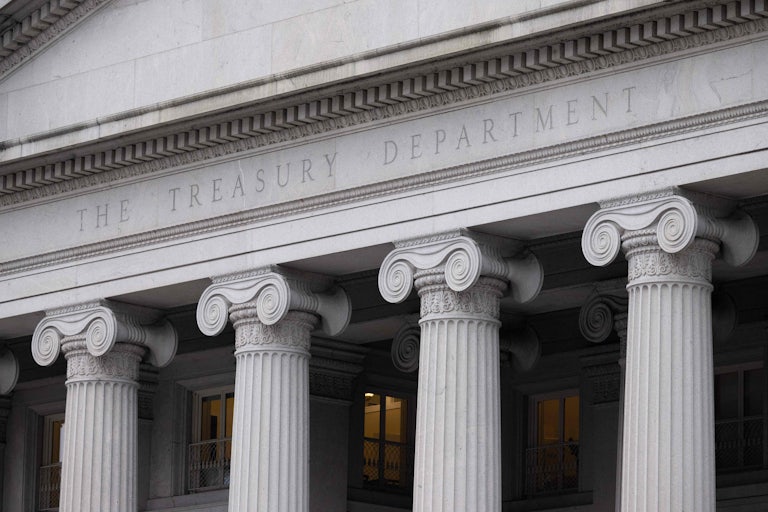
The Treasury Department is taking steps to make sure the U.S. doesn’t default on its debt, as House Republicans and the White House continue to face off.

SAUL LOEB/AFP/Getty Images

The Treasury is having to resort to “extraordinary measures” to prevent the United States from defaulting on its debt, which could plummet the country into a recession, Secretary Janet Yellen told Congress Thursday.

In a letter, Yellen explained the U.S. has reached its $31.4 trillion debt limit, forcing her to take steps to ensure the government does not default and has a little more time to solve the problem. For now, those “extraordinary measures” include redeeming and suspending new federal investments in the Civil Service Retirement and Disability Fund and the Postal Service Retiree Health Benefits Fund. In a letter last week, Yellen also expected that the Treasury will suspend reinvestment of the Government Securities Investment Fund of the Federal Employees Retirement System Thrift Savings Plan.

Suspending investment in these funds will preserve the country’s credit until June, but Yellen noted that the amount of time these measures will work is “subject to considerable uncertainty” and urged Congress to act quickly.

She warned last week that defaulting would cause “irreparable harm to the U.S. economy.”

The debt ceiling is the maximum amount of money the U.S. can borrow. The current level was set two years ago. If the government reaches its borrowing limit, it could default on its debt or fail to make a payment. Already high prices and inflation could skyrocket, sending the U.S. into a recession.

House Republicans, who hold the majority in the chamber, refuse to raise the debt ceiling and instead are trying to slash spending in other areas, such as entitlement programs, including Social Security and Medicare. But Democrats and President Joe Biden refuse to negotiate, with White House spokeswoman Karine Jean-Pierre warning Wednesday that the debt limit should not be used as a “political football.”

Defaulting means the government would be unable to pay military salaries and Social Security benefits. A lower debt ceiling would also mean less funding for programs such as Medicare and Medicaid, SNAP or food stamps, and meal programs for low-income students.

During the last debt ceiling standoff in 2021, Mark Zandi, the chief economist at Moody’s Analytics, warned that defaulting would send the U.S. into an almost immediate recession, wiping out up to $15 trillion in household wealth and nearly doubling the unemployment rate from about 5 percent at the time to about 9 percent.

“This economic scenario is cataclysmic.… The downturn would be comparable to that suffered during the financial crisis” of 2008, Zandi and Bernard Yaros, Moody’s assistant director and economist, said in a report.