Breaking News
Breaking News
from Washington and beyond

Why Are Joe Manchin and John Hickenlooper Already Endorsing Kyrsten Sinema?

The two Democratic senators have expressed support for Sinema, who switched her party to independent, over Ruben Gallego, who is running as a Democrat.

Anna Moneymaker/Getty Images

After Arizona Representative Ruben Gallego announced his candidacy for Kyrsten Sinema’s Senate seat on Monday, most congressional Democrats remained noncommittal about who they will back (if not, perhaps, hinting support for Gallego).

There were two notable exceptions, however: West Virginia Senator Joe Manchin and Colorado Senator John Hickenlooper, per Punchbowl News. “I think having a voice like that—she says what she thinks. And I think she adds value to the caucus,” Hickenlooper said. “The problem is she’s too moderate as a Democrat—well, that’s half the time what they say about me!”

Hickenlooper also nodded toward Senators Angus King and Bernie Sanders as two independents who caucus with the Democrats, citing them as examples for why Sinema should apparently be seen no differently. “I can’t imagine not supporting her,” he said.

Manchin, meanwhile, said he’s “totally supportive” of Sinema and said leadership “should support someone who brings basically some peace, if you will, or some rational thinking on some of this stuff without being pushed far left and far right.”

It’s understandable why most Democrats aren’t expressing their preferences one way or another. It’s still very early, and Sinema is still a voting and committee-sitting senator in a narrowly Democratic-led Senate. What’s more fascinating is why senators would so publicly express their support for Sinema given how early it is, how Sinema has not even expressed her 2024 intentions, and how Kari Lake or some other far-right Republican may soon announce their candidacy, raising the stakes of the race all the more.

Manchin’s early support for Sinema is unsurprising in a “Manchinema” universe that has plagued politics over recent years, obstructing a voter-won Democratic agenda and watering down legislation in favor of corporations at the expense of everyone else.

Hickenlooper’s support, on the other hand, seems less immediately intuitive. A look at his record at least presents an ideological affinity between him and Sinema. A longtime fossil fuel–favoring politician, Hickenlooper has been a linchpin for corporate influence in government. Hickenlooper famously shilled for fracking at a 2013 hearing, as he described drinking a glass of Haliburton-produced fracking fluid alongside Haliburton executives.

He was one of seven Democrats that joined Republicans to block a fracking ban in 2021.

Hickenlooper has shifted somewhat left on climate, perhaps propelled by the moment or by the 2020 primary challenge against him by Andrew Romanoff, endorsed by the likes of Bill McKibben and the Sunrise Movement. Still, Hickenlooper seems to find some kinship with his fellow “too moderate” Sinema.

The entrance of a Republican like Lake into the race, as well as Sinema’s moves from here on out, will indicate how eager Democrats actually are to rid themselves of her antics and how far they’re willing to go (and risk) to make it happen.

White Nationalist and Nazi Nick Fuentes Is Back on Twitter

Elon Musk’s Twitter has reinstated Fuentes’s account. Just last week, Fuentes called Hitler “really fucking cool.”

Zach D Roberts/NurPhoto/Getty Images

Nazi, white nationalist, and Taliban fan Nick Fuentes is back on Twitter.

Fuentes was originally banned from Twitter in July 2021 for his dangerous and violent rhetoric about people of color, women, Jewish people, immigrants, LGBTQ people, Covid-19, and much more.

Even after being banned from Twitter (and several other social media platforms), Fuentes continued his venomous tirade against everyone and everything in the world that is not him. He has proudly said he’s “just like Hitler,” has called for the right to embrace becoming a “truly reactionary party,” and has said that “Catholic monarchy, and just war, and crusades, and inquisitions” are much better than democracy.

Just last week, Fuentes called Hitler “a pedophile … also really fucking cool.”

And now Elon Musk’s Twitter has brought him back.

Fuentes proudly announced his return Tuesday morning:

Musk’s reinstatement of Fuentes legitimizes all the vicious garbage the Nazi has spewed, and essentially returns to him a massive avenue to spread it further:

And in an era of Twitter where the “For you” tab seems to operate more like a TikTok-ified right-wing funnel, amplifying accounts that many users would have no business seeing, the danger of Fuentes’s return cannot be overstated.

The reinstatement comes after Musk’s repeated failed attempts to bring Kanye West, known now as Ye, back to Twitter. In December, West appeared alongside Fuentes on Alex Jones’s InfoWars, where he peddled Nazi propaganda, Holocaust denialism, and support for Hitler. Later that night, he posted a swastika. Musk reneged and finally resuspended West. This episode was shortly after West and Fuentes shared a dinner with former President Donald Trump—one that relatively few Republicans denounced, by the way.

Fuentes’s return follows the reinstatement of other Nazis such as Andrew Anglin, founder of the neo-Nazi publication The Daily Stormer. Representative Marjorie Taylor Greene, Jordan Peterson, vicious transphobe Megan Murphy, and Trump himself round up other prominent individuals who have had their accounts reinstated after committing various and numerous Twitter policy violations.

Gavin Newsom Says Second Amendment Is “Becoming a Suicide Pact” After Yet Another Mass Shooting

At least seven people were killed in the Half Moon Bay shooting. California is reeling from three mass shootings in three days.

Mario Tama/Getty Images
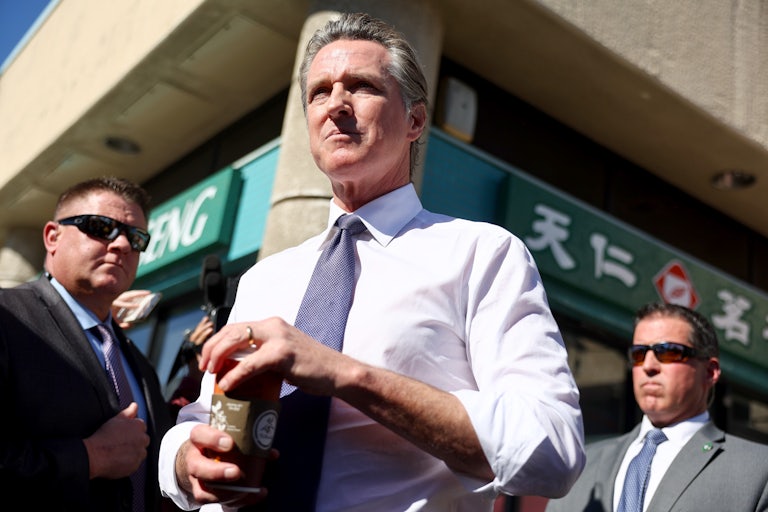
California Governor Gavin Newsom stands near the scene of a deadly mass shooting at a ballroom dance studio on January 23, in Monterey Park, California.

California Governor Gavin Newsom slammed the Second Amendment as his state reels from its third mass shooting in as many days.

Newsom was visiting Monday evening with victims of the tragic Monterey Park shooting when he received reports that there had been another shooting in Half Moon Bay, which killed seven people and injured one more.

Just a few hours earlier, he told CBS anchor Norah O’Donnell that the Second Amendment, which many Americans believe guarantees them unfettered access to guns, is “becoming a suicide pact.”

“Nothing about this is surprising. Everything about this is infuriating,” he said of the Monterey Park attack.

The Half Moon Bay attack is California’s third mass shooting in just three days. A 67-year-old gunman opened fire on a mushroom farm and a nearby trucking facility. The victims were primarily Chinese laborers. It came just hours after a shooter attacked a gas station in Oakland, killing one person and wounding seven others. The Gun Violence Archive defines a mass shooting as one where four or more people are shot.

The Monterey Park and Half Moon Bay attacks are the deadliest in their respective counties’ recent history. The Half Moon Bay massacre was the thirty-seventh mass shooting in the U.S. in 2023, according to the Gun Violence Archive. There has already been another mass shooting since Half Moon Bay, meaning there have been more mass shootings than there have been days this year.

California has some of the strictest gun laws in the country, but they’re not foolproof when regulations at the national level have so many loopholes. As The Washington Post noted, “The state’s strict gun laws are incapable of fully preventing gun violence in a country where gun ownership is widely considered a constitutionally protected right, firearms move freely between states with vastly different regulations and gun-control measures are dotted with exceptions.”

The Problem With Jeff Zients, Biden’s New Chief of Staff

The White House is planning to appoint Zients, a former private equity executive accused of “profiteering in health care,” as the next chief of staff.

Jeffrey Zients sits at a table with a binder, notepad, and pen in front of him (right profile shot)
Alex Wong/Getty Images

It’s been a day since President Joe Biden picked Jeff Zients, his former Covid-19 response adviser, to replace Ron Klain as his chief of staff, and the reaction has not been pretty.

Zients comes from the private equity world and is estimated to have a net worth of between $89 and $442 million, according to MarketWatch. He made a lot of this money investing in health care corporations. Zients’s investment fund, Portfolio Logic, featured multiple firms that paid millions of dollars in settlements for alleged Medicare and Medicaid fraud. He was also one of the original investors in the popular Washington, D.C., bagel chain Call Your Mother (one of the few local restaurants the Bidens have frequented).

Zients served under President Barack Obama as director of the National Economic Council and acting director of the Office of Management and Budget. He won praise under Obama for helping to repair the Healthcare.gov website after a bungled rollout, and again under Biden for his handling of the massive Covid-19 vaccine rollout.

But he only served as Biden’s Covid czar for a year, stepping away after the administration was accused of failing to prepare for the delta and omicron waves, sharing confusing messaging about testing and booster shots, and allowing Covid prevention funding to dry up. Both Public Citizen and the Center for Economic Policy and Research criticized Zients’s tenure, particularly his refusal to allocate resources for vaccination efforts abroad.

Jeff Hauser, founder of the nonprofit Revolving Door Project accused Zients of “profiteering in healthcare” and said Biden risks his legacy with the nomination. Progressive groups are worried that Zients will be less amenable to the causes that they and even the Biden administration have championed. Adam Green, co-founder of the Progressive Change Campaign Committee, expressed hope that Zients will prove them wrong.

“Ron Klain has been an open ear and even-handed engager of actors across the Democratic Party,” Green said in a statement. “Whomever the next chief of staff is, that will be the continued hope and expectation.”

Who Is Brandon Johnson? More on the Chicago Mayoral Challenger With a History in Organizing

Cook County Commissioner Brandon Johnson says Chicago deserves a progressive mayor “willing to invest in people.”

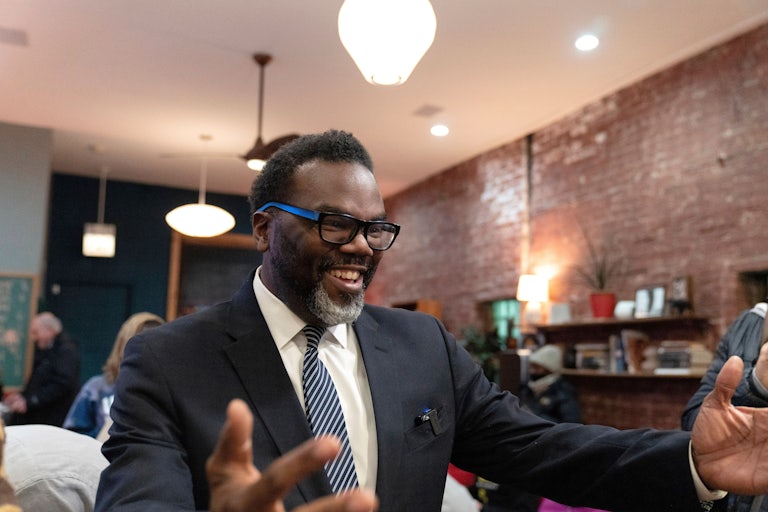
Chicago mayoral candidate Brandon Johnson smiles and holds his arms out
Erin Hooley/AP/Shutterstock
Chicago mayoral candidate Brandon Johnson speaks to supporters during a public listening session at Principle Barbers, in the North Lawndale neighborhood of Chicago.

In the past 34 years,* there have been only three mayors in Chicago: Richard Daley, from 1989 to 2011; Rahm Emanuel, from 2011 to 2019; and Lori Lightfoot since then. Now a field of nine candidates are running to unseat Lightfoot next month and become Chicago’s mayor. Cook County Commissioner Brandon Johnson sat down to talk to The New Republic about how he’s looking to come out of left field and upset expectations.

Johnson, a teacher and organizer, has emerged among the top candidates in a race that requires the winner to cross a simple majority threshold. If no candidate reaches at least 50 percent in next month’s election, which is the likely case, the top two vote-getters will proceed to an April runoff. Johnson, whose candidacy garnered no opinion from more than 70 percent of voters as recently as last month, is already putting up a formidable fight.

Polling averages from the four most recent polls have Representative Jesús “Chuy” Garcia leading the pack at 20.75 percent, conservative Democrat and former Chicago Public Schools CEO Paul Vallas at 18.25 percent, Lightfoot at 15.2 percent, and Johnson at 13.55 percent. Johnson has also been endorsed by SEIU’s Local 73 and Chicago Teachers Union and officials like Representatives Delia Ramirez and Jonathan Jackson (son of Reverend Jesse Jackson). Such endorsements led Johnson to outpace every other candidate in fundraising over the final quarter of 2022, much of the money coming from unions.

One of 10 children in a household fathered by a pastor and carpenter, Johnson told TNR his upbringing was “where you learned, right away, how to lean on one another.” That lesson guided Johnson’s path forward, toward a politics that embraces that spirit.

“Chicago can be better with a progressive mayor who loves people and is willing to invest in people,” Johnson said. “The safest cities in America all have something in common: They invest in people.”

After obtaining his master’s degree in teaching, Johnson began teaching social studies in the Chicago Public Schools system. In 2011, he joined organizing efforts with the Teachers Union, helping organize the 2012 Chicago teachers’ strike that earned teachers a 17.6 percent pay rise over four years. The strike also reframed education reform efforts to speak more directly to student concerns: class sizes; funding for music, art, and physical education; paid teacher preparation time; and less standardized test emphasis.

In 2018, Johnson ran against an incumbent to become a Cook County commissioner, member of a board overseeing the second-largest county in the United States. Since serving on the commission, he led the passage of a housing ordinance that took on rental discrimination against people with criminal histories. He also supported the Chicago Public Schools’ strike in 2019, appearing at a solidarity rally and writing newspaper opinion letters in support of striking teachers and staff.

Now, in a race where crime and public safety have steered the conversation, the progressive is rejecting the decades-long “tough on crime” stance. “This so-called toughness that politicians or insiders have just been recycling over the past 40 years has failed us—in the most dramatic of ways,” Johnson said. He points to Chicago being among the cities with the highest police spending per capita in the country, while schools and mental health facilities shutter. “What’s most disturbing, whether it’s Lori Lightfoot, whether it’s Congressman Garcia who has essentially copied and pasted the same so-called public safety plan of the person he endorsed four years ago, they’re using the same stale failed talking points and policies that have not kept our community safe.”

Johnson proposes investing more in areas like mental health and housing, but he also wants to fully fund year-round youth employment opportunities and create an Office of Community Safety. He is seeking deeper crime prevention rather than just crime response.

“This is not radical, right? The fact that employment and investment in people is considered a progressive idea, and is not just a humanitarian idea, tells you everything that’s wrong with the same old stale politics and policies that continue to make it to debates,” Johnson said. “They shouldn’t be allowed to debate failed policy. We should just retire any policy that has failed people for the past 40 years.”

Johnson is a man buoyed by hope while having plenty of reasons not to. He has taught in a school system where he says even his students wished he taught at a “good school.” And he has seen how the coldness of the world can leave someone. “My older brother Leon was my hero. He was very talented, but he had untreated trauma. He died addicted and unhoused. If the city and this country actually provided more support to mental health—if those resources were available for my brother, I do believe he would be allowed today to see his grandchildren.”

Yet he’s channeled those experiences into his candidacy. “The city of Chicago can be saved by doing what safe American cities do, and that’s what I’m gonna do as mayor: invest in people and the services that people rely on and those that actually do the work.”

With just over a month to go, the road ahead certainly is not an easy one. But Johnson has already convinced thousands that his vision is worth hoping for.

“I’m grateful that there is so much hope that we can provide the city,” Johnson said. “And to transform this city into a place where it’s safe for everyone … it’s very humbling to be in a moment where this could be a historical moment that people will look to for guidance as other cities look to do the same thing.”

* This post originally misstated the number of years in which Chicago has had only three mayors.