Breaking News
Breaking News
from Washington and beyond

The Right Is Somehow Already Using Video of the Attack on Paul Pelosi to Push Conspiracy Theories

After video footage was released, the right began to seize on minor details, like what Paul Pelosi was wearing, overlooking the other graphic details of the attack.

Screenshot of Fox News hosts talking (4 women and 1 man, sitting in a semicircle) with the chyron: Paul Pelosi Hammer Attack Bodycam Video Released

Nearly three months after Nancy Pelosi’s husband, Paul, was attacked by a home invader, the authorities released body cam footage and 911 call audio tape detailing what exactly transpired during the attack. The footage, warning, is graphic, and can be seen here.

Before the footage was released, right-wingers fomented gross conspiracy about the attack, even going as far as to simply joke about and laugh at it.

One of the conspiracies was that the attacker, David Depape, was a lover of Paul Pelosi. Despite the footage, 911 call, and testimony, some right-wingers (and their fans) are still persisting in peddling their baseless theories, citing things like Pelosi not wearing pants or that he was holding a glass in his hand.

This Twitter user, a proud self-proclaimed “MAGA” “Elon Groupie” gleefully wrote “it’s finally hammer time!”

And even Fox News, both the home of mainstream already-radical conservatism and the off-ramp toward even more extreme sources, couldn’t simply say, “This is horrifying,” and move on:

But contrary to this Fox host’s point, it doesn’t matter if your impulse is to feel conspiratorial about a straightforward case of violence (especially when your network is primarily guilty of training that impulse). As right-wing hero Ben Shapiro always says, facts don’t care about your feelings. But for some reason, facts—and even video evidence—just aren’t a match for the visceral, mind-melting conspiracy sensations that right-wingers have developed.
Marjorie Taylor Greene Says Biden “Abused His Power” by Lowering Gas Prices

Do Republicans even want lower gas prices or not?

Al Drago/Bloomberg/Getty Images

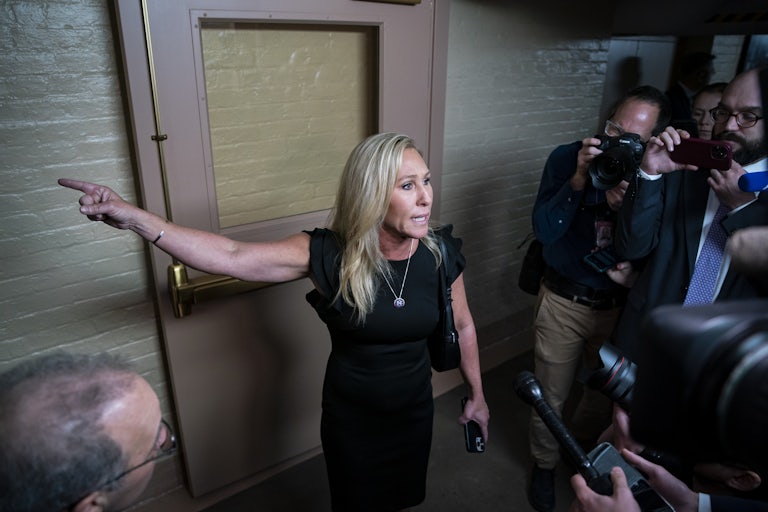
Marjorie Taylor Greene claimed Friday that President Joe Biden “abused his power” by lowering gas prices in order to influence the outcome of the midterm elections, leading many to speculate whether Republicans wanted lower gas prices.

In the months ahead of the November vote, Biden took multiple steps to bring down gasoline prices that had surged due to Russia’s invasion of Ukraine. One major move was to release 15 million barrels from the Strategic Petroleum Reserve, which helped flood the U.S. gas market. The national average price per gallon dropped dramatically to $3.76 in October from about $5 per gallon in June.

Speaking on the floor of the House of Representatives, Greene accused Biden of driving down gas prices for political gain. Republicans campaigned heavily on inflation, particularly gas prices, ahead of the 2022 midterms. While Democrats saw historic wins during the elections, about a third of voters said inflation was a top factor in how they voted, according to a CNN exit poll. More than seven out of 10 of those people voted for Republicans.

Republicans spent months blaming Biden for the exorbitant gas prices, and now they apparently are also angry at him for bringing those prices down.

As if this nonsensical about-face weren’t enough, Greene apparently has zero sense of self-awareness.

“It’s a shame to trick the American people just to win an election,” she chastises. “No president should be able to use their emergency powers for politics.”

Says the woman who apparently has Donald Trump on speed dial, the man who lied that the 2020 election was stolen from him and used his emergency powers several times for his own political agenda.

Tyre Nichols’s Mother: “They Beat My Son Like a Piñata … I Feel Sorry for Them”

In a gut-wrenching interview with CNN’s Don Lemon, Tyre Nichols’s mother discussed the police killing of her son.

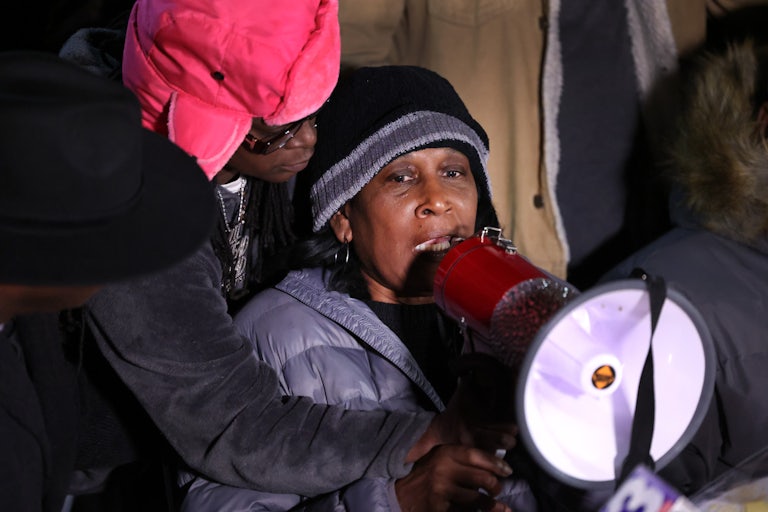
RowVaughn Wells speaks in a podium (wearing winter clothing, outdoors).
Scott Olson/Getty Images

“Where was the humanity? They beat my son like a piñata.”

Friday morning, CNN’s Don Lemon interviewed Tyre Nichols’s mother, RowVaughn Wells, and stepfather, Rodney Wells, about the violent police beating to death of her son, Tyre.

On January 7, Nichols, a 29-year-old Black man, was reportedly pulled over about 250 feet away from his home by Memphis police officers. A police statement said Nichols was pulled over for suspected reckless driving, after which a “confrontation” ensued. Five officers were involved in beating Nichols to the brink of death; he succumbed to his injuries three days later from said “confrontation.” He died in the hospital.

The five officers were fired nearly two weeks after the traffic stop; each was arrested and charged with numerous crimes, including second-degree murder, on Thursday.

In an interview following the indictment of the five officers, Nichols’s mother revealed that police had initially blocked her from seeing her dying son at the hospital because he was “under arrest.”

Nichols was “already gone” by the time she and her husband arrived at the hospital, she said. “They had beat him to a pulp.”

After losing their son to such heinous violence dealt by those supposedly meant to “protect and serve,” Nichols’s family now is just trying to make sense of such senselessness.

“Where was the humanity?” Nichols’s mother asked. She described the shocking imbalance—her 150-pound son, afflicted with Crohn’s disease, being beaten to death by five police officers.

She actually feels “sorry” for the officers. She described the harm and shame the officers have brought to their own families and to the Black community. “They didn’t have to do this.”

“I don’t hate anybody, that’s not in my nature,” she said. “I just feel sorry for them because they did something horrendous.”

To hear Nichols’s mother is to attempt to understand the profoundly difficult burden she now holds. Mired in the grief of such unspeakable violence, she speaks to the severe lack of humanity that plagues our structures of policing, and the vicious consequences of that poison.

Watch the CNN interview here.

FDA Eases Blood Donation Ban on Gay and Bisexual Men, but Only if They’re in Monogamous Relationships

The proposed rule change is a big shift in blood donation guidelines, but it still doesn’t go far enough.

Paul Bersebach/MediaNews Group/Orange County Register/Getty Images

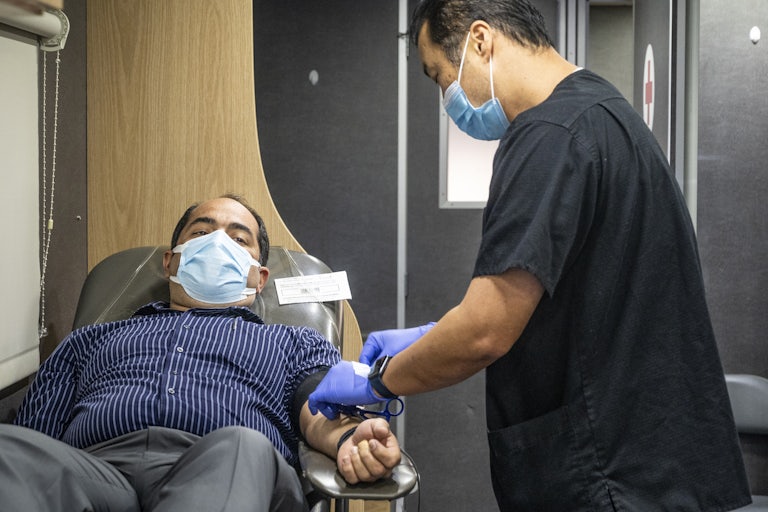
Gay and bisexual men would no longer have to abstain from sex before donating blood under rules changes the Food and Drug Administration proposed Friday, but only if they are in monogamous relationships.

Men who have sex with men, or MSM, were initially banned from donating blood during the HIV/AIDS crisis in the 1980s. The FDA relaxed those rules, first in 2015 by deciding MSM could donate after remaining celibate for a year and then again in 2020 by changing the abstention period to three months.

Under the newly recommended changes, all potential blood donors—regardless of gender or sexual orientation—would report whether they had seen multiple sexual partners or a new partner in the past three months. If so, they would be asked if they had anal sex. If they have, they would have to wait before they can donate blood.

There will be no change in deferral time for people taking PrEP or PEP, landmark HIV-prevention drugs, for people who consistently wear condoms during sex, or for people who present a negative HIV test.

The American Medical Association, blood banks, and LGBTQ rights organizations have urged the FDA for years to change its rules for blood donation. Health experts say the current regulations are homophobic, outdated, and don’t actually work to keep the nation’s donated blood supply safe.

Some experts worry that the proposed changes would still single out MSM, many of whom say they have felt like pariahs for decades because the FDA rules make them feel as if they are seen as untrustworthy or merely disease transmitters.

The Human Rights Campaign hailed the potential changes as “an important first step toward dismantling an antiquated and discriminatory blood donation policy.”

But “while today’s announcement is a victory, it’s not the end of the road,” HRC President Kelley Robinson said in a statement, calling on the FDA to adopt “an approach rooted in science, not identity.”

The FDA proposal will be open for public comment for 60 days, after which the agency will review the comments and make a final decision.

Now That You’ve Found Him, the Twitter “Menswear Guy” Would Like to Talk to You About Fast Fashion

Derek Guy, @dieworkwear, doesn’t know why he’s suddenly on so many people’s timelines. But he would like to talk to you about how to dress well and sustainably.

man in a suit crosses his arms (can't see the person's face)
Daniel Andruseyko/Unsplash

Twitter has a seemingly ever-changing layout and algorithm. Now there’s the “For You” timeline, the default setting instead of a timeline of people one follows. And more often than not, people are finding tweets on that new timeline to … not really be “for them,” or at least they wouldn’t think so. And now, for some reason or other, the algorithm appears to curiously be pushing Derek Guy, an innocuous menswear writer, onto a not insignificant number of people’s timelines.

Algorithms can work in strange ways. The preponderance of Guy’s posts on people’s timelines could be explained by any number of reasons: His posts often have high engagement, which is good for the algorithm, or perhaps many of the people being pushed toward Guy’s posts are in concentric Twitter bubbles, so posts recommended to one person are recommended to another—and the whole coincidence is just socially manufactured and self-fulfilling. Maybe it’s all the workings of a lone, fun-seeking Twitter engineer.

The mystique behind why Guy’s appearing on the timelines of many has become a bit of a meme, but the intrigue in his virality somewhat overshadows what Guy actually wants to talk about: the labor crisis born from fast fashion, the ways liberalism may have influenced clothing consumption, and how we can adopt a more thoughtful approach to fashion. Guy and his posts are more than just an accidental discovery from an algorithm. But still, he knows what everyone is asking. Why is he suddenly showing up on their Twitter feed?

“I don’t have any secret insight into their code,” Guy says, shruggingly. “But my guess is that the stuff that I post gets a lot of likes and comments.” Whatever the reason, Guy has seen the impacts, gaining some 30,000 of his now 110,000 followers in the past month.

The man behind the handle is more than a manifestation of the oddities of Elon Musk’s Twitter, though. Guy, in fact, seems to embody characteristics antithetical to the algorithms of our time, which thrive on high-octane emotion and short attention spans. Peppered with good-natured quips, most of Guy’s online activity involves explaining strategies for how to dress well, sustainably, and efficiently—in great detail and care.

“I love wearing clothes,” Guy chuckles. “It sounds absurd, but I do like clothes.” As he grew up, Guy was surrounded by friends in the music scene, collecting items like vintage Polo Ralph Lauren. He began reading and writing about clothing, reading more and more blogs in the 2000s. French cinema, jazz, and blues led him to get more interested in suits and tailoring, specifically.

“I got my horn-rimmed glasses—sounds so corny, but I was young and I was really into jazz and French New Wave—because of Bill Evans and Malcolm X,” Guy says. “I thought those two guys were supercool.”

Guy began spreading his passion to Tumblr, posting waves of menswear photos on a site where people would typically post one or two. The positive responses prompted him to write short posts about the photos, which would garner even further positive responses, beckoning him to write even more. Soon, Jesse Thorn, editor of menswear site Put This On, asked him to write for the site.

That chance set him on his path to become a prominent voice in the space, writing for sites like Put This On, The Washington Post, and Esquire.

All this dedicated time and effort has led Guy to reflect on how fashion represents one’s cultural background and the broader cultural forces connected to those backgrounds.

“Just yesterday I saw this older woman who was wearing a black cardigan, but the pockets and trims were a furry, leopard material, and she decorated her walking stick with the tinsel you’d use for a Christmas tree and she was wearing really brightly colored shoes,” Guy recalls. “And that was like a nice thing to see. It’s nice to see someone who’s older who takes such joy in daily dress. You know, to wrap tinsel around something that is sometimes considered like a handicap.”

That kind of intentionality and ingenuity is what Guy is concerned society is losing. He worries that the infinite amount of choices consumers have has led some to buy cheap, freely—without much concern for longevity or for the material conditions of those who made the clothes.

“In my heart, the thing that worries me most about fast and cheap fashion is the squeezing of labor,” Guy says. “When I read about the lives of garment workers, that’s what gets me most emotional.”

Guy believes capitalism alone isn’t to blame. Liberalism, though obviously positive in relieving people of certain social constraints and granting them freedoms, may have also helped lead to a rise in fast fashion. “The infinite number of identities” people are now able to explore both embodies the freeing nature of liberalism and also perhaps opens the door for people to enter into wasteful tendencies with their wardrobes.

Guy is not some social regressive. But he has tips for people on how to both mitigate the crisis of fast fashion and enhance their wardrobes while doing it: things like building wardrobes over time, shopping vintage, and buying fewer things for more money. He explains how exploration—whether attempting to pull off rugged, or preppy, or a niche Japanese brand—can be done as effectively with one pair of trusty jeans.

Guy argues that buying things with more intention and being willing to spend slightly more ensures a higher return if and when you choose to sell them secondhand, or at least ensures that someone else will take them after you. The tendency to rely on donating clothes, while perhaps well intentioned, is misguided. If an item doesn’t get picked up by someone, “the end point for that garment is typically the landfill, or the rag market in Africa, where it destroys local economies,” Guy says.

The crisis of fast fashion, and how to solve it, is rife for debate and discussion. But Guy wants at least to offer people an “entry point” to fashion. Especially with his newfound audience, he describes feeling extra cautious about even the jokes he makes. “I wouldn’t want someone to walk outside and think, ‘Oh, do people think my shoes are lame?’ That’s dumb, and it’d be dumb for me to make someone feel that way,” he says flatly. He says he’s leaning more into posting informative threads, like style for men with larger figures. Ultimately, he is concerned with accessibility for fashion in terms of both aesthetics and ethics.

He describes how he’s advocated for J Crew as an accessible pathway for newcomers into menswear, in the same fashion that Howard Zinn’s work has offered an accessible pathway into politics and theory for people. “There are different paths up the mountain.”

“It’s so cliché, but, like everyone says, politics is in everything,” Guy continues. “It’s especially true in clothes. It deals with material production, so we have wages. We have environmental impact, because of the end life of the garments. And then on our very bodies, we wear clothes to project identity, which is inherently political.”