Breaking News
Breaking News
from Washington and beyond

Federal Reserve Hikes Interest Rates Up 0.25 Percent, Smallest Increase in Almost a Year

Here’s what exactly the Fed Reserve rate hike means for you.

Jeremy Powell speaks at a podium
Al Drago/Bloomberg/Getty Images

The Federal Reserve announced an interest rate hike of 0.25 percent Wednesday, the smallest increase since it began ramping rates up in March.

Inflation has fallen slowly but steadily over the past six months, particularly from October to December. The Fed has been on a tear to get interest rates high enough to discourage people from spending money, slowing the economy down in turn. The central bank only began easing its rate hikes in December. The risk is that growth will slow while prices and borrowing rates stay high, sending the economy into a recession.

“Shifting to a slower pace will better allow the committee to assess the economy’s progress toward our goals as we determine the extent of future increases that will be required to attain a sufficiently restrictive stance,” Fed Chair Jerome Powell told a press conference. “While recent developments are encouraging, we will need substantially more evidence to be confident that inflation is on a sustained downward path.”

Goods prices are generally falling, and the unemployment rate in December was 3.468, the lowest in 50 years—all indicators that the Fed’s previous rate hikes are working as intended. Ian Shepherdson, the chief economist at Pantheon Economics, warned Tuesday that the central bank shouldn’t raise interest rates anymore lest they go too far.

Dean Baker, senior economist at the Center for Economic Policy and Research, answered five questions about what the latest rate hike means going forward.

1. What has changed in recent months that gives the Fed enough confidence to hike rates by the smallest amount in almost a year?

“The economy and inflation have both slowed sharply,” Baker told The New Republic, describing the initial 0.75 percent rate hikes as a “bit of a panic.”

Indicators such as the consumer price index have decreased in recent months, a sign that the economy is slowing and inflation is finally easing up a bit. Baker suggested that Wednesday’s small rate hike is more to “demonstrate [the Fed’s] commitment to fighting inflation.”

2. What can consumers expect from a 0.25 percent rate increase?

Since the rate increase is so small, it’s unlikely to have much effect on the economy, according to Baker. “Since it was widely anticipated, the impact has already been incorporated into the rate structure.”

Now many economists are hopeful the Fed will take a step back and be more reactive with future rate increases, instead of proactive.

3. What can we expect from the Fed going forward?

In a statement, the central bank predicted that “ongoing increases … will be appropriate in order to attain a stance of monetary policy that is sufficiently restrictive to return inflation to 2 percent.”

Monetary tightening measures often have delayed effects, which the policy-setting Federal Open Market Committee said it would take into account when deciding on whether to increase rate hikes in the future.

Looking at current data, the Fed “should be looking to claim victory in the war on inflation, and back off from further rate hikes,” said Baker. He noted that Powell is probably hesitant to do so, but “he should do it soon” if trends continue as they have.

4. Is it possible for the Fed to go too far with rate increases?

There’s a chance that the Fed will go too far with rate increases and tip the economy into a recession, but Baker doesn’t see that on the horizon right now.

“I don’t think that is likely to happen with the rate hikes to date, but if they were to go much further, I would be very worried,” said Baker.

The current economy looks fairly strong, he added, even in some of the sectors most sensitive to changes in interest rates, such as housing, trade, and cars. Housing construction has stayed high due to a backlog of unfinished homes resulting from supply chain disruptions. Car sales have also held up as the supply chain untangles and the industry is finally able to meet demand.

Meanwhile, consumption has shifted from goods to services, so imports are down, meaning the U.S. import and export levels are balancing out.

5. What are the current chances of a recession?

There is some good news: It looks like a soft landing is possible, after all.

A soft landing is a decrease in inflation without a major increase in unemployment, and “it looks like we are seeing that,” said Baker. “The surge in inflation was due to one-time factors associated with the pandemic. Now that those are largely behind us, it looks like the inflation they caused is behind us as well.”

Baker put the chances of a recession at about 20 percent, fairly low. That would increase if the Fed goes too far with rate hikes, but Baker doesn’t think Powell will get too zealous. Another risk would be an escalation of the war in Ukraine, but that is hard to predict.

This post has been updated.
MrBeast’s Gift of Vision Is Nice! But One Guy Shouldn’t Have To Do It

The popular YouTuber released a new video giving 1,000 blind people cataract surgery to restore their vision. Access to life-changing procedures like this shouldn’t be dependent on the goodwill of others.

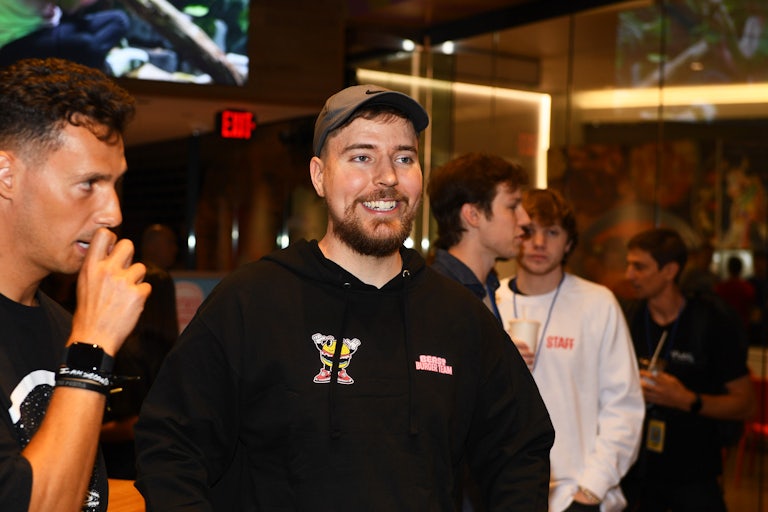
Dave Kotinsky/Getty Images for MrBeast Burger

It’s really great when people’s lives are made better, but mass uplift should not be subject to the goodwill or charity of a few. This is the major takeaway of a new viral video of MrBeast’s latest charitable act.

On Saturday, MrBeast, the YouTuber with a whopping 236 million subscribers, posted a video titled, “1,000 Blind People See For The First Time.”

Jimmy Donaldson, a.k.a MrBeast, begins the video by saying that 200 million people worldwide suffer from impaired vision. “They can’t see. But we have all the technology to fix it.” Ophthalmologist Jeffrey Levenson, who joined Donaldson, says that half of all cases of blindness in the world consists of people who need a 10-minute operation, a cataract surgery that vacuums out a cloudy lens in an eye and replaces it with an artificial one. With this context, Donaldson provides the quick operation to 1,000 individuals across the world, even giving some patients additional sums of money or cars as goodwill gifts.

As far as content creation goes, this is simply just a nice thing to do; MrBeast has accumulated inordinate amounts of wealth from his massive platform and is using it to help other people. There’s a discussion to be had about so-called “poverty porn,” in which forms of media exploit one’s poor conditions in order to generate attention. On a larger scheme, out of all the malicious ways people use and exploit others’ emotions online, this video perhaps isn’t too reproachable, particularly given MrBeast, at this point, has no issue garnering viewers. He is the fourth–most subscribed account on YouTube and the most popular individual account.

But the on-the-surface heartwarming story also reveals how dependent we are as a society on charity to improve people’s material conditions.

Not only does cataract surgery take a matter of minutes, as MrBeast’s video points out, but the life-changing operation also can cost as little as $25. Yet still, people are left paying hundreds, and more often thousands of dollars for such surgeries, especially for those who are uninsured.

MrBeast himself, not known by any means as a crusading socialist, understands this:

Though he also frames the contradiction, perhaps sincerely or perhaps to appease his broader audience in terms of market logic, MrBeast still communicated to his many fans what we all know to be true: such conditions are incomprehensible.

And so, it would be worthwhile to avoid any overscrupulous analysis of what MrBeast’s latest act of charity represents: the good nature of people, and why we should seek to embrace and imbue that nature into our systems, rather than restrict it to only existing in individuals.

New College of Florida President Kicked Out, Replaced With DeSantis Ally

The conservative board of trustees, stacked with appointees of Governor Ron DeSantis, voted to oust the president and replace her with an ally of the governor.

Octavio Jones/Bloomberg via Getty Images

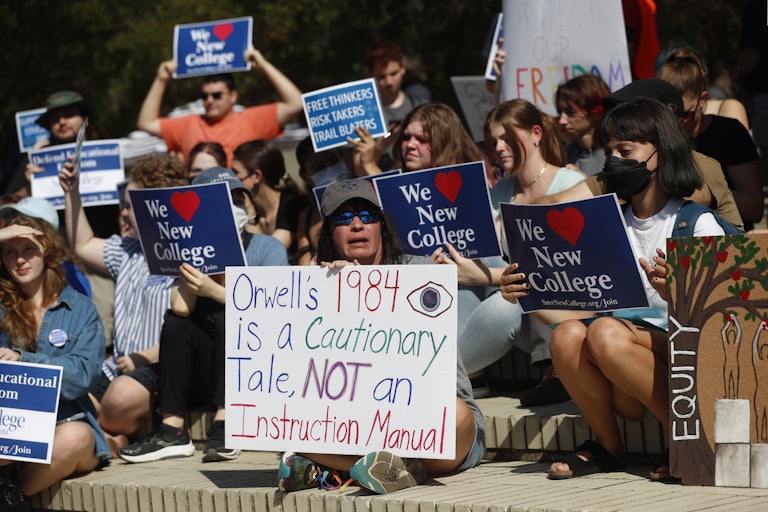
The president of the New College of Florida was forced out by a board of trustees stacked with appointees of Governor Ron DeSantis, who is cracking down on “woke” thought in state schools, and replaced with another DeSantis ally.

The New College is a top-notch liberal arts school, as well as a politically liberal enclave not just in deeply red Florida, but in the county where it is located, too. The college’s board of trustees was overhauled in early January when DeSantis appointed six new conservative members.

The 13-member board of trustees met Tuesday night, where they ousted President Patricia Okker to the dismay of the school community.

DeSantis’s picks include Christopher Rufo, an anti–critical race theory advocate also known for his anti-LGBTQ rhetoric; Charles Kesler, a senior fellow at a far right think tank; and Matthew Spalding, a government professor at Hillsdale College, a highly conservative private Christian college in Michigan. Both Rufo and DeSantis’s chief of staff have said they want to remake New College in the image of Hillsdale.

During the meeting, DeSantis appointee Mark Bauerlein described diversity, equity, and inclusion, or DEI, programs as “McCarthyite.” Rufo also criticized DEI and motioned to shutter the Office of Outreach and Inclusive Excellence.

The trustees appointed Richard Corcoran as interim president. Corcoran, the former state education commissioner, is a close DeSantis ally and was described by the Sarasota Herald-Tribune as “an eager participant in the governor’s education culture war battles.”

Students protested the meeting and have tried to push back on the changes at their school, but it’s a struggle in the face of what appears to be an all-out war by DeSantis on the state school system.

The New College board meeting came just hours after DeSantis announced he intends to defund DEI programs on state college campuses. He has also signed a law limiting what professors can teach about race, and another requiring tenured faculty to undergo review every five years.

Public school teachers have been told to hide their classroom libraries or risk five years in jail and a $5,000 fine for having material deemed “inappropriate” for students. DeSantis also banned high schools from teaching an A.P. African American studies class, deeming it “woke indoctrination.”

College Board Caves and Revises A.P. African American Studies Course After Backlash From the Right

The new curriculum has removed Black Lives Matter and prominent queer writers. It also suggests “Black conservatism” as an additional research topic for students.

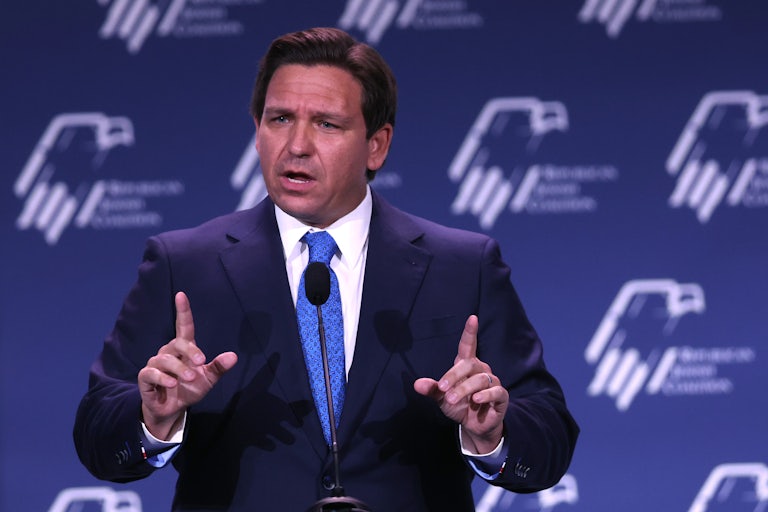
Ron DeSantis speaks at a podium
Scott Olson/Getty Images

The College Board on Wednesday released an updated curriculum for its new Advanced Placement African American Studies course—and now missing are many Black writers and scholars on intersectionality, critical race theory, the queer experience, and Black feminism. Black Lives Matter is now optional in the new curriculum.

The New York Times first reported the news, which comes at the start of Black History Month.

The revision comes after Florida Governor Ron DeSantis said he wouldn’t allow the A.P. course in state schools, calling an earlier draft of the curriculum “woke indoctrination.” DeSantis and the Florida Department of Education specifically named six topics they took issue with: Black Queer Studies, Intersectionality, the Movement for Black Lives, Black Feminist Literary Thought, The Reparations Movement, and Black Struggle in the 21st Century. (He also complained that queer theory has nothing to do with Black history and is “pushing an agenda on our kids.”)

Many experts on those topics are now gone: bell hooks, the feminist writer and author of Feminism Is for Everybody; Kimberlé W. Crenshaw, a Columbia University law professor and pioneering scholar on critical race theory; Roderick Ferguson, a professor of women’s, gender, and sexuality studies at Yale University; and Ta-Nehisi Coates, the author and journalist who wrote the definitive case for reparations for slavery and the National Book Award–winning Between the World and Me.

In a new curriculum, the College Board also suggests “Black conservatism” as an optional research topic for students.

David Coleman, the head of the College Board, told The New York Times that the changes were not due to political pressure. “At the College Board, we can’t look to statements of political leaders,” he said. The changes came from “the input of professors” and “longstanding A.P. principles.”

DeSantis’s criticism of the A.P. course seemed to be a preview of the Florida governor’s attack on education. On Tuesday, he vowed to defund diversity, equity, and inclusion programs at state colleges and suggested requiring students to take a course on Western civilization.

As The New Republic’s Tori Otten wrote:

It’s part of a larger war the governor is waging against “woke culture.” This includes signing a law limiting what professors can teach about race and another that would require tenured faculty to receive performance reviews every five years. If they are not up to standards, which have not been specified yet, they could be let go (defeating the purpose of tenure). DeSantis has also blocked high schools from teaching an A.P. African American studies class.

Benjamin Netanyahu Says Not To Get “Hung Up” On Peace

In an interview strung with falsehoods and redirects, the Israeli prime minister told CNN’s Jake Tapper that he’ll “circle back” to the Palestinians.

AMIR COHEN/POOL/AFP/Getty Images

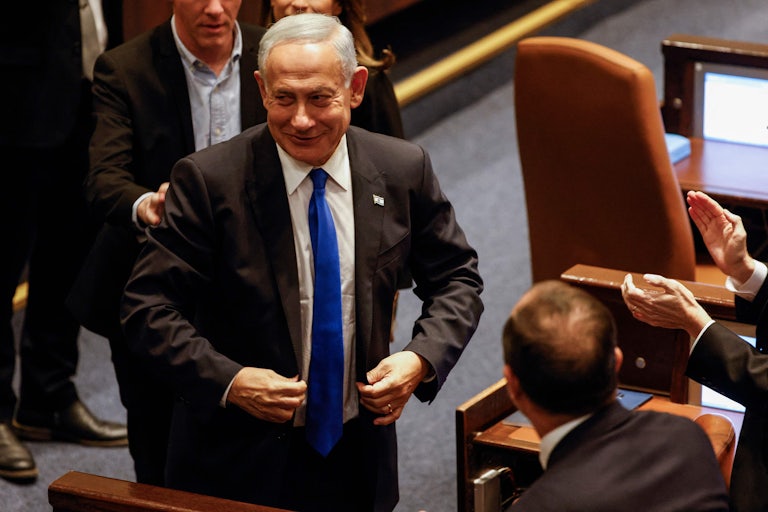
As Israel continues to escalate its violent campaign against Palestinians, Israeli Prime Minister Benjamin Netanyahu joined CNN’s Jake Tapper for an interview, in which the Israeli prime minister said he is not going to be bothered to get “hung up” on peace with Palestinians.

“If we wait for them, we’re not going to have peace,” Netanyahu said in the interview Tuesday evening, describing his plan to instead focus on other nations like Saudi Arabia first. “I think we’ll circle back to the Palestinians and get a workable peace with the Palestinians.”

In other words, Netanyahu’s grand master strategy is to delay addressing the devastating crisis Palestinians face, brought by the actions of the government he leads, because apparently Palestinians aren’t ready to come to the table to negotiate on not being occupied.

“I went around them (Palestinians). I went directly to the Arab states and forged, with a new concept of peace … I forged four historic peace agreements: the Abraham Accords,” he said.

When Tapper asked Netanyahu whether would be willing to give the right to vote to people residing in the West Bank or East Jerusalem, Netanyahu dodged the question and said he’s “willing to have them have all the powers that they need to govern themselves, but none of the powers that threaten us.”

Netanyahu also streamed lie after lie as he attempted to justify his proposal to weaken the Israeli judiciary by allowing a simple majority in the Knesset to overturn any Supreme Court decision. This would subject an independent supreme court to the party in power (thus making it no longer an independent).

Israel is currently led by the furthest right government ever, so such a plan would be all the more convenient for Netanyahu—especially as he himself seeks to evade accountability from his own corruption trial. Netanyahu’s justice minister, Yariv Levin, told the Israeli Knesset two weeks ago that the charges against Netanyahu “contributed to a very broad public understanding that there are failures that need to be corrected” in the judicial system.

The United States certainly has its own role in affirming Netanyahu’s nonsense. Beyond sending billions of dollars in military aid to Israel, the U.S. simply fails to recognize the humanity of Palestinians. Last week, Vedant Patel, spokesman of Biden’s State Department, refused to acknowledge that Palestinians are occupied. Israeli forces killed at least 35 Palestinians in just the first month of 2023.