Breaking News
Breaking News
from Washington and beyond

EPA Finally Beginning to Hold Norfolk Southern Accountable After Ohio Train Derailment

The Environmental Protection Agency is demanding the rail company responsible clean contaminated water and soil, and pick up the tab on all cleanup expenses.

Michael Swensen/Getty Images

On Tuesday, the Environmental Protection Agency, or EPA, seized the reins of the cleanup in East Palestine, Ohio, after the disastrous Norfolk Southern train derailment that left thousands of residents sick and distrustful of the company’s remediation efforts. The EPA is also directing Norfolk Southern to pick up the tab on all cleanup expenses.

“The Norfolk Southern train derailment has upended the lives of East Palestine families, and EPA’s order will ensure the company is held accountable for jeopardizing the health and safety of this community,” said EPA Administrator Michael Regan. “Let me be clear: Norfolk Southern will pay for cleaning up the mess they created and for the trauma they’ve inflicted on this community.”

The EPA directs Norfolk Southern to pursue all available avenues to clean contaminated water and soil, pay for any EPA expenses (including the cleaning services the agency will provide to community members), participate in public meetings, and publish relevant information online for the public. The EPA warned that if Norfolk Southern fails to comply, the agency would do the work itself and then seek triple the cost from the company.

Regan added that he understands the order “cannot undo the nightmare that families in this town have been living with, but it will begin to deliver much-needed comfort for the pain that Norfolk Southern has caused.”

While air tests thus far have mostly come back with no concerning levels of vinyl chloride or other contaminants from the train, residents are still concerned about further consistent testing, as well as more stringent testing of the water and soil; swaths of residents are still reporting symptoms, and reports of soiled waterways carrying dead creatures continue.

Meanwhile, on Sunday, Transportation Secretary Pete Buttigieg sent a letter to Norfolk Southern, warning too that the company must “demonstrate unequivocal support” for the community and surrounding areas.

“Norfolk Southern must live up to its commitment to make residents whole—and must also live up to its obligation to do whatever it takes to stop putting communities such as East Palestine at risk,” Buttigieg said. “This is the right time for Norfolk Southern to take a leadership position within the rail industry, shifting to a posture that focuses on supporting, not thwarting, efforts to raise the standard of U.S. rail safety regulation.”

Buttigieg called some of these regulatory policies out by name, and how the rail industry has lobbied to weaken them: higher safety standards for trains carrying hazardous materials, electronic braking system for those trains, and a now-delayed deadline for instituting more durable rail cars for hazardous materials. He also said he will call on Congress to raise the cap on fines against railroads for violating regulations. Buttigieg’s letter seemed to be cognizant of the myriad of ways corporations have bought government support for deregulation, which is welcome news.

The White House has so far hesitated to take the lead on updating these regulations for fear of pushback from the rail industry. Buttigieg’s letter, too, ended with a rather ambiguous pledge: “Soon I will be laying out several steps that Norfolk Southern, and all major railroads, should take immediately to improve rail safety for workers and communities—in addition to prioritized actions planned at our department in furtherance of our safety mission.” It will be seen whether Buttigieg will actually reinstate much-needed regulations, whittled away by rail corporations, and solidify a pathway toward a safer railroad industry.


Donald Trump Says All Presidential Candidates Should Take “Mental Competency” Tests

As we all know, he would definitely ace that test.

Donald Trump makes a weird face on stage. A podium in front of him has a sign that reads "New Hampshire Republican Party."
Scott Eisen/Getty Images

Donald Trump thinks every presidential candidate should have to take a mental competency test, which, as we all know, he would ace.

Trump’s comment Tuesday was in response to Nikki Haley’s proposal for mandatory mental competency tests for all politicians older than 75, a clear dig at both Trump, 76, and President Joe Biden, 80.

“ANYBODY running for the Office of President of the United States should agree to take a full & complete Mental Competency Test simultaneously (or before!) with the announcement that he or she is running, & likewise, but to a somewhat lesser extent, agree to a test which would prove that you are physically capable of doing the job,” Trump wrote on Truth Social. “Being an outstanding President requires great mental acuity & physical stamina. If you don’t have these qualities or traits, it is likely you won’t succeed. MAGA!”

The former president is no stranger to mental competency tests. He went viral in the summer of 2020 when he bragged repeatedly about doing well on such an exam. Trump said one of the questions involved hearing a series of words and then repeating those words back. As a hypothetical example, he said the series could be, “Person, woman, man, camera, TV.”

Trump clearly thought he had taken a test that provided further proof of his being a “very stable genius.” As it turns out, he actually took the Montreal Cognitive Assessment, which is usually administered to someone suspected of experiencing dementia or other cognitive declines. A perfect score on that test only shows the test-taker is not cognitively impaired.

As for Haley’s suggestion, not only is it ageist, but it’s also not that great a suggestion. Three geriatric health experts told Slate that the aging process varies from person to person, so a mental competency test won’t necessarily provide useful results.

There are huge individual differences in how people age. Some are sharp as a tack at 90 or 100, some have cognitive impairment in their 50s,” explained Carolyn Aldwin, the director of the gerontology program at Oregon State University.

A mental competency test also won’t measure leadership or diplomacy skills.

It would seem that Haley’s proposal isn’t really intended to change policy, but more to make her stand out from her opponents. At 51, she’s currently the youngest presidential candidate. But that can’t be her only thing.

Wisconsin’s Supreme Court Election: The Big Race You May Not Know About

An election for a seat on the state’s Supreme Court is turning into an expensive and high-stakes battle, with massive implications for abortion, voting rights, and democracy.

A bunch of people hold signs in the rotunda. In the forefront is a sign that reads "I love someone who had an abortion."
Sara Stathas/The Washington Post/Getty Images
Abortion rights supporters rally in the rotunda of the Wisconsin Capitol on January 22, 2022.

Wisconsin voters are heading to the polls Tuesday to determine which two candidates will proceed to compete for an open seat on the state Supreme Court. What may seem like a very specific statewide race in fact has massive implications for abortion, voting rights, and even national democracy.

The departure of a conservative judge, Chief Justice Patience Roggensack, has left both parties eager to seize her spot. While the election is technically “nonpartisan,” conservatives are aiming to defend their slim 4–3 majority on the court while Democrats hope to flip control for the first time in 15 years.

Such high stakes mean this could soon be the most expensive race of the year, with some estimating the race’s spending to exceed $30 million. (The previously most expensive race for a single state Supreme Court seat involved $15.2 million spent in a 2004 Illinois race.)

Almost $8 million has already been spent on the primary. Four candidates—two liberals and two conservatives—are vying to move on to the final round of the election. Milwaukee County Judge Janet Protasiewicz has become the leading Democratic candidate, netting some $2.3 million since entering the race. Her fellow liberal Dane County Judge Everett Mitchell has raised about $223,000. Conservatives are backing Waukesha County Judge Jennifer Dorow and former Supreme Court Justice Dan Kelly, who lost his seat in 2020 to a liberal justice. Neither conservative candidate has surpassed $1 million in fundraising.

The stakes are all the higher as the rest of Wisconsin’s government branches are split. Democrat Tony Evers holds the governorship, while Republicans maintain control in the legislature; the gerrymander-enabled Republican legislature has proven to be an incredibly difficult obstacle for the agenda of a governor who was just reelected statewide. Republicans hold two-thirds of the state Senate and nearly two-thirds of the state Assembly, even while Democrats won the governor, secretary of state, and attorney general races in 2022.

The court is set to hear major cases, including a lawsuit from Evers and Attorney General Josh Kaul against Wisconsin’s abortion ban that was activated after the overturning of Roe v. Wade. The court is also expected to rule on the heavily gerrymandered maps that have kept conservatives in control of the swing state since 2010. (Bear in mind, in 2016, Trump won the state by just about 23,000 votes; in 2020, Biden won by some 20,000 votes himself.)

The court will also hold a crucial role in the 2024 elections given Wisconsin’s swing state status, especially so if Donald Trump is the Republican nominee. While the court has largely ruled in favor of conservatives on contentious questions (like banning absentee ballot drop boxes or slashing public sector union power), it narrowly ruled 4–3 to reject a Trump lawsuit that sought to overturn his 2020 loss in the state. Basic democracy narrowly survived in 2020; there’s no guarantee it would fare as well in 2024.

Rep. David Cicilline From Rhode Island to Resign, Setting Up Competitive Democratic Race

A special election for his seat will take place later this year.

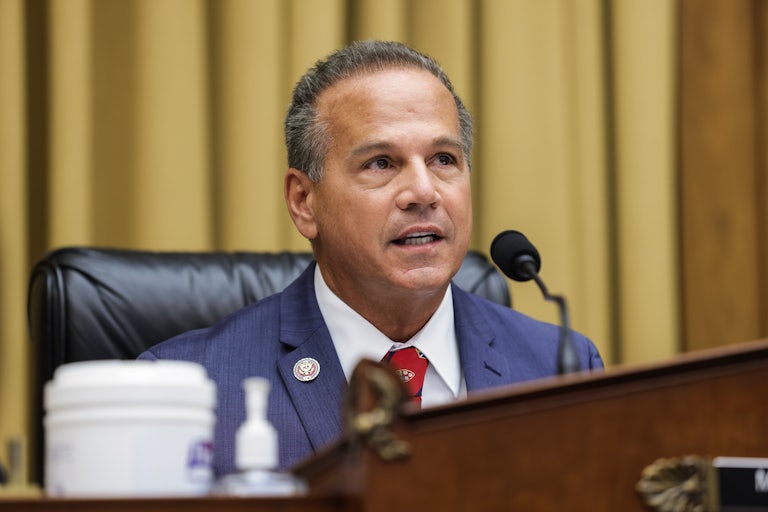
Rep. David Cicilline from Rhode Island sits at a desk with a microphone.
Graeme Jennings-Pool/Getty Images

Rhode Island Representative David Cicilline will resign at the end of May to lead a state charity foundation, setting up what is sure to be a competitive special election among Democrats.

Cicilline’s decision, first reported Tuesday by The Boston Globe, will trigger a special election after he steps down. This is the second time in two years that a Rhode Island lawmaker has caused a stir, after Representative James Langevin announced in 2022 he would retire after 11 terms in Congress. (Rhode Island has only two congressional districts.)

“For more than a decade, the people of Rhode Island entrusted me with a sacred duty to represent them in Congress, and it is a responsibility I put my heart and soul into every day,” Cicilline told the Globe. He promised to bring “the same energy and commitment” to serving as president and CEO of the Rhode Island Foundation.

Cicilline has served in Congress since 2011, and many political analysts thought the 61-year-old could hold the role for the rest of his life. He was hugely popular in his district, winning more than 64 percent of the vote during the 2022 midterms.

Before working on Capitol Hill, Cicilline was mayor of Providence, Rhode Island, for eight years. He was the first openly gay mayor of a U.S. state capital. Since then, he has become the longest-serving current House representative who identifies as LGBTQ.

On the Hill, Cicilline was a major advocate for antitrust law and LGBTQ rights. He chaired the House Subcommittee of Antitrust, Commercial, and Administrative Law, which held hearings with tech giants including Google, Facebook, and Amazon. Most recently, he participated in the hearings on Ticketmaster’s hold on the music performance industry.

Cicilline co-chairs the LGBTQ+ Equality Caucus and was a lead sponsor of the Respect for Marriage Act, which codified marriage equality and passed with broad bipartisan support. He is also vice chair of the Congressional Progressive Caucus.

The congressman was able to draw on his experience serving as a Washington public defender in the 1980s during Donald Trump’s second impeachment. Cicilline was an impeachment manager during the former president’s trial for insurrection on January 6.

While Cicilline clearly enjoyed high standing in Congress and favorable public opinion at home, it’s possible he’s stepping away to have a more immediate effect on his constituents. Democrats are the minority party in the House, and Cicilline was not up for leadership positions such as whip or caucus chair.

He reportedly considered running for Rhode Island governor, but opted to stay in Congress. Now, running the Rhode Island Foundation will give him the power to influence and actually implement major policy decisions in his state, ranging from affordable health care to ending homelessness.

Wisconsin Senator Ron Johnson Is Fundraising off the Ohio Train Disaster

The senator, who has received donations from the rail company responsible, is suddenly pretending to care.

Ron Johnson shakes someone's hand as supporters stand around him with signs that read "Ron Johnson for US Senate." A camera is in the background.
Scott Olson/Getty Images
Senator Ron Johnson

Infamous tax-evading trust fund benefactor and Wisconsin Senator Ron Johnson is fundraising off of the Ohio train derailment, a disaster he has played no role in helping to prevent and no role in helping to address.

On Monday, Johnson sent out an email from his Senate campaign with the subject line, “Have you noticed the silence around the train derailment too?”

“I fear we barely know the impact this disaster has caused. Nearby wildlife are dropping dead, fish are dying up and down the Ohio River and this is probably just the beginning,” Johnson’s email read. “We need answers and we need them NOW. But … the media is barely covering this.”

Apparently, Johnson hasn’t kept up to date with the myriad of outlets, including TNR, that have been actively covering the impact this disaster has caused. If there’s silence, Johnson himself seems to be part of it. Forget actual political advocacy; the senator’s two Twitter accounts have posted nothing about the derailment, or rail policy generally.

A button in the email also encouraged users to share their thoughts on why the media isn’t covering the story and fill out their contact information, presumably to build up Johnson’s newsletter list.

Despite his best efforts to pretend, the Wisconsin senator does not have a history of exhibiting any actual pro-worker, pro-rail safety concerns. In 2022 alone, Johnson received $7,500 from Norfolk Southern, the rail company responsible for the disaster in Ohio. Johnson is also most famous for evading millions in federal taxes, buying his Senate seat with even more millions brought from a company he inherited from his wife’s brother, and using his position to get $215 million in tax deductions for his two biggest campaign donors.

And he has maintained his wealth-favoring ideology in the sphere of rail policy too. One of the few rail-related bills that Johnson has co-sponsored was a bill introduced in the 113th and 114th Congresses backed by the Association of American Railroads; the bill sought to delay the industry-wide implementation of a monitoring system to help prevent train collisions and derailments. Norfolk Southern is among the companies represented by the association.

As if Johnson’s shameless impersonation of someone who actually cares about rail safety wasn’t enough, he concluded the email by asking for the reader to help pay off his campaign debts. “I hate to ask this, but will you help me finally see this campaign through to the end so I can double down on our Conservative efforts in the Senate?”