Breaking News
Breaking News
from Washington and beyond

Tennessee Becomes the First State to Pass a Ban on Drag Shows

The bill is so vaguely worded it could also target trans people and Pride celebrations generally.

Danielle Del Valle/Getty Images
Kameron Michaels performs onstage for RuPaul’s Drag Race Werq the World Tour in Nashville, Tennessee, on August 9.

Tennessee lawmakers passed the country’s first ban on drag performances Thursday, part of an onslaught of bills restricting LGBTQ rights across the United States that could have much further-reaching consequences.

House Bill 9 is headed to Governor Bill Lee, who has said he will decide whether to sign the bill once it reaches his desk. If he does, the measure will go into effect on April 1, two months ahead of Pride Month.

The bill bans “male or female impersonators who provide entertainment that appeals to prurient interest,” meaning of a sexual nature, either in public or if there is a minor present. The language is vague and makes no distinction between drag performers and transgender people.

When H.B. 9 was first introduced in November 2022, the ACLU of Tennessee noted that “dance, fashion, and music—essential components of a drag performance—are all protected by the First Amendment. Yet, these laws are written so broadly and vaguely that they would allow government officials to censor performers based on their own subjective viewpoints of what they deem appropriate on any given day.”

“So, let’s call this what it is—a malicious attempt to remove LGBTQ people from public life,” the group said in a statement.

The bill’s vagueness could also affect Pride celebrations, which last for the month of June. Drag performers or trans people appearing in public could be charged with felonies simply for existing.

“By passing House Bill 9, the Tennessee legislature has done nothing but spread hate, misinformation, and extremism,” Human Rights Campaign legal director Sarah Warbelow said in a statement. “Drag is a longstanding, celebratory form of entertainment and a meaningful source of employment for many across the state. Yet, rather than focus on actual policy issues facing Tennesseans, politicians would rather spend their time and effort misconstruing age-appropriate performances at a library to pass as many anti-LGBTQ+ bills as they can.”

It should go without saying that drag, like any performance, can be tailored to be appropriate for any audience. Seeing drag performances can actually be beneficial to younger people who are LGBTQ, because it shows them that they are not alone. More than half of LGBTQ youth struggle with depression, and 45 percent of trans kids have considered suicide, according to the HRC. But those with at least one adult in their life who accepts them are 40 percent less likely to attempt suicide.

Tennessee’s bill, unfortunately, is part of a homophobic and transphobic backlash to the increasing visibility of LGBTQ people. Drag performers have become a particular target for Republicans and right-wing extremist groups, who accuse the entertainers of being pedophiles.

There are dozens of bills being moved through state legislatures across the U.S. that would ban drag performances. Florida Governor Ron DeSantis recently revoked an organization’s liquor license because it hosted a drag show.

Live Nation–Ticketmaster Reports Record $16.7 Billion in Revenue

Meanwhile, artists and fans continue to pay the price.

Ticketmaster site open on a browser
Joe Raedle/Getty Images

At a time of growing public pressure on the monopolistic practices of Live Nation and Ticketmaster, the ticketing giant doesn’t seem to be crumbling one bit. On Thursday, the company announced record profits, reporting a 2022 operating income up 125 percent from pre-pandemic levels to $732 million, and revenue up 44 percent to $16.7 billion.

Last month, the Senate held a hearing on Live Nation and Ticketmaster’s hold over the ticketing industry. And in November, Senators Amy Klobuchar, Richard Blumenthal, and Ed Markey sent a letter to Attorney General Merrick Garland, asking for a Justice Department investigation into the massive company, even suggesting the department consider breaking up the dominating duo’s merger. Members of Congress from all sides of the aisle have expressed their interest in taking on the massive company and helping consumers not be hounded by exorbitant fees and no alternatives.

And since then? Not too much. But in the meantime, Live Nation–Ticketmaster is swimming in cash.

The struggle against the de facto monopoly spans years. Thirty years ago, members of Pearl Jam began advocating for the breakup of Ticketmaster’s hold on consumers. “All the members of Pearl Jam remember what it’s like to be young and not have a lot of money,” said guitarist Stone Gossard. “We have made a conscious decision that we do not want to put the price of our concerts out of the reach of our fans.”

Public pressure has spiked more recently after fans of performers like Bad Bunny and Taylor Swift suffered from prohibitive prices and poor ticketing practices that led to people being turned away from concerts even though they had valid tickets. Millions of frustrated fans, big artists who care about those fans, and smaller artists’ income streams suffer from the monopoly power of entities like Live Nation and Ticketmaster.

On Wednesday, Senators Klobuchar and Mike Lee sent a letter to Assistant Attorney General for Antitrust Jonathan Kanter, citing their findings from the January hearing and encouraging the Justice Department’s antitrust division to investigate further and act if it finds the company has indeed “walled itself off from competitive pressure at the expense of the industry and fans.” If that’s the case, so long as the division really looks for even a moment, it’ll have plenty of justification to take action.

Students Across Florida Walk Out in Protest of Ron DeSantis

The Florida governor has led an authoritarian onslaught on education in the state.

Octavio Jones/Bloomberg/Getty Images
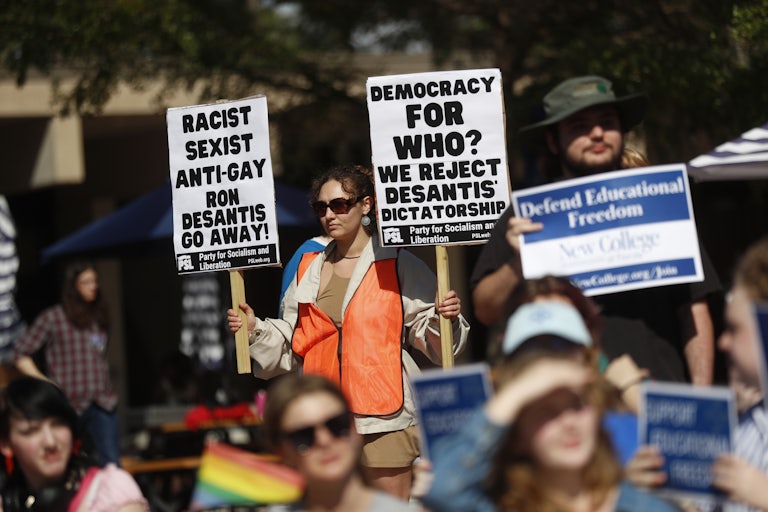
Students at a Defend New College protest in Sarasota, Florida, on January 31

Students at Florida public universities, including Florida State University, the University of Florida, and Florida International University, among others, staged a coordinated walkout Thursday in protest of Governor Ron DeSantis’s ongoing attacks on education, including policies targeting people of color and LGBTQ people.

The student protests were inspired in part by the DeSantis administration’s order for public universities to provide data on how many people seek gender-affirming care. But the collective action also came to be a stance against the broader authoritarian onslaught directed underneath the DeSantis administration.

Florida school districts are banning books en masse, while others are closing their libraries in order to avoid prosecution under a new law that requires a “specialist” to review every book in school. The New College of Florida’s president was forced out by the DeSantis-stacked board of trustees and replaced with another DeSantis ally. DeSantis has pushed through the “Don’t Say Gay” bill, which prevents discussion of sexual orientation and gender identity through third grade. He has lobbied for the “Stop Woke Act,” which restricts teaching on race in colleges. And he has announced plans to mandate Western civilization courses and to defund diversity, equity, and inclusion programs on state college campuses.

DeSantis also banned schools from being able to teach Advanced Placement African American Studies, after his administration first pushed the College Board to water down the class anyway. He even filed an administrative complaint against the Orlando Philharmonic Plaza Foundation for hosting a drag show, stripping the organization of its liquor license.

While it may feel easy to yield to frustration or cynicism in the face of DeSantian authoritarianism, the kids, as always, are not relenting—for themselves, and those they may not ever know.

“Ron DeSantis, we’re on our way to take you down and we’re full-steam ahead for a better day,” Dream Defenders Tallahassee organizer Malik Gary told Teen Vogue. “For people that work in the minority class, for people of the Black and brown community, for people that identify in the LGBTQIA community, for folks that are somebody, no matter what color, or race, or gender, or ethnicity. Everybody is somebody and deserves respect.”

Democrats Slam Joe Biden for “Repackaged Trump-Era” Asylum Ban

The new policy makes it harder for people who are otherwise eligible to seek asylum in the United States.

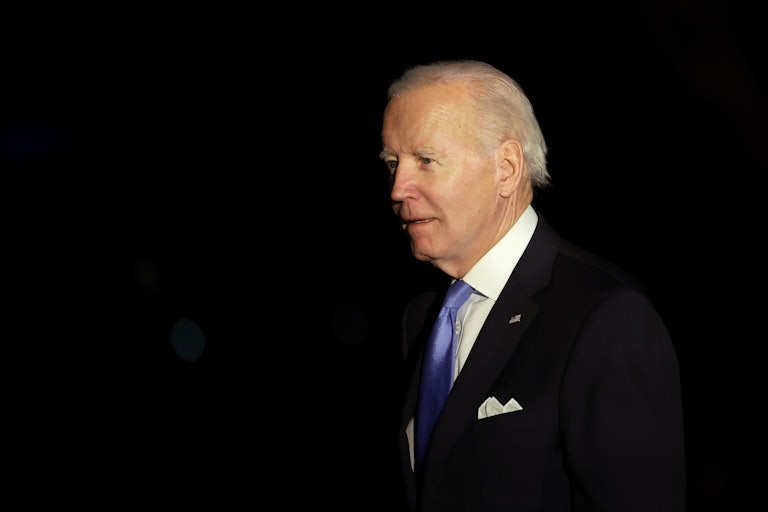
Joe Biden
Kevin Dietsch/Getty Images

Democrats are slamming President Joe Biden’s new immigration policy, with many branding it no better than the measures seen under his predecessor, Donald Trump.

The convoluted policy prevents adults or families from receiving asylum in the United States if they traveled through another country en route and did not apply for (and were denied) asylum there. The new process to apply for asylum in the U.S. includes multiple steps that are neither obvious nor easy to accomplish. It also requires immigrants to use a phone app, CPB One, that is poorly designed and glitchy.

Democratic Representative Jamaal Bowman slammed the policy Thursday as “extreme” and “not supported by U.S. law.” His fellow New Yorker Alexandria Ocasio-Cortez urged Biden’s administration to rethink the policy, which she argued was far too restrictive.

Ilhan Omar and Ayanna Pressley both called seeking asylum a “fundamental human right,” with Omar adding the policy “flies in the face of international law, U.S. law, and basic morality.”

Other Democrats have been pushing back on the policy since it was unveiled on Tuesday. Senators Bob Menendez, Cory Booker, Alex Padilla, and Ben Ray Lujan released a joint statement warning the policy “only perpetuates the harmful myth that asylum seekers are a threat to this nation.”

Representatives Pramila Jayapal and Jerry Nadler called on the president in another joint statement to increase the number of pathways to asylum instead of restricting them. “The ability to seek asylum is a bedrock principle protected by federal law and should never be violated,” they said.

Biden has come under fire since taking office for what Republicans have deemed a crisis at the southern border. Border crossings have reached their highest level in 20 years, and many lawmakers have warned that the U.S. is not equipped to handle the massive influx of people. This latest policy is an attempt to stem that flow, but many immigration rights groups say it could prevent tens of thousands of people from claiming asylum.

“This asylum ban is, at its core, Trump’s asylum ban under a different name. It will leave the most vulnerable people in much the same position as Trump’s policy did—at risk and unfairly denied the protection of asylum for reasons that have nothing to do with their need for refuge,” Anu Joshi, the deputy director of the ACLU’s National Political Advocacy Department, said.

The National Immigration Justice Center and its partner groups are preparing to sue the Biden administration if the law passes, noting that a similar Trump policy did not stand up in court.

Adding to the sting was Biden praising Poland for accepting so many Ukrainian refugees, just hours before his administration unveiled the new measure.

Rail Companies Are Finally Giving Workers Paid Sick Days. This Isn’t Close to the End of the Fight.

Note to the government: Don’t ease up on the pressure now.

Nick Hagen/Anadolu Agency/Getty Images
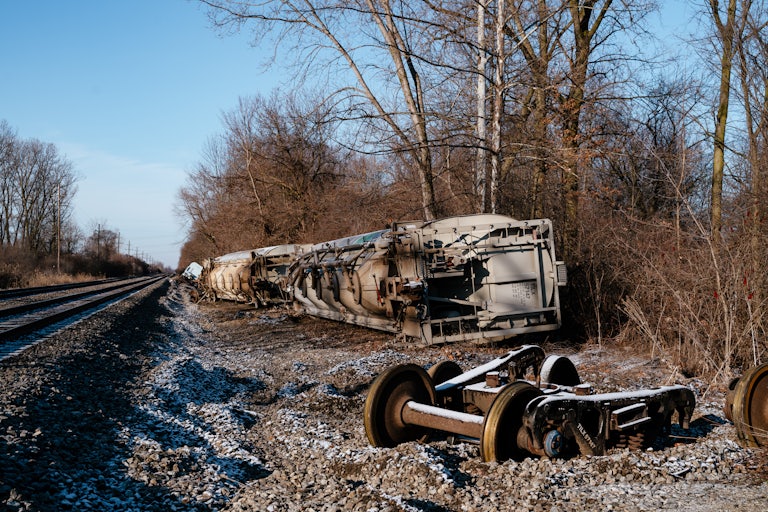
A derailed Norfolk Southern train in Michigan, February 18

While the public is coming to understand how dangerously deregulated the railroad industry is, rail companies themselves are desperately trying to ward off regulation by finally giving workers the necessary benefits. In doing so, though, the companies reveal they could’ve done this of their own volition this whole time.

In the weeks since the disastrous February 3 Norfolk Southern train derailment in East Palestine, Ohio, as more details come to light on how threadbare rail regulation is, and how much of that is thanks to the close relationship between industry and government, companies have coincidentally begun announcing new benefits for workers.

On Wednesday, Norfolk Southern, whose train derailed in East Palestine, reached an agreement with the Brotherhood of Maintenance of Way Employes Division, or BMWED, to provide some 3,000 workers with four days of paid sick leave, and the ability to designate up to three paid personal leave days as paid sick leave.

On Monday, workers at Union Pacific announced an agreement between the company and the National Conference of Firemen and Oilers, or NCFO, and Brotherhood of Railway Carmen, or BRC. Effective April 1, the NCFO agreement prorates the deal to give workers three days of sick leave this year, and the regular four beginning in 2024; the NCFO members can use the paid sick time in half or full-day increments. BRC members, moreover, will have the ability to designate personal leave days for sick leave. In total, 2,100 Union Pacific workers will have gained the benefits.

On February 7, railroad company CSX reached agreements with the BMWED and BRC for four paid sick days, with another three paid personal leave days offered; the agreement also gives workers the option to dedicate unused paid sick leave to their 401(k) or to receive it in a payout. On February 10, the International Association of Machinists and Aerospace Workers, or IAM, and NCFO joined the agreement; on February 14, the IAM Roadway Mechanics division and BRC Carmen for Fruit Growers Express Company division signed on as well. The eight other unions are said to be signing on eventually as well; for now, some 6,000 workers will gain the new benefits.

The cascading agreements, with suggestions of more to come with other unions, is a good thing; workers are finally earning some of the baseline protections and benefits they deserve, ones the government failed in bipartisan fashion to advocate for previously. However, these incredibly late voluntary decisions to finally relent to workers’ demands shows how they could’ve given these workers such benefits even without government regulation or public pressure—but they never did.

Meanwhile, railroad companies are still getting away with a myriad of other things—too big of trains with too little staff; using outdated braking and safety systems, minimizing inspections and audits; and more. Accordingly, the pressure shouldn’t dissipate, but rather increase.

Rail workers (who have been proven right in their warnings of disasters like that in East Palestine) are rallying for complete public ownership of rails. There is widespread, cross-partisan public support for finally clamping down on these corporate freebooters. Now is a moment demanding to be seized. While these companies pretend to tap their brakes, the government would do well to call their bluff and proceed to full throttle.