Breaking News
Breaking News
from Washington and beyond

GOP Rep. Andy Ogles Said He’s an Economist, but He Barely Passed His One Econ Class in College

A Tennessee outlet published a copy of Ogles’s college transcript, revealing that the lawmaker lied about his major.

Representative Andy Ogles
Al Drago/Bloomberg/Getty Images

Tennessee Representative Andy Ogles appears to have lied about his background, making him the latest freshman member of Congress to come under fire for apparently fabricating parts of his résumé.

The Republican says he studied “policy and economics” at Middle Tennessee State University, but an investigation by NewsChannel 5 has found that may not be the case at all.

The Nashville outlet found a copy of Ogles’s college transcript that he submitted as part of a job application 10 years ago. They also found a résumé from 2009, on which Ogles said he majored in international relations, not economics.

According to the transcript, Ogles enrolled in the university in 1990 and finally graduated in 2007. During that time, he took only one economics class, in which he got a C. He also got a C in American history, and he flat-out failed the nine political science courses he took during his college career. Ogles did get an A in theater appreciation, though, which could explain his apparent penchant for dramatic embellishment.

When he finally graduated, it was with a bachelor’s in liberal studies, a generalized degree for people who do not pick a specialized major.

Last week, a NewsChannel 5 investigation cast doubt on other aspects of Ogles’s résumé, revealing that he exaggerated a career in law enforcement and as an expert on international sex crimes. Ogles claimed that he worked with anti–human trafficking group Abolition International in 12 countries. But Abolition International did not have operations in 12 countries during his time working for them.

Ogles released a statement Sunday night saying that he thought he had fulfilled a political science and international relations major, and it wasn’t until he saw his official transcript last week that he realized he had majored in liberal studies.

But Randy Stamps, the former political director for the Tennessee Republican Party, slammed Ogles for the “level of deception” the congressman was willing to go to.

“If he is willing to run around and say, ‘Hey, I’m an economist,’ who knows what else he is going to tell you that is not true,” Stamps told NewsChannel 5. Stamps had broken with his party and endorsed the Democratic candidate during the 2022 midterms because he said he found Ogles so untrustworthy.

Ogles isn’t the first—or frankly, even the most out-there—instance of a member of Congress seemingly making up parts of their background. By this point, everyone has heard about George Santos and his web of falsehoods, from saying his mother survived 9/11 (she was not even in the country) to seemingly lying that his grandparents fled the Holocaust and four of his employees were killed in the Pulse nightclub shooting. Florida Representative Anna Paulina Luna has also claimed Jewish heritage, but not only does she appear to have no ties to Judaism, her grandfather may have served in the Nazi army.
Moderate Democrat Elissa Slotkin Enters Race for Michigan Senate Seat

Slotkin is seeking to replace outgoing Senator Debbie Stabenow, as Democrats try to defend their seat in the battleground state.

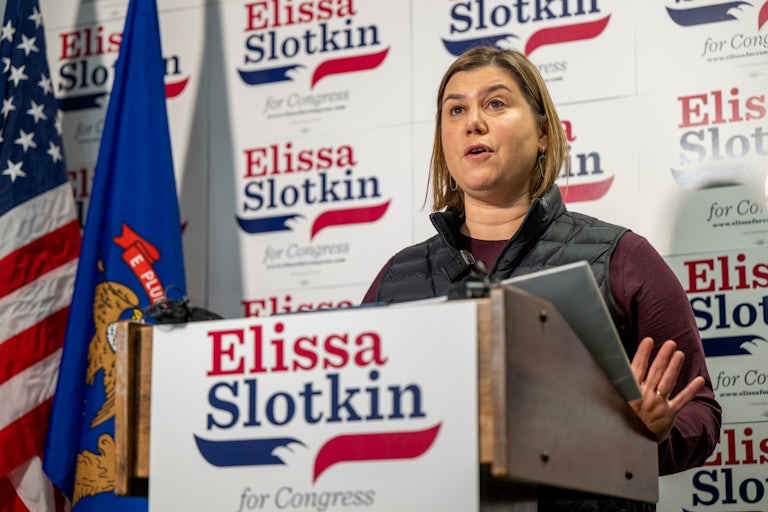
Photo by Brandon Bell/Getty Images

On Monday, Democratic Representative Elissa Slotkin announced her candidacy for outgoing Senator Debbie Stabenow’s Michigan seat. Slotkin is the first Democrat to enter what may be among the most highly contested and expensive Senate races in 2024.

In her announcement video, Slotkin highlights working for the Central Intelligence Agency and her experience working in the White House under both the Bush and Obama administrations.

One primary focus of Slotkin’s announcement video was the tragic loss of her mother to ovarian cancer; the loss came following financial pang after pang, her mother grappling with the diagnosis without health insurance and even being forced to declare bankruptcy.

“We seem to be living crisis to crisis,” Slotkin said. “But there are certain things that should be really simple,” she continued, listing things like increasing domestic production, protecting children from gun violence, and protecting democracy.

Slotkin first entered Congress in 2019, riding the Democratic wave spurred in backlash to Donald Trump. She narrowly won, becoming the first Democrat to represent Michigan’s eighth district since 2001, when the seat was held by Stabenow herself. Slotkin was again narrowly reelected in 2020, after becoming one of the forefront voices to call for Trump’s impeachment. And in 2022, Slotkin ran in the seventh district, in what was among the most expensive House races of the year; in this race, Slotkin became the first ever Democrat endorsed by Liz Cheney.

The Michigan Senate seat is part of a larger challenging map for the Democrats. They’re defending 23 of the 33 seats up for reelection. Some, like Montana, Ohio, and West Virginia, are ones that Trump won by no small margins; others, like Michigan, Arizona, Nevada, and Wisconsin, are pivotal swing states whose results will reveal how strong a message the party really has.

But the moment is more than just about tough political races; it’s the consequences of the races that matter the most, of course. And the times—of cross-partisan-tolerated corporate greed leading to disaster, of mass shooting after mass shooting, of conservative attacks on everything from the basic humanity of LGBTQ people and migrant workers to Social Security and Medicare—require Democrats willing to go up to bat on each and every one of those battles.

While Slotkin has positioned herself to be a liberal in good standing (she has voted 100 percent of the time with Biden, was a leading voice on Trump’s impeachment, and has won close races while standing true to basic liberal ideals around abortion and health care), she also embodies parts of the Democratic establishment wedded to conservative impulses.

Slotkin opposed student debt assistance on a vote supported by 93 percent of the caucus, voted against 85 percent of her caucus on whether the United States should even study the impact of its sanctions on other countries, voted to overturn locally enacted criminal justice and voting rights reforms in Washington, D.C., and even voted against 94 percent of her caucus to bar security clearance from anyone who has used cannabis.

Slotkin also does not openly support Medicare for All, the Green New Deal, or abolishing the death penalty.

Primaries are meant for debate and for candidates to earn the support of their parties. Slotkin has led impressive wins before; while some candidates have bowed out of running, the party would do best to welcome, and not discourage competition. Previous attempts to anoint moderates in consequential races—from Kyrsten Sinema to Hilary Clinton—have not gone well.

Other potential candidates, like Secretary of State Jocelyn Benson, Representative Debbie Dingell, and former Representative Andy Levin, have not outwardly indicated their intentions yet. Slotkin is a proven formidable candidate. May she will have to continue proving herself—and whether her politics are the ones for this moment—against a field of candidates, rather than an open path.

Paul Ryan Says He’ll Skip the 2024 RNC if Trump Is the Nominee: “We’re Going to Lose With Him”

The former House speaker endorsed Donald Trump in 2016.

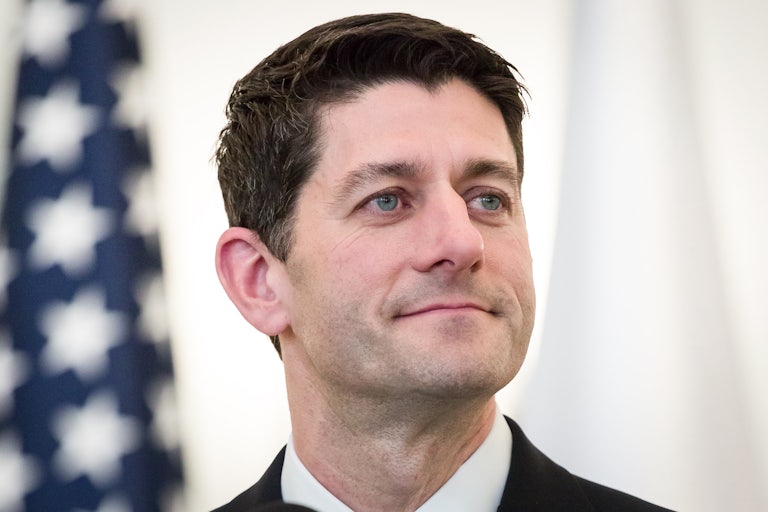
Paul Ryan
Mateusz Wlodarczyk/NurPhoto/Getty Images

Former House Speaker Paul Ryan said he won’t attend the Republican National Convention if Donald Trump is the presidential nominee, a lackluster and pretty on-brand rebuke.

Speaking to a local Milwaukee news station Sunday, Ryan said that even though the 2024 convention will be held in his home state of Wisconsin, his attendance “depends on who the nominee is.”

“I’ll be here if it’s somebody not named Trump,” Ryan said. “I’m not interested in participating” if Trump does become the GOP presidential nominee.

Ryan argued Trump has been bad for the party, noting the former president “cost us the House in ’18, he lost the White House in ’20, he cost us the Senate in ’20, he cost us the Senate again in 2022, and he cost us probably a good dozen House seats in 2022.”

It’s not entirely clear, though, what Ryan thinks his tepid protest will accomplish. It’s been a while since he had any real political influence. He was Mitt Romney’s running mate in 2012 and then served as House speaker for four years, leaving behind a chaotic legacy.

Ryan repeatedly criticized Trump’s actions during the 2016 presidential campaign but always stopped just short of actually taking a stand against him. He ultimately endorsed Trump in June that year.

In the two years he served as speaker under Trump, Ryan took advantage of Republican control of the White House and Congress to help push through his own agenda. Since leaving office, having gotten what he wanted, he has become more outspoken against Trump, previously calling him a “proven loser.”

But Ryan has stayed true to his lukewarm brand of criticism. As a result of his unwillingness to stand up to Trump, Ryan briefly landed on Wikipedia’s list of invertebrates in 2017.

Trump hit back at Ryan on Truth Social, also taking the opportunity to plug his lie that he won the 2020 election. “Paul Ryan is a loser, Mitt Romney could have won without him. I won twice, did much better the second time, and was 233 Wins out of 253 Races in the Midterms. Paul Ryan is destroying Fox, and couldn’t get elected dogcatcher in the Republican Party!” he said.

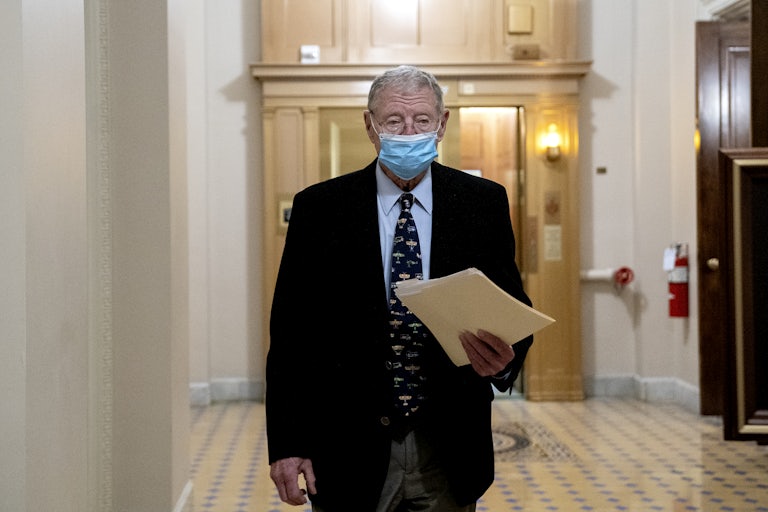
Ex-Senator Jim Inhofe Retired Due to Long Covid, Says at Least Five Other Congress Members Also Have It

The Oklahoma Republican called out his colleagues.

Stefani Reynolds/Pool/Getty Images
Senator Jim Inhofe

Former Senator Jim Inhofe revealed that he suffers from long-term effects of Covid-19, which played a part in his decision to retire from Congress, and at least five other members of Congress suffer from the same thing.

The Oklahoma Republican announced last February he planned to retire after almost 40 years on Capitol Hill. During the same press conference, his chief of staff announced that Inhofe had contracted a “very mild” case of Covid-19. But clearly, the effects of the virus have been much longer-lasting. And he’s not the only one.

“Five or six others have (long Covid), but I’m the only one who admits it,” Inhofe told Tulsa World in a recent interview.

He did not say what symptoms of long Covid he suffers from, nor which other members of Congress are struggling with long Covid. But Democratic Senator Tim Kaine has been open about his mild long Covid symptoms.

Inhofe struck a highly contradictory tone during the start of the coronavirus pandemic. He warned people to take the virus seriously, telling Tulsa World in a March 2020 interview, “You know I’d be the first to say we’re overreacting because that’s kind of how I am, but we’re not. By people not believing, by not taking precautions, they’re making it more likely to spread.”

In the same interview, however, he said he had tried to annoy a reporter by saying he wasn’t doing anything to protect himself against Covid and then trying to shake hands.

Inhofe also voted against several key Covid relief bills, including the Families First Coronavirus Response Act, which required employers to give employees paid sick leave or expanded medical and family leave for Covid-related reasons. That bill had enormous bipartisan support, with 90 senators voting for it.

Inhofe also voted against the American Rescue Plan, which was aimed at providing economic relief due to the crisis caused by the pandemic. The bill included funding for the national vaccination program, the stimulus checks, and the expanded unemployment benefits.

Republicans Suddenly Pretend to Care About Infrastructure, Just to Criticize U.S. Aid to Ukraine

Well, that’s a new one.

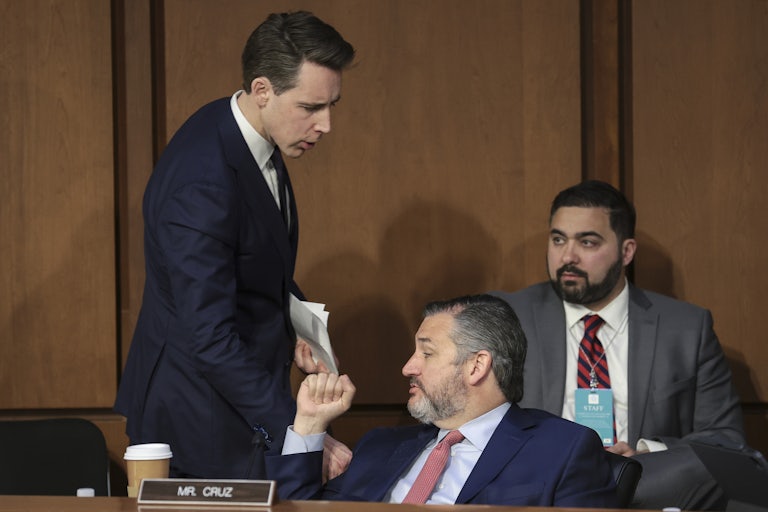
Josh Hawley bends down to talk to Ted Cruz, seated, who holds up a clenched fist
Win McNamee/Getty Images
Senators Josh Hawley and Ted Cruz

Republicans who have spent years blocking critical infrastructure spending suddenly seem incensed at the idea that we are not spending money on critical infrastructure.

Friday marked one year since Russia’s invasion of Ukraine, and throughout the week, Republicans increasingly and in larger numbers criticized the Biden administration’s support of the attacked nation. And they’ve been using the disastrous Norfolk Southern train derailment in East Palestine, Ohio, as fodder for their complaints.

Regardless of one’s specific views on sustained military support for Ukraine, the argument is rich coming from conservatives, who have fought tooth and nail to water down massive infrastructure investments over the past few years, especially in Biden’s Build Back Better effort.

Tucker Carlson, for example, has dedicated countless hours on his program to bullying Republicans for supporting infrastructure spending, only to suddenly change tune when he could then blame it all on Ukraine.

The Infrastructure Investment and Jobs Act was first introduced by the Biden administration as a $2.3 trillion appendage of the larger investment effort. After conservative stonewalling, the bill was cut to $1.2 trillion in what was then called the Bipartisan Infrastructure Law. About $14 billion of rail modernization dollars were cut out in the watered-down framework. Such is the cost of “bipartisan” collaboration with intransigent Republicans, it seems. And this was just one of many losses incurred after conservatives—including Senators Joe Manchin and Kyrsten Sinema—hamstrung Democratic efforts to deliver on the infrastructure-building agenda they were elected to carry out.

Two years ago, Senator Ted Cruz bragged about standing strong alongside Senators Ron Johnson and Mike Lee against any Republicans expressing a willingness to work with Democrats.

And now Cruz, who cosplayed as an ally to rail workers asking for more industry regulation, is in fact holding his tune for deregulation:

And while celebrating more deregulation, Cruz also spent his week podcasting to complain about Biden visiting Ukraine.

Meanwhile, Johnson is busy fundraising off the East Palestine derailment, complaining that “the media is barely covering this.” Beyond taking money from Norfolk Southern and fighting against infrastructure spending alongside Cruz, one of the only rail-related bills Johnson has signed off on was one backed by the Association of American Railroads. It sought to delay the industry-wide implementation of a monitoring system to help prevent train collisions and derailments. Norfolk Southern is among the companies represented by the association.

Senator Josh Hawley is also now pitting spending on Ukraine and East Palestine against each other, but years ago, he complained about the proposed infrastructure bill. He took specific issue with the bill’s environmental investments. (Conservatives now feign concern for the kinds of environmental issues in East Palestine that plague communities all across the country, ones that would in fact have been addressed by Green New Deal–esque investment).

It is reasonable to question how long the United States may stay involved in Ukraine—or any affairs elsewhere, given our track record. But it’s unserious for conservatives who have already dedicated much of their careers to fighting against government investment to now posture as eager proponents of mass infrastructure projects. But, hey, if it’s sincere, be our guest: We’ll be waiting for the legislation!