Breaking News
Breaking News
from Washington and beyond

A Texas GOP Bill Wants to Stop Credit Card Companies From Processing Your Abortion Pill Payment

Texas Republicans are introducing bill after bill to make it harder to get an abortion.

MARK FELIX/AFP/Getty Images
An abortion rights demonstrator holds a sign outside the Harris County Courthouse during the Women’s Wave march in Houston, on October 8.

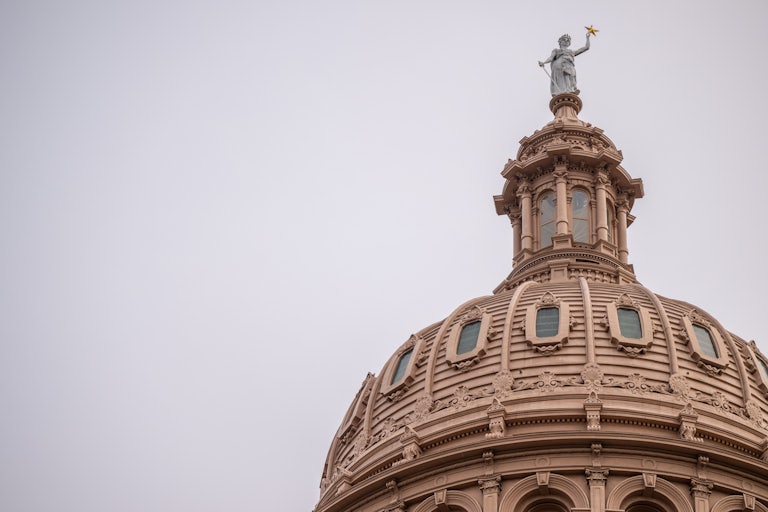
A Texas Republican lawmaker has introduced a bill that would ban credit card companies from processing transactions for abortion pills, the state’s latest attempt to dramatically curb safe access to the medical procedure.

The bill, which Representative Drew Springer proposed Thursday night, would classify processing credit card transactions for “the provision of an abortion-inducing drug by courier, delivery, or mail service” as a felony. The legislation would also allow individuals to sue credit card companies that allow such transactions to go through.

Springer’s bill did not say how the state would monitor credit card purchases for abortion pills, nor how civilians would know which card companies continue to process the transactions.

Since Roe v. Wade was overturned, Texas has banned abortion after six weeks, before many people even know they are pregnant. There are no exceptions for rape or incest, and only a few to save the life of the pregnant person. Individuals are also allowed to sue anyone who provides abortion care or helps someone get an abortion, in what’s known as the state’s chilling vigilante law.

Apparently not satisfied with those restrictions, Texas has continued to try to limit access to other forms of reproductive health. Last week, another Republican lawmaker introduced a bill that would compel internet providers in the state to block websites that sell or provide information on how to obtain abortion pills.

Under the Women and Child Safety Act, abortion funds and their staffers could face criminal penalties for helping someone get an abortion even if they travel out of state, as could individuals who manufacture and distribute abortion pills in Texas or who provide information on how to get the drugs. The bill would also allow individuals to bring civil lawsuits against the people who maintain such sites, another extension of the state’s vigilante law. All of these restrictions, however, run counter to what Texans actually want: A study by the Public Religion Research Institute found that 57 percent of state residents think abortion should be legal in all or most cases.

Medication abortions, which consist of taking the two drugs mifepristone and misoprostol, make up more than half of all abortions in the United States, according to the Guttmacher Institute. The pills are considered a crucial resource in maintaining widespread access to safe abortions. Restricting the means to medication abortions will hit people of color and lower-income people the hardest.

Mississippi Republicans Want to Ban Ballot Initiatives on Abortion

Fun new attack on democracy

Posters outside the pink abortion clinic read things like "This clinic is a refuge" and "Pink House, thank you for being here. These people, this place, has saved my life."
ANDY HUFFAKER/AFP/Getty Images
The Jackson Women’s Health Organization, Mississippi’s last abortion clinic, on July 7, 2022. The clinic is now closed.

Mississippi lawmakers have introduced a bill that would give citizens back the right to vote on ballot initiatives—except on laws about abortion access.

State residents were stripped of their right to introduce citizen-led ballot initiatives in 2021. This new bill, introduced Tuesday, would allow them to propose changes to laws but not constitutional amendments. They would also not be allowed to “propose any new law or amend or repeal any existing law relating to abortion.”

The U.S. Supreme Court ruled in Dobbs v. Jackson Women’s Health Organization last summer to roll back the nationwide right to an abortion. The case concerned the constitutionality of Mississippi’s law banning abortion after 15 weeks. After the ruling, Mississippi’s trigger law went into effect, and abortion is now illegal in the state except in cases of rape or incest or to save the pregnant person’s life.

Opinion regarding abortion in Mississippi is almost evenly split. A recent study by the Public Religion Research Institute found that 49 percent of state residents believe the procedure should be legal in all or most cases. In July 2022, a month after the Dobbs ruling, a poll conducted by Blueprint Polling for the ACLU of Mississippi found that 51 percent of state residents disagreed with the Supreme Court’s decision.

Mississippi residents also rejected a previous ballot initiative aimed at curbing abortion access. In 2011, anti-abortion groups put the Personhood Amendment on the ballot. The amendment would have defined the word “person” in the state constitution to include fertilized human eggs. An overwhelming majority of voters, 58 percent, rejected the initiative.

Lawmakers in Mississippi have a history of using the right to ballot initiatives as a punitive tool. It has been taken away twice, once in 1922 and again in 2021, because officials disagreed with the results of citizen-led ballot initiatives.

If the measure passes the state legislature, it would be just another instance of lawmakers creating loopholes to continue restricting abortion, instead of letting the people decide what they want for themselves. This has also happened in Kentucky, where a Republican lawmaker introduced a bill to prosecute people who get illegal abortions for criminal homicide, despite state residents voting in the 2022 midterms against an amendment that would have said abortion is not a protected right in the state.

The most egregious example is Kansas, where residents voted overwhelmingly in August to keep abortion protections in the state constitution. Lawmakers responded by introducing a bill that would let individual cities and counties restrict abortion, directly circumventing the will of the people.

Texas GOP Bill Would Give Major Tax Cut to Straight, Never-Divorced Parents

If you make it to kid number 10, there’s an extra reward for you.

Brandon Bell/Getty Images

Conservatives are always seeking ways to (a) defund the government and its services and (b) push their own cultural values onto others. One Texas state representative found a way to try doing both.

Representative Bryan Slaton has filed a bill to roll back 100 percent of property taxes for heterosexual married couples with 10 children.

The legislation calls for property tax relief by increments of 10 percent for each child, starting with married couples with four “qualifying children” receiving a 40 percent credit, those with five receiving a 50 percent credit, and so on. (Couples with three children or fewer do not qualify for the credit.)

If a “qualifying married couple” has 10 or more “qualifying children,” they would receive a 100 percent credit off their property taxes.

Language in the bill defines a “qualifying child” to be a “natural child of both spouses of a qualifying married couple born after the date on which the qualifying married couple married,” or an adopted child of one or both spouses, adopted after the couple was married.

And what constitutes a “qualifying married couple,” you may ask? Well, it “means a man and a woman who are legally married to each other, neither of whom have ever been divorced.”

“With this bill, Texas will start saying to couples: ‘Get married, stay married, and be fruitful and multiply,’” Slaton said in a statement.

The bill may not be surprising coming from Slaton. The Houston Press reports that the Texas representative, a former minister, has proposed banning minors from all drag events and has also dedicated much of his time in government to trying to attach various anti-LGBTQ amendments to completely unrelated legislative packages.

Slaton’s former intern Jake Neidert is a self-described Christian nationalist who has menacingly called for trans people to be “publicly executed.” The vicious figure went on to work as legislative director for Representative Tony Tinderholt, Slaton’s ally in many of his anti-LGBTQ crusades.

So, whether or not this specific bill gets awfully far, rest assured its author is heavily active in working to advance a radical fundamentalist agenda on Texans.

Donald Trump Can Be Sued for Inciting January 6 Riot, Justice Department Says

Trump cannot claim presidential immunity from lawsuits filed against him by Capitol Police officers and House Democrats.

Donald Trump waves to the crowd at a "Stop the Steal" rally shortly before rioters stormed the United States Capitol
Tasos Katopodis/Getty Images

President Donald Trump is not entitled to immunity from civil lawsuits over his role in the January 6 insurrection, the Department of Justice said Thursday.

Two Capitol Police officers, backed by 11 Democratic House members, have sued Trump for physical and psychological injuries they suffered during the riot. The suit was brought under a statute that allows for damages to be paid when force, threats, or intimidation are used to prevent government officials from doing their job. Trump has argued that he is protected against the suit by presidential immunity.

But the Justice Department disagreed. “Speaking to the public on matters of public concern is a traditional function of the Presidency, and the outer perimeter of the President’s Office includes a vast realm of such speech,” attorneys for the department’s Civil Division said. “But that traditional function is one of public communication. It does not include incitement of imminent private violence.”

A U.S. district judge had found in February 2022 that Trump could be sued, and the former president’s lawyers appealed the decision. The appeals court debated the case in December and ultimately asked the Justice Department to weigh in.

A dozen former White House and Justice Department officials from Democratic and Republican administrations had already called for the court to reject Trump’s immunity argument, saying it was “the rare but clear circumstance in which a President broke the law while acting well beyond any official capacity.”

Another group of Capitol Police officers have sued Trump in a separate case for inciting the insurrection, as have D.C. police officers. The partner of Brian Sicknick, a Capitol Police officer who died after being brutally attacked by rioters, has also sued Trump, as well as two members of the mob.

Capitol Police officers have made it clear they hold Trump and other Republican leaders accountable for the deadly riot, as well as for law enforcement’s lack of preparedness on the day.

Quite a Few Notable Republicans Are Skipping CPAC This Year

CPAC used to be a premier event for Republicans. Now it’s looking more like a Donald Trump fan party.

Spencer Platt/Getty Images
Florida Governor Ron DeSantis

The Conservative Political Action Conference kicked off this week, minus a few noteworthy faces.

The annual gathering was once considered a premier event for Republicans and a must-do for anyone considering a presidential run. But this year, the event has been overshadowed by sexual assault allegations against Matt Schlapp, head of the American Conservative Union, which organizes CPAC. A staffer on Herschel Walker’s Senate campaign has accused Schlapp of groping him without consent. Schlapp has denied the allegations but has yet to address them at CPAC, during which he is speaking multiple times, along with his wife and one of his children.

Another reason many notable Republicans are staying away from CPAC could be that it has turned into more of a Donald Trump fan party, which seems to have turned off many of the people seeking to challenge him in 2024.

Chief among them is Florida Governor Ron DeSantis, who is predicted to be Trump’s main contender for the Republican presidential nomination. DeSantis, who seems to be busy curtailing human rights in his state, will instead be at a retreat hosted by the Club for Growth, a conservative economics organization.

Former Vice President Mike Pence, who is also reportedly considering a presidential run, will similarly be at the Club for Growth event. Pence has tried to walk a fine line recently of distancing himself from Trump enough to appeal to potential moderate supporters, but not so much that he alienates his former boss’s most loyal fanbase.

House Speaker Kevin McCarthy will not be at CPAC, which comes as a surprise given all his efforts to stay in Trump’s good graces. Neither will Senate Minority Leader Mitch McConnell, who has become a Trump critic despite using the former president to push through conservative judges and legislation.

Republican National Committee Chair Ronna McDaniel won’t be there, either. Trump backed her run for reelection as RNC head, but McDaniel announced Sunday that all Republican presidential candidates would be required to sign a pledge to support the eventual nominee, no matter who, in order to be allowed onto the debate stage. In response to McDaniel, Trump’s campaign spokeswoman told CNN that Trump “will support the Republican nominee because it will be him.”

These absences could be a sign that some of the Republican Party is turning on Trump, who will be the closing speaker at CPAC on Saturday. The event seems to be turning into a glorified Trump rally. In 2021, CPAC unveiled a golden statue of the former president for attendees to take selfies with, and the 2023 speaker lineup has been packed with Trump loyalists, including Matt Gaetz, Marjorie Taylor Greene, Jim Jordan, Donald Trump Jr., and even Jair Bolsonaro.

However, Nikki Haley and Vivek Ramaswamy, both of whom are running against Trump in 2024, and Mike Pompeo and Tim Scott, who are reportedly considering running, will speak at CPAC. All four of these candidates are considered extreme long shots, so they could be trying to peel support away from Trump over the course of the event.