Breaking News
Breaking News
from Washington and beyond

Georgia House Passes Bill Banning Gender-Affirming Care for Trans Kids

Georgia is on track to become the ninth state blocking gender-affirming care for transgender youth.

Megan Varner/Getty Images
Georgia Capitol building

The Georgia House of Representatives passed a bill Thursday banning gender-affirming care for minors, putting it on track to become the ninth state to target transgender youth.

The bill passed by a vote of 96–75 and now goes to the Senate. The Republican-controlled chamber already passed a previous version of the measure and so is likely to pass the amended one too.

If it becomes law, the bill would ban hormone therapy and transition-related surgeries for anyone under the age of 18, with proponents and the bill text arguing that doing so would protect children.

Major medical organizations, including the American Academy of Pediatrics, support giving gender-confirming care to children, deeming it medically necessary and even lifesaving.

Democratic Representative Omari Crawford slammed the measure ahead of the vote, arguing that passing it would essentially be the same as the chamber making medical decisions. “We are not doctors, we are lawmakers,” he said. “Voting for this bill would make us hypocrites.”

While debating the bill, several of the representatives who back it cited data that is outdated and inaccurate, writer Erin Reed pointed out. Republicans also insisted that there are no studies that show whether gender-affirming care has a positive effect.

This is not true: Multiple studies, including one published in the New England Journal of Medicine and another released by the Journal of Adolescent Health, have found that trans and nonbinary teenagers who receive gender-affirming care have significantly lower rates of anxiety, depression, and suicide or suicide attempts.

What you just heard is disinformation,” Democratic Representative Sam Park said of his Republican colleagues’ arguments. “You are not protecting children by passing this bill. You are inflicting harm.

“You are passing this bill in your political self-interest.”

Other Democrats pointed out the hypocrisy of barring parents from making decisions about their children’s welfare while insisting parents had the right to decide what topics kids study in school.

Georgia is part of a much larger wave of Republican-led states seeking to dramatically curtail the rights of gender minorities. The bills don’t just focus on trans minors: Other bills would attack drag performances, prevent people from changing their IDs to reflect their gender identity, or even set a legal definition of gender to exclude trans and nonbinary people.
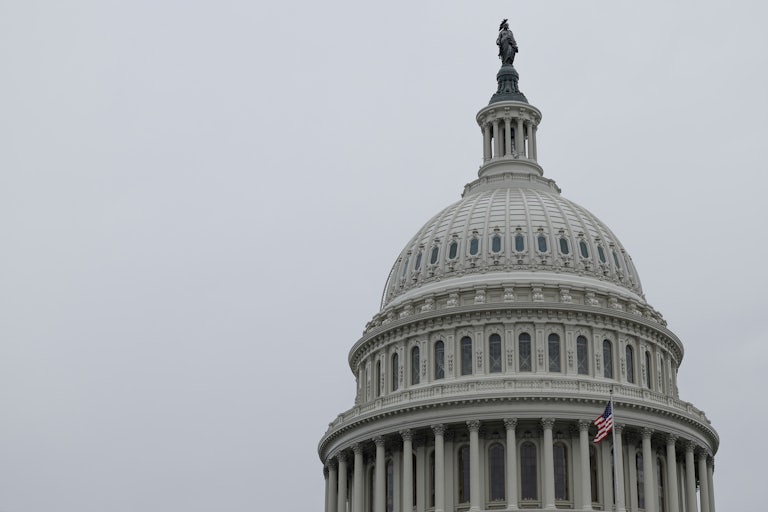

The List of Senators Who Voted Not to Repeal the 1991 and 2002 Iraq War Authorizations

Unclear why the list on this AUMF vote is this long.

Capitol Building
Anna Moneymaker/Getty Images

On Thursday, the Senate voted 68–27 to advance legislation that would repeal the 1991 and 2002 Authorizations for Use of Military Force, or AUMFs, against Iraq.

Here is a list of every senator—all Republicans—who voted against advancing the legislation:

  • Marsha Blackburn
  • John Boozman
  • Katie Britt
  • Shelley Moore Capito
  • John Cornyn
  • Tom Cotton
  • Mike Crapo
  • Joni Ernst
  • Deb Fischer
  • Lindsey Graham
  • Bill Hagerty
  • Cindy Hyde-Smith
  • John Neely Kennedy
  • James Lankford
  • Markwayne Mullin
  • Pete Ricketts
  • James Risch
  • Mitt Romney
  • Mike Rounds
  • Marco Rubio
  • Rick Scott
  • Tim Scott
  • Dan Sullivan
  • John Thune
  • Thom Tillis
  • Tommy Tuberville
  • Roger Wicker

Republicans John Barrasso, Ted Cruz, and Mitch McConnell, as well as Democrats Dianne Feinstein and John Fetterman, were absent.

Senate Moves To Finally Repeal 1991 and 2002 Iraq War Authorizations

The symbolic AUMF vote comes ahead of the 20th anniversary of the 2003 invasion of Iraq.

The sign reads: End the War Now.
Brendan Smialowski/Getty Images
An anti-war protester holds a sign up in front of the Capitol on September 15, 2007.

On Thursday, the Senate voted 68–27 to advance legislation that would repeal the 1991 and 2002 Authorizations for Use of Military Force, or AUMFs, against Iraq.

The bipartisan legislation seeks to eliminate the authorizations that opened the door for the Gulf War under President George H.W. Bush, and the invasion of Iraq under President George W. Bush. Monday will mark 20 years since the 2003 invasion.

Repealing military authorizations has been an ongoing struggle. In June 2021, the House voted 268–161 to roll back the 2002 AUMF but the effort fizzled away in the Senate.

The 2001 AUMF after September 11, however, is untouched by this legislation. In its endorsement of the legislation to repeal the 1991 and 2002 authorizations, the Biden administration noted that the U.S. “conducts no ongoing military activities that rely primarily” on the two authorizations. “Repeal of these authorizations would have no impact on current U.S. military Operations,” the administration notes.

The 2001 AUMF has been used to justify U.S. action in Afghanistan, Cuba, Djibouti, Eritrea, Ethiopia, Georgia, Iraq, Kenya, Libya, the Philippines, Somalia, Syria, and Yemen, among others.

Thursday’s advancement to repeal the 1991 and 2002 authorizations follows the House last week rejecting a War Powers Resolution that would have required a withdrawal of all U.S. troops from Syria. Only 56 Democrats and 47 Republicans voted in favor of the resolution.

So while the move to advance the legislation is encouraging, it’s worth noting that the advancement is largely symbolic. Which is not to say it’s futile: Symbols, especially for a country in which so much violence has been spurred by them, are still significant. The last time Congress repealed a war authorization was in 1971 when it voted to repeal the Gulf of Tonkin Resolution that provided authority for the Vietnam War.

Ideally, the legislation will continue advancing, be signed by Biden promptly, and even galvanize support to confront the 2001 AUMF. At the same time, it’s already been more than 30 years since the first authorization, and it still hasn’t been repealed. Before considering ideal outcomes, pressure will need to be maintained at least to repeal this first pair of authorizations. For now, it’s one bite at a time—it’s just prudent we stay hungry enough to keep going.

North Dakota Judges Uphold Pause on Abortion Ban, Citing “Fundamental Right” to Lifesaving Procedure

The ruling keeps in place a temporary block against the state’s near-total abortion ban.

Dave Kolpack/AP/Shutterstock
An abortion clinic that for nearly 25 years operated on a busy street in downtown Fargo, North Dakota, moved to this commercial building in an industrial area in neighboring Moorhead, Minnesota.

The North Dakota Supreme Court has upheld up a decision to temporarily block the state’s near-total abortion ban. The court also stated that residents have a “fundamental right” to abortions that preserve pregnant people’s health.

The majority opinion denied Attorney General Drew Wrigley’s request to remove a temporary injunction against a trigger law that would have enacted the state’s abortion ban after the overturning of Roe v. Wade.

In 2007, the state passed a bill that would outlaw abortion within 30 days if the U.S. Supreme Court ever overturned Roe v. Wade. Last June, the bill was triggered by Dobbs v. Jackson, which indeed overturned the landmark case.

The Red River Women’s Clinic, formerly the state’s only abortion provider, sued Wrigley to stop the ban, claiming that the state’s constitution grants residents the right to an abortion. Last summer, the clinic moved from Fargo, North Dakota, to nearby Minnesota town, Moorhead, where abortion remains legal.

A county judge had temporarily blocked the ban while the case continued. On Thursday, the Supreme Court upheld the county judge’s injunction.

Wrigley had appealed to the Supreme Court, asking it to remove the injunction, on the grounds that the Red River Women’s Clinic and other plaintiffs “failed to prove they have a substantial likelihood of success on the merits” that they would “suffer irreparable injury,” that there would be “harm to other interested parties,” or that “the effect on the public interest” weighs in favor of a temporary pause on the ban.

The Supreme Court denied Wrigley’s appeal, claiming that, in fact, the clinic did demonstrate “likely success on the merits,” conceding that “there is a fundamental right to an abortion” in “life-saving and health-preserving circumstances.” The Court cited law as far back as 1877 to show precedent for legalized life-preserving abortion, in order to state that, in 2023, people have the right to such a procedure.

This post has been updated.

Janet Yellen Trashes GOP Debt Ceiling Plan as “Recipe for Economic and Financial Catastrophe”

The treasury secretary did not mince words on the Republican plan.

Treasury Secretary Janet Yellen seated in the Capitol
Chip Somodevilla/Getty Images
Treasury Secretary Janet Yellen

Treasury Secretary Janet Yellen on Thursday slammed the Republican plan for what the United States should do if it hits the debt limit.

The GOP has refused to lift the debt ceiling until major budget cuts are made. Instead, House Republicans introduced a proposal last week that would order the Treasury to prioritize payments on government debt and Social Security should the U.S. reach its debt maximum. Democrats have rejected the measure.

“Our systems are built to pay all of our bills on time and not to pick and choose which bills to pay,” Yellen told the Senate Finance Committee. “There is a reason that treasury secretaries of both parties have rejected this incredibly risky and dangerous idea.”

I cannot give any assurances about the technical feasibility of such a plan,” she continued. “It would be an exceptionally risky, untested, and radical departure from normal payment practices of agencies across the federal government.”

Republicans have made clear they are willing to hold the debt ceiling hostage in order to cut costs in the federal budget. They proposed another plan last week that would slash funding for student debt relief, climate change policy, and IRS enforcement, among other things.

But Democrats, including President Joe Biden, have said they refuse to compromise on the debt ceiling, setting up a protracted battle. If the debate drags out too long, the United States could be in serious trouble. The government already hit the debt ceiling in January, and Yellen has previously warned the U.S. could default on its debt by the summer if the cap isn’t raised.

“It’s simply a recipe for economic and financial catastrophe to think we can pay some of our bills and not all of them,” Yellen said Thursday.