Breaking News
Breaking News
from Washington and beyond

GOP Senator Worth Up to $75 Million Attacks Bernie Sanders for Holding a Billionaire Accountable

Oklahoma Republican Markwayne Mullin attacked Bernie for holding a hearing with former Starbucks CEO Howard Schultz on union-busting.

Markwayne Mullin
Al Drago/Bloomberg/Getty Images
Oklahoma Senator Markwayne Mullin

Oklahoma Republican Markwayne Mullin seems to think Bernie Sanders is a hypocrite for attacking Starbucks because he wrote a bestselling book that made some money.

Mullin, who earlier this month told the Teamsters union president to “shut your mouth,” made the claims during a Senate hearing Wednesday with former Starbucks CEO Howard Schultz. Arguing that Sanders himself has some money after his book was published (Sanders is still nowhere close to being a billionaire), Mullin seemed to believe the Vermont senator should not be going after Schultz or Starbucks for its union-busting practices.

“Mr. Chairman, you yourself have been very successful, rightfully so, glad you have been. You’ve been in office for 28 years and you and your wife have immersed [sic] a wealth of over $8 million,” Mullin began, incorrectly inflating Sanders’ reported net worth of $3 million.

“If you can be a millionaire, why can’t Mr. Schultz and other CEOs be millionaires and be honest too? If that’s the case, then why is it that Mr. Schultz, who actually creates jobs—and the bestseller of a book isn’t creating any jobs—why is it that he’s corrupt, and you’re not? Why is it that all CEOs are corrupt because they’re wealthy, and yet our chairman—who is wealthy, and I’m glad you are—you’re not?”

Beyond the factual errors, Mullin seemed to be entirely disinterested in the substance of the hearing at all. Why indeed can’t rich people like Schultz be deemed “honest?” Well, if they are carrying out a union-busting campaign to prevent workers from being able to advocate for adequate wages and benefits—and lying about doing so—then, indeed, they could readily be deemed corrupt.

Sanders, for his part, did not play too much into the charade. After briefly countering Mullin’s false claims about his net worth or that he thinks “all CEOs” are corrupt, he focused on the purpose of why they were there at all.

“What this hearing is about is whether workers have the constitutional right to form a union,” Sanders said. “The evidence is overwhelming, not from me, but from the National Labor Relations Board … that time after time after time—despite what Mr. Schultz is saying—Starbucks has broken the law and has prevented workers from joining unions to collectively bargain for decent wages and benefits.”

Mullin himself warrants his own level of scrutiny as to whether he is an “honest” millionaire. The Oklahoma Republican was already swimming in assets worth up to $29.9 million in 2020. The following year, his net worth exploded to be anywhere between $31.6 million and a gargantuan $75.6 million. Mullin received some $1.4 million in federal PPP loans and was among the members of Congress who helped tank the TRUTH Act, which would have required public disclosure of companies receiving those relief funds.

Mullin’s implication that Sanders is somehow hypocritical to hold the rich accountable since he is wealthy is a familiar talking point from the right. Its salience is weak given that, if anything, the talking point actually proves Sanders’s commitment to pursue policies even when they may impact him (like higher taxes on the wealthy).

Moreover, if Sanders is somehow in the wrong for holding fellow rich people accountable (though Schultz is worth 1,000 times as much as Sanders), what does that make rich people like Mullin who defend union-busting CEOs?
Howard Schultz Says It’s “Unfair” to Call Him a Billionaire

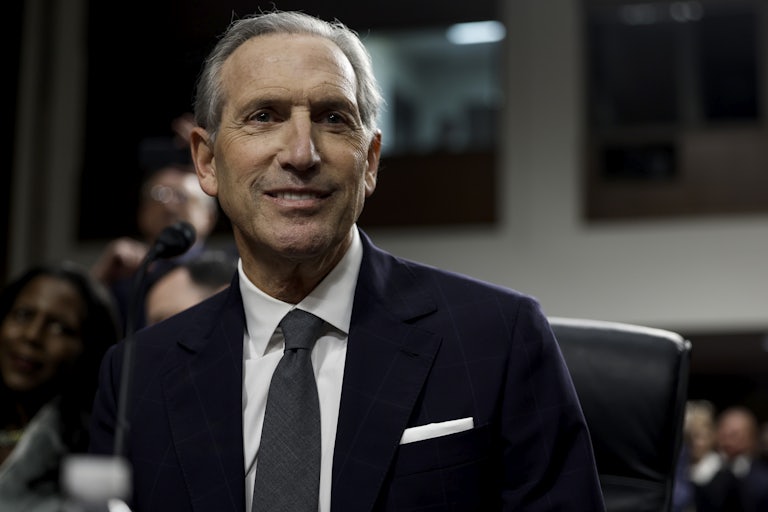
The former Starbucks CEO complained people were being mean to him during a Senate hearing about union-busting.

Former Starbucks CEO Howard Schultz smiles
Anna Moneymaker/Getty Images
Former Starbucks CEO Howard Schultz

Howard Schultz (net worth of $3.7 billion) is not happy with you calling him a billionaire.

During a Wednesday hearing before the Senate Health, Education, Labor and Pensions Committee, the Starbucks CEO objected to being described as a billionaire because he did not grow up that way, an argument he seems to think automatically absolves him of any culpability for his current behavior.

“This moniker of billionaire, let’s just get at that, OK?” Schultz started. “I grew up in federally subsidized housing. My parents never owned a home. I came from nothing. I thought my entire life was based on the achievement of the American dream.

“Yes, I have billions of dollars—I earned it. No one gave it to me. And I’ve shared it constantly with the people of Starbucks,” Schultz said (though apparently he has withheld it from workers attempting to unionize). “And so anyone who keeps labeling this billionaire thing,” Schultz trailed off, as Senator Bernie Sanders urged the hearing to keep moving.

“It’s your moniker, constantly,” Schultz interjected. “It’s unfair.”

That one of the richest people in American society feels a level of pressure to not be seen by the public as just another billionaire embodies some shift in the cultural zeitgeist surrounding wealth inequality in this country. And that Schultz attempted to argue that he shared his riches with his workers shows a growing (correct) baseline assumption by many in this country that the rich hoard their unearned wealth from those who helped them attain it in the first place.

It was a small moment in the hearing, but perhaps one that represents a broader cultural shift that could become much more potent, if it is fully activated.

Senate Votes to Repeal Iraq War Authorizations, 20 Years After U.S. Invasion

The vote repeals two AUMFs that authorized the 1991 Gulf War and the 2003 invasion.

Kevin Dietsch/Getty Images

On Wednesday, the Senate voted 66–30 to repeal the 1991 and 2002 Authorizations for Use of Military Force, or AUMFs, against Iraq.

The bill will eliminate the authorizations that authorized America’s Gulf War under President George H.W. Bush and the invasion of Iraq under President George W. Bush.

It has taken a long process for the United States to eliminate the authorizations. In June 2021, the House voted 268–161 to roll back the 2002 AUMF, but the Senate did not advance it any further. Now this Senate’s repeal effort goes to the House, where an array of legislators on both sides of the aisle have expressed their support.

House Majority Leader Kevin McCarthy has said he’s “into” the repeal effort—so long as the 2001 AUMF enacted after 9/11 remains untouched. Such an opinion is likely held by many members in both parties. While endorsing the effort to repeal the 1991 and 2002 authorizations, the Biden administration noted that the U.S. “conducts no ongoing military activities that rely primarily” on the pair of authorizations anyhow. “Repeal of these authorizations would have no impact on current U.S. military operations,” the administration said in a statement.

And indeed, the 2001 AUMF after September 11 is untouched by this legislation. The authorization has been used to justify U.S. action in Afghanistan, Cuba, Djibouti, Eritrea, Ethiopia, Georgia, Iraq, Kenya, Libya, the Philippines, Somalia, Syria, and Yemen, among others.

Earlier this month, the House rejected a resolution that would have required a withdrawal of all U.S. troops from Syria. Only 56 Democrats and 47 Republicans voted in favor of the resolution.

So it is good to see even Republicans joining the righteous movement to repeal these military authorizations; ideally the margins are even larger in the House vote. But the Senate vote was not even close to unanimous. That, coupled with such an outward impulse exhibited by leaders in both parties to assure that the bill will not impact America’s existing military presence throughout the world, does not inspire confidence about how much reflection the country is actually undergoing. While the repeal signifies some level of chapter-turning, other pages remain wide open and full of space to spill more bloody ink on.

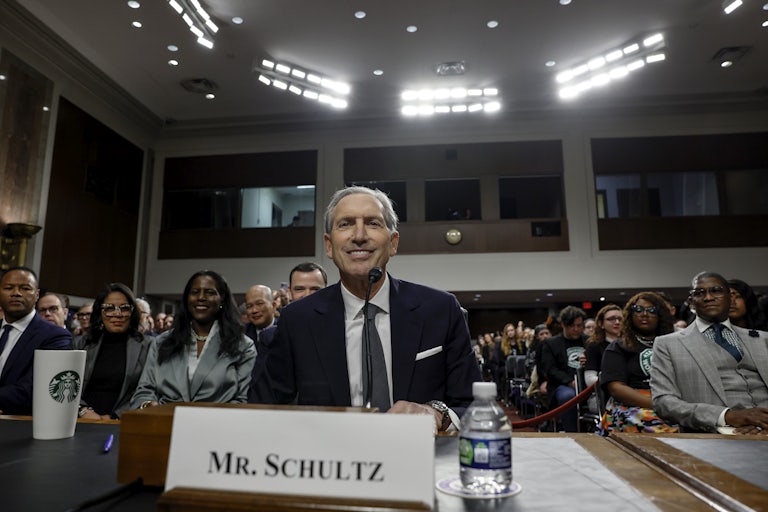
Howard Schultz Accidentally Admits Starbucks Violated Labor Law on Unions

The former Starbucks CEO appeared before a Senate hearing, during which he confirmed the labor violation.

Former Starbucks CEO Howard Schultz testifies
Anna Moneymaker/Getty Images
Former Starbucks CEO Howard Schultz

Howard Schultz admitted Starbucks violated labor law during a Wednesday hearing before the Senate Health, Education, Labor and Pensions Committee.

Senator Mitt Romney, attempting to defend the former Starbucks CEO, asked Shultz whether nonunion store employees made less than union store employees.

“The starting wage has been the same,” Schultz began. “The only difference is the benefits that we created in May, in my understanding under the law, is that we were not allowed to provide those benefits to people who were organizing to join a union.”

“So, in fact, the nonunion stores are actually a little better total package than the union stores,” Romney responded, unwittingly confirming the labor violation.

It is unclear what law Schultz was referring to that prevented Starbucks from increasing benefits for all workers. Meanwhile, last year, the National Labor Relations Board deemed it a labor law violation to give pay raises and benefits to nonunion stores but deny them from organizing stores.

Romney (co-founder of Bain Capital, one of the largest private investment firms in the nation, and whose net worth is reportedly some $300 million) also complained about the hearing’s premise generally.

“I recognize at the outset there’s some irony to a non–coffee drinking Mormon conservative defending a Democrat candidate for president and perhaps one of the most liberal companies in America,” Romney said, even though Schultz never ran for president, and no matter how many “equality” pictures a company tweets, they are not “liberal” if they union-bust. “That being said, I also think it’s somewhat rich that you’re being grilled by people who have never had the opportunity to create a single job. And yet they believe that they know better how to do so.”

Apparently, according to Romney, you’re not allowed to challenge America’s elites unless you’re a boss.

“Largest Crowd I’ve Seen”: Hundreds Protest Kentucky’s Extreme Anti-Trans Bill Ahead of Veto Override

The Kentucky legislature is expected to push through one of the most extreme anti-trans bills in the country.

Yana Paskova/Getty Images

Hundreds of people, primarily teenagers, gathered outside the Kentucky state Capitol Wednesday to protest against one of the most extreme anti-transgender rights bills in the country, which the Senate is expected to vote into law.

Governor Andy Beshear vetoed the bill last week, warning that it will cause an “increase in suicide among Kentucky’s youth” if it becomes law. But the measure passed the state Senate by a veto-proof majority, and the chamber is expected to override Beshear’s veto on Wednesday or Thursday.

If it becomes law, Senate Bill 150 would ban all gender-affirming care for trans minors in Kentucky and would force doctors to detransition any minors in their care. It would prohibit discussing sexual orientation or gender identity in public schools at any level, prevent trans students from using the bathroom that corresponds to their gender identity, and would allow teachers to refuse to use a student’s preferred pronouns.

Courier Journal reporter Olivia Krauth, who has covered S.B. 150 extensively, said Wednesday’s crowd may be the biggest she’s seen during the current legislative session.

Protesters chanted, “Trans rights are human rights,” as they waved signs and listened to Democratic state senators speak.

One senator, Karen Berg, told the protesters, “You are perfect the way God made you. Remember that every moment of your life.” The bill is particularly personal for Berg, whose trans son died by suicide last year.

Later, when the session began, Berg warned her colleagues, “This hate will not stop. We know from history this is how you destroy a democracy.”

The crowd continued to grow throughout the morning, as more people showed up to express support for trans Kentuckians.

The ACLU of Kentucky described the bill when it passed as “the worst anti-trans bill in the country.” Republicans rushed S.B. 150 through the House and Senate in a record daylong sprint.

Kentucky is just the latest state to have lawmakers try to curtail LGBTQ rights. Last week, Florida advanced an anti-trans bill so broad and extreme it could also prevent people from getting breast cancer treatment. Georgia, meanwhile, passed a law banning gender-affirming care for minors and criminalizing medical workers who provide that care.