Breaking News
Breaking News
from Washington and beyond

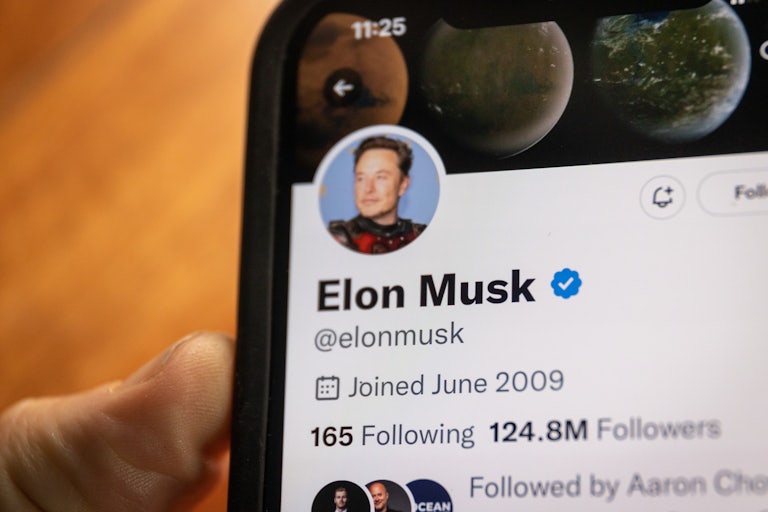
Elon Musk’s New Plan Is to Make It Impossible to Tell Who Paid Him for a Blue Check

Everything is going just fine at Twitter under Elon Musk, thanks for asking.

 In this photo illustration, a Twitter logo is displayed on a smartphone with Blue Tick logo in the background.
Avishek Das/SOPA Images/LightRocket/Getty Images

Another day, another of Elon Musk’s Twitter ideas going exactly according to plan.

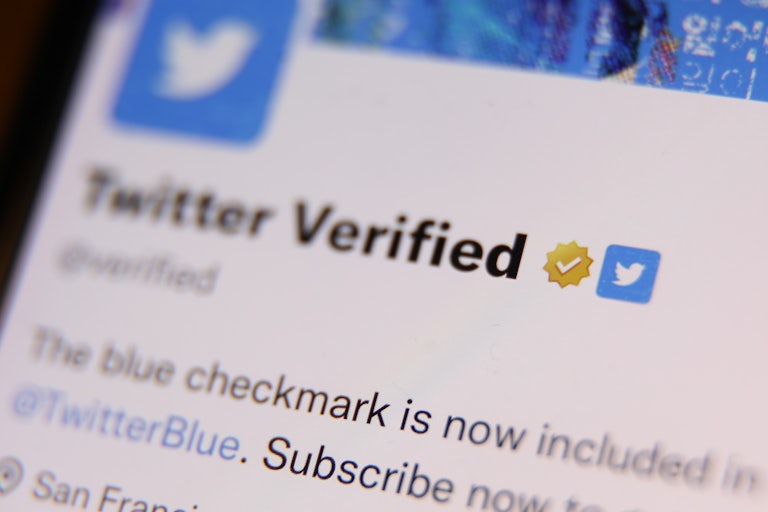
Pretty much everyone on Twitter has kept their blue check marks, despite Musk previously announcing a plan to phase out legacy verified accounts and require people to pay for verification beginning April 1.

Since taking over Twitter in October, Musk has launched a massive cost-cutting scheme, which includes laying off almost 75 percent of all staff, auctioning off everything in the company’s San Francisco headquarters, and just not paying rent.

He also unveiled Twitter Blue, a subscription plan in which users can pay for a verification check mark, as well as increased visibility on the platform. The plan costs $8 for individual users and $1,000 for U.S.-based businesses and organizations, plus $50 for each subaccount.

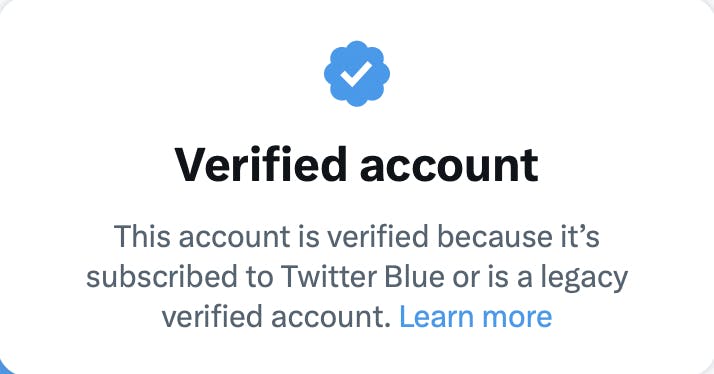
But as of Monday, everyone still had their check marks. The only difference was that, before, you could click on an account’s check mark to see if they were a legacy verified account or a Twitter Blue subscriber. Now, no distinction is made.
Screenshot/Twitter

Well, almost everyone: The New York Times no longer has a check mark. Twitter removed the Times blue check mark on Sunday, after a user pointed out that the paper has expressed no interest in paying to be a verified account. In a now-deleted tweet, Musk also said Sunday that Twitter would give verified accounts “a few weeks grace, unless they tell they won’t pay now, in which we will remove it.”

Considering that no one—from the White House to journalists and professional athletes—was going to pay for Twitter Blue, it’s no surprise that Musk had to pivot. But lumping paying users and legitimately notable accounts together is dangerous.

The point of verification is to prove that a person or organization of public interest is who they claim to be. Misinformation has already risen significantly since Musk took over and gutted Twitter’s content moderation policies. Now, it will be even more difficult to tell if the information an account shares can be trusted.
Sorry Elon, No One Cares About Losing Their Blue Check Mark on Twitter

The White House, news organizations, and celebrities are all saying they have no interest in paying for verification.

Jakub Porzycki/NurPhoto/Getty Images

On the eve of Elon Musk’s plan to phase out existing verified accounts and install a new order—in which anyone can pay a monthly fee in order to get a blue check mark next to their name, as well as a series of other privileges—it seems most users are simply … not interested.

Everyone, from professional athletes to elected officials to journalists, is opting out of Twitter’s attempt to fill the financial hole left gaping wide after Musk took over the social media website.

The cost for Musk’s Twitter Blue scheme is $8 (or $11 through Apple’s iOS) per month for individuals, while businesses and organizations in the United States would be charged $1,000 per month, plus a $50 fee for each affiliated subaccount (employees, other organizational divisions, etc.).

Musk’s Twitter has tried to mitigate the slow-motion car crash. An internal document revealed Twitter is considering waiving fees for the top 500 advertisers and 10,000 most-followed organizations that were previously verified. Unfortunately, it just doesn’t matter.

CNN’s Oliver Darcy reported that The New York Times, the Los Angeles Times, BuzzFeed, Politico, Vox Media, The Washington Post, and CNN will all not pay for Twitter Blue services for their journalists. Most confirmed their organizations will not pay for the institutional account either.

And on Friday, Axios reported that the White House also will not pay for Twitter Blue for its staffers or for the official White House account. “It is our understanding that Twitter Blue does not provide person-level verification as a service. Thus, a blue checkmark will now simply serve as a verification that the account is a paid user,” White House director of digital strategy Rob Flaherty wrote to staffers in an email.

Even star athletes like Lebron James and Patrick Mahomes have said they will not be paying for Musk’s last-ditch Hail Mary.

It’s all fun and games watching yet another Musk endeavor fall flat, but of course the stakes are indeed very high. One example of many came just this week, as a verified account tweeted a screenshot falsely depicting a news outlet sharing a fake quote from the father of a victim in the Nashville school shooting calling for “the end of the trans evil.” And that is just a drop in the bucket of all the moderation problems Twitter has already been dealing with; Musk’s overhaul of verification will escalate an ongoing disaster.

Twitter Admits It’s Been Forcing Elon Musk on Your Timeline

When Twitter released its source code, it tried to spin it as some public service. That didn’t quite go to plan.

Matt Cardy/Getty Images

It’s confirmed: Twitter is forcing Elon Musk onto your timelines.

On Friday, Twitter announced the public release of the source code for various parts of the website, including their recommendations algorithm, which drives the much-assailed new “innovation,” the “For You” timeline.

The company described the release as an effort to make “Twitter 2.0” transparent, while also claiming they took additional steps to ensure no released code would compromise user security and privacy (something already under threat).

After the release, one part of the code stuck out more than others, a breakdown of tweet authors into four categories: Elon Musk, “Power User,” Democrat, or Republican. The code suggested the “For You” recommendations have specific directives for these four categories of tweet authors—and something particularly distinct for Musk’s own account.

“It shouldn’t be there,” Musk said on the code, during a Twitter Spaces live conversation after the release. “There’s a ton of stupid and embarrassing things being shown by making the code open source.”

Twitter’s release initially sounded almost egalitarian. Calling itself the “town square of the internet,” the company said in a statement that it is “doing this to foster transparency and build trust with our users, customers, and the general public.”

We invite the community to submit GitHub issues and pull requests for suggestions on improving the recommendations algorithm. We are working on tools to manage these suggestions and sync changes to our internal repository. Any security concerns or issues should be routed to our official bug bounty program through HackerOne. We hope to benefit from the collective intelligence and expertise of the global community in helping us identify issues and suggest improvements, ultimately leading to a better Twitter.

In reality, the move seems less like a positive and constructive action and more like a meager P.R.-laced attempt to soften the forthcoming overhaul of verified users—and a way to enlist free labor to do their job for them. The “community” is invited to dig through the code and report security concerns or issues themselves. Twitter wants to “benefit from the collective intelligence and expertise” of people they very well could hire (and perhaps previously did). But how can you hire them, when ad revenue is down almost 90 percent and your own CEO estimates the company’s value to have dropped in half since he took over?

And the best part? If things go wrong (which they know they will), it’s not Twitter’s fault—it’s our fault.

Dominion’s Historic $1.6 Billion Lawsuit Against Fox News Is Officially Going to Trial

A federal judge denied Fox’s attempt to get the case thrown out of court.

TIMOTHY A. CLARY/AFP/Getty Images

A judge on Friday ordered a jury trial in Dominions Voting System’s historic $1.6 billion defamation lawsuit against Fox News, over claims the news corporation spread false information about the firm after the 2020 election.

Superior Court Judge Eric Davis also delivered a major victory to Dominion, ruling that Fox’s statements about Dominion were categorically false. Fox News had attempted to get the defamation case thrown out of court.

“Fox failed to meet its burden.” Davis wrote in his ruling. “The evidence developed in this civil proceeding demonstrates that [it] is CRYSTAL clear that none of the Statements relating to Dominion about the 2020 election are true.”

“[T]he evidence does not support that [Fox News] conducted good-faith, disinterested reporting.”

The court ruled that Fox News did make false claims about Dominion but left open the question of whether Fox Corporation (its parent company) is responsible for that misinformation. A jury will now hear the defamation case beginning April 17.

The case thus far has led to landmark revelations about how Fox News hosts and executives knew they were lying about the 2020 election to their viewers, even while privately dismissing Trump and his conspiracy theories about a stolen election.

This post has been updated.

Republicans’ Only Defense Against the Trump Indictment: George Soros

The antisemitic conspiracy theory is back stronger than ever before.

Brandon Bell/Getty Images

Republicans are using the tried-and-true antisemitic trope of blaming billionaire George Soros for everything, this time for Donald Trump being indicted.

Trump became the first president ever to be criminally charged Thursday, when a Manhattan grand jury voted to indict him for his role in paying hush money to porn star Stormy Daniels. Republicans rushed to his defense, with many trotting out an antisemitic conspiracy theory that Jewish people control the world.

Both Trump and his son Donald Jr. were quick to jump on the bandwagon, with the former president claiming that Manhattan District Attorney Alvin Bragg was “hand-picked and funded by George Soros.” Don Jr. also said Bragg was “Soros-backed.”

Florida Governor Ron DeSantis, who is reportedly gearing up for a presidential run, accused the “Soros-backed Manhattan district attorney” of “stretching the law to target a political opponent.”

Senator Rick Scott similarly alleged that “Democrats and the corrupt Soros-funded NY attorney” were politically motivated in indicting Trump.

Representative Matt Gaetz said the indictment was the result of the “Sorosification of the criminal justice system.”

Republicans blaming Soros is nothing new. The Jewish billionaire has long been a bogeyman for the right, and has been blamed for everything from antifa to Covid-19 and creating a “shadow government” in the United States. The conspiracy theories have a real-world impact. Cesar Sayoc, the Trump supporter who mailed pipe bombs to Soros and Trump’s political enemies in 2018, railed against Soros regularly on Twitter. Sayoc even claimed Soros had paid off a victim of the Parkland school shooting.

For what it’s worth, Soros told Semafor’s Steve Clemons that he has never met Bragg and did not donate to his campaign. “I think some on the right would rather focus on far-fetched conspiracy theories than on the serious charges against the former president,” Soros said.

But the point is not whether Soros backs Bragg. The point of blaming Soros is that it’s a reliable Republican dog whistle. It’s a good tool for whipping Trump supporters up into a frenzy, by telling them that the global elite are out to get them.

As reporter Emily Tamkin pointed out, “It’s genuinely important to see this not as something new, but a continuation, a playing of the hits, a doubling down on the same old.”

“You can be against billionaire money in policy, politics, but that is different from collapsing the distinction between financing a campaign or initiative—as Soros has done for more progressive drug policy for over 25 years—and claiming or implying that all agency in a criminal case can be put at the feet of one (yes, Jewish) billionaire,” she said.