Breaking News
Breaking News
from Washington and beyond

A Day Before His Arraignment, Trump Throws a Hail Mary and Hires a New Lawyer

Trump has added Todd Blanche, a white-collar criminal defense lawyer, to his legal team.

Atilgan Ozdil/Anadolu Agency/Getty Images

Twice-impeached and criminally indicted former President Donald Trump (who faces at least three other criminal investigations) has hired a new lawyer one day before his arraignment.

Todd Blanche, an elite white-collar criminal defense lawyer and former federal prosecutor, has been tapped to be Trump’s lead counsel as he heads into Manhattan to face his indictment over a hush-money payment made to porn actress Stormy Daniels, reports Politico.

The hire comes amid turmoil within Trump’s legal team, as a number of the former president’s other lawyers have derided co–lead defense attorney Joe Tacopina as “dumb” and a “loudmouth,” according to Rolling Stone.

And perhaps the complaints are not unwarranted: In recent weeks, Tacopina has taken a shovel and only dug his boss in deeper. Appearing on MSNBC, Tacopina tried to snatch notes away from host Ari Melber as he fact-checked Tacopina in real time.

Melber asked Tacopina if he would defend Trump in the investigation into his role in inciting the January 6 attack. Tacopina said he would if he “believed in the case,” but wouldn’t definitively say yes.

These instances, among others, seem to have swayed Trump’s allies against the lawyer. One source called Tacopina “such a frickin’ idiot” to Rolling Stone.

Blanche has previously represented Trump campaign chair Paul Manafort and Igor Fruman, a former Rudy Giuliani associate who allegedly helped search in Ukraine for damaging information on Trump’s rivals. He was sentenced to a one-year prison term for a campaign finance violation.

Both Manafort and Fruman had been charged by Manhattan courts. Manafort was charged specifically by then–Manhattan District Attorney Cyrus Vance and was able to evade mortgage fraud and other charges with the help of Blanche.

Blanche had called charges against Manafort “politically motivated,” which perhaps gives Trump all the more comfort as he throws the same accusations at current Manhattan District Attorney Alvin Bragg.

In a separate case, federal prosecutors have also expanded investigations into whether Trump’s social media company (which owns Truth Social) violated money-laundering laws. Manafort was able to strike a deal that avoided a money-laundering charge; perhaps Blanche will get to try the same with Trump.
Every Detail About Donald Trump’s Motorcade to New York for His Indictment Was Perfect

Who doesn’t need 11 SUVs to get to the airport?

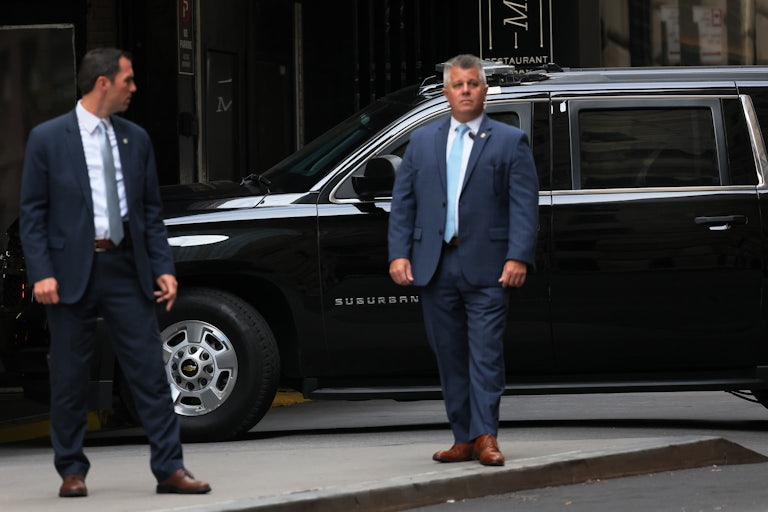
Two men in suits stand in front of a black SUV
Michael M. Santiago/Getty Images

Donald Trump headed to the airport Monday to fly to New York for his arraignment in a motorcade that was 11 cars long.

Trump became the first former president ever to be criminally charged last week, when a Manhattan grand jury voted to indict him for his role in paying hush money to porn star Stormy Daniels. He is due to be arraigned in a Manhattan court on Tuesday.

He headed up ahead of time with a perfectly reasonable number of cars in tow.

And since Twitter is not broken yet (despite Elon Musk’s best efforts), the internet had some jokes. Many people were quick to note that there was one white SUV among the black ones and drew a comparison to another infamous celebrity run-in with the law.

Some Trump supporters lined the road to show support for the former president, but as Fox News inadvertently pointed out, some of them were also law enforcement officers to prevent the “death & destruction” Trump called for.

Trump’s adviser Dan Scavino and son Eric Trump both posted videos that showed a thick crowd of fans. But network aerial coverage showed that the crowd was fairly sparse.

Most people were just confused about why Trump needed 11 SUVs to get him to the airport.

This post has been updated.

Florida Senate Passes Bill Banning Abortion After Six Weeks

This will have massive repercussions on abortion access in the South.

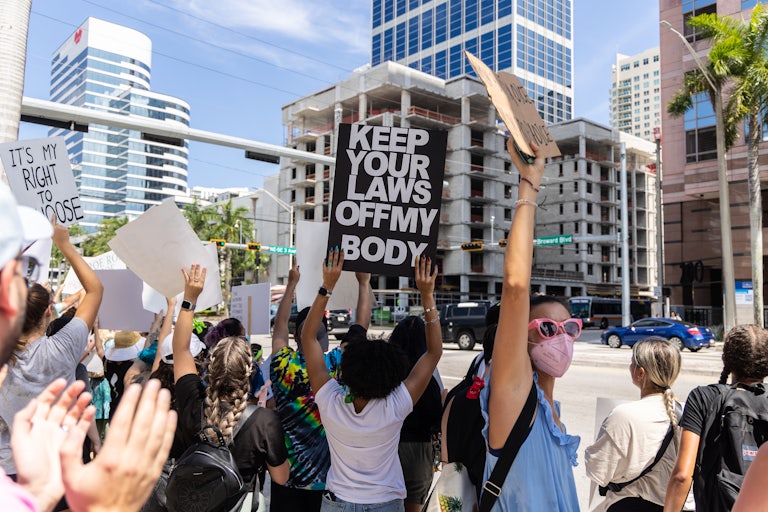
Sign reads: "Keep Your Laws Off My Body"
John Parra/Getty Images for MoveOn

The Florida Senate passed a bill Monday banning abortion after six weeks, a measure that is expected to quickly and easily become law.

Senate Bill 300 passed by a vote of 26–13. The bill prohibits abortion after six weeks, down from 15 weeks and before many people even know they are pregnant. It makes exceptions for rape, incest, fetal abnormalities, or to save the pregnant person’s life. However, two doctors have to agree the abortion was “necessary,” and the patient “must provide a copy of a restraining order, police report, medical record, or other court order or documentation proving” they were the victim of rape or incest.

“I know many of you fundamentally believe abortion is wrong. So guess what? No one is forcing you to have an abortion,” said Senator Tina Polsky. “But don’t tell me, my daughters, and all the daughters of Florida that they can’t do that if it’s right for them.”

A similar bill was introduced in the House of Representatives in early March and is still in committee hearings. Republicans hold a supermajority in the state legislature, and they and Governor Ron DeSantis are unlikely to face much opposition in their attempts to make the near-total abortion ban a reality.

The bill passed Monday would also ban individuals, government agencies, and public education institutions from using state funds to help someone travel out of state for an abortion, unless it is medically necessary to save the pregnant person’s life, or unless those groups are already legally required to use federal funds for such aid.

The bill would also lower the amount of money that the state Department of Health is required to spend on pregnancy and parental support services to 85 percent, down from 90 percent. These services include pregnancy testing, counseling, prenatal classes, adoption education, and material aid such as diapers and formula. Abortion rights advocates regularly point out that states with some of the toughest abortion laws often fail to set up social welfare systems to support children after they are born. People can currently receive such support for up to a year after the child is born. The bill removes that element.

The measure removes the clause that specifically states abortion regulations “may not impose an unconstitutional burden on a woman’s freedom to decide whether to terminate her pregnancy,” specifically stripping away people’s autonomy.

The vote was temporarily delayed when protesters shouted at Republican senators that “people will die” if the abortion ban is passed. The chamber took a 10-minute recess while security cleared the gallery.

If it becomes law, as it is expected to, S.B. 300 will have a significant negative effect across the rest of the South. Florida currently allows abortion up to 15 weeks and has become an abortion haven in the region, as many neighboring states have imposed harsher restrictions on the procedure since Roe v. Wade was overturned.

Days After Nashville Shooting, Florida Gov. Ron DeSantis Quietly Signs Bill Allowing Permitless Carry

It is now legal to carry concealed firearms in Florida without a permit, training, or background checks.

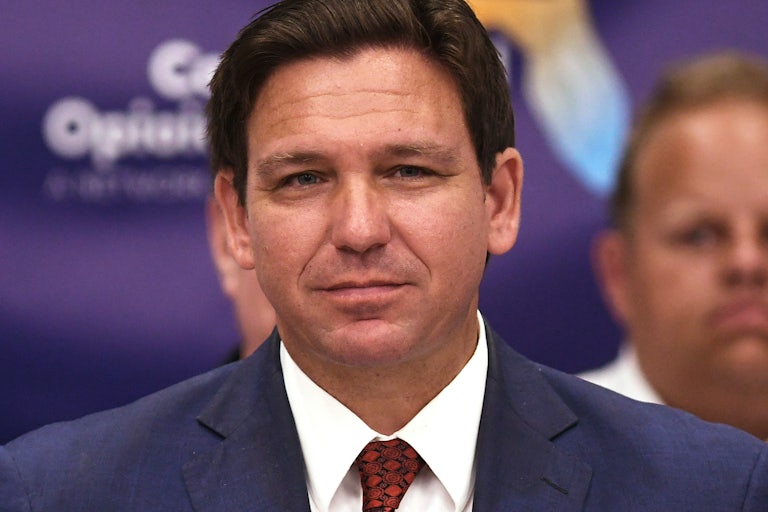
Ron DeSantis closeup
Paul Hennessy/SOPA Images/LightRocket/Getty Images

On Monday, Florida Governor Ron DeSantis quietly signed a bill to allow people to carry concealed loaded guns without any permits, training, or background checks.

The change, the execution of a promise DeSantis had repeatedly made in the past, comes after it passed the state legislative chambers largely on party lines.

Florida now becomes the twenty-sixth state to allow permitless concealed carry. One study found states that pass such laws experience a 22 percent increase in gun homicide during the three years after the law’s passage.

The bill was first introduced in late January, and just hours later, a mass shooting in Lakeland, Florida, left 11 people injured. Now the bill’s passage comes in the wake of a school shooting in Nashville, Tennessee, that left three children and three adults dead.

The timing, as well as the mass unpopularity of gun deregulation amid what is now a continual cycle of mass shootings, explains why DeSantis passed it with little fanfare (compared to the ceremony he exhibits when signing bills like the “Don’t Say Gay” bill, for example).

But, as with most changes Republicans pursue nowadays, permitless carry is massively unpopular.

A December poll showed 68 percent of voters in Miami-Dade opposing permitless carry,  including 65 percent of registered Republicans and 60 percent of voters who said they voted for DeSantis in November.

Moreover, once voters were told explicitly that the now-signed bill would allow anyone who can purchase a gun to carry it in public, opposition grew by 12, to 80 percent—with 81 percent of Hispanics and 69 percent of DeSantis voters being opposed to such a policy. And cutting against the bipartisan crime panic, more respondents attributed crime to lax gun laws than to a lack of police funding.

Another poll conducted last September yielded similar results, with 61 percent of Floridian voters opposed to permitless carry, including 71 percent of Hispanic voters.

Still—despite the unpopularity and the material threats such a bill introduces to his own people, all after yet another horrific mass shooting—DeSantis has now made it even easier for people to carry guns and schoolchildren to get murdered.

Thousands of Students Walk Out to Demand Gun Control After Nashville Shooting

“We all just want to live through high school.”

Seth Herald/Getty Images
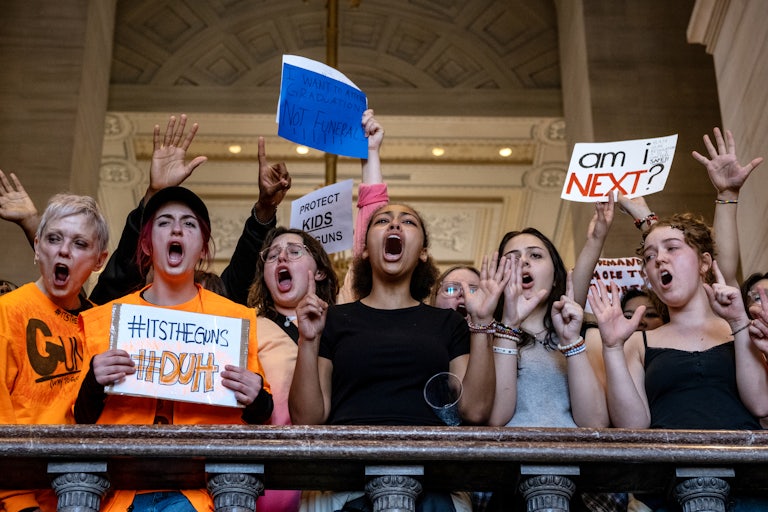
Protesters gather inside the Tennessee State Capitol on March 30.

Thousands of students in Nashville staged a walkout Monday to demand stronger gun control laws, a week after a shooter killed six people at a grade school.

A shooter opened fire at the Covenant School last week, killing three children and three adults and wounding several others. State Republicans have insisted that there is nothing they could have done or could do differently to prevent such a tragedy.

Thousands of students marched to the state Capitol building, chanting for more gun regulations. Local reporter Chris O’Brien estimated there were 2,500 to 3,000 people there. Gun control organization March for Our Lives put the number at more than twice as many.

They rallied outside the building, where they sang songs and called on lawmakers to protect them. “We all just want to live through high school,” one student said.

The students passed out a flyer with their list of demands, which include a red flag law, safe storage laws, and a ban on permitless carrying.

The protest comes just days after thousands of people, including students, rallied at the state Capitol building to protest Tennessee gun regulations.

Protesters marched inside the Capitol ahead of the House and Senate regular floor sessions on Thursday, calling for gun control and for lawmakers to “protect our kids!

Governor Bill Lee and his fellow Republicans have carefully evaded the fact that they helped create the circumstances that allowed the shooting to occur. The GOP holds a supermajority in the Tennessee legislature, as well as the governor’s office.

Two years ago, lawmakers failed to pass a red flag law that would have prevented the shooter from legally acquiring seven guns, three of which were used in the attack. In the past few years, Republicans also loosened gun restrictions, focusing instead on attacking LGBTQ rights.

This post has been updated.