Breaking News
Breaking News
from Washington and beyond

Trump-Appointed Judges Are Micromanaging Access to the Abortion Pill

The abortion pill is technically still available, but for now, it’s going to be much harder to get.

Chris Coduto/Getty Images/UltraViolet

Two Trump-appointed judges on the Fifth Circuit Court of Appeals decided late Wednesday that access to the abortion pill should be sharply curtailed, dealing a major blow to abortion access nationwide.

Last week, Texas federal Judge Matthew Kacsmaryk, also appointed by Donald Trump, ruled that mifepristone, one of the medications used to induce an abortion, had been improperly approved by the Food and Drug Administration and should be yanked from the U.S. market. Another judge in Washington state filed a dueling injunction the same day to keep the drug available. The Department of Justice asked the Fifth Circuit Court of Appeals Monday evening to stay the ruling while the case is appealed and the lawsuit plays out completely.

The Fifth Circuit only stayed the part of Kacsmaryk’s ruling, which was set to go into effect this Saturday, that referred to mifepristone’s initial FDA approval in 2000, saying the plaintiffs were too late to challenge that decision. In other words, the abortion pill is still available for now.

But two members of the three-judge panel, both appointed by Trump, upheld the rest of Kacsmaryk’s decision rolling back changes that had made mifepristone more easily accessible. The third judge, who was appointed by George W. Bush, wanted to stay the entire Texas ruling and keep the pill available without restrictions.

Under the appellate court ruling, mifepristone is now only available up to seven weeks of pregnancy, before many people even know they are pregnant, as opposed to 10 weeks. Retail pharmacies can no longer dispense the drug, and people cannot buy the pill online or via telemedicine. Instead, they will have to visit a physician. Nonphysicians are not allowed to prescribe or administer mifepristone.

The ruling also suspends FDA approval of the generic version of mifepristone, which would take a more affordable option off the market.

Medication abortions make up more than half of all abortions performed in the United States. These drugs can be ordered online and delivered via mail, making them a key resource for people who live in states that have cracked down on abortion access since Roe v. Wade was overturned last summer. The Fifth Circuit’s ruling is a huge blow to nationwide abortion access.

The appellate ruling also conflicts directly with the injunction out of Washington, which orders that mifepristone’s status and the means to acquire it must remain unchanged. The only way the FDA can comply with both rulings is by exercising enforcement discretion—a legal tool it can also use if the lawsuit ultimately is decided against mifepristone and abortion rights.

A bigger issue at play, though, is that nonelected judges who do not have medical backgrounds are making decisions about medication. As Rachel Rebouché, the dean of Temple University’s law school, previously told The New Republic, “The question for appellate courts is not just about abortion but about deference to a federal agency’s expertise.”

Kacsmaryk’s ruling “undermined” the FDA’s authority, she said. “To take seriously that it ignored risks, risks unsupported by any credible evidence, suggests questions as to what federal courts might decide about other federal agencies’ decisions.”

The Justice Department has said it will “seek relief in the Supreme Court if necessary.”

If Kacsmaryk’s complete ruling went into effect, it “would thwart FDA’s scientific judgment and severely harm women, particularly those for whom mifepristone is a medical or practical necessity,” department lawyers argued in the filing.

“This harm would be felt throughout the country, given that mifepristone has lawful uses in every State,” the filing said. “The order would undermine healthcare systems and the reliance interests of businesses and medical providers. In contrast, plaintiffs present no evidence that they will be injured at all, much less irreparably harmed, by maintaining the status quo they left unchallenged for years.”

Nebraska Republican Says Six-Week Abortion Ban Is Necessary Because White People Are Being Replaced

Fun little one-two punch of misogyny and racism

State capitol building in Lincoln, Nebraska
Education Images/Universal Images Group/Getty Images
The state Capitol building in Lincoln, Nebraska

A Nebraska Republican state senator argued Wednesday for a six-week abortion ban by claiming there are too many foreigners living in the state, invoking a racist conspiracy theory.

Since Roe v. Wade was overturned, abortion is allowed in Nebraska up to 21 weeks and six days of pregnancy. But on Wednesday, the Senate began debating a bill that would ban abortion after six weeks, before many people even know they are pregnant.

Senator Steve Erdman decided that the best argument in favor of the ban was the “great replacement theory,” which the Southern Poverty Law Center defines as a “racist conspiracy narrative [that] falsely asserts there is an active, ongoing, and covert effort to replace white populations in current white-majority countries.”

“Our state population has not grown except by those foreigners who have moved here or refugees who have been placed here,” Erdman told the chamber.

Erdman also said that all of the aborted fetuses “could be working and filling some of those positions that we have vacancies.”

Erdman’s argument delivers a nice one-two punch of racism and misogyny. First, he thinks that abortions should be banned to force more white people to have babies. But it’s actually people of color who are hardest hit by abortion restrictions. Not all states report the racial and ethnic data of people who get abortions, but those that do found a disproportionately high number of people of color seek the procedure.

The Centers for Disease Control and Prevention found that in 2020, in 29 states and Washington, D.C., 39.2 percent of people who got an abortion were Black. Hispanic people made up 21.1 percent of people who got an abortion, and other nonwhite ethnicities made up 7 percent.

What’s more, if Erdman is actually worried about increasing the labor force, he definitely shouldn’t be banning abortions. Abortion gives people better control over their own lives and allows them more opportunities to join the workforce and move upward economically. Treasury Secretary Janet Yellen warned the Senate Banking Committee in May last year, a month before the Dobbs ruling, that “eliminating the right of women to make decisions about when and whether to have children would have very damaging effects on the economy and would set women back decades.”

Six-week abortion bans are being considered across the country, including in Florida, which just passed such a bill on Thursday by a vote of 70-40, mainly along party lines. It now goes to Governor Ron DeSantis, who is expected to sign it into law.

This post has been updated.

Missouri Republican Pushing Anti-Trans Bill Ends Up Defending Child Marriage

This was never about “saving the children.”

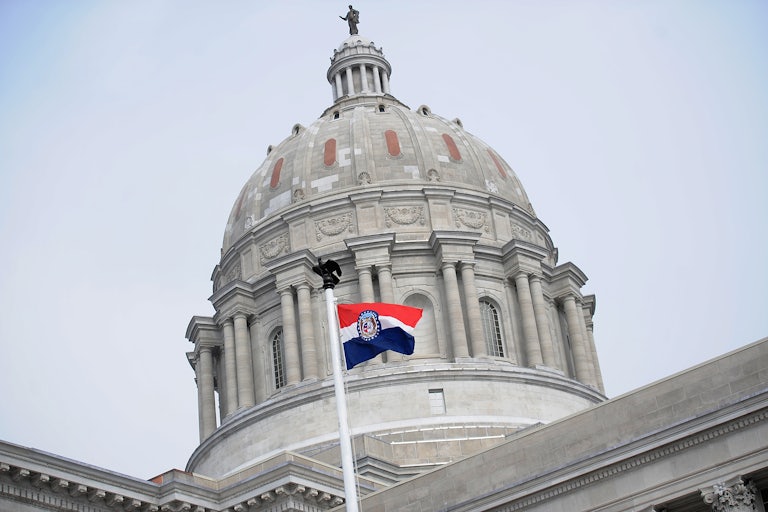
Missouri state Capitol building with Missouri flag
Michael B. Thomas/Getty Images
Missouri state Capitol building

“Do you know any kids who have been married at age 12? I do,” said Missouri Republican state Senator Mike Moon. “And guess what? They’re still married.”

Moon’s concerning comments came Tuesday during a debate on a bill he had been pushing to ban gender-affirming care for transgender people under the age of 18. Moon made the comments in response to Democratic state Representative Peter Merideth, who was attempting to highlight the hypocrisy of the Missouri Republican’s supposed concern for children.

“I’ve heard you talk about parents’ rights to raise their kids how they want. In fact, I just double-checked. You voted ‘no’ on making it illegal for kids to be married to adults at the age of 12, if their parents consented to it,” Merideth said to Moon. “You said, actually, that should be the law because it’s the parents’ right and the kids’ right to decide what’s best for them. To be raped by an adult.”

That was when Moon shared his anecdotal story on a successful child marriage.

Moon’s bill passed through the House 106–45 on Tuesday; a companion bill passed the Missouri Senate in late March. Missouri’s Republican Governor Mike Parson has supported limiting health care for trans kids.

As the Springfield News-Leader reports, Moon’s support for child marriage spans to at least 2018, when he voted against a bill that raised the minimum legal marriage age from 15 to 16 and required parental permission for older teenagers to marry. While the bill ultimately passed, Moon was steadfast in his opposition, even leaning on the same anecdote of a couple he had known who married at age 12.

At the time, he said the example was “something to ponder.”

Something else to ponder, of course, is Moon’s incredibly tenuous logic.

While Moon’s anecdote was ostensibly about two similarly aged minors getting married, Merideth’s broader point gets at the basic foolishness of it all. Moon is imposing his will to legislate banning children from accessing lifesaving and humanity-affirming treatment under the same vector of “saving the children” that ought to actually be used to legislate away the threat of exploitation in child marriages.

A Proposed Expansion to Privacy Law Would Protect People Seeking an Abortion Out of State

The Biden administration wants to expand HIPAA protections.

Gina Ferazzi/Los Angeles Times/Getty Images
A staff member at an abortion clinic in San Antonio, Texas, hugs a patient after informing her the clinic could no longer provide abortion services, on June 24, 2022. The Supreme Court had overturned Roe v. Wade moments earlier.

The Biden administration proposed expanding the main U.S. health privacy law Wednesday to add more protections for people who seek or provide an abortion.

The Department of Health and Human Services issued a Notice of Proposed Rulemaking through its Office for Civil Rights that prohibits health caregivers and insurers from giving information to state officials trying to investigate, sue, or prosecute someone for seeking or helping provide an abortion.

Under the new rule, the Health Insurance Portability and Accountability Act, or HIPAA, would protect people who get an abortion in their home state or who cross state lines to get the procedure. It would also cover people who help someone access an abortion, such as the health care provider who conducts the procedure or a family member who provides transportation.

Under the rule, if an organization receives a request for private health information, it must also include a “signed attestation that the use or disclosure is not for a prohibited purpose.” The rule is open to public comment for 60 days, after which HHS will decide whether to implement it.

Abortion rights supporters, including lawmakers, have urged the Biden administration for months to expand HIPAA protections to cover abortion access. While Wednesday’s move is a step in the right direction, it may be too little, too late.

Kate Bertash, founder of the nonprofit Digital Defense Fund, which provides digital security for abortion access, pointed out that it’s unlikely law enforcement will signal that they are trying to prosecute someone for giving or getting an abortion.

Trusting that a legal request for data will clearly be labeled as regarding an abortion feels like a tall order,” she tweeted, pointing out that most lawsuits about abortions are prosecuted under different laws. One such case occurred last summer in Nebraska, where abortion is banned after 21 weeks and six days. A young woman was charged with mishandling human remains after she got an abortion after that cutoff.

The proposed rule also comes amid increasing attacks on abortion access. A federal judge in Texas ruled Friday that the Food and Drug Administration improperly approved mifepristone, one of the drugs used to induce an abortion, and ordered it pulled from the market. The Department of Justice has requested the ruling be stayed pending appeal.

Also last week, Idaho’s Republican governor signed a law banning people from helping others access abortions out of state. Idaho is not the first Republican-led state to try to criminalize traveling out of state for an abortion, although it is the first to codify it into law.

Florida Republican Defends Anti-Drag Bill Even If It Means “Erasing a Community”

The bill in question is so vaguely worded it targets LGBTQ Floridians generally.

Eric Thayer/Bloomberg/Getty Images

On Wednesday, Florida Republican Representative Randy Fine vehemently defended a bill banning anyone under the age of 18 from being able to attend a drag show.

“If it means erasing a community because you have to target children, then, damn right, we ought to do it!” Fine said.

While Fine didn’t mention what community exactly he is in favor of erasing, the bill in question targets LGBTQ Floridians as a whole, not just drag performers.

Fine argued the bill’s language does not ban drag shows but rather uses language specifically geared toward protecting children. His logic goes, then, if opponents of the bill feel attacked, that’s because they’re in violation of targeting children.

Not so fast, however. On its face, the bill is worded so ambiguously in its focus on the term “adult live performance,” that it would prevent a high school kid from having the ability to watch The Rocky Horror Picture Show or even the musical Hair.

The bill defines “adult live performance” to include “any show, exhibition or other presentation in front of a live audience,” that in any form “depicts or simulates nudity, sexual conduct, sexual excitement, or specific sexual activities,” such as “lewd conduct, or the lewd exposure of prosthetic or imitation genitals or breasts.”

Consequently, the bill also targets Pride parades and celebrations, by preventing a government entity from issuing permits to organizations that put on such performances. Under the law, any establishment that violates the law would be subject to license suspension or revocation and liable to large fines and a misdemeanor charge. One violation would spur a $5,000 fine; subsequent incidents would spur $10,000 fines.

Ostensibly, authors of the bill are concerned with any conduct deemed “patently offensive to prevailing standards in the adult community of this state as a whole with respect to what is suitable material or conduct for the age of the child present.” Yet the bill leaves open the question of what those standards in the “adult community” even are.

Consequently, while Fine argues that the bill’s language is strictly concerned with shielding children, there’s no clear understanding of what the bill is shielding them from. Fine’s idea of what is “offensive” may be radically different from what millions of other people think. And it does not require any special imagination to foresee radical Florida Republicans using such a bill to target any range of activities related to or hosted by LGBTQ people.

After all, this is the same state party whose members have not been shy about attacking LGBTQ people. Governor Ron DeSantis stripped the Orlando Philharmonic Plaza Foundation of its liquor license for allowing children to attend a Christmas drag show; banned transgender women from playing women’s sports; fired a state attorney for saying prosecutors can’t criminalize personal medical decisions like abortion or transgender health care; and signed the so-called “Don’t Say Gay” bill, among other things.

Meanwhile, other Republican lawmakers have called trans people “mutants” and “demons,” while advancing legislation to ban gender-affirming health care and changing defamation law to make it easier to sue people criticizing bigotry.

The bill Fine was defending has already passed the Senate and is working its way through the House, where Republicans also hold control.

Fine, beyond passionately advancing anti-drag-show bills, is also known for threatening to cut off Special Olympics funding for a Florida community after he wasn’t invited to a Special Olympics fundraising event hosted by a city police department, while a school board member Fine has repeatedly attacked was invited. “I’m not going to jack [expletive] where that whore is at,” Fine said in response to a later invitation to the event. “You guys will have to raise a lot of money given that’s who you want to honor, not the person who got you money in the budget.”

Despite, or perhaps because of, it all, Fine is DeSantis’s leading pick to become the new president of Florida Atlantic University, amid the Florida governor’s efforts to hijack the university system with his friends and donors in order to impose radical conservative policies on college campuses.