Breaking News
Breaking News
from Washington and beyond

Twitter Quietly Rolls Back Ban on Misgendering Trans People

Twitter reversed a policy to protect trans people from hate speech on the platform.

Rafael Henrique/SOPA Images/LightRocket/Getty Images

Twitter secretly changed its hateful-conduct policy to remove protections for transgender users, opening them up to even more online abuse.

The social media network implemented a rule in 2018 prohibiting users from referring to trans people by the wrong gender or by their dead name, meaning the name they were given prior to transitioning. Under the policy, misgendering or deadnaming trans people was considered “targeting others with repeated slurs, tropes or other content that intends to degrade or reinforce negative or harmful stereotypes about a protected category.”

That rule was in place until April 7, according to the internet archive the Wayback Machine. But by the next day, the second sentence had been removed from Twitter’s policies. As civil rights lawyer Alejandra Caraballo pointed out, this opens the door to even more abuse toward trans people, who are already subjected to a lot of hatred both on- and offline.

Twitter did not announce the change, meaning that people are only just learning about it 10 days after the fact. GLAAD slammed the switch as “the latest example of just how unsafe the company is for users and advertisers alike.”

“Social media companies committed to maintaining safe environments for LGBTQ people should be working to improve hate speech policies, not deleting long-standing ones,” GLAAD president and CEO Sarah Kate Ellis said in a statement, noting that civil rights groups, including the Anti-Defamation League, have categorized misgendering and deadnaming people as a form of hate speech.

Ellis also pointed out that TikTok, Pinterest, and Meta have trans protection policies, making Twitter an outlier.

Hate speech has risen dramatically on Twitter since Elon Musk took over in October, although he insists otherwise. A report released in December by Media Matters and GLAAD analyzed tweets from nine prominent right-wing figures and accounts and found that in the first month under Musk’s leadership, there was a 1,200 percent increase in retweets of posts that use the word “groomer,” a homophobic slur.

The social media research group National Contagion Research Institute found that in the 12 hours after Musk bought Twitter, use of the n-word increased almost 500 percent. Musk has let Nazis back on Twitter, given blue verification check marks to the Taliban, and shared transphobic memes and Nazi photos himself.
Democrats Begin to Call for Feinstein’s Resignation

Republicans are not going to help Democrats replace Dianne Feinstein on the Judiciary Committee. So there’s only one option left.

Tom Williams/CQ-Roll Call, Inc/Getty Images

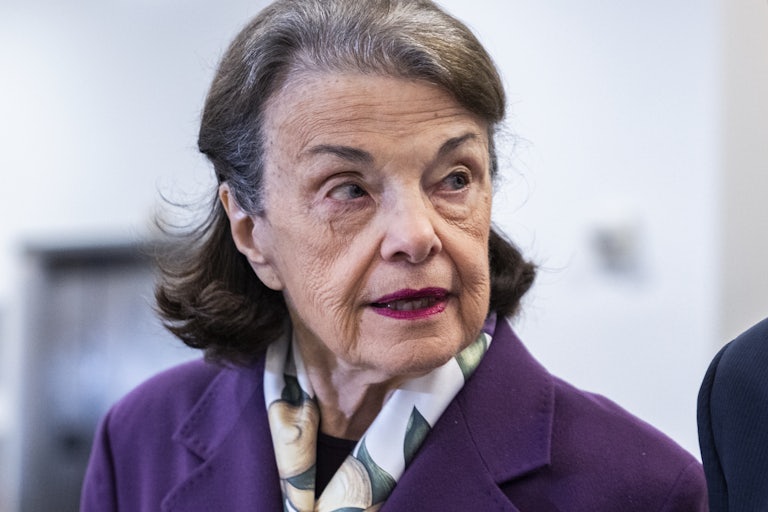
On Monday, Representatives Jamaal Bowman and Alexandria Ocasio-Cortez expressed support for the resignation of Senator Dianne Feinstein, as the congressional veteran’s absence leaves key votes, including on juridical nominations, in limbo.

Last week, Representative Ro Khanna became the first Democrat to call for Feinstein’s resignation, with Minnesota Representative Dean Phillips echoing Khanna’s call shortly after.

“Yes, you know, she’s had a very long and stellar career, you know, but missing that many votes, you know, stops us from moving forward judge nominations,” Bowman cautiously told CNN’s Manu Raju.

Ocasio-Cortez echoed Bowman’s remorseful tone, saying that “it is unfortunately something that … is appropriate to consider in this case.”

The growing calls for Feinstein’s resignation comes amid the tanking of Senator Dick Durbin and Chuck Schumer’s idealistic vision to keep Feinstein in office but find a replacement for her on the Judiciary Committee. Sixty senators would have to approve the Feinstein replacement, which means a few Republicans would have to join the effort. While there is precedent for unanimous support for committee reappropriation, enough key Senate Republicans have announced they are not interested in playing along this time. With Feinstein missing, the committee is split, and Biden’s judicial nominees will continue to be blocked.

Now the options are far and few between for Democrats. And the stakes are no less heightened with the backdrop of the scandalous financial entanglements of one of the most powerful jurists in the country, Clarence Thomas.

Though calls for Feinstein’s resignation continue to grow, both in and outside of government, some members of Congress have been less open to the idea. Senator Kirsten Gillibrand said Monday that Feinstein was “voted by her state to be senator for six years; she has the right, in my opinion, to decide when she steps down.” Former Democratic House leader Nancy Pelosi has insinuated the calls are rooted in sexism, saying she doesn’t “know what political agendas are at work that are going after Senator Feinstein.”

Meanwhile, most Democrats have been largely mum or deferential up to this point, allowing the likes of Khanna to be the lone voices against leadership that has relentlessly stood by Feinstein. But the growing calls may signal a sea change. Other members of Congress who have publicly been on the fence could be primed to come out in support of Feinstein gracefully resigning given the narrowing options.

On Sunday, Senator Amy Klobuchar told ABC that “if this goes on month after month after month, then she’s gonna have to make a decision with her family and her friends about what her future holds because this isn’t just about California, it’s also about the nation.” Klobuchar, by no means someone who is routinely out of step with the party center, may be indicative of how many Democrats feel. Given the sparse options and less and less time to confirm judges (and how crucial courts have come to be: from abortion access and immigrant protection to labor and civil rights), Democrats can ride off the movement spurred by Khanna and Phillips, and now Ocasio-Cortez and Bowman, to encourage Feinstein to conclude her career in the best way possible.

Feinstein can resign of her own volition, focus on regaining her health without a timeline pressuring her, and enjoy her life after a long-storied career in the Senate. And to top it all off, she’ll leave a legacy that many politicians fail to secure: shedding a bit of ego and knowing when to leave.

Now Ron DeSantis Wants to Put Mickey Mouse in Prison

The Florida governor’s war on Disney continues.

Ron DeSantis
Paul Hennessy/SOPA Images/LightRocket/Getty Images

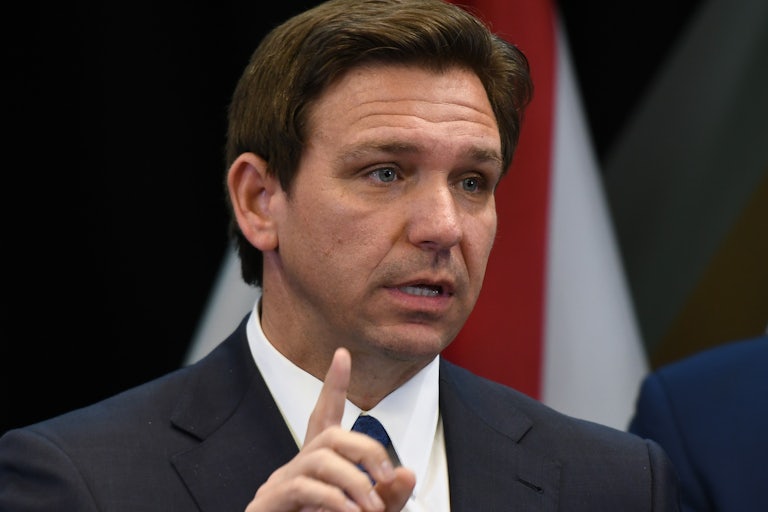
Ron DeSantis’s latest plan to get back at Disney is so bad, it’s criminal.

The Florida governor has been engaged in the weirdest back-and-forth with Disney World since 2022, after the company’s then-chairman condemned DeSantis’s “Don’t Say Gay” law. DeSantis retaliated by stripping the park of its autonomous governing powers and installing a leadership board of allies.

Disney, in turn, snuck a clause into the development agreement that dramatically limits what the new board can actually do. Apparently, all board members failed to read the contract. And now, in a pettiness masterclass, Disney doesn’t need board approval for major construction projects, nor can the board use Disney branding. The clause lasts until “21 years after the death of the last survivor of the descendants of King Charles III”—meaning it could last for 100 years.

Well now, DeSantis has a new idea to one-up the House of Mouse: turn it into a big house.

DeSantis rhetorically wondered what to do with the land around Disney during a Monday press conference. “Someone even said, ‘Maybe you need another state prison.’ Who knows?” he said. “I just think that the possibilities are endless.”

It’s not entirely clear what DeSantis thinks he is achieving by taking on Disney. Brandon Wolf, the press secretary for LGBTQ rights organization Equality Florida, described the governor’s latest threat as “a truly unhinged display of ego.”

DeSantis is widely expected to announce he’s running for president in 2024, and many of his latest actions (or lack thereof) are clearly to set himself up for campaigning as an “anti-woke” champion. But he’s doing so at the cost of his current constituents.

Areas of southern Florida are still experiencing historic rainfall and flooding, and DeSantis has been noticeably absent from the state response.

The Catholic League Probably Should Have Thought Twice Before Chiming In on Budweiser

The organization got torn apart on social media by those who remember the church’s famous scandals: “Makes sense, I know you want to encourage people to bring their kids.”

Bryan Bedder/Getty Images

The Catholic League is drawing a line in the sand on sexual exploitation. The organization that aims to defend “the rights of Catholics—lay and clergy alike—to participate in public life without defamation or discrimination” (that is to say: not be investigated for rampant sexual abuse) has bravely come out to say that it will not serve Budweiser at its fiftieth-anniversary dinner.

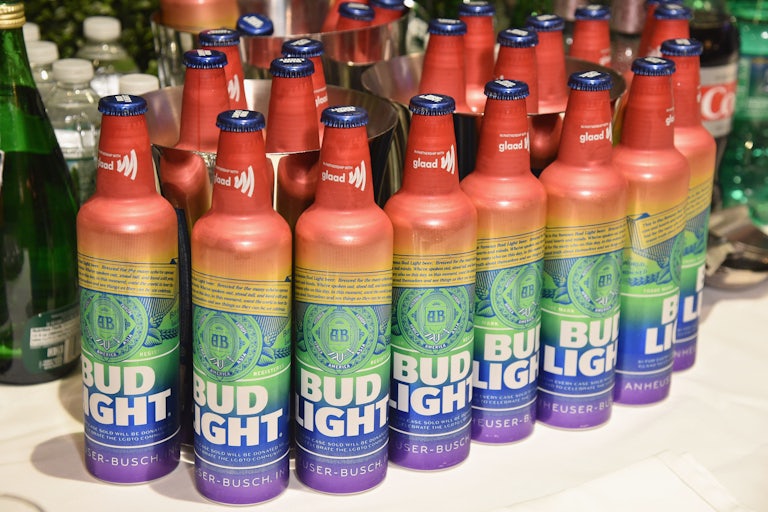
The groundbreaking news came in a tweet for which the organization ended up having to hide the replies just as vigorously as the Catholic Church has covered up allegations of sexual abuse by clergy members. In what has become one of 2023’s most inane far-right culture wars, the Catholic League joins the most out-of-touch (and bearded) entities in America in whipping up outrage against Bud Light for having run a single ad that featured a transgender woman.

Outrage toward the ad stems from the rampant transphobia embodied by a very loud, very radical minority of society that looks to foment anti-trans anger whenever a chance arises. Factually untrue and simply discriminatory notions of some phantasmic “trans agenda” aiming to exploit children serves as the vessel for that bigotry.

Most of the people who’ve gone to performative lengths to own Budweiser on social media have merely shot weird videos of themselves pouring cans of beer they bought down the drain. The Catholic League has taken the bold boycott a step further by refusing to serve the beverage at a party commemorating the legacy of such a prominent institution.

After all, who better to stake moral claims on child exploitation than an organization dedicated to defending Catholic clergy members from “defamation”? The League’s own website boasts of particular members who speak praises on the organization’s work.

There’s the late Benedict Groeschel, who once said that “[priests accused of sexual abuse] are among the most penitent people I have met in my life. When you pick up the media, you don’t hear about the penitence,” and that “a lot of the cases, the youngster—14, 16, 18—is the seducer,” which is certainly a take. Then there’s Archbishop Sean Patrick O’Malley, whose Catholic Charities of Boston organization ended its adoption services after state law required that gay people be allowed to adopt children. And who can forget Cardinal Timothy F. Dolan, who allegedly moved nearly $57 million into a trust fund that would keep the money away from victims of clergy sexual abuse demanding compensation?

The Catholic League’s own president, Bill Donohue, once said that “there is no ongoing crisis—it’s a total myth,” with regard to the rampant child sexual abuse within the Catholic Church. “In fact, there is no institution, private or public, that has less of a problem with the sexual abuse of minors today than the Catholic Church.” He said this while in the same breath adding that he figured that “only” … “maybe half” of some 300 accused priests were guilty.

Also on Monday, ex-Cardinal Theodore McCarrick was charged with sexually assaulting an 18-year-old more than 45 years ago; McCarrick had been previously found to have sexually molested adults and children. Two weeks ago, the Maryland attorney general released a 463-page investigation detailing revelations of Baltimore Catholic Clergy members abusing hundreds of children and teenagers.

Anywho, while the Catholic League is not busy taking bold stands on grooming, it is promoting a movie called Buying Off Black America, which features eminent voices like Vivek Ramaswamy and Ben Carson, or complaining that the FBI keeps investigating it.

No Charges for Police Officers Who Shot Black Man Almost 50 Times

Cops fired more than 90 rounds at Jayland Walker, who was unarmed at the time.

Tayfun Coskun/Getty Images

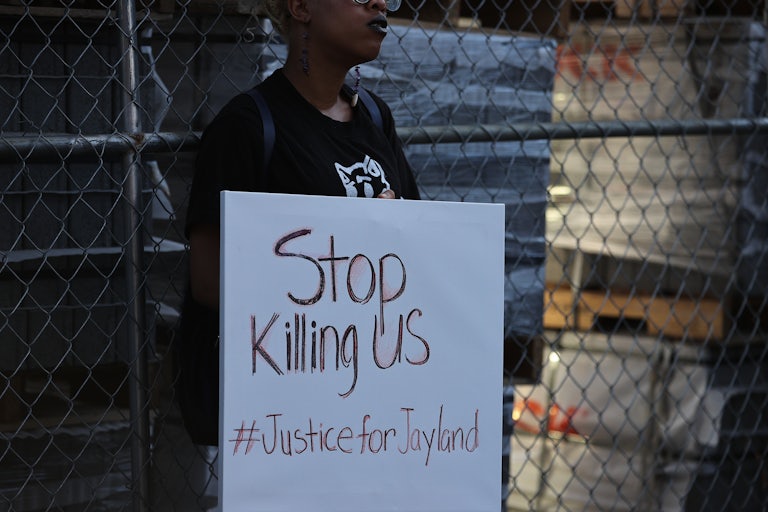
A grand jury has decided not to bring state criminal charges against Ohio police officers who fatally shot a 25-year-old Black man during a car and foot chase last summer.

Police in Akron attempted to pull Jayland Walker over for an alleged traffic violation the night of June 27, 2022. Walker did not stop, and officers in pursuit allege that they saw a flash of light come from the driver’s side of the car, which they believed to be the muzzle flash of a gun, according to their accounts of the encounter. 

Body camera footage shows officers pursuing Walker as he drove away from the scene; he  eventually jumped out of his car and ran. While he attempted to flee on foot, the eight officers on the scene said they thought he was moving to draw a gun. They subsequently fired a total of 94 bullets at him. 

Walker suffered 46 gunshot wounds and died on the scene. He was unarmed, although a gun was found in his car. The officers involved were put on paid leave during the investigation into the shooting but were ultimately brought back for administrative duty during a staffing shortage. The grand jury was seated last week to determine whether to indict any of the officers.

“The grand jury just a little while ago issued what is called a no bill, meaning that there will be no state criminal action, no charges at the state level,” Ohio Attorney General Dave Yost told a press conference Monday.

Akron has been bracing for the grand jury’s decision, after Walker’s death sparked citywide protests last summer. Police used tear gas to disperse protesters outside the Akron Police Department headquarters and arrested about 50 people (most of those charges were dropped).

But many Ohio residents are furious—and not without cause: The barrage of stories of Black people, particularly young Black men, being killed feels relentless. And few of those victims seem to get justice. Just last week, 16-year-old Ralph Yarl was shot twice in the head when he went to the wrong house to pick up his siblings. Yarl survived. Authorities have released the shooter, sparking widespread criticism. 

“We’ve seen it too many times. A routine traffic [stop] ends in death, and a family and community mourns the loss of a son,” Representative Emilia Strong Sykes, who represents the district Akron is in, said in a statement. “As this country and community reckons with another tragic death, we find ourselves yearning for a justice system that protects us all.”

Sykes said she will ask the Department of Justice to investigate the Akron Police Department’s practices. “The safety and security of our neighborhoods requires trust between the community and the law enforcement officers who have taken an oath to protect and serve, but this trust has been violated and must be rebuilt.”