Breaking News
Breaking News
from Washington and beyond

Supreme Court Sides With Corporate America, Weakens Clean Water Act

The conservative court just made it easier for corporations to pollute our bodies of water.

Lev Radin/Pacific Press/LightRocket/Getty Images

In a time when we see the consequences of corporations decimating the beauty, the harmony, and the value of our natural landscape, we ought to be doing everything we can to fight back and protect the earth. The conservative-led Supreme Court, however, believes otherwise.

On Thursday, the court ruled 5–4 to weaken the already whittled-down Environmental Protection Agency’s ability to regulate water pollution.

The question at hand involved defining “waters of the United States” that qualify for protection by the Clean Water Act. And the court held that the 51-year-old CWA does not enable the EPA to regulate discharges into some wetlands near other bodies of water.

Justice Samuel Alito wrote the opinion that decided the agency has jurisdiction over wetlands only if they have “a continuing surface connection” to larger bodies of water.

Almost 20 years ago, the court ruled that wetlands are covered by the CWA if they have a ”significant nexus” to regulated bodies of water. Various groups, including property and business organizations and fossil fuel interests, have since rallied to weaken that definition—and on Thursday, they ultimately succeeded.

The court decision follows twice-impeached, criminally indicted, and liable-for-sexual-abuse former President Donald Trump rolling back updates to the CWA made under President Obama. Trump limited federal protection to cover only “permanent” bodies of water and not other smaller but still significant waterways, like streams of water that flow only part of the year. Trump’s rule gave states greater authority to determine what should be regulated under the CWA, which meant less protection for our climate.

With the Supreme Court’s ruling, the CWA’s jurisdiction is now all the weaker. Any seasonal streams of ebbing and flowing waterways can be more readily polluted at will by some of the most callously destructive interests in American society.

What is at stake? Look no further than East Palestine, Ohio, where a disastrous Norfolk Southern train derailment months ago has to this day left residents confused, sick, and disenchanted by the government. The derailment implicated and polluted numerous waterways—some that interlink with adjacent smaller streams and wetlands. While residents even now fear corporate-driven cover-ups of more environmental damage than meets the eye, the conservative-led Supreme Court has made it even easier for communities across America to be upended, just as East Palestine was.
South Carolina Governor Signs Draconian Abortion Ban Behind Closed Doors

With Governor Henry McMaster’s signature, abortion access in the South has been effectively wiped out.

Sean Rayford/Getty Images

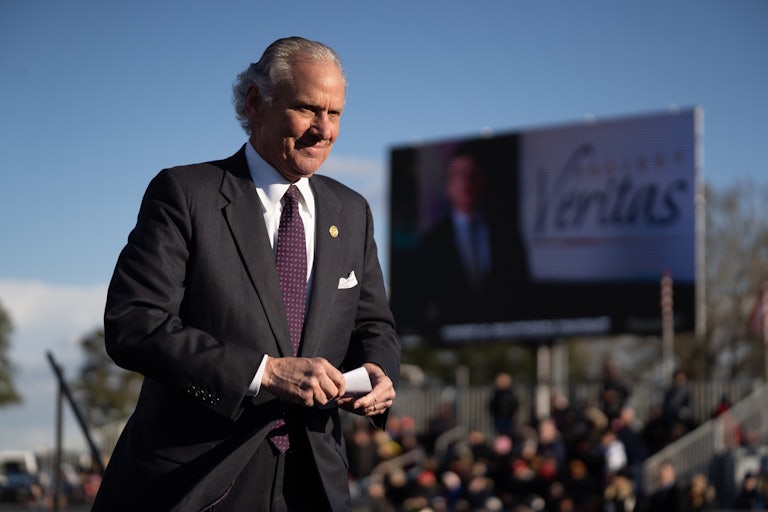
South Carolina Governor Henry McMaster signed a bill Thursday banning abortion after six weeks, wiping out access to the procedure for the entire Southeast.

A similar ban had died in the legislature in late April after all of the female senators, who span the political spectrum, banded together to filibuster the measure. But McMaster called the lawmakers back for a special session to consider multiple measures, including a new abortion ban, which passed the legislature on Tuesday. He signed the bill behind closed doors, with no fanfare or warning to doctors who could be about to perform a newly illegal procedure.

“What we are doing today is not going to do away with illegal abortions. It is going to cause illegal abortions,” warned Republican Senator Sandy Senn during the final debate.

Addressing state residents directly, she said, “When … your teenagers end up dying because they went to get an illegal abortion because they didn’t know they were pregnant before six weeks, it is our fault!”

The new law bans abortion after six weeks, before many people even know they are pregnant. It includes exceptions for rape and incest up to 12 weeks, but health care providers are required to tell patients that they will report the assault to law enforcement. This could discourage people from seeking abortions because they don’t want to report the attack.

The measure also prohibits mental health from being considered a medical emergency, so even if someone is diagnosed as suicidal, they still cannot get an abortion. Doctors who break the law face fines and up to two years in prison.

While the law does require child support payments be made from the moment of conception, writer Jessica Valenti points out that this is less to help the pregnant person and more to establish that personhood begins at conception.

The South Carolina arm of Planned Parenthood Votes South Atlantic has already said it intends to try to block the law in the courts. There is a slim chance it will succeed: After Roe v. Wade was overturned, South Carolina enacted a six-week trigger ban, which the state Supreme Court blocked in January. The new law is an attempt to circumvent the ruling, and if it’s challenged in court, it’s possible the state’s high court will block it once more.

But until it is blocked, abortion access will be decimated in the South. After Florida and North Carolina codified new abortion restrictions in quick succession, South Carolina was one of the last states in the South to hold the line on access to the procedure. Now that it has fallen, it will be next to impossible for anyone in the region to get an abortion.

Unfortunately, Trump’s Trolling of Ron DeSantis’s Failed Twitter Launch Is Quite Good

Ron DiSaster has made it so, so easy.

Brian Lawless/PA Images/Getty Images Anna Moneymaker/Getty Images

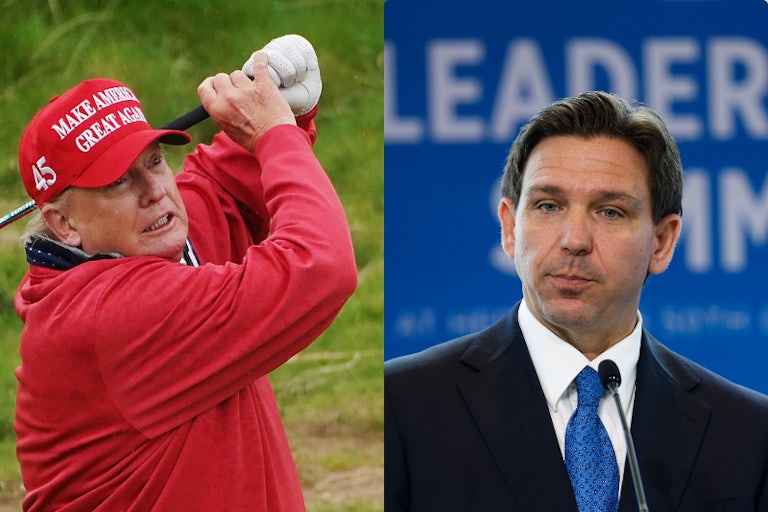
Ron DeSantis’s long-delayed presidential announcement was a disaster. And Donald Trump is cheesing from cheek to cheek.

A Twitter Space with audio glitches, jarring feedback echoes, nervous whispers wondering whether the operation was even working. The DeSantis x Elon Musk x David Sacks collab even fully crashed at one point. The whole affair didn’t even begin until 30 minutes later. The content itself was just as embarrassing; a tinny-voiced DeSantis fielded questions from an entirely sympathetic rotating cast, all while sounding like he was reading off bullet points as quickly as possible, lest the whole Twitter Space chat room crash again before he got it all off his chest.

And Trump had a field day with it all.

He was quick to remind everyone how absurd it was that DeSantis was announcing in the manner he did at all:

Someone also helped Trump figure out A.I. voice impersonations, placing DeSantis in a fictional Twitter Space with a cast including the FBI, the Devil, and Hitler (Trump was also able to scratch a far-right itch by including George Soros in the mix):

And he poked fun at a key feature of Musk: Everything he touches soon blows up:

Of course, even if DeSantis somehow had the brain cells to host a “successful” campaign launch, there’s more at stake. Everything about his résumé exhibits a destructive man corrosive to social harmony, or society working at all.

But whether it’s the decisions of him or those around him, every choice DeSantis has made so far has been downright daffy. Waiting as long as he did to announce. Announcing in the most physically out-of-touch manner—not in his home state, nor even a swing state, but on a website famously eviscerated on the back end. Doing the announcement in a setting in which people can only hear his voice that some may argue is not fit for radio. And all those decisions come while he tries to outdo the twice-impeached, criminally indicted, and liable-for-sexual-abuse former president, while barely criticizing him for any of those faults.

There’s a satisfaction in watching the instantaneous collapse of someone as obscenely evil and dramatically uninterested in unity as DeSantis—even if it is prompted by his role model.

Think Ron Desantis’s Twitter Space Was Bad? What Came After Was Even Worse.

To say DeSantis’s presidential announcement did not go well is an understatement.

Anna Moneymaker/Getty Images

Ron DeSantis somehow managed to follow his disastrous Twitter Space with an equally cringey Fox News interview.

The Florida governor formally announced he was running for president Wednesday night in a Twitter event with Elon Musk and David Sacks. To say things had gone poorly would be an understatement, with constant glitches and bad jokes derailing any sense of pomp or celebration. But DeSantis’s subsequent interview on Fox News didn’t really improve things.

When host Trey Gowdy asked how DeSantis would address the war in Ukraine, the Florida man launched into a rant about how the military is too “woke.” “First, I think what we need to do as a veteran is recognize that our military has become politicized,” DeSantis said. “You talk about gender ideology, you talk about things like global warming that they’re somehow concerned, and that’s not the military that I served in.”

He did not mention what he specifically would do about Ukraine. (Recall that DeSantis has previously faced blowback from Republicans for saying Ukraine is not a vital interest.)

Gowdy then asked about the government’s role in addressing climate change (which, props to him for semi-acknowledging that it’s real). DeSantis promptly responded that the weather has been subject to “politicization.”

Insisting that hurricanes have not gotten more intense in recent years, DeSantis instead said, apropos of nothing, “I think what we should be doing in the United States is focusing on being energy independent.”

It’s interesting how quick DeSantis was to denounce things being too politicized, considering all the things he has recently decided to politicize in his home state: bathrooms, drag queens, children’s books, and Disney World, to name a few.

The Ron DeSantis Twitter Campaign Launch Was a Disaster

The Florida governor’s attempt to kick off his presidential candidacy from deep within Elon Musk’s collapsing empire went exactly as well as you’d expect.

Joe Raedle/Getty Images

Ron DeSantis’s presidential launch was supposed to be a rebranding moment. Faltering in the polls in recent weeks, the Florida governor had lost much of the heir-to-Trumpism sheen he had earned during his tenure in the Florida statehouse. If he once seemed like the future of the Republican Party, lately he’s just seemed, well, weird: Upon closer inspection—and put next to Donald Trump—he has been robotic, odd, and uncharismatic.

But DeSantis’s campaign launch on Wednesday was supposed to turn the page on all that. Rather than the usual pageantry—a rally in a hometown, flanked by family, broadcast on Fox News during prime time—DeSantis’s team decided to take a big risk. They would take the campaign to Donald Trump’s turf and launch it on Twitter, in a live interview with influencer David Sacks and Twitter CEO Elon Musk. DeSantis was coming for Trump’s core audience: the terminally online.

Well, you get what you pay for, I guess! Hundreds of thousands of users logged on to watch the campaign launch on Twitter Spaces only to overload the social network’s wheezing servers. Musk and Sacks could occasionally be heard mumbling in grainy audio. Mostly, though, there was just silence. It was glitchy, awkward, and strange—a metaphor for DeSantis’s own faltering presidential campaign. “You broke the internet,” Musk could be heard awkwardly mumbling at one point. It was a comment better directed at himself, given the current shambolic state of Twitter.

Thirty minutes after it was scheduled to start, the event finally got underway—with the expected array of awkward braying about “free speech” and dismissal of invocations of racism. DeSantis shrugged off a recent NAACP travel advisory: “Under the leadership of Governor DeSantis, the state of Florida has become hostile to Black Americans and in direct conflict with the democratic ideals that our union was founded upon,” NAACP President and CEO Derrick Johnson said. Musk similarly dismissed criticisms that Twitter had become overloaded with Nazis, racists, and freaks under his leadership.

Wasn’t this supposed to be a campaign kickoff? If so, it could hardly be described as a success. A few hundred thousand viewers is impressive, but DeSantis probably could’ve gotten significantly more if he had launched on, say, a Fox News prime-time show. He would, at the very least, have gotten some level of broadcast professionalism (and substantially less hold music): The glitchy, awkward, audio-only format of Twitter Spaces hardly helped assuage concerns that DeSantis lacks the charisma and human touch most successful presidential campaigns require.

Still, DeSantis ultimately got the extremely online event he wanted: one aimed at Musk fanboys and other online weirdos. But that doesn’t mean it was a success. Much like a recent rocket, this can only be described as a classic failure to launch.