Breaking News
Breaking News
from Washington and beyond

Atlanta Activists Want to Let the People Decide on Cop City

Organizers are pushing a referendum to let the public vote on whether their tax dollars should be used for a massive police facility.

Andrew Lichtenstein/Corbis/Getty Images
Environmental activists reoccupy a preserved forest in Atlanta that is scheduled to be developed as a police training center, on March 4.

Protesters against Cop City are not backing down.

The Atlanta City Council on Tuesday voted to approve $67 million in taxpayer money for a massive police training facility—all after police officers indiscriminately arrested protesters and even killed one in cold blood.

And the very next day, organizers announced a public referendum campaign to demand the city repeal the lease agreement for the forest land set to be razed to construct the massive $90 million police training facility.

Organizers need at least 75,000 signatures from registered voters in the next 60 days to make it on the ballot this November.

“The Atlanta City Council has again turned its back on working class, particularly Black, Atlantans,” said organizer Kamau Franklin. “The overwhelming majority of people opposed Cop City but the city council chose again to side with the police & corporations to continue to criminalize our community—which is why it is time for the people of Atlanta to decide.”

Organizers’ decision to move this to a public vote comes after hundreds of Atlantans flooded City Hall to protest the approval of the Cop City funding.

“Viva viva, Tortuguita!” the crowd chanted, early Tuesday morning, in reference to Manuel Esteban Paez Terán, known as Tortuguita, who was shot and killed by Atlanta police in January. Contrary to police claims that the officers only shot after being shot at first, an independent autopsy found Tortuguita’s hands were raised during the shooting. Even worse, police shot Tortuguita at least 57 times.

“The Atlanta community has repeatedly drawn attention to the serious harms posed by Cop City, including environmental damage and the dangers of a militarized police force that have the potential of impacting the everyday lives of Black Atlantans,” said R. Gary Spencer, senior counsel for the NAACP Legal Defense and Educational Fund. “But instead of addressing these concerns, Georgia officials have responded with police violence, targeted arrests, and unduly harsh charging decisions. As a result, Atlantans have witnessed the police killing of Manuel ‘Tortuguita’ Esteban Paez Terán, domestic terrorism charges against activists based on tenuous evidence, and felony charges against protestors for simply distributing flyers.”

In March, dozens of people were indiscriminately arrested at a music festival organized by protesters. They were detained on accusations of participating in vandalism and arson at a construction site that was over a mile away from where the music festival was being held, some even charged with domestic terrorism. Worse, many were arrested and denied bond on the grounds of having muddy shoes (they were all in a forest, where it had rained), or being “part of the team” because they were wearing black.

Last week, Atlanta police used a heavy-duty police truck and hordes of riot police to arrest just three individuals who had been helping organize bail funds and legal support for protesters. The trio were arrested on flimsy charges of “money laundering” and “charity fraud.” Even the presiding judge seemed uncompelled by the prosecution. “I don’t find it very impressive,” he said. “There’s not a lot of meat on the bones.”

“The Atlanta community has repeatedly drawn attention to the serious harms posed. Cop City symbolizes the failures of a public safety system that continues to weaponize law enforcement against communities rather than invest in resources that would actually produce the safety and stability they need,” Spencer said. “The voice of the people has been repeatedly ignored, so it is time for the residents of Atlanta to exercise their political will and decide the fate of Cop City. This referendum does just that.”
Well, Well, Well: Republicans Suddenly Care About Early Voting

RNC Chair Ronna McDaniel wants to make this a big part of Republicans’ 2024 strategy.

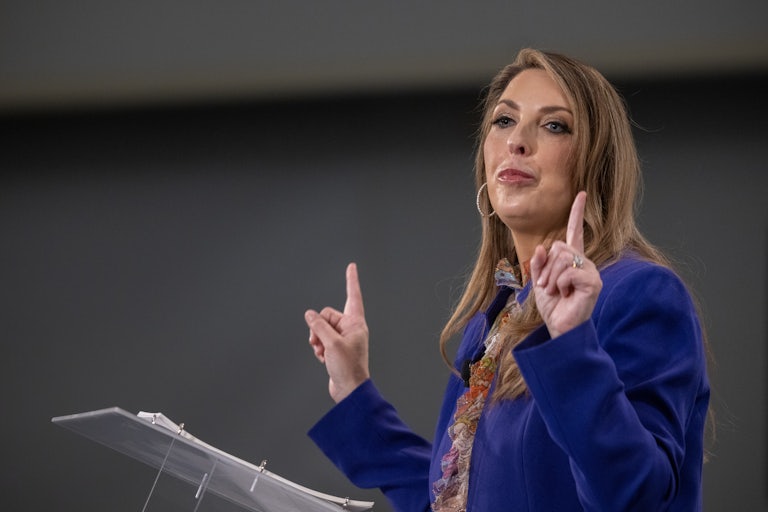
RNC Chair Ronna McDaniel speaks at a podium
David McNew/Getty Images
RNC Chair Ronna McDaniel

With the 2024 election cycle kicking off, Republicans have announced a new strategy: early voting.

The GOP has vehemently opposed early voting, and expanded voter access in general, for some time, with former President Donald Trump renewing the charge. Republicans across the country moved to restrict access to early voting after a surge during the pandemic.

But on Wednesday, Republican National Committee Chair Ronna McDaniel revealed the party’s new plan for the upcoming election cycle. “In addition to protecting the vote, we need you to bank your vote,” she said in a video message.

“To win close elections, we need to close the gap on pre–Election Day voting,” she said.

The shift in favor of early voting began in December, following Republican Senate candidate Herschel Walker’s loss in Georgia (as well as a series of other embarrassing losses in the midterms). McDaniel also began pushing back on party members who opposed early and mail-in voting.

“There were many in 2020 saying, ‘Don’t vote by mail, don’t vote early,’” she told Fox News after Walker’s defeat. “And we have to stop that and understand that if Democrats are getting ballots in for a month, we can’t expect to get it all done in one day.”

McDaniel’s staff insisted she wasn’t referring to Trump, but it’s hard to think who else she could have been talking about. Trump is one of the leading voices still falsely claiming that mail-in voting leads to fraud. He has repeatedly urged his supporters to watch ballot boxes, leading to multiple accusations of voter intimidation during the 2022 election.

Early voting is important, and a useful tool in elections, but the bigger issue is that Republicans aren’t focusing on policies that people actually care about. For instance, they have embraced extreme stances on abortion that most people oppose. The GOP also talks a lot about fighting “wokeism,” when many voters want politicians to focus on the economy or climate change.

It’s similar to the time after the 2022 midterm elections, when record-high numbers of young voters turned out for Democrats. The Republican response was to demand raising the voting age, instead of looking at the issues important to Gen Z.

In Sign That Biden Probe Is Going Great, GOP Senator Begs for More Whistleblowers

The Republican Party is grasping for straws in its “investigation” of Joe Biden.

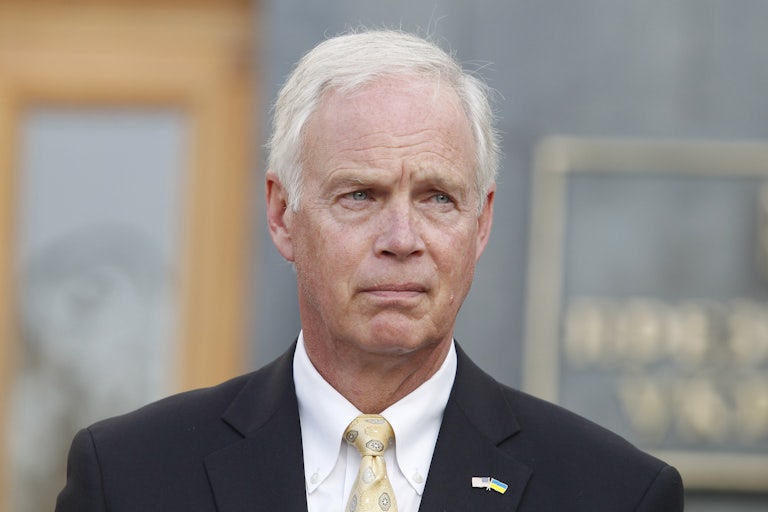
Wisconsin Senator Ron Johnson
STR/NurPhoto/Getty Images

Who ever said Republicans were cynical? After all, the way they’re treating the throw-it-all-at-the-wall investigation into Joe Biden’s family is in fact quite optimistic. Take, for instance, Senator Ron Johnson, who, on Wednesday, tried to put a positive spin on what sounds like a chase with no end in sight.

“Investigations are hard; it’s a tough, hard slog, but we’re getting—we’re getting more and more pieces of information, and we need more whistleblowers,” the Wisconsin Republican said on Fox.

Johnson, who on Tuesday called the January 6 attack on the Capitol just “pockets of rioting,” is not alone in his glass-half-full demeanor about the amorphous investigation into Biden’s family.

House Oversight Committee Chair James Comer, pack leader of the Biden probe, has assured a wide range of outlets that there is a laundry list of informants who have evidence pinning the Bidens to crimes. The problem is that he keeps changing the number of informants he apparently has, and has shared little to no information with Democrats, let alone the public.

One informant apparently even went poof. “Well, unfortunately, we can’t track down the informant,” Comer told Fox host Maria Bartiromo last month. “We’re hopeful that the informant is still there. The whistleblower knows the informant. The whistleblower is very credible,” he insisted.

Bartiromo was confused by the statement, and her colleague Steve Doocy even pressed him on it earlier that week. “You don’t actually have any facts to that point. You’ve got some circumstantial evidence,” Doocy said to Comer live on air. “And the other thing is, of all those names, the one person who didn’t profit is—there’s no evidence that Joe Biden did anything illegally.”

All of these media mishaps follow a House GOP report published in May that detailed a sprawling investigation into Biden and his family; but in all 65 pages of the report, hard evidence linking Biden to any misdeeds was notably absent. Comer himself admitted they had none.

Chris Christie Takes on the Trumps: “The Grift From This Family Is Breathtaking”

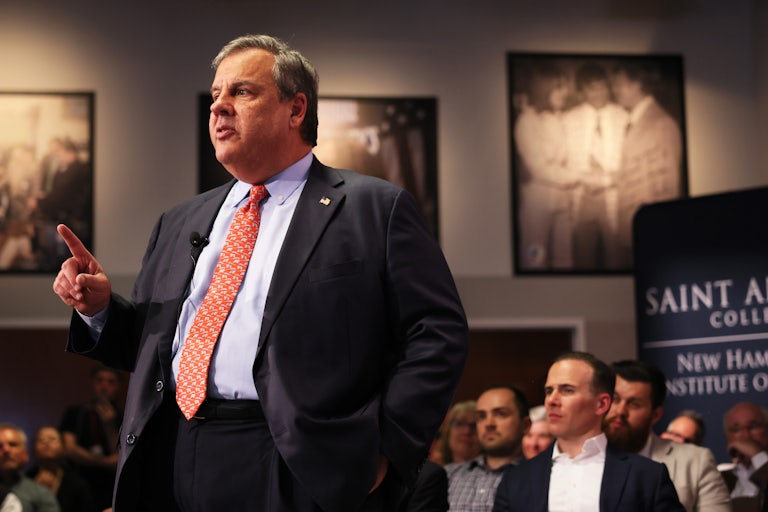
Christie seems to be the only Republican candidate willing to directly criticize the Trumps.

Michael M. Santiago/Getty Images

Chris Christie isn’t holding back on the Trump family anymore, calling them out for “breathtaking” corruption during his official presidential campaign launch.

Christie had been a major supporter of Donald Trump since dropping out of the 2016 election, even running his 2020 reelection campaign. But apparently, Trump’s refusal to accept the election results was a bridge too far, and Christie has since pivoted sharply.

“The grift from this family is breathtaking,” Christie said during his Tuesday night launch event, a town hall in New Hampshire. “It’s breathtaking. Jared Kushner and Ivanka Kushner walk out of the White House, and months later get $2 billion from the Saudis.”

Christie was referring to a $2 billion investment made by a sovereign wealth fund, which Kushner used to start his private equity firm A Fin Management LLC in 2021. The fund is chaired by Saudi Crown Prince Mohammed bin Salman, who ordered the killing of Washington Post columnist Jamal Khashoggi. And Trump and Kushner looked the other way after his murder.

“You think it’s ’cuz he’s some kind of investing genius? Or do you think it’s ’cuz he was sitting next to the president of the United States for four years doing favors for the Saudis?” Christie asked the crowd, referring to Jared Kushner. “That’s your money he stole and gave it to his family. You know what that makes us? A banana republic.”

Christie seems to be the only Republican candidate willing to call Trump (and his family) out, but it doesn’t seem to be doing him any good just yet. RealClearPolitics took the average of the results of several presidential primary surveys and found that Christie has just 1 percent of support.

Who Is Doug Burgum? More on the Midwestern Presidential Candidate

The North Dakota governor has announced his bid for president. Here’s what his record looks like.

Stephen Yang/Getty Images
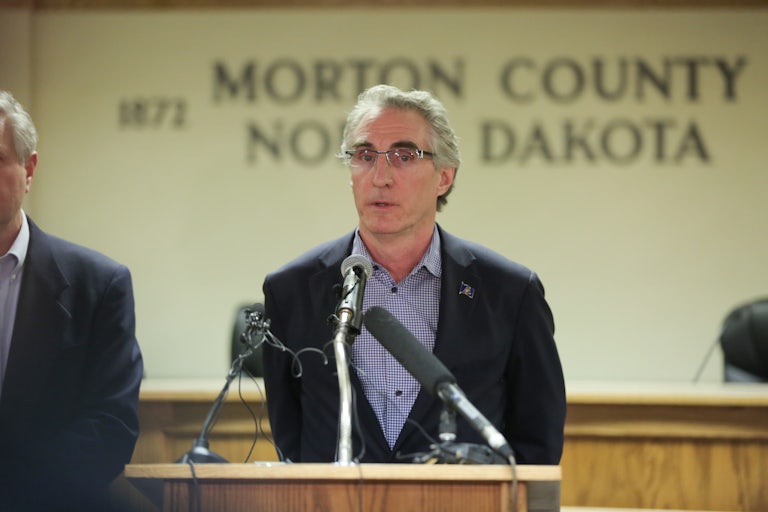
North Dakota Governor Doug Burgum

North Dakota Governor Doug Burgum has officially thrown his hat in the ever-widening ring to become the 2024 Republican nominee for president. And apparently, much of the country has no idea who he is.

Upon the release of his initial teaser video earlier this week, much of the online reaction ranged from “Who is this?” to “Well, this is a great tourism video for North Dakota.” Even The New York Times’ Bret Stephens conceded he didn’t know who Burgum was.

But beyond the humorous reaction to his announcement, Burgum’s candidacy, and his governorship, is quite distinct from the rest of the Republican Party—which is steeped in cultural attacks on millions of people’s civil rights, teacher’s and student’s rights to maintain a free education, and hyperfixation on crime and migrants.

On Tuesday, Burgum announced his candidacy with an op-ed in The Wall Street Journal, with no mention of any of those talking points.

“We need a change in the White House. We need a new leader for a changing economy,” he wrote simply. “That’s why I’m announcing my run for president today.”

Of course, Republicans, no matter how measured they may appear, have generally similar views when it comes down to it. And Burgum is no exception.

Burgum was born in small-town North Dakota, moving on to study business at Stanford after graduating from North Dakota State University. While surrounded by the Palo Alto atmosphere, Burgum befriended Steve Ballmer, who would go on to become Microsoft’s CEO.

After graduation, Burgum moved to Chicago to work as a consultant for McKinsey. Shortly thereafter, the North Dakotan mortgaged $250,000 of inherited farmland to provide funds to software company Great Plains Software, becoming the president a year later. After years of growth, Burgum sold the company to Ballmer’s Microsoft for a nice $1.1 billion. Burgum remained active in Microsoft and the North Dakota business community for years afterward.

Finally, in 2016, with no formal experience, Burgum announced his campaign to become governor of the state. He in fact lost the state Republican Party’s endorsement contest but went on to win the primary election, and then the general handily. Burgum easily won reelection in 2020, despite facing a challenge not just from a Democrat but from a far-right candidate too.

Burgum has in many ways avoided the fray of Trump-adjacent chaos, even using his own money to boost Republicans in state legislative races who were running against more extreme far-right Trump-aligned candidates. Still, Burgum endorsed Trump in both 2016 and 2020, and enjoyed reciprocal endorsements from the twice-impeached, criminally indicted, and liable-for-sexual-abuse former president.

And though Burgum has attempted in his own way to prevent the furthest radicalization of his party in a state where there is not a likely electoral consequence for it anyhow, he has still signed numerous bills that are touchstones for the national Republican agenda.

In 2021, Burgum signed a bill banning the teaching of “critical race theory” in K-12 schools. The bill’s text defined critical race theory as “the theory that racism is not merely the product of learned individual bias or prejudice, but that racism is systemically embedded in American society and the American legal system to facilitate racial inequality,” which, as a reminder, is patently true when considering the ongoing ramifications of redlining, mass incarceration, or environmental racism, to name just a few examples.

And though Burgum called the 2020 state party’s platform “divisive and divisional” with regard to LGBTQ issues, he has signed an array of anti-trans laws this year, including an almost total ban on gender-affirming care for people under the age of 18 and another that bans transgender people from using school bathrooms or locker rooms aligned with their identity. Burgum has also signed a near-total abortion ban, one of the strictest in the country.

Burgum has vetoed some bills, like one that threatened librarians with criminal prosecution unless they reviewed their collections for sexually explicit material and another that prohibited teachers and staff from referring to transgender students by their preferred pronouns. He still, however, signed another bill allowing teachers and state employees to misgender transgender students and colleagues.

All that to say, Burgum’s record as a Republican is a mixed bag. He’s exhibited some restraint from participating in the cultural race to the bottom but has carried out much of the radical Republican agenda that has left the party losing pivotal races over and over again—from 2020 to the midterms, to state referenda, to Wisconsin’s Supreme Court election this past spring.

Still, considering aesthetics and some Republican voters’ own dignity, Burgum may rise in the race more than pundits think. His time in business has fostered connections with an array of potential wealthy donors who could fund his first momentum-displaying percentage or two (given how large the field is, and how unknown he is, any point would prove significant). Appearing then on a debate stage with Trump and an array of Republicans who are infamous for kissing the former president’s feet may offer Burgum just enough room to become a successful, mid-tier candidate.