Breaking News
Breaking News
from Washington and beyond

Cormac McCarthy, One of America’s Greatest Novelists, Has Died

He takes his place with Melville, Faulkner, and Twain in the pantheon.

Photo by Jim Spellman/WireImage
Novelist Cormac McCarthy (left) and director John Hillcoat at the premiere of “The Road” in 2009

No one wrote like Cormac McCarthy, who died on Tuesday in New Mexico at the age of 89. In the tributes and appreciations that will be published in the coming days, there will be mentions of Melville and Faulkner and maybe Twain. But McCarthy was an utterly singular and manifestly American writer, and a more than worthy heir to that triumvirate.

Much of that singularity was centered in McCarthy’s prose, which ricocheted—sometimes gracefully, sometimes jarringly—between gruff matter-of-factness and soaring, biblical grandiloquence. His style married Hemingwayean bluntness with the transcendent beauty (and sometimes ridiculousness) of the King James Bible. McCarthy’s passages—and his sentences, sometimes—merged the ordinary and the sublime. His novels frequently contained descriptions of extraordinary violence and gore, but they were rarely cartoonish, in part because of this ability to imbue the mundane with a prevailing, sometimes overwhelming sense of mystery.

McCarthy’s great theme was the frontier—a theme that was, arguably, the great theme of American culture for over a century. McCarthy wrote about the West, certainly, but also about life on the outskirts—my favorite novel of his is the hilarious, sad, autobiographical Suttree, which tracks life among vagrants and weirdos in Knoxville, Tennessee. McCarthy’s career began as the frontier’s central place in American culture was rapidly diminishing, and yet it’s notable in part because his work is strong argument for its continued relevance. For McCarthy, the frontier is where you go to understand America. Many of his best novels—Blood Meridian, No Country for Old Men, All the Pretty Horses—double as arguments for its continued relevance in American art.

McCarthy’s frontier was frequently a place of extreme violence and often evil, but it was also a place containing grand, if often inscrutable, truth and beauty. Much of McCarthy’s writing revolves around relatively straightforward themes—the nature of evil, the existence of God, the violence at the heart of America—but his characters frequently find themselves facing questions about the nature of existence itself.

Take the ending of The Road, McCarthy’s late-career postapocalyptic masterpiece:

Once there were brook trouts in the streams in the mountains. You could see them standing in the amber current where the white edges of their fins wimpled softly in the flow. They smelled of moss in your hand. Polished and muscular and torsional. On their backs were vermiculate patterns that were maps of the world in its becoming. Maps and mazes. Of a thing which could not be put back. Not be made right again. In the deep glens where they lived all things were older than man and they hummed of mystery.

Or this, from Blood Meridian:

The truth about the world, he said, is that anything is possible. Had you not seen it all from birth and thereby bled it of its strangeness it would appear to you for what it is, a hat trick in a medicine show, a fevered dream, a trance bepopulate with chimeras having neither analogue nor precedent, an itinerant carnival, a migratory tentshow whose ultimate destination after many a pitch in many a mudded field is unspeakable and calamitous beyond reckoning.

The universe is no narrow thing and the order within it is not constrained by any latitude in its conception to repeat what exists in one part in any other part. Even in this world more things exist without our knowledge than with it and the order in creation which you see is that which you have put there, like a string in a maze, so that you shall not lose your way. For existence has its own order and that no man’s mind can compass, that mind itself being but a fact among others.

At its best, McCarthy’s fiction could compass the strange and often violent order of existence. It is not at all clear that that order will ever find a chronicler of his manifold talents and complexity again.
On Same Day He’s Arrested, Trump Faces New Legal Troubles for Different Crime

E. Jean Carroll is back.

Victor J. Blue/Bloomberg/Getty Images

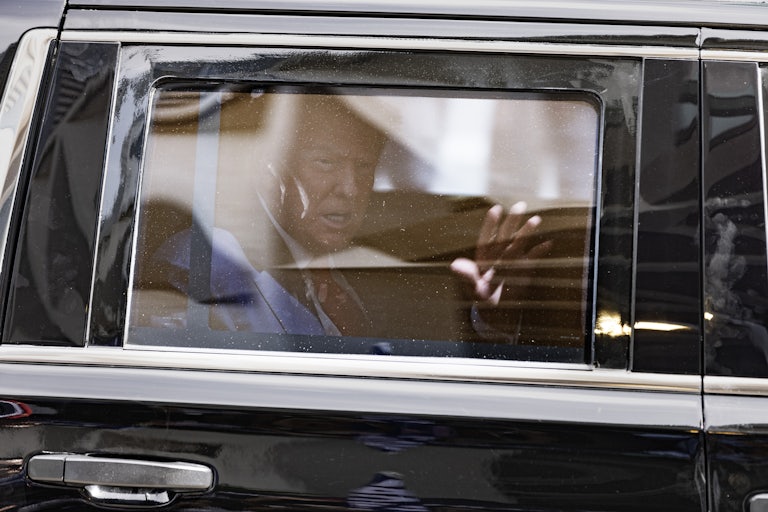
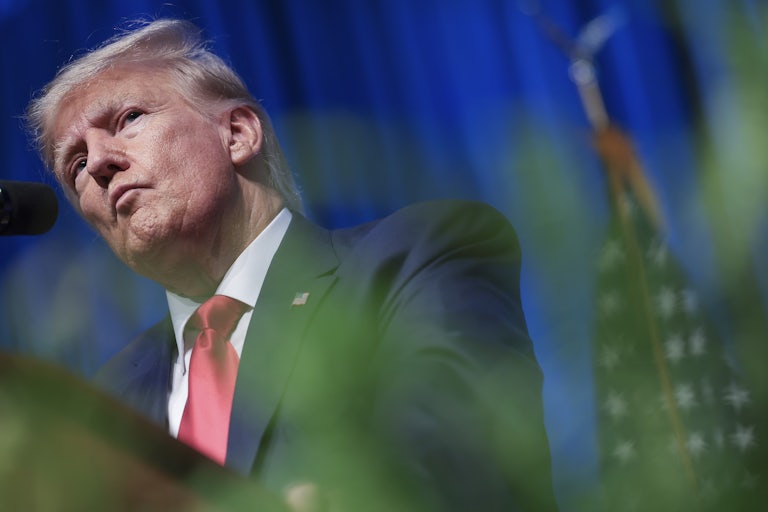
On the very day that Trump was arrested and became the first former president to face a federal indictment, his legal troubles somehow got even worse.

A judge on Tuesday granted E. Jean Carroll permission to amend her defamation lawsuit against Trump to include comments he made about her during a CNN town hall.

Trump was unanimously found liable on May 9 for sexual abuse and battery against Carroll in the mid-1990s, and for defaming her in 2022 while denying the assault. He was ordered to pay her about $5 million in damages. Just one day later, Trump bashed her during a CNN town hall, prompting Carroll to file for new damages from him.

Carroll also sued Trump for defamation in 2019. Judge Lewis Kaplan, who presided over the original trial, allowed Carroll to add the damages for the CNN comments to the 2019 lawsuit. She is seeking at least $10 million in damages.

Carroll accused Trump in her 2019 memoir of raping her in the Manhattan Bergdorf Goodman department store in the mid-1990s. She initially sued him twice for defamation: first in 2019, when he said she made up the rape allegation to promote her book, and again in November for posts he made about her on social media.

Carroll is not the only woman to accuse Trump of sexual assault, but her case was the first to make it to a courtroom. Trump continues to vehemently deny all of the allegations and launched fresh vitriol at Carroll during the disastrous CNN town hall last month.

Trump and his allies have repeatedly tried to thwart Carroll’s various lawsuits. Two weeks ago, a judge denied an attempt to throw out the 2019 defamation suit by Trump ally James H. Brady, who argued that the former president was being unfairly treated because he is a “white Christian.”

Last week, Trump and his legal team also requested that the 2019 suit be dismissed, arguing that he couldn’t have defamed Carroll then because he was technically telling the truth when he denied raping her. When that didn’t work, he begged for a new trial altogether, arguing that the $5 million in damages he was ordered to pay was too much.

The Very Short List of Republicans Denouncing Trump on Classified Docs

Here are all the Republicans brave enough to say it’s bad to hide CIA documents in your bathroom.

Just a handful of Republicans have spoken out against Donald Trump after he was indicted once again, this time for taking and mishandling secret government documents, going as far hiding the documents in a Mar-a-Lago bathroom and showing off the documents (from agencies like the CIA, Defense Department, and NSA) to a representative of his PAC as well as staff members.

In almost all the condemnations, Republicans still default to also criticizing Joe Biden or Mike Pence for having taken government documents after they left the White House (though both appear to have cooperated with government efforts to return said documents, while Trump actively did not).

Nevertheless, as the wider party remains silent, here’s the very small list of Republicans who have condemned Trump for mishandling top secret government information.

Presidential Candidates

Chris Christie went on a broadside against Trump, as well as his fellow candidates, in a CNN town hall Monday. “They’re playing political games with you,” Christie told the audience about Republicans who are attacking the Department of Justice but avoiding the specifics on Trump’s “indefensible” indictment. “The evidence is pretty damning,” he added.

Nikki Haley said if the indictment is true, “Trump was incredibly reckless with our national security.”

“My husband’s about to deploy this weekend. This puts all of our military men and women in danger,” Haley continued, while still tempering her condemnations by claiming that the Department of Justice and FBI have “lost all credibility with the American people.” (Haley tapped the brakes even further on Tuesday, saying she “would be inclined in favor of a pardon” for Trump if she became president and he was convicted.)

Tim Scott said it was a “serious case with serious allegations,” according to The Post and Courier. Still, he couldn’t help himself either, adding that “what we see today across this administration of President Joe Biden is a double standard. That double standard is both un-American and unacceptable. You can’t protect Democrats while targeting and hunting Republicans.”

Mike Pence said he “cannot defend what is alleged,” while also hedging, claiming there had to have been a degree of politicization involved, and that he reserves full judgment, as Trump “has a right to his day in court.” Pence echoed Haley in citing familial concerns. “My son’s a Marine, my son-in-law is a Navy lieutenant. I mean, the very prospect that … highly sensitive classified material could have fallen into the wrong hands—even inadvertently—that jeopardizes our national security, it puts at risk the men and women of our armed forces.”

Asa Hutchinson was the first candidate to have taken a firm stance upon the indictment’s release last Thursday. “With the news that Donald Trump has been indicted for the second time, our country finds itself in a position that weakens our democracy,” the former Arkansas governor said in a statement. “Donald Trump’s actions—from his willful disregard for the Constitution to his disrespect for the rule of law—should not define our nation or the Republican Party.”

Senators

Senator Lisa Murkowski said the indictment is “a pretty comprehensive condemnation of the president’s actions,” also criticizing Republican efforts to target investigators. “We cannot take this lightly, so to kill the messenger does not account for the gravity of the indictment that is out there,” she said. “I don’t care whether you’re a Trump supporter or a Trump opposer, you have  to take this seriously.”

Senator John Cornyn simply said the Trump indictment is “not good,” while Senator John Thune called it “very serious,” echoing his endorsee Scott. He too added the same caveat: “What I would hope is what others have done, whether it’s Hillary Clinton or Joe Biden or anybody else, wouldn’t become the standard of behavior for Republican leaders.”

Senator Mitt Romney said, “I’m increasingly angry the more I think about it. The country is going through angst and turmoil, and that could have been avoided if President Trump had just turned in the documents; he wouldn’t have been indicted.”

He added, “Why? What purpose would you have for doing that?” 

House Members

On CNN, Representative Ken Buck said he “would not feel comfortable with a convicted felon in the White House,” saying that Trump’s attacks on Hillary Clinton in 2016 “set the standard.”

“It’s very problematic. There’s a reason I’m not defending it,” Representative Dan Crenshaw said.

“I just think it’s obvious what the president did was wrong,” said Representative Don Bacon. “I just think the emperor has no clothes, and we need to have Republicans stand up and say that, because come around after the primary … the other party’s going to be saying this.”

When asked if he would be okay with a convicted felon being the party’s nominee, Representative Tim Burchett said “honestly on the surface, I wouldn’t. That doesn’t look good.”

Representative Steve Womack said that he has “serious concerns about anybody that has a reckless disregard for the handling of classified documents.”

All that to say: nothing too stellar from the party that purports to care about our “men and women in uniform.” It was already known how much they actually do, based on how often they jostle to send them to war or how little they care for them once they return. But now Republicans aren’t even bothered to express concern for national security interests.

This article has been updated.

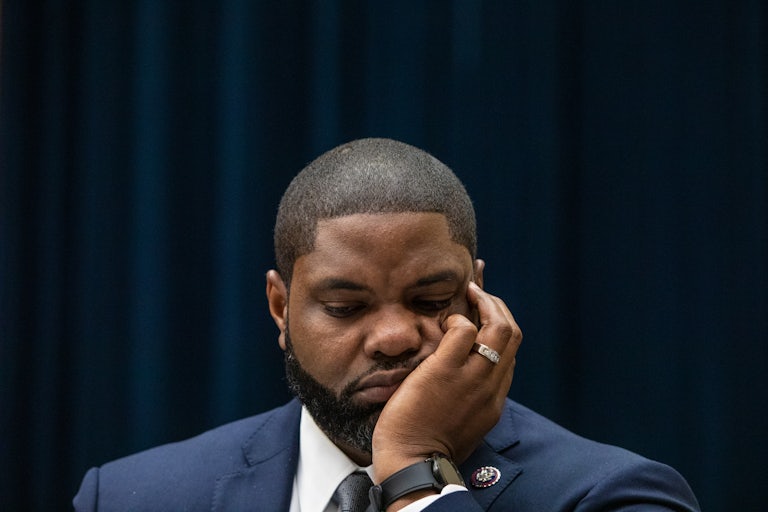
Republican Congressman Offers Stupidest Defense of Trump Yet

Byron Donalds is trying to justify Trump’s hoarding of national security documents in the bathroom.

Anna Rose Layden/Bloomberg/Getty Images
Representative Byron Donalds

Republicans continue to find ways to downplay Donald Trump’s being indicted for mishandling classified documents, and Representative Byron Donalds just offered the worst one yet.

Trump was arraigned Tuesday for how he allegedly handled the sensitive material. The investigation revealed that Trump had squirreled hundreds of documents into various rooms at his Mar-a-Lago resort, including the ballroom and a bathroom. According to Donalds, that’s not so bad.

“As somebody who’s been to Mar-a-Lago, you just can’t walk through Mar-a-Lago of your own accord because Secret Service is all over the place,” Donalds told CNN Tuesday morning. “There are 33 bathrooms at Mar-a-Lago. So don’t act like it’s just in some random bathroom that the guests can go into.”

Trump was charged with a total of 37 counts for keeping national defense information without authorization, making false statements, and conspiring to obstruct justice. He also reportedly showed the documents off to people who did not have security clearance, such as a representative of his PAC and members of staff.

The indictment did not specify whether the documents had been stored in Trump’s personal bathroom, so they may well have been kept in “some random bathroom.” What’s more, you can just walk around Mar-a-Lago on your own, so long as you pay a membership fee. Granted, the fees are exorbitant, but there are other ways to get in too.

As the indictment notes, Mar-a-Lago hosted more than 150 social events between January 2021 and August 2022, including in the ballroom where Trump stored documents. Those events included “weddings, movie premieres, and fundraisers that together drew tens of thousands of guests.” It’s unlikely the documents were in the ballroom during those events, but it does mean that outsiders were given access to the resort property and allowed to walk around.

Donalds is not the first Republican to try to downplay the fact that highly sensitive documents were kept in a bathroom. House Speaker Kevin McCarthy argued that the materials were fine in the bathroom because a bathroom door locks. But the thing about bathroom doors is that they typically lock on the inside, when someone’s using them, not on the outside after someone stores a bunch of classified documents inside.

South Carolina Teacher’s Lesson on Racism Shut Down by School District

The classroom was barred from reading Ta-Nehisi Coates’s “Between the World and Me.”

Raychel Brightman/Newsday RM/Getty Images

Cancel culture is in full force.

This time, an Advanced Placement language class in South Carolina was barred from discussing Ta-Nehisi Coates’s famed book Between the World and Me because of a new state law that prohibits classrooms from genuinely talking about race.

Teacher Mary Wood had planned to teach her class the book as part of the class’s preparation for the argumentative essay portion of the A.P. test. Writing to the district, Lexington-Richland School District Five, Wood explained that she taught the same book the previous year without any issue, reports South Carolina newspaper The State.

While preparing for the book, Wood played two short videos for the class, one depicting pretty elementary metaphors for structural inequities throughout American history and another that explores manifestations of systemic racism like mass incarceration and predatory loans. The videos detailing historical and social facts of America were apparently too much for a couple of students.

“These videos portrayed an inaccurate description of life from past centuries that she is trying to resurface. I don’t feel as though it is right because these videos showed antiquated history. I understand in AP Lang, we are learning to develop an argument and have evidence to support it, yet this topic is too heavy to discuss,” one student said.

Sample reading lists for such high school courses have included “heavy” texts including The Grapes of Wrath by John Steinbeck, Night by Elie Wiesel, and George Orwell’s 1984.

“I was incredibly uncomfortable throughout both videos, and was in shock that she would do something illegal like that,” another student wrote. “I am pretty sure a teacher talking about systemic racism is illegal in South Carolina,” they added.

Not exactly. South Carolina lawmakers passed a motion that prohibits state funds from going toward the narrow teaching of ideas like “an individual, by virtue of his race or sex, is inherently racist, sexist or oppressive.” The teaching of how structures like law and policy have contributed to long-standing and ongoing racial inequity and inequality does not necessitate the teaching that individual people are inherently oppressive individuals.

Nevertheless, The State notes, far-right legislators sued a neighboring district for apparently violating the ban; the suit is still in court.

In Wood’s case, school officials warned that since “there is proposed legislation up for discussion and voting currently,” they “need to cease this assignment.” As in, proposals not even enshrined in law are casting a chilling effect on more holistic teaching in our schools.

In a letter addressed to Superintendent Akil Ross and the school board, Wood said the “lack of clarity” from the district, and the school’s kicking her to the curb, has left her feeling unsafe, spurring her to install a security system at home.

“In this culture, EVERYTHING may be considered controversial,” Wood wrote. “To prevent conversations about experiences which exist outside of heterosexual, caucasian norms is both biased and discriminatory and completely antithetical to the development of critical thinking and civil discourse, which is the entire point of an AP Lang course.”

“There is an odd juxtaposition where we are trusted to protect students from armed intruders but subject to ridicule from community members who proclaim we are indoctrinating children,” Wood said to The State. “Until we cease to lend a space for vilifying teachers, more of us will leave the classroom.”

Wood’s case echoes that of Wisconsin teacher Melissa Tempel, who has been set to be fired for publicly complaining about her school district banning her students from singing Dolly Parton and Miley Cyrus’s song about rainbows and unity.