Breaking News
Breaking News
from Washington and beyond

A Majority of Israelis Think Netanyahu Should Resign

Ninety-four percent of Israelis believe the government bears some responsibility for Hamas’s devastating attacks, while a slight majority think the prime minister should step down after the conflict ends.

Photo by JACK GUEZ/AFP/Getty Images
Israeli Prime Minister Benjamin Netanyahu earlier this year

An overwhelming majority of Israelis blame their government and Prime Minister Benjamin Netanyahu for Hamas’s invasion last week, according to a new poll.

A recent survey by the Dialog Center found that out of 620 Israeli Jews polled, 86 percent felt that the surprise attack from Gaza was the fault of Israel’s government. Seventy-nine percent of coalition supporters also agreed, a damning assessment of Netanyahu’s leadership.

Nearly all of the respondents—a whopping 94 percent—said the government was responsible for the lack of security that led to the infiltration of Israel’s south, reported The Jerusalem Post.

But that doesn’t mean Bibi’s time as prime minister is in imminent jeopardy. A smaller majority, 56 percent, of Israelis polled said that Netanyahu should resign after the current conflict ends, with only 28 percent of coalition supporters feeling the same way.

The war between Israel and Palestine, sparked on Saturday when the Palestinian militant group Hamas launched a three-pronged assault on Israel’s southern border with Gaza, has so far killed at least 1,400 people in Palestine and another 1,200 in Israel, ABC reported. At least 27 Americans have also died in the escalating conflict, per reports.

Gaza, a small strip of land sandwiched between Israel, Egypt, and the Mediterranean Sea, is one of the most densely populated areas of the world, housing more than two million people, with some 40 percent of the population under the age of 14.

In a press briefing late Wednesday night, Israeli Defense Minister Yoav Gallant claimed that Israeli military forces would “wipe [Hamas] off the face of the Earth.”  Since the initial assault, Israeli defenses have launched more than 6,000 bombs over Gaza, and leadership has cut off access to electricity, fuel, and humanitarian aid. 

“Humanitarian aid to Gaza? No electric switch will be turned on, no water tap will be opened, and no fuel truck will enter until the Israeli abductees are returned home,” said Israel Katz, Israel’s minister of energy, on Thursday.

The fallout of that decision has caused what Gaza’s authorities describe as a “humanitarian crisis,” plunging the country into total darkness as it runs out of water and food.

But the front line is shifting. Early Thursday, Israel sent a large number of the 300,000 Israeli reserve soldiers to the country’s northern border with Lebanon, fearing a possible attack from the Iran-backed Hezbollah, reported the BBC.

While there was a great deal of speculation in the immediate aftermath of the attacks that Netanyahu’s government would be strengthened, that does not seem to currently be the case. 
Donald Trump Praises Hezbollah, Criticizes Israeli Government in Wake of Attacks

The former president called the Lebanese militant group “very smart” on Wednesday.

GIORGIO VIERA/AFP/Getty Images
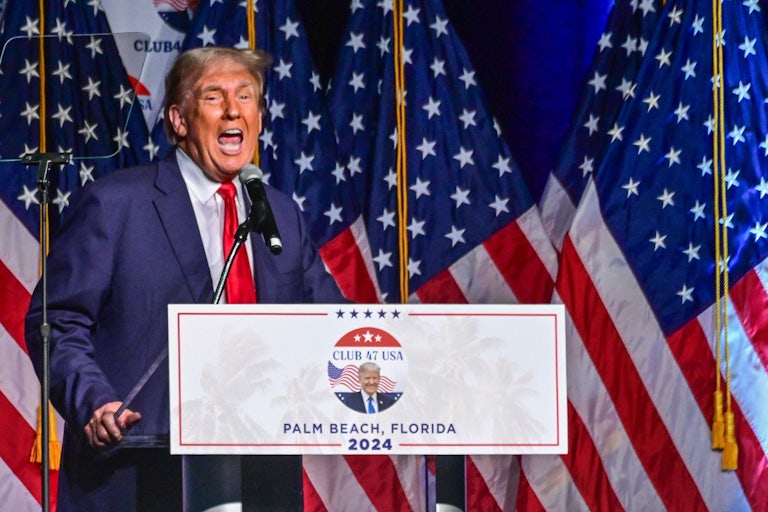
Donald Trump speaking in West Palm Beach on Wednesday

Politicians on both sides of the aisle came down hard on Trump Wednesday night after the former president praised the Lebanese militant group and longtime Israeli enemy Hezbollah, calling the group “very smart.”

“Two nights ago, I read all of Biden’s security people, can you imagine, national defense people, and they said, ‘Gee, I hope Hezbollah doesn’t attack from the north, because that’s the most vulnerable spot,’” Trump said at a gathering in West Palm Beach.

“You know Hezbollah is very smart, they’re all very smart,” he added.

Trump also took the opportunity to complain about Israel’s leader, Prime Minister Benjamin Netanyahu, for refusing to aid his administration in the 2020 assassination of an Iranian Revolutionary Guard chief, Major General Qassem Soleimani.

“I’ll never forget that Bibi Netanyahu let us down, that was a very terrible thing,” Trump said.

Governor Ron DeSantis was quick to slam the comments, taking a hard line against his former mentor, tweeting that it was “absurd” that the GOP presidential front-runner would “praise Hezbollah terrorists as ‘very smart.’”

Trump, who has recently polled as much as 40 percent higher than DeSantis in the GOP primaries, has a long history of vocally supporting authoritarian states and leaders around the world, including Russian President Vladimir Putin, Chinese President Xi Jinping, and North Korean Leader Kim Jong Un.

The White House also condemned the statement, calling Trump’s language “dangerous and unhinged.”

“It’s completely lost on us why any American would ever praise an Iran-backed terrorist organization as ‘smart,’” White House deputy press secretary Andrew Bates said in a statement.

Is the GOP Too Chaotic to Elect a Speaker?

Steve Scalise is struggling to secure enough votes, as more than a dozen Republicans oppose his candidacy.

Photo by Anna Moneymaker/Getty Images
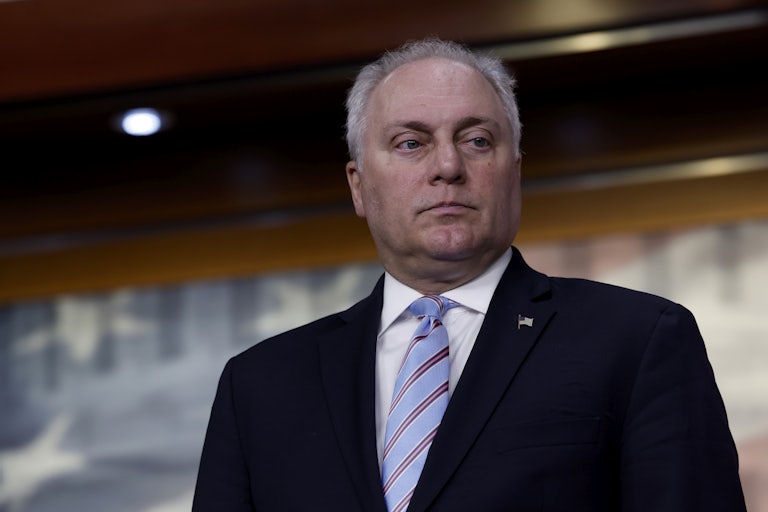
Representative Steve Scalise, who is vying to become the next speaker of the House

Representative Steve Scalise narrowly won the GOP nomination for speaker of the House of Representatives on Wednesday, but a slew of Republicans still have their doubts.

The party’s razor-thin majority requires a nearly unanimous vote to win the speakership, but so far 13 Republicans, including Representatives Nancy Mace and George Santos, have publicly stated that they plan to vote against Scalise whenever ballots are cast.

That’s more than enough to prevent the Louisiana representative from ever grasping the gavel. In order to win, the majority leader will need to earn 217 votes—slightly fewer than usual, since the House holds two vacancies. As of now, Scalise has only 208 Republicans backing him.

Scalise’s job is made more difficult by the fact that his holdouts are far from unified in their opposition: It’s not clear that he could offer a slate of concessions, as his predecessor, Kevin McCarthy, did, to appease enough of them to support his candidacy.

Before Tuesday’s nomination, Representative Marjorie Taylor Greene told reporters that she feels Scalise isn’t healthy enough to handle the stress that comes with running the House. (Scalise has multiple myeloma, a form of blood cancer.) Representative Thomas Massie wants assurances from the GOP nominee that the party won’t vote on omnibus spending bills. Meanwhile Mace, who campaigned with Scalise and trumpeted his endorsement in her 2020 race, says she can’t “in good conscience” get behind a candidate who once spoke at a white supremacist event and had compared himself to David Duke, according to Politico.

Team Trump, who had backed Representative Jim Jordan for the role, told The Messenger that the former president won’t be lifting a finger to help Scalise sway the outliers. The drama in the House is familiar: Last winter, McCarthy narrowly won the speakership after a historic 15 ballots—and only secured the gavel after agreeing to a number of concessions that ultimately led him to be removed earlier this month.

That plan of attack didn’t work out well for him. After months spent trying to appease far-right members of his party, McCarthy got the boot for negotiating a short-term bipartisan stopgap spending bill to avoid a government shutdown.

But Scalise, who is still the clear favorite after winning over Representatives Jordan and Matt Gaetz, has some advantages that the former speaker didn’t.

Namely, trust. Unlike McCarthy, Scalise has yet to make or break promises to the holdouts in his party—earning favor with members of the far right, who long distrusted the former speaker.

And the Louisiana Republican has already started churning some undecided votes into yeses. On Tuesday, Representative Anna Paulina Luna flipped to Team Scalise after the nominee spoke with her about impeaching President Joe Biden and subpoenaing his son Hunter Biden. Scalise may ultimately turn it around. For now, the deck is stacked against him. House Republicans are increasingly ungovernable. There may be no figure who can unify them.

Mary Trump: My Uncle Is a Deeply Insecure Fascist

The former president’s niece explained his enduring appeal despite his obvious fraud and failures.

Mary Altafeer/Pool/Getty Images

The stakes of the 2024 election could not be clearer, says Mary Trump: It’s “​​a choice between democracy and fascism.”

The psychologist, author, and niece of former President Donald Trump spoke at The New Republic’s Stop Trump Summit on Wednesday about why her uncle still has deep support across much of the country. It’s not what many observers believe, she said.

“They identify not with Donald’s strength … but they identify with his weakness,” Trump said, arguing that his supporters know to some extent that he’s a fraud. In fact, they like that about him. “They identify with the fact that he gets away with everything.”

“To me, one of the biggest scams was this myth that Donald was this successful businessman … that he was a champion of the working man,” she said. “By the way, that’s not something he ever says. Somebody else made that up about him.”

Trump said that Donald’s portrayal in the media as a working-class hero is founded on a misunderstanding—he grew up privileged in Manhattan, after all—and that he then exploited it. “He just then flew his stupid private jet from rally to rally, and I guess that was enough to convince people that he really cared about them,” she said.

Asked by moderator Molly Jong-Fast whether Donald is a “dry drunk,” Trump said, “He acts like one” but declined to “diagnose” him.

“I do think it’s important to understand the roots of what’s going on,” she added. “The deeper cause is his insecurity. This is a man who knows on an unconscious level that he is absolutely nothing of what he claims to be.”

Trump Ghostwriter Reveals How Much of His Royalties Went to Causes Trump Hates

Tony Schwartz admitted what he did with the “blood money” from ghostwriting “Trump: The Art of the Deal.”

Chris Williamson/Getty Images
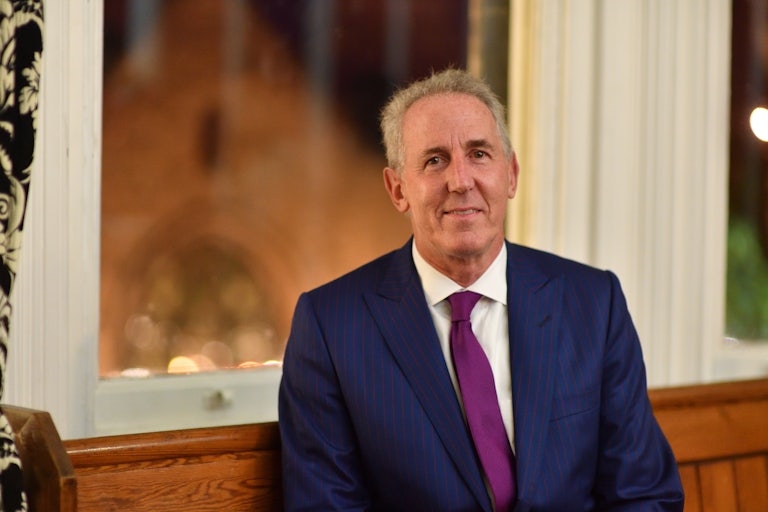
Author and journalist Tony Schwartz

The ghostwriter behind one of Trump’s most successful books, Trump: The Art of the Deal, says he’s donated several hundred thousand dollars from the book’s proceeds to causes he believes the former president would hate.

During The New Republic’s Stop Trump Summit, author and journalist Tony Schwartz said that since the beginning of Trump’s presidency, he’s given away $375,000 to “causes [Trump] would despise,” including environmentalism, immigration advocacy, and other progressive causes.

“I consider it blood money,” Schwartz added, noting that he’s “thrilled” to be able to donate to causes that Trump has attempted to topple with money that the disgraced businessman himself helped generate.

But for Schwartz, the contribution is bittersweet.

“I still feel like I’m doing penance,” he told panel host and fellow author Meryl Gordon. “I knew while I was doing that book that it was a mistake to do it. I knew who he was. He was not a different person than he is now.”

Schwartz, Trump, and their royalty checks over the New York Times bestseller have a complicated history. After Schwartz shared in a 2016 tell-all in The New Yorker that he felt he had “put lipstick on a pig” and felt a “deep sense of remorse” for making the real estate mogul more appealing than he was, Trump sued his co-author for defamation.

In a cease-and-desist letter drafted to Schwarz hours after the interview’s publication, Trump demanded “a certified check made payable to Mr. Trump” for several million dollars in royalties that the ghostwriter had earned on the book, along with half of the book’s $500,000 advance.