Breaking News
Breaking News
from Washington and beyond

Why House Republicans Aren’t Going to Fund the Government

They’re focusing on bogus impeachment hearings instead of doing their jobs.

Photo by Ricky Carioti/The Washington Post/Getty Images
House Speaker Mike Johnson

House Republicans are trying to wrap up their impeachment effort against Joe Biden by January, a move that could disrupt attempts to avert a government shutdown.

Republicans have sought for months to prove that the president is guilty of influence peddling and corruption. The GOP’s lengthy investigation and impeachment proceedings have yet to produce any actual evidence of Biden’s wrongdoing. But House Republicans are hoping to finish the impeachment inquiry by January and then decide whether to file formal articles of impeachment.

“We get those depositions done this year and … then we can decide on whether or not there’s articles,” House Judiciary Chair Jim Jordan told Politico in a Tuesday story.

But that schedule would run right up against one of two deadlines for the government budget. Biden signed an eleventh-hour temporary spending bill last week, delaying a potential government shutdown until 2024. Congress has until January 19 to pass appropriations bills for some federal agencies, and until February 2 to determine funding for the rest.

This could spell doom for the impeachment effort. The Republican majority in the House is razor-thin, and the entire caucus would need to vote unanimously for impeachment articles to pass.

It’s unclear that the impeachment backers have the votes. Many centrist Republicans have indicated they don’t think the impeachment inquiry turned up sufficient proof. Meanwhile, there are 18 Republicans who won in districts that Biden carried in 2020. Backing impeachment could put those 18 in vulnerable positions ahead of the 2024 elections.

“Any kind of an impeachment puts our Biden people in a really tough spot,” a GOP lawmaker involved in the investigation told Politico, speaking anonymously. “Impeachment hurts us politically—it makes our base feel better.”

Even some hard-line Republicans are skeptical of the impeachment inquiry. Colorado Representative Ken Buck, a member of the far-right Freedom Caucus, has been an outspoken critic of the impeachment effort.

In July, Buck accused then-Speaker Kevin McCarthy of using “impeachment theater” to distract from his efforts to reach a deal on the federal budget.

“What he’s doing is he’s saying, ‘There’s a shiny object over here, and we’re really going to focus on that. We just need to get all these things done so that we can focus on the shiny object,’” Buck said. “Most of us are concerned about spending.”

Buck has decided not to seek reelection, so he won’t be worried about any consequences from voting against articles of impeachment. But other budget hawks may follow his lead.
Elon Musk Wants to Destroy the Media

By suing Media Matters, Musk is sending a message to news outlets: Cover him critically, and risk destruction.

Photo by Chesnot/Getty Images
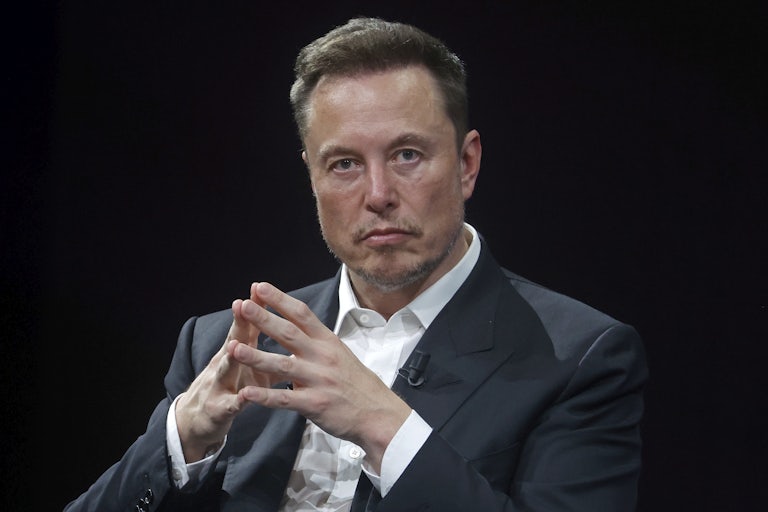
Elon Musk, plotting something stupid in June

Elon Musk is going scorched earth on Media Matters after the news watchdog revealed that X (the social media network formerly known as Twitter) was placing ads from reputable companies alongside antisemitic, pro-Nazi posts.

On Monday, Musk filed a lawsuit against the company in a U.S. District Court in Texas, alleging that the publication defamed his platform by publishing its investigation.

The report’s explosive findings resulted in the mass hemorrhage of some of X’s biggest and markedly safe advertisers, such as Apple, IBM, Disney, Lionsgate, and Paramount.

“​​The overall effect on advertisers and users was to create the false, misleading perception that these types of pairings were common, widespread, and alarming,” the lawsuit reads. “Media Matters hid its manipulations through omissions, deceptive image selections, misrepresentations, and secrecy settings.”

In a legal complaint, the company argued that the Media Matters investigation “exploited” the platform’s features and algorithm in order to “force a situation in which a brand ad post appeared adjacent to fringe content.”

X CEO Linda Yaccarino, who has faced immense pressure to resign as chief executive amid the scandal, said she’s siding with the company. “If you know me, you know I’m committed to truth and fairness. Here’s the truth,” Yaccarino said.

“Not a single authentic user on X saw IBM’s, Comcast’s, or Oracle’s ads next to the content in Media Matters’ article. Only 2 users saw Apple’s ad next to the content, at least one of which was Media Matters. Data wins over manipulation or allegations. Don’t be manipulated. Stand with X.”

On Monday, Texas Attorney General Ken Paxton announced that his office was opening an investigation into the publication’s report, claiming he was “extremely troubled” by allegations that Media Matters had manipulated data on the social media platform.

Missouri Attorney General Andrew Bailey, who introduced an emergency rule earlier this year to ban health care for transgender adults in his state, also joined the legal charge, posting that his team “is looking into this matter.”

“Great!,” responded Musk.

Media Matters appeared unthreatened by the challenge, shrugging off the lawsuit in favor of standing behind its reporting. “This is a frivolous lawsuit meant to bully X’s critics into silence,” Media Matters’ president, Angelo Carusone, told Reuters in an emailed statement.

After Musk initially threatened the lawsuit on Friday, Carusone called Musk a “bully who threatens meritless lawsuits.”

“Musk admitted the ads at issue ran alongside the pro-Nazi content we identified. If he does sue us, we will win,” Carusone said.

Guess Who Just Brought Back Pizzagate?

Days after promoting antisemitism, Elon Musk has moved to another vile conspiracy theory.

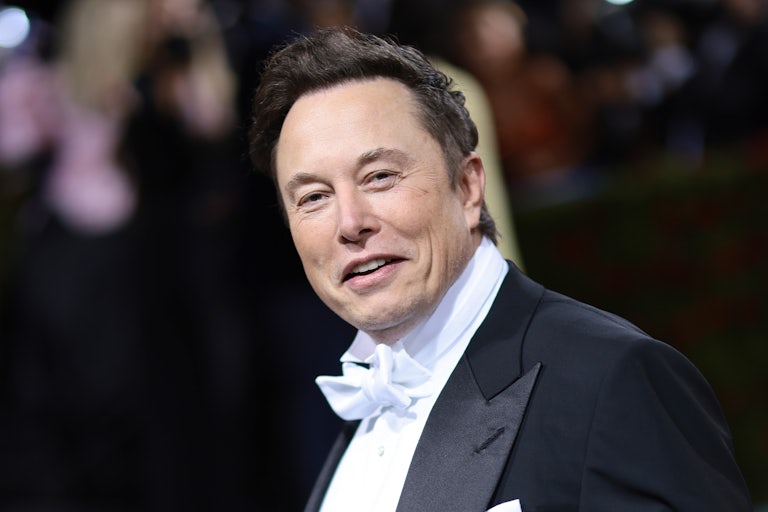
Dimitrios Kambouris/Getty Images for The Met Museum/Vogue

Apparently not satisfied with endorsing one horrific conspiracy theory, Elon Musk on Monday resurrected another: Pizzagate.

In 2016, a man opened fire in the Washington, D.C., restaurant Comet Ping Pong. He believed the “Pizzagate” conspiracy theory that prominent Democrats were running a child sex trafficking ring partly through the pizza restaurant. Pizzagate’s clearest ideological successor is QAnon.

Musk tweeted Monday that “Media Matters is pure evil,” quoting a post that pointed out the media watchdog group was founded by liberal political consultant David Brock. One X (formerly Twitter) user replied that Brock used to date Comet Ping Pong owner James Alefantis.

“Weird,” Musk commented.

Musk’s animosity towards Media Matters is due to a report the group published last week. Media Matters found that X has been placing ads for brands including Apple, Bravo, IBM, Oracle, and Xfinity next to posts that promote Hitler and Nazi beliefs. Multiple major advertisers have yanked their business from X while they look into the report’s findings.

This isn’t the first time Musk has shared a dangerous lie. It’s not even the first time this month: Just last week, an X user posted that Jewish communities have pushed “diabolical hatred against whites,” a neo-Nazi talking point.

Musk replied, “You have said the actual truth.” About an hour later, he tried to claim he was only criticizing the Anti-Defamation League, a Jewish nonprofit Musk has threatened to sue for monitoring hate speech on X.

The Voting Rights Act Is in Big Trouble

Trump-appointed judges are to blame.

Photo by Drew Angerer/Getty Images
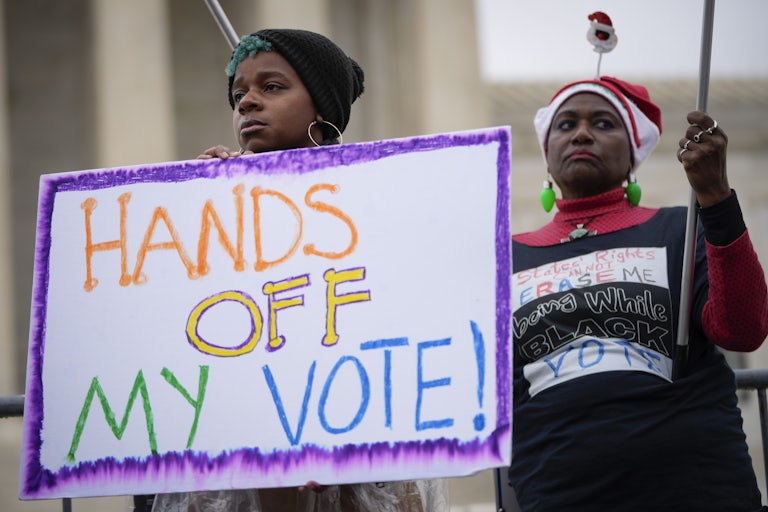
Pro-voting rights protesters outside the Supreme Court in 2022

Two rulings by Trump-appointed judges could gut the Voting Rights Act, dramatically reducing the protections it offers to millions of voters of color.

U.S. District Judge Lee Rudofsky ruled in February 2022 that only the U.S. attorney general, the head of the Justice Department, can bring lawsuits about Section 2 of the act, which forbids voting practices that discriminate based on race. Rudofsky, an appointee of former President Donald Trump, dismissed a case brought by advocacy groups on behalf of Black voters in Arkansas.

The Eighth U.S. Circuit Court of Appeals upheld Rudofsky’s ruling on Monday, with Judge David Stras, another Trump appointee, writing the majority opinion.

“For much of the last half-century, courts have assumed that [Section 2] is privately enforceable,” Stras wrote. “A deeper look has revealed that this assumption rests on flimsy footing.” This suggests that no one had previously bothered to look closely at the Voting Rights Act for more than 50 years, an assertion that simply does not hold up to scrutiny.

Stras was joined by Judge Raymond Gruender, a George W. Bush appointee. Judge Lavenski Smith, another Bush appointee, dissented. He argued that nonfederal individuals should be allowed to bring Section 2 lawsuits until the Supreme Court or Congress formally changes the statute.

If allowed to stand, the two rulings would gut the protections offered by the Voting Rights Act. Civil rights groups, individual voters, and political parties would not be able to challenge discriminatory voting practices. This includes redistricting gerrymandered maps and voter ID requirements.

But Smith’s dissenting opinion pointed to how the case is likely to go. The case is widely expected to be appealed to the Supreme Court. While it’s never clear how the conservative-leaning court will land, the nine justices gave a major hint earlier this year.

The high court ruled in June that Alabama’s Republican-drawn congressional districts discriminated against Black voters under the Voting Rights Act. Chief Justice John Roberts and Justice Brett Kavanaugh joined the three liberal justices for the 5–4 decision. It’s possible they could do so again when the Arkansas case comes before them.

No One Wants to Be in Congress Anymore

Ongoing dysfunction is pushing several lawmakers to retirement.

Chip Somodevilla/Getty
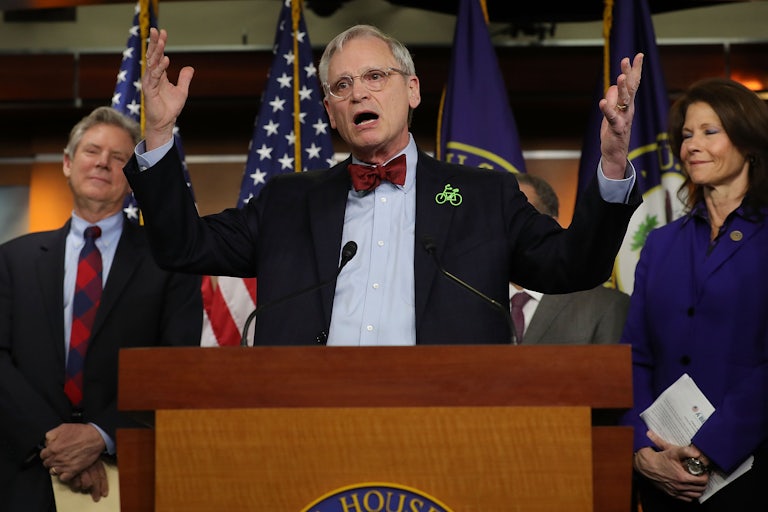
Representative Earl Blumenauer, who announced his retirement last month

A growing number of politicians have decided that the rat race to the highest echelons of government is simply not worth the effort anymore.

Oregon Representative Earl Blumenauer announced his retirement last month, joining 28 other members of the House who’ve recently decided to pull the plug on their legislative careers. Other recent evacuees of Capitol Hill include Texas Representative Michael Burgess and Arizona Representative Debbie Lesko.

The mass desertion follows several weeks of chaos, including historic infighting among the Republican caucus that led to the ousting of former House Speaker Kevin McCarthy, as well as actual fighting between McCarthy and Representative Tim Burchett, one of the members who voted for him to lose the coveted position.

Meanwhile, on the other side of the Capitol Building, Senator Markwayne Mullin threatened to brawl with a committee witness, general president of the International Brotherhood of Teamsters Sean O’Brien.

Amid the high drama, the House has teetered on the brink of a government shutdown several times over the last several months, opting each time to dismiss it with a stopgap spending measure rather than get to work on a bona fide budget. After passing yet another stopgap resolution, parts of the government will run out of funding in mid-January.

So far, 19 Democrats and 10 Republicans have decided to disconnect from the House, though out of that number, 16 members are planning to run for separate offices, reported The Washington Post.

That may not be an atypical resignation number for any year, but some politicians argue that the value of those retirements, which constitute several senior members and signify a sizable loss of expertise, will be felt for years to come.

In 2021, almost 46 percent of House members had served for less than five years, according to data from the Center for Effective Lawmaking—up 12 percent from nearly two decades prior.

“It’s not the quantity of retirements. It’s the quality,” former Representative Steve Israel told the outlet. “These are people who really understand how to get things done.”

But the recent slew of resignations could just be the tip of the iceberg, reported the Post, which hypothesized that another wave could be forthcoming after the holidays.