Breaking News
Breaking News
from Washington and beyond

Texas Just Passed One of the Country’s Most Racist Immigration Laws

The law sets the state up for a standoff with the federal government.

Brandon Bell/Getty Images

Opponents both domestic and abroad have come out in full force against Texas’s latest immigration law, which gives local judges the authority to deport immigrants illegally crossing the U.S.-Mexico border.

The law, which was signed by Governor Greg Abbott on Monday, is the amalgamation of Texas Senate Bill 3 and Texas Senate Bill 4. The first-of-its-kind policy appropriates $1.5 billion in border funding and effectively makes crossing the Texas-Mexico border a state crime, creating a new state misdemeanor for immigrants who enter or reenter the state illegally, with violations of the new crimes punishable by up to two years. The law also gives local and state police the authority to arrest immigrants whom they suspect of having unlawfully crossed into the state, as opposed to federal agencies.

On Tuesday, the American Civil Liberties Union filed suit against the state in an effort to block the state-specific anti-immigration effort, arguing that the bill is unconstitutional and defies federal immigration law, according to the lawsuit.

“Governor Abbott’s efforts to circumvent the federal immigration system and deny people the right to due process is not only unconstitutional but also dangerously prone to error, and will disproportionately harm Black and Brown people regardless of their immigration status,” Anand Balakrishnan, a senior staff attorney at the ACLU, said in a statement.

Abbott has responded that the state is willing to take that lawsuit all the way up to the Supreme Court if necessary, reported Politico.

But they weren’t the only ones angered by the state’s creeping regulations. The nation’s southern neighbor also came out in fierce opposition to the newly minted law, promising to file a formal challenge.

“The foreign ministry is already working on the process to challenge this law,” Mexican President Andrés Manuel López Obrador said on Tuesday, according to Reuters.
Tommy Tuberville Criticizes Trump ... for Not Sounding Even More Like Hitler

The Alabama senator wants the former president’s rhetoric about migrants to be even crueler.

Kevin Dietsch/Getty Images
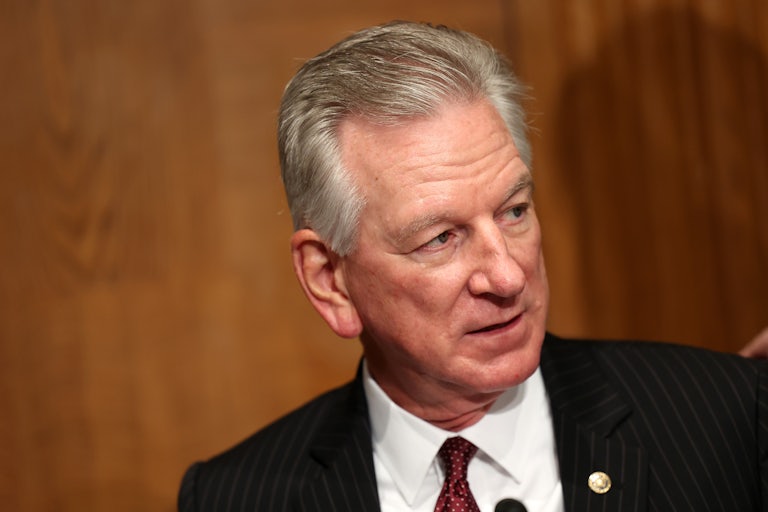
Tommy Tuberville

Senator Tommy Tuberville on Tuesday criticized Donald Trump’s comments about migrants—for not being cruel enough.

Trump dived deeper into fascism over the weekend, saying Saturday that immigrants are “poisoning the blood of our country.” When asked about Trump paraphrasing Adolf Hitler, Tuberville merely backed him up.

“I’m mad he wasn’t tougher than that,” Tuberville told reporters. “Because have you seen what’s happening at the border? We’re being overrun. They’re taking us over. So a little bit disappointed it wasn’t tougher.”

In addition to being incredibly xenophobic and factually inaccurate, Tuberville’s response is deeply ironic. Complaints about not having strong enough protections for the country are pretty rich coming from the man who spent the past year single-handedly wrecking U.S. military readiness.

Trump also said over the weekend that he would use federal law enforcement funds to combat a “military invasion” at the southern border.

“Drugs, criminals, gang members, and terrorists are pouring into our country at record levels. We’ve never seen anything like it. They’re taking over our cities,” Trump said Sunday.

He then promised to “shift massive portions of federal law enforcement to immigration enforcement, including parts of the DEA, ATF, FBI, and DHS.”

Tuberville, unfortunately, is the only Republican senator so far to take an explicit stance on Trump’s comments. His fellow GOP senators have opted instead for lukewarm rebukes. Senator Roger Wicker said he “certainly wouldn’t have said that,” and Senator Thom Tillis called Trump’s words “unhelpful.”

This Horrible Congress Is Even Worse Than You Thought

The 118th Congress passed just a couple dozen laws in 2023.

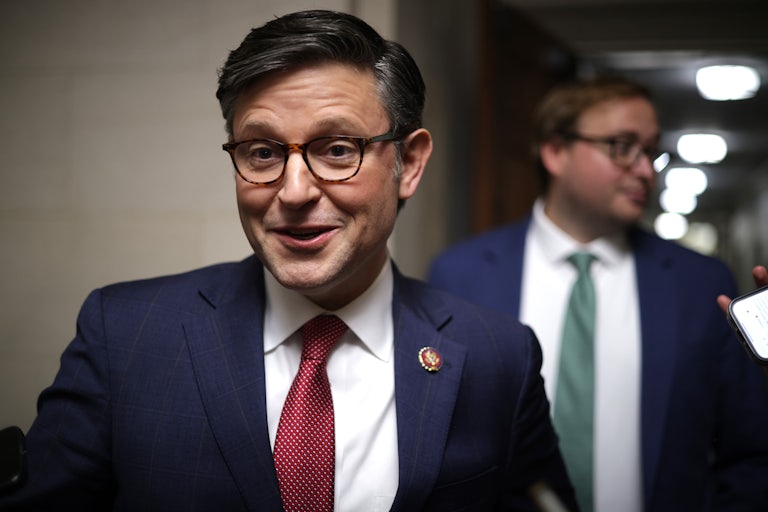
Mike Johnson smiles.
Alex Wong/Getty Images
House Speaker Mike Johnson

Congress had a no-good, very bad year.

As the 118th Congress winds down the first of its two-year session, it’s abundantly clear that this latest iteration has come up shockingly short, passing just 20 bills through both chambers, according to Quorum legislative data analyzed by Axios. Four additional bills are currently waiting Biden’s signature.

That’s drastically lower than previous congresses, which tallied far above 50 bills in their first year and typically passed between 300 and 450 laws.

This year’s congressional report card sank below even some of Congress’s most unproductive years, reported Axios, including the 104th, 112th, and 11th Congresses, which saw Republicans controlling the House or Senate during Bill Clinton and Barack Obama’s presidencies. Still, those sessions managed to pass between 70 and 73 laws.

The abysmal productivity is thanks, in large part, to historic divisions and tensions among Republicans, who are still holding onto a slim majority, effectively necessitating unanimous consent to pass sections of their agenda.

The House has also failed to come up with budgetary solutions as the government stares down another looming government shutdown just weeks after it comes back from Christmas break.

The majority of bills that were able to slip through the cracks this year were unsurprisingly uncontroversial. Those included measures to rename Veterans Affairs clinics and to mint a coin commemorating the 250th anniversary of the Marine Corps, noted Axios.

Republicans also managed to waste the better part of two months over the last year, unable to pick a leader. Given the upcoming election, it’s unlikely that next year will prove more productive.

The GOP also chose to waste time on the impeachment of President Joe Biden, which even Republican lawmakers admitted failed to tie the president to any wrongdoing, let alone illegal activity.

The Big Problem With Trump’s Call for a Chip Roy Primary Challenge

The deadline to file to run against Roy passed last week.

Anna Moneymaker/Getty Images
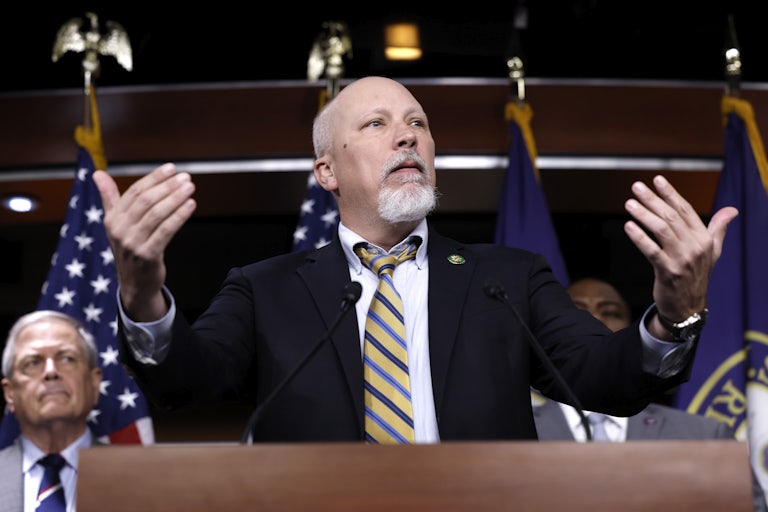
Representative Chip Roy in 2020

Donald Trump wants someone to challenge Texas Representative Chip Roy in the primary.

Although Roy sits comfortably in the House of Representatives’ far-right wing, the Freedom Caucus member and Trump have locked horns a few times before. Trump took aim at Roy on Monday in a classic late-night social media post.

“Has any smart and energetic Republican in the Great State of Texas decided to run in the Primary against RINO Congressman Chip Roy. For the right person, he is very beatable,” Trump wrote on Truth Social. “If interested, let me know!!!”

Roy is currently running unopposed in the Republican primary. And since the deadline to file candidacy was last week, it looks likely to stay that way.

Trump and Roy have bumped heads a few times since the latter took office in 2019. Roy voted against overturning the 2020 election results. A year later, when Roy ran for GOP conference chair, Trump endorsed Representative Elise Stefanik. Stefanik was elected.

Roy was also one of the first backers of Trump’s 2024 primary opponent, Ron DeSantis. Roy first endorsed DeSantis in March, before the Florida governor had even officially declared his candidacy.

Once touted as Trump’s successor, DeSantis failed to pick up steam and is trailing Trump badly in the polls. But that clearly doesn’t mean Roy’s continued support for DeSantis doesn’t irk Trump. It’s possible that two years from now, the Texas representative will face a challenge from a Trump-backed candidate—and that candidate could dethrone him. But for now, his seat is very safe.

Biden’s Young Voter Problem Just Got Even Worse

The incumbent’s tanking poll numbers might keep voters at home next November.

Drew Angerer/Getty Images

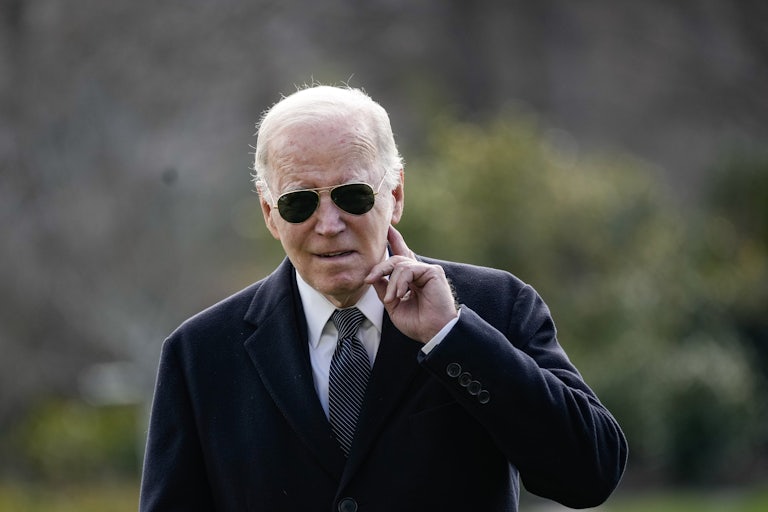
Young voters are proving decidedly less interested in a 2024 Biden win than they were four years ago.

A New York Times/Siena College poll published Tuesday indicates that most young voters are leaning toward voting for Donald Trump, with the indicted former president pulling 49 percent of the vote from constituents aged 18 to 29, with Biden at just 43 percent. That’s a stark contrast from July, when young voters preferred Biden by as much as 10 percentage points.

The difference is likely due to the president’s handling of the conflict in Gaza, in which Biden has been a staunch ally to Israel. That’s resulted in a 72 percent disapproval rating within the same age bracket, according to the poll. However, faced with Trump on the other side of the ballot, those voters say they may be more likely to stay home than turn up to the voting booths.

“I don’t want to vote for someone who is not aligned with my own personal values, as Biden has shown he is not when it comes to Gaza,” Colin Lohner, a 27-year-old software engineer in San Francisco, told The New York Times. “Do I vote for Biden or do I not vote at all? That’s really difficult, because if I don’t vote for Biden, I open up the possibility that Trump will win, and I really do not want that.”

So far, the conflict has killed more than 20,000 Palestinians and displaced 1.9 million people living in the Gaza Strip—roughly 90 percent of its population—since the war began on October 7.

The dwindling poll numbers are an alarming difference for the beleaguered president, who needed the support of young and minority voters to clinch his 2020 bid for the White House. Biden has voiced his own concern, reportedly marking his favorability ratings as a known issue in a closed-door White House meeting with top aides the day before Thanksgiving.

At the time, Biden was neck and neck in general election polls with GOP front-runner Donald Trump, with Trump predicted to win by a hair with 43 percent of the vote against Biden’s 42 percent, according to a Morning Consult poll.

And yet, the president is particularly irked that voters are not rewarding him for low unemployment figures and a humming economy that has defied predictions of a looming recession. As of December 14, Biden trailed eight points behind the oft-indicted former president in a national survey, predicted to gain just 35 percent of the vote against Trump’s 43 percent, according to a HarrisX/Harris poll.