Breaking News
Breaking News
from Washington and beyond

Sotomayor Asks One Damning Question in Supreme Court Homelessness Case

The Supreme Court is considering how far cities can go in banning homeless people from sleeping outside—and Justice Sonia Sotomayor simplified the entire case to a brilliant hypothetical.

People protest outside the Supreme Cour twith signs that read "Housing not handcuffs"
SAUL LOEB/AFP/Getty Images

The Supreme Court on Monday heard arguments on perhaps the most consequential case on homeless policy in decades, weighing how far cities can go in criminalizing people for sleeping outside.

And liberal Justice Sonia Sotomayor kicked things off with a particularly damning hypothetical.

Under a law punishing people for sleeping outside, would people who stargaze outside not be punished? What about people who fall asleep on the beach? Or babies in public with blankets over them?

Sotomayor’s line of questioning in City of Grants Pass, Oregon v. Johnson highlighted the obvious flaws in the 2019 law that the court is considering. The town of Grants Pass, which has no public homeless shelters, effectively banned homelessness by imposing escalating fines starting at $180 on those who sleep outside. One of the original plaintiffs in the case against the city had over $5,000 in penalties before she died.

The Supreme Court’s decision in this case will determine whether localities can criminalize homelessness by punishing those who sleep out on streets using tents, blankets, or even a piece of cardboard. The court must weigh if doing so when no beds are available violates the Eighth Amendment and constitutes cruel and unusual punishment.

And like Sotomayor, the other liberal justices weren’t so impressed.

The Grants Pass legal team tried to argue that homelessness is “conduct,” something someone does, rather than “status,” something that someone is. But justice Elena Kagan pushed back saying matter of factly “homelessness is a status, it’s a status of not having a home.”

“Sleeping is a biological necessity,” she added. “It’s sort of like breathing, you could say breathing is conduct too but presumably you would not think it’s okay to criminalize breathing in public.” For a homeless person who has no place to sleep, Kagan continued, sleeping in public is the same as breathing in public.

“It seems both cruel and unusual to punish people for acts that constitute basic human needs,” Justice Ketanji Brown Jackson told lawyer Theane Evangelis, whose previous legal work for Uber and Grubhub has been described as “keeping the wheels of the gig economy turning.”

As the hearing continued, both Sotomayor and Jackson became increasingly incensed with Evangelis, who complained about the crime and unsanitary nature of unsheltered encampments, which she called harmful and dangerous.

“Suppose the city decided that it was going to execute homeless people... It would solve the problems that you are talking about,” Jackson quipped.

“Where do we put them if every city, every village, every town lacks compassion and passes a law identical to this, where are they supposed to sleep?” asked Sotomayor. “Are they supposed to kill themselves not sleeping?”

Evangelis continued that homelessness is a difficult and complicated problem.

But as Sotomayor responded: “What’s so complicated about letting someone somewhere sleep outside with a blanket if they have nowhere to sleep?”
First Witness in Trump’s Hush Money Trial Could Wreck His Whole Case

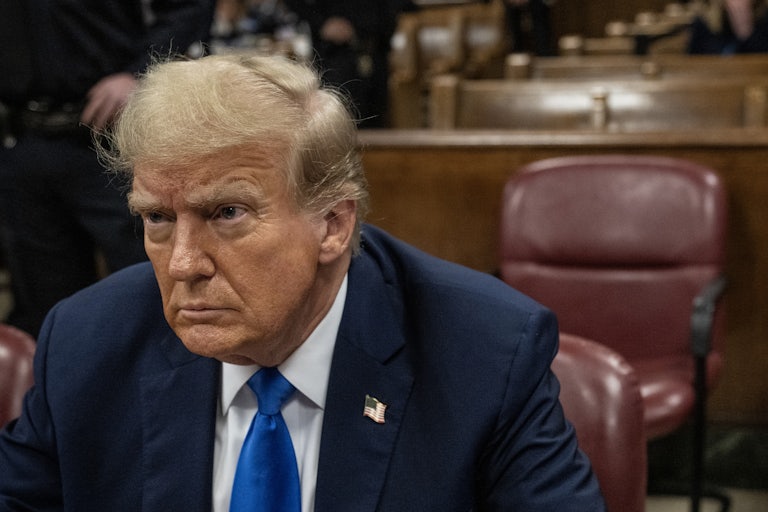
Prosecutors called publishing executive David Pecker as their first witness.

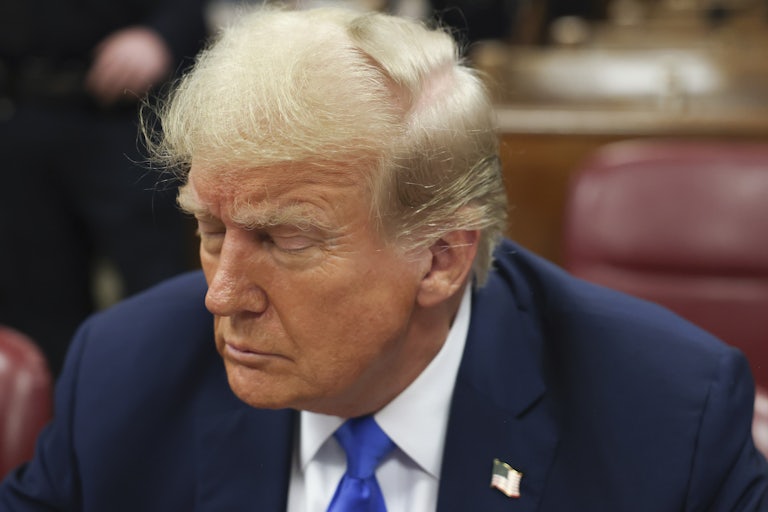
Donald Trump sits with his eyes closed
Yuki Iwamura/Pool/Getty Images

“The people call David Pecker”—the former publisher of the National Enquirer and former CEO of its parent company, American Media Inc.

Pecker, the first witness in Donald Trump’s first criminal trial and an old friend of the former president, took the stand on Monday. In brief testimony, he started detailing a media coverage scheme handcrafted between Trump, Trump’s former fixer Michael Cohen, and himself.

In opening statements just minutes prior, Manhattan district attorney prosecutor Matthew Colangelo proclaimed that “The National Enquirer ran headline after headline that extolled the defendant’s virtues.” Colangelo noted that the Enquirer also “ran stories attacking Mr. Trump’s political opponents” such as Ben Carson and Ted Cruz.

Pecker participated in an August 2015 meeting with Cohen and Trump to arrange the Enquirer’s catch-and-kill campaign, buying potentially damaging stories about Trump and his affairs with women with the intent to never publish them. The trio also allegedly discussed adult film actress Stormy Daniels, who had an affair with Trump after meeting him at a golf tournament in 2006, shortly after Trump’s wife Melania had given birth to their son Barron. Cohen later paid Daniels $130,000, allegedly at Trump’s behest, to keep the entanglement under wraps—but it wasn’t the first time Pecker was involved in a catch-and-kill scheme.

The Enquirer had also purchased rights to the story of another one of Trump’s alleged mistresses—former Playboy model Karen McDougal—for $150,000, in order to ensure the story would never see the light of day.

Pecker’s testimony on the stand offered some initial insights into the machinations of the Enquirer, including a key detail that all big stories pertaining to celebrities had to go through him.

“We used checkbook journalism and we paid for stories,” Pecker testified. “I gave a number to the editors that they could not spend more than $10,000 to investigate, produce or publish a story.”

Pecker agreed to cooperate with prosecution back in 2018, and is expected to continue his testimony on Tuesday. And the details he provides could be damning for the former president.

Trump is accused of using Cohen to sweep an affair with Daniels under the rug ahead of the 2016 presidential election. The trial is expected to last several weeks. He faces 34 felony charges in this case for allegedly falsifying business records with the intent to further an underlying crime. Trump has pleaded not guilty on all counts.

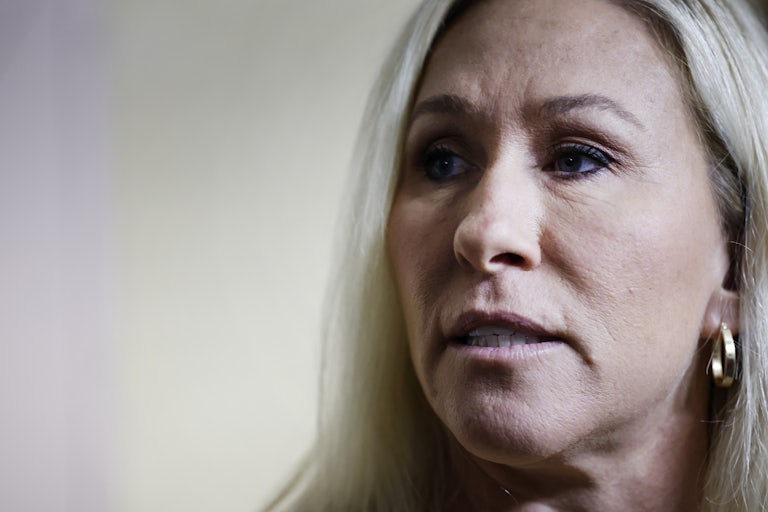
Conservatives Quickly Turn Against “Idiot” Marjorie Taylor Greene

The Georgia Republican is fast falling out of favor for her opposition to the Ukraine aid bill.

Marjorie Taylor Greene looks to the side
Anna Moneymaker/Getty Images

Representative Marjorie Taylor Greene’s failed fight to end aid to Ukraine, and her sort-of-serious crusade against House Speaker Mike Johnson, has cost her the support of right-wing media.

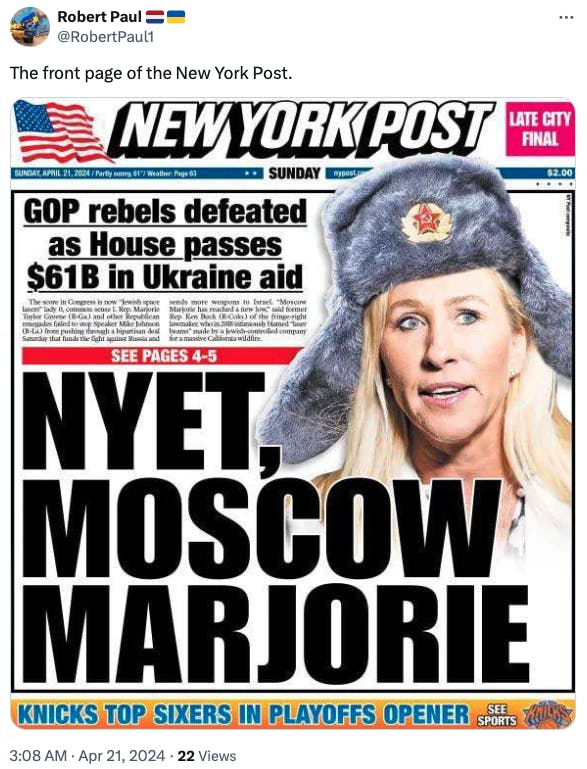
The Sunday front page of The New York Post, owned by the conservative Murdoch family, was the latest outlet to attack Greene, invoking the “Moscow Marjorie” nickname coined by former representative Ken Buck.

Screenshot of a tweet
Screenshot

Fox News, another arm of the Murdoch media empire, had already taken aim at the Georgia Republican last week, with columnist Liz Peek calling her an “idiot” and saying she needs to “turn all that bombastic self-serving showmanship and drama queen energy on Democrats.” This follows an editorial last month from The Wall Street Journal, also in the Murdoch portfolio, that called Greene “Rep. Mayhem Taylor Greene” and accused her and her allies of being “most interested in TV hits and internet donors.”

Even a non-Murdoch outlet is on the attack, as conservative Las Vegas Review-Journal columnist Debra Saunders demanded to know “who put Marjorie Taylor Greene in charge?”

It was only a matter of time before Greene’s antics cost her friends in the world of conservative media. She has an old reputation for peddling crazy conspiracy theories; she’s been in a feud with fellow far-right Representative Lauren Boebert for quite a while; and she has parroted Russian talking points on Ukraine, to the point that even Russian state television is gushing over her. Over the weekend, a Russian state TV host described Greene as “a real beauty. She is a blond who wears white coats with a fur collar. She’s demonstrably heterosexual.”

Meanwhile, Johnson successfully passing aid to Ukraine shows that he is able to deflect her attacks, despite the GOP’s razor thin-majority in the House. If Greene keeps losing allies, he won’t have to worry about her at all.

Trump Suffers a Major Loss Just Minutes into Hush-Money Trial

Some of the former president’s actions are coming back to bite him.

Donald Trump looks forward
Victor J. Blue/Pool/Getty Images

Donald Trump won’t be getting his way in his New York hush money trial—at least, not without consequences.

Presiding Judge Juan Merchan decided Monday that prosecutors can cross-examine the former president on prior judgements and gag order violations. This is only relevant if Trump takes the stand, but given he has said he would “absolutely” testify in the trial, he seems pretty eager.

But his legal team might not allow him to, especially considering the previous times Trump took the stand in an effort to change the narrative behind prior judgments.

Last week, the district attorney’s office signaled that they would be interested in bringing up a slew of Trump’s prior lawsuits to paint a picture of an untrustworthy man. Those cases include the New York civil fraud trial in which Trump was ordered to pay nearly half a billion dollars to the state, and the defamation trials brought against him by E. Jean Carroll, who won a payout of $83.3 million.

So far, Merchan has decided that he will allow questioning pertaining to Trump’s defamation of E. Jean Carroll (he did not mention the sexual assault ruling), the New York bank fraud trial, a 2018 case that led to the dissolution of the Trump Foundation over financial irregularities, and Trump’s repeat violations of the gag order issued by Judge Arthur Engoron after he refused to stop attacking the judge’s law clerk.

That last bit is noteworthy, considering that Trump has already teetered several times on violating another gag order issued in this trial, using his Truth Social account to disparage witnesses, court staff, and their family members, including Merchan’s daughter.

Merchan told the court Monday that he had “greatly curtailed” what elements of Trump’s legal history could be questioned, and warned the GOP presidential nominee that the decision was “a shield and not a sword” to which his testimony could become a “door to questioning that has otherwise been excluded,” according to The New York Times.

Read more about the district attorney's request:

Did Trump Blow Up His Hush-Money Trial Before It’s Even Begun?

There might be a fatal flaw in the former president’s defense arguments.

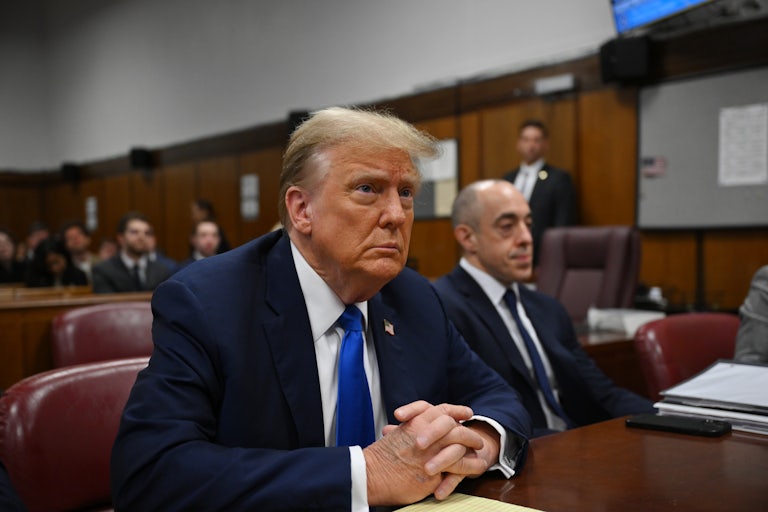
Donald Trump sits at a table with his hands folded
Angela Weiss/Pool/Getty Images

Donald Trump’s legal defense in his hush-money trial may be doomed before it begins.

Trump is on trial for 34 felony counts for allegedly falsifying business records after his lawyer and fixer at the time, Michael Cohen, paid $130,000 to silence adult film actress Stormy Daniels from speaking about her affair with the former president. Trump claims that those payments were simply part of Cohen’s ordinary fees.

Ex-prosecutor Andrew Weissman wrote on X (formerly Twitter) Sunday that even if Trump tries to claim that those payments were actually legal fees, there are notes made at the time that are more specific.

“Trump’s latest defense, which we will see at trial I’m sure, that the 34 business records were not false because they were legal payments (reimbursing his lawyer Cohen for making the $130,000 hush money payment) is BELIED by contemporaneous notations that the payments were for ongoing legal services rendered during a certain month,” Weissman explained. “Oops.”

But Trump’s legal team isn’t exactly on the ball, as all of their blatant attempts to delay proceedings in this trial have been shot down. One attorney, Alina Habba, has claimed that Trump’s being required to attend every day of his hush-money trial, per state law, is a violation of due process, and has tried to excuse away his dozing off in court by saying he “reads a lot.”

Presiding Judge Juan Merchan has also refused to let the team know who the prosecution’s first three witnesses are, lest Trump try to attack the witnesses on social media.

This is Trump’s first criminal trial, and he’s under a gag order that prevents him from speaking about court staff or their families. It hasn’t prevented him from attacking about Merchan’s daughter, though, and he has a contempt of court hearing this week about it.

Now, as jury selection ends and his trial begins in earnest, the proceedings aren’t going to be an easy experience for the former president. The witness list includes his former employees, his White House aide Hope Hicks, Daniels, and his former fixer Cohen. If Cohen’s words are anything to go by, Trump and his lawyers have reason to “be worried.”