Breaking News
Breaking News
from Washington and beyond

The Texas Supreme Court Tells Women They Can Go Die

The court rejected a lawsuit challenging the state’s abortion ban.

People hold up pro-abortion rights protest signs
Montinique Monroe/Getty Images

The Texas Supreme Court unanimously rejected a challenge to the state’s abortion laws Friday, overturning a lower court’s decision that would have allowed women within Texas to actually access abortions granted within the confines of the state’s ban.

The case, Zurawski v. Texas, began with five women and eventually grew to represent 20 women and two doctors. It became the strongest challenge to the constitutionality of the state’s myriad abortion restrictions implemented since Roe v. Wade was overturned in 2022.

The Center for Reproductive Rights, which brought the suit last year, argued that while the state’s laws technically left room for abortions in urgent circumstances, they were also so vague that they practically restricted all medical practitioners from actually considering the procedure as an option. Specifically, people could undergo abortions during complicated pregnancies so long as their doctor made a “good faith judgment” that it was medically necessary.

But opponents to the laws have argued that “good faith” is too subjective for language determining medical access—and could potentially open doctors up to lawsuits brought by anyone who didn’t believe the procedure was required. The court, however, did not see that complication.

“A physician who tells a patient, ‘Your life is threatened by a complication that has arisen during your pregnancy, and you may die, or there is a serious risk you will suffer substantial physical impairment unless an abortion is performed,’ and in the same breath states ‘but the law won’t allow me to provide an abortion in these circumstances’ is simply wrong in that legal assessment,” wrote Justice Jane Bland in the court’s opinion.

The ruling effectively leaves people in need of abortions within the state just two options: either leave, or risk death.

“Sadly, what we know is that there are anti-abortion advocates who will always question [a doctor’s] decision,” Molly Duane, senior counsel for the Center for Reproductive Rights, told The Texas Tribune. “I don’t know how all of this will actually function in practice … the fact that true exceptions do not exist in practice will continue to be the norm.”

The brief opinion made no mention of the 20-plus women who were represented by the lawsuit and who individually suffered under Texas’s nearly airtight abortion restrictions. Lauren Miller, a Dallas mother who was forced out of state after learning that one of her twin fetuses had a complication that threatened her health as well as the health of her other child, told the Tribune that the decision felt like a “gut punch.”

“I read the ruling. I felt like I had missed something. And so I immediately reread it, and I realized what was missing in those pages was us. We weren’t there. We didn’t exist,” Miller told the publication.

One member of the court, Justice Brett Busby, left enough wiggle room in his concurring opinion for a broader challenge to the law. But legal challenges are time-consuming, and in the meantime, more patients could be forced to wait until their symptoms are life-threatening before doctors can offer them abortions.

Texas has recently turned up the heat on its anti-abortion policies, forcing the issue into the center of the Lone Star State’s politics. Over the weekend, a policy agenda proposed by the GOP convention in San Antonio included calls for legislation that would transform the fetal personhood ideology into law, a move that would effectively categorize any person receiving an abortion at any stage as a murderer.
Mike Johnson Begs Supreme Court to Save Dear Leader Trump

House Speaker Mike Johnson is calling on the Supreme Court to make Donald Trump’s guilty verdicts disappear.

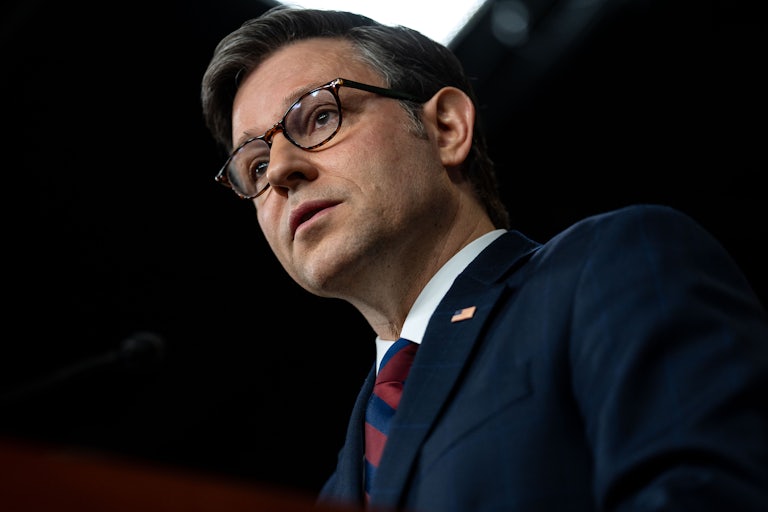
Mike Johnson speaking
Kent Nishimura/Getty Images

House Speaker and fascist elf Mike Johnson called in to Fox and Friends on Friday to express his desire for the Supreme Court to “step in” and overturn the criminal convictions handed down by a Manhattan jury against Trump on Thursday.

During the segment, which Johnson published to his official YouTube channel, Johnson intimated that he’s spoken with Supreme Court justices who are “deeply concerned” about the criminal justice system functioning properly for once. “I think that the justices on the court—I know many of them personally—I think they are deeply concerned about that, as we are. So I think they’ll set this straight.”

Johnson, either from wishful thinking or showing his hand, shifted from what he thinks and hopes the Supreme Court will do to essentially speaking on behalf of the court’s conservative bloc, promising viewers, “This will be overturned, guys, there’s no question about it; it’s just going to take some time to do it.”

Trump has plans to appeal his conviction, after issuing a variety of false statements about the trial over its duration. Per New York penal law, he has 30 days to submit the appeal—which would come just weeks before his July 11 sentencing hearing. That appeal would begin at the New York Court of Appeals. If that state-level court denies his appeal, Trump can petition to ask the Supreme Court to review the case. Considering the conservative majority on the court, with its three justices directly appointed by Trump, they’ll likely hear the case and potentially overturn the conviction. How long that process takes can range from months to years.

More on how Trump is reacting to this trial:

Trump Loses It Like Never Before in Wildly Incoherent Press Conference

It was nearly impossible to make out what Trump was saying in this press conference about his guilty verdict.

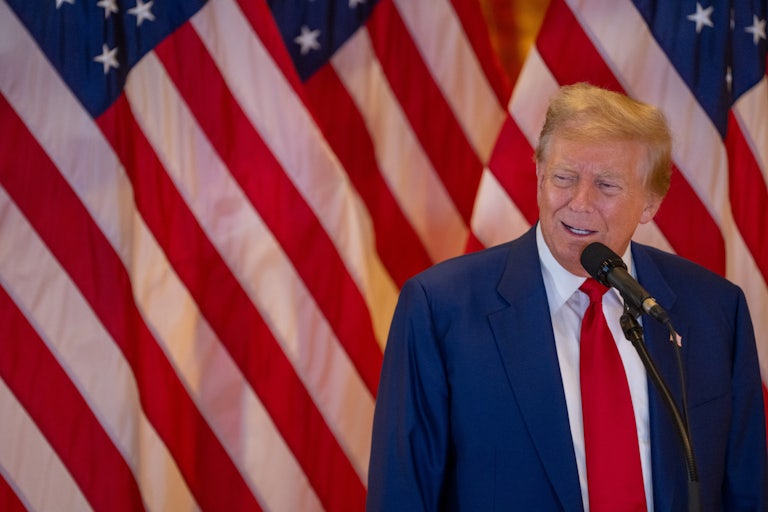
David Dee Delgado/Getty Images

At a press conference Friday, Donald Trump ranted and raved about his displeasure at being found guilty of 34 felony charges in his hush-money trial.

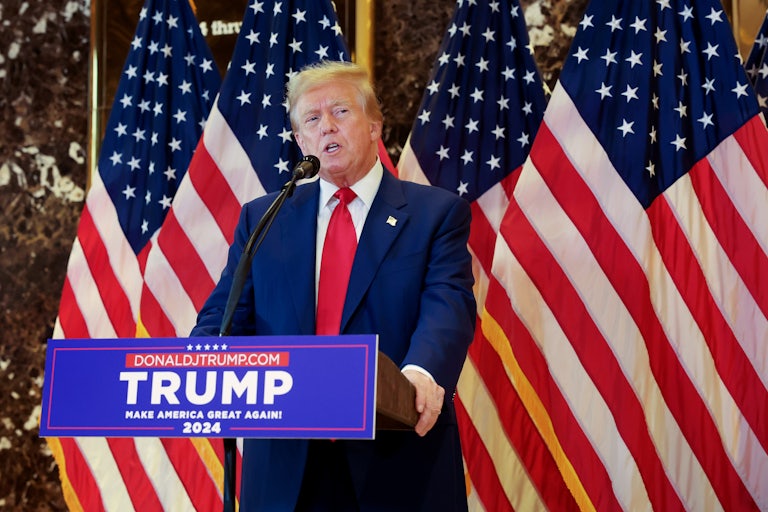
Standing in front of a line of flags at Trump Tower in New York, Trump took aim at Michael Cohen, Judge Juan Merchan, Manhattan District Attorney Alvin Bragg, Democrats, and just about anyone who he thinks wronged him, violating his gag order in the process. But his biggest target might have been the English language.

At times, his words were hard to follow, as the first convicted felon former president went off on tangents with sentences with no clear end.

In one bizarre sentence, he demonstrated a profound misunderstanding of the word “literally” by claiming witnesses “for our side” were “literally crucified by this man who looks like an angel, but he’s really a devil,” referring to Merchan.

This could very well be another sign of cognitive decline from the Republican presidential nominee, exacerbated by possibly the worst news he’s ever received. Last week, at a Bronx rally, he bragged about being able to put on his pants, and two weeks ago, he seemed to freeze while speaking at the NRA’s annual convention. His rant on Friday included an attack on immigrants who speak incomprehensible languages, a nod to similar bizarre remarks he made at the southern U.S. border in February.

If Trump hadn’t also explained why he didn’t testify at this trial, anyone watching his remarks would have realized why themselves.

Spineless Trump Admits Why He Was Too Afraid to Testify

Donald Trump chose not to testify in his hush-money trial—and he’s finally confessing why.

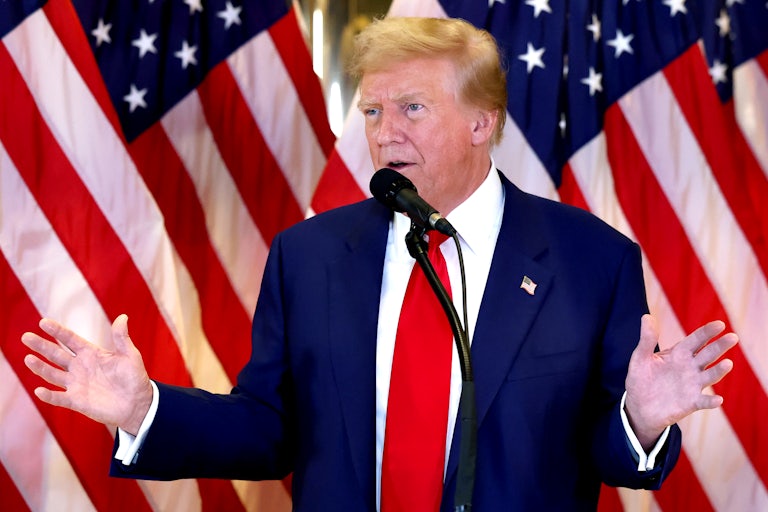
Donald Trump stands in front of U.S. flags speaking before a mic, hands splayed out
Yuki Iwamura/Bloomberg/Getty Images

Donald Trump claims he wanted to testify in his hush-money trial—but he was afraid he’d be found guilty of more crimes. Trump’s statements came during a meandering, often incoherent tirade in front of the press at Trump Tower on Friday, the day after he was convicted of 34 felonies by a Manhattan jury.

“I would have testified. I wanted to testify,” he said one day after his first criminal trial came to a close.

“The judge allowed them to go into everything I was ever involved in–not this case–everything I was ever involved in, which is a first. In other words, you could go into every single thing that I ever did [and ask], ‘Was he a bad boy here? Was he a bad boy there?’” he continued, seeming to imply that if the prosecution really dug into his past they would have found more crimes.

But you would have been, you would have said something out of whack, like, ‘It was a beautiful sunny day,’ and it was actually raining out,” Trump continued, providing a false example of perjury, before seemingly word-associating to talk about the pro-Trump gathering outside Manhattan Criminal Court.

Trump opened his presser with claims that witnesses for Trump’s defense were “literally crucified” by Manhattan District Attorney Alvin Bragg, who Trump described as looking “so nice and soft” and that he “looks like an angel, but he’s really a devil” before moving on to his boilerplate racist rant about migrants.

During the trial, Trump falsely claimed he was prohibited from testifying as a result of a gag order restricting his public statements after he incited harassment against judge Juan Merchan and Merchan’s daughter. Trump allies opposed him testifying, voicing concerns about his tendency to ramble.

Felon Trump Drives Up Jail Time Odds With Every Word

The former president’s gag order is still in place—and he just violated it.

Donald Trump speaks into a microphone
Spencer Platt/Getty Images

The day after Donald Trump became the first former president to be convicted of a felony, he rushed to Trump Tower to hold a press conference proclaiming his innocence. But in doing so, he also immediately violated his gag order.

In a 30-minute speech on Friday, Trump slammed his former fixer Michael Cohen as slimy and untrustworthy.

“Again, if I wrote down and paid a lawyer—and by the way, this was a highly qualified lawyer. Now, I’m not allowed to use his name because of the gag order,” Trump said. “But, you know, he’s a sleazebag.”

“Everybody knows that,” he continued. “Took me a while to find out, but he was effective. He did work.”

Trump’s gag order—which has not yet been lifted—bars him from publicly attacking the court staff, witnesses, or jurors involved in the case. And he’s already been hit with repercussions for previous transgressions. Earlier this month, Judge Juan Merchan ruled that Trump would have to pay $10,000—the maximum penalty of $1,000 per violation—for continually breaking the order.

But that ruling came with an added threat that is still on the table. Since the court could not craft an “appropriate” financial penalty for a deep-pocketed defendant like Trump, Merchan wrote that, in order to “protect the dignity of the judicial system and to compel respect for its mandates,” the court “must therefore consider whether in some instances, jail may be a necessary punishment.”

Trump is due to be sentenced on July 11, just days before the Republican National Convention. And his words could come back to haunt him in that hearing: In criminal cases, judges often consider a defendant’s level of remorse (or lack thereof) when deciding a sentence.

Meanwhile, Cohen responded Friday in real time, posting on X that “Trump’s press conference was nothing shy of a batshit crazy avalanche of broken brain word manure,” while tagging his nickname for his former boss: “#VonShitzInPantz.”