Breaking News
Breaking News
from Washington and beyond

Infowars Receives More Bad News From Supreme Court

Conspiracy theorist Owen Shroyer lost a far-flung appeal in his January 6 case. Cue the crocodile tears.

Owen Shroyer closeup (he makes a weird face and is probably wearing a black cowboy hat)
Sergio Flores/Getty Images

Expect more crocodile tears from Alex Jones: Right-wing conspiracy theorist and Alex Jones underling Owen Shroyer lost his petition for the Supreme Court to overturn the conviction for his participation in the January 6 Capitol riot on Monday, according to Supreme Court documents reviewed by Politico reporter Kyle Cheney.
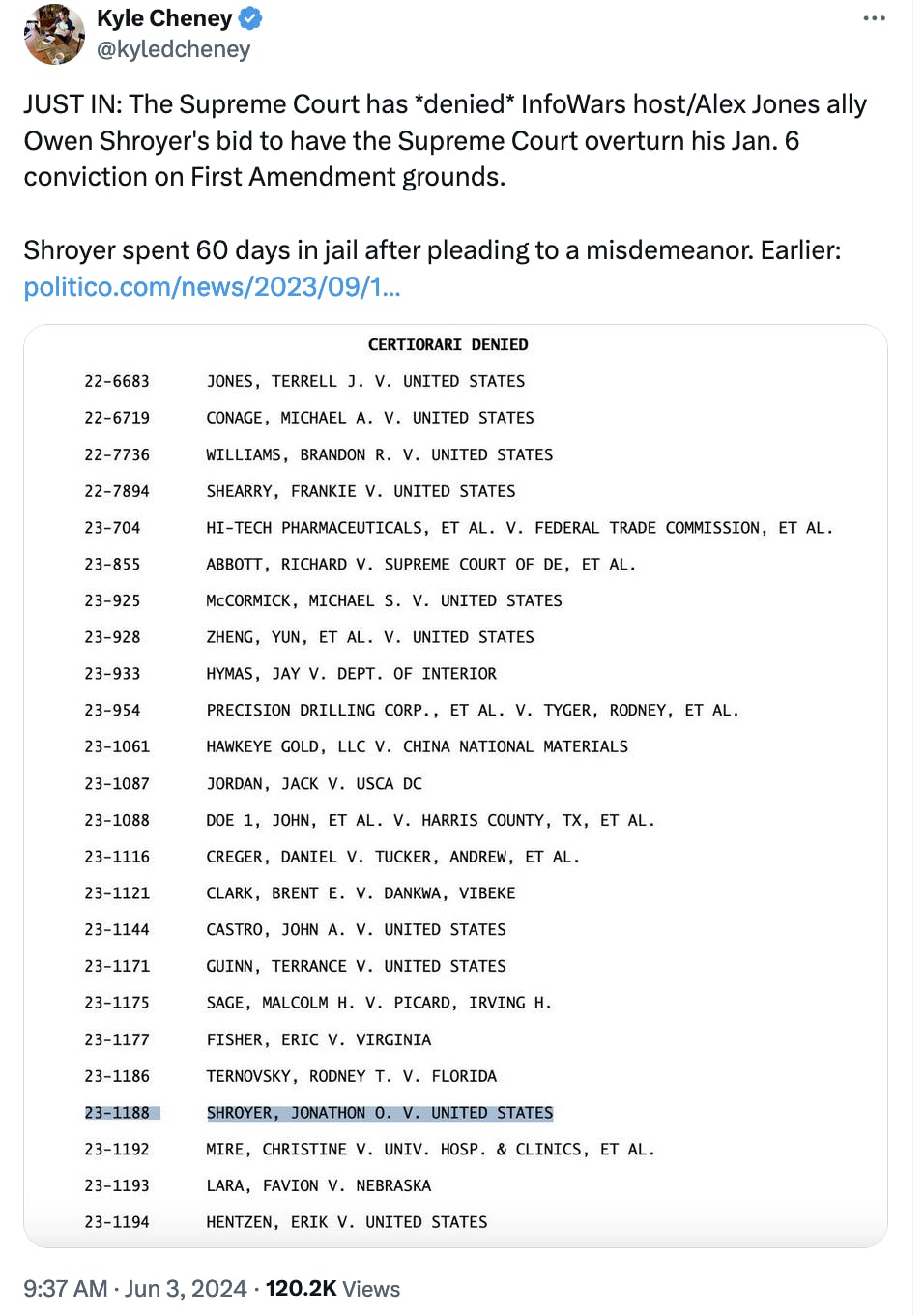
Tweet screenshot - Kyle Cheney

Shroyer, who hosts a show on far-right website Infowars, was originally sentenced to a mere 60 days in federal prison for misdemeanor charges of entering restricted grounds and leading the mob in chants outside the U.S. Capitol ahead of the January 6 Capitol riot—charges to which he pleaded guilty. Prior to January 6, Shroyer used the once-sizable Infowars platform to spew violent, inciting rhetoric and election-denialist propaganda to hundreds of thousands of people.

Shroyer’s gambit sought to grift on his misdemeanor, claiming in videos that his Supreme Court appeal was a test of whether the Supreme Court supports “free speech,” which in Shroyer’s case is more commonly known as “trespassing.”

Shroyer filed a writ of certiorari, a type of petition sent to the Supreme Court as a last-ditch effort to appeal a lower court’s ruling. As Shroyer was sentenced by a federal court and not a state court, his appeal request went directly to the highest court in the country. Technically, any guilty verdict of a criminal case can file an appeal—but pleading guilty, as Shroyer did, certainly doesn’t help.

The Supreme Court’s denial of Shroyer’s petition suggests other convicted Capitol rioters who may be inclined to attempt to submit gimmicky appeals to the Supreme Court will find themselves similarly rejected.
Jail-Shy Trump Suddenly Backs Away From Major Catchphrase

The former president insisted he had never even called to imprison Hillary Clinton.

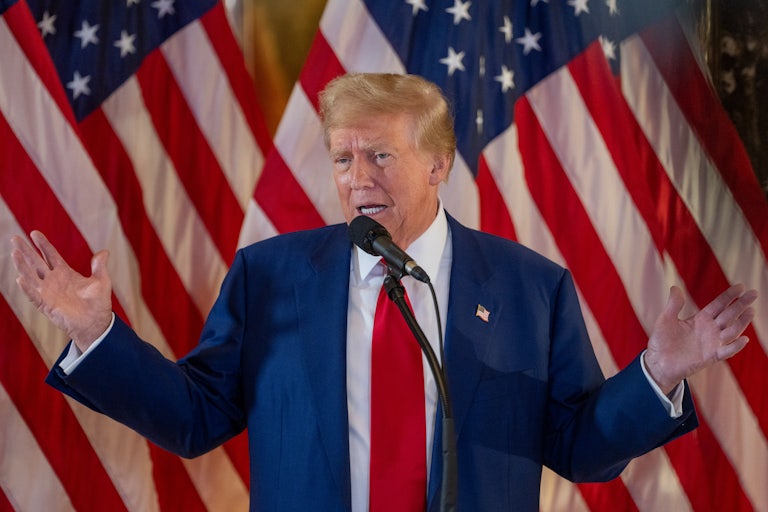
Donald Trump gestures as he speaks into a microphone
David Dee Delgado/Getty Images

Now that he is facing the very real possibility of jail time, Donald Trump suddenly doesn’t seem to remember one of his major catchphrases against his 2016 presidential opponent, Hillary Clinton.

In a Fox & Friends exclusive interview that aired Sunday, Trump claimed he had never suggested the government should “lock her up” in reference to Clinton’s email scandal.

“You famously said, regarding Hillary Clinton, ‘Lock her up.’ You declined to do that as president,” prompted Fox host Will Cain.

“I beat her. It’s easier when you win,” Trump said. “I could have done it, but I felt it would have been a terrible thing. And then this happened to me.”

“Hillary Clinton—I didn’t say, ‘Lock her up,’ but the people would all say, ‘Lock her up, lock her up,’ OK—then we won,” he said. “And I said, pretty openly, I said, ‘Alright, come on, just let’s relax, we’ve gotta make our country great.’”

That is, however, completely false. Throughout his 2016 campaign, Trump used the phrase dozens of times while speaking at rallies around the country, going so far as to encourage his supporters to throw the phrase back at Clinton during her own public appearances and even telling her in person that he’d throw her in jail, during a debate just one month out from the election.

The phrase threatened Clinton with new legal repercussions for using a private email server while conducting business as secretary of state during the Obama administration. Clinton was investigated at the time but was not charged with any criminal wrongdoing. Once in office, Trump conceded that he had little interest in actually prosecuting Clinton—but only until 2020, when he dredged the phrase back up as leverage in his fight for reelection.

The wide-ranging interview also saw Trump suggest that Democrats wanted to lock him up for a $130,000 “accounting thing” (referring to his New York bank fraud trial), as well as reiterating his presidential agenda should he win in November, including proposals for gutting several government agencies and mass deportations of immigrants and asylum-seekers.

But aside from the content of the interview, audiences were caught off guard by a barrage of rough cuts and heavy edits that interrupted and disjointed Trump’s comments. Some viewers pinned the blame on the presumptive GOP presidential nominee’s mental acuity, claiming that the “deranged rambling mess” could only sound coherent with the assistance of creative video editors.

Lauren Boebert Missing From Debate as Rivals Take Turns Roasting Her

The Colorado representative was missing from a key debate as questions about “Beetlejuice” have been hounding her on the campaign trail.

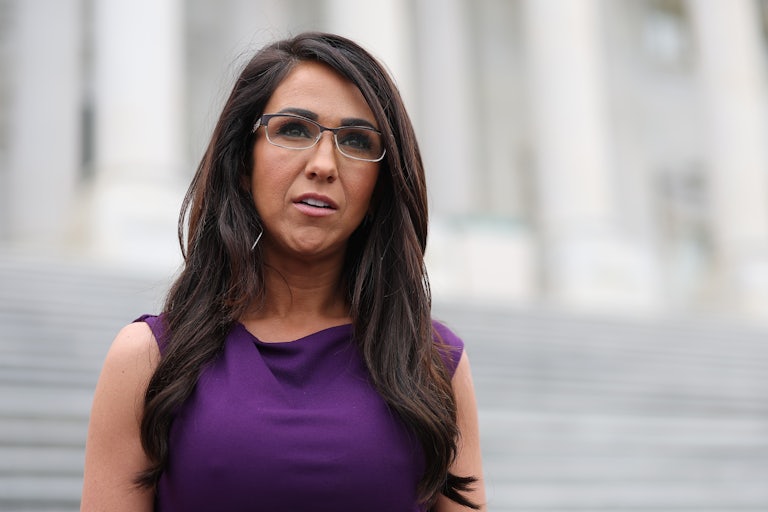
Lauren Boebert wears a purple dress and glasses and looks off camera. She may be standing on the steps of the Capitol.
Kevin Dietsch/Getty Images

Representative Lauren Boebert’s reelection campaign hit some more snags over the weekend when she missed a debate with the other Republican candidates running to represent Colorado’s 4th district on Saturday.

The debate, hosted by the Republican Women of Weld and the Lincoln Club of Colorado, quickly became a chance for Boebert’s rivals to criticize the absent congresswoman.

State Representative Mike Lynch called out Boebert’s poor legislative record, noting that he had passed bills before.

“One, I’ve actually passed legislation,” Lynch said. “This race and this time is important enough that we need people who know how to get stuff done … I would never abandon my district.”

Richard Holtorf, another Colorado state representative, said Boebert wasn’t working in Coloradans’ best interests when she voted against a water project for the state.

“How do you do that if you represent this state? You can’t,” Holtorf said. “She doesn’t know eastern Colorado, and she was the wrong fit for this congressional district.”

Former state Senator Jerry Sonnenberg didn’t mention Boebert by name but seemed to call out her attention-seeking behavior.

“Integrity and character in my neck of the woods is vital,” Sonnenberg said. “If you’re looking for someone that wants to be on TV, I’m not it. If you want somebody that’s a workhorse, and not a show horse, that’s me.”

While Boebert had declined the debate invitation weeks ago, she did take part in a televised Republican primary debate on Friday, which quickly went south for her once the moderator, 9News Denver’s Kyle Clark, brought up her infamous Beetlejuice theater date, where she sang along, recorded the show, and groped her date (who was also groping her). She denied vaping, only for Clark to later uncover footage of her vaping.

“I’m apologizing for you, Kyle Clark, getting footage and releasing that—people seeing this in a very private moment,” Boebert said.

“I certainly have owned up to my night out in Denver, and I’ve gone on that public apology tour, and I’m grateful for the mercy and grace that have been shown, but I’m not going to continue to live life in shame and continue to be beat up by this,” Boebert said later during the debate.

She also faced questions about her legislative record, including bragging about securing funding in legislation she actually opposed.

Boebert is running in Colorado’s 4th district to have a better chance of winning reelection after a very narrow win in 2022, but she keeps running into trouble. She’s polling behind one of her Democratic challengers in what is supposed to be a safe conservative district, and has struggled to win support. She already had one poor debate to kick things off, and while she has Trump’s endorsement, it doesn’t seem to have helped her, even after she showed up at his hush-money trial.

Trump Issues Menacing Warning on What Comes Next if He’s Jailed

Donald Trump is speaking directly to his supporters after being convicted.

Yuki Iwamura/Bloomberg/Getty Images

Felonious Trump openly speculated that there would be a “breaking point” if he is sentenced to jail time or house arrest after being convicted of 34 felonies in his hush-money trial that concluded last week.

Speaking with Fox and Friends on Sunday, Trump speculated, “I don’t know that the public would stand it, you know? I don’t—I’m not sure the public would stand for it.”

Seemingly hoping to nudge calamity into fruition, Trump added, “I think it’d be tough for the public to take. You know, at a certain point, there’s a breaking point.”

The last time Trump lost bigly, he incited a deadly riot at the U.S. Capitol in 2021. Since then, however, his base has been sluggish to mobilize with militancy at his command: As news of his conviction broke, a small gaggle of local Trump supporters and Capitol rioters cried outside the courthouse, where during deliberations they spent the day flashing their boobs and picking fights with counterprotesters. They were met by an even larger group of people cheering and dancing at the news. Across the country, Trump supporters and far-right groups erected inverted U.S. flags in the style of Samuel Alito, yet life otherwise carried on as normal.

There are still a lot of unknowns of what will come next: Judge Juan Merchan has previously indicated hesitancy in sending Trump to jail given the constraints of safely housing Trump in a jail or prison with a mandatory Secret Service detail. Trump’s team intends to appeal the conviction, with a deadline to file their appeal coming just a few weeks before his sentencing hearing on July 11.

Panicking Felon Trump Begs His Favorite Justices for Mercy

The former president has faith in at least one court, apparently.

Justin Lane/Pool/Getty Images

Donald Trump is hoping that he can leverage the Supreme Court to get out of his newfound felony conviction—but legal experts don’t believe that’s in the cards.

The cornered former president took to Truth Social on Sunday, claiming that a SCOTUS intervention might be his only way out of the New York ruling and practically begging his appointees to involve themselves in his criminal convictions.

“The ‘Sentencing’ for not having done anything wrong will be, conveniently for the Fascists, 4 days before the Republican National Convention,” Trump wrote. “A Radical Left Soros backed D.A., who ran on a platform of ‘I will get Trump,’ reporting to an ‘Acting’ Local Judge, appointed by the Democrats, who is HIGHLY CONFLICTED, will make a decision which will determine the future of our Nation? The United States Supreme Court MUST DECIDE!”

Trump has reason to turn to the high court: House Speaker Mike Johnson shockingly indicated Friday that he thought some of the justices were “deeply concerned” about the trial outcome. But the bid is unlikely to pay off.

Trump could potentially push the state case to federal courts if he were reelected as president, but doing so would be incredibly unlikely unless he had already exhausted all other avenues via the appeals process, which could take years, according to legal experts that spoke with The New York Times.

Appealing the case would most likely turn into a referendum on the judge that oversaw it, Judge Juan Merchan, who endured Trump’s mud-slinging throughout the seven-week trial primarily over a gag order, which prevented Trump from attacking witnesses, jurors, and courtroom staff’s family—but did not prevent him from hurling vitriol at Merchan.

Trump repeatedly falsely claimed Merchan was violating his First Amendment right to free speech, but despite the constant heat, Merchan never broke. Appellate lawyers have described Merchan’s behavior throughout the trial as “flawless” and have predicted that won’t play well for Trump’s appeals.

“This is a garden-variety state court conviction,” Mark Zauderer, a New York litigator, told the Times. “I don’t see a plausible path to the Supreme Court.”