Breaking News
Breaking News
from Washington and beyond

Stable Genius Trump Pitches Idiotic Idea on Bitcoin Mining

Does Donald Trump actually understand how cryptocurrency works?

Donald Trump holds up his fist as he stands at a podium
Jim Watson/AFP/Getty Images

Donald Trump wants to bring Bitcoin mining back to the U.S.—but it’s not entirely clear that he knows what cryptocurrency even is, or how massively its production strains a country’s infrastructure.

“VOTE FOR TRUMP! Bitcoin mining may be our last line of defense against a CBDC,” the presidential candidate wrote Wednesday on Truth Social, referring to a “central bank digital currency,” or a digital version of the American dollar.

“Biden’s hatred of Bitcoin only helps China, Russia, and the Radical Communist Left,” Trump continued. “We want all the remaining Bitcoin to be MADE IN THE USA!!! It will help us be ENERGY DOMINANT!!!”

But promising to make Bitcoin mining exclusively American wouldn’t exactly be a good thing for the nation, and the very premise of the proposal calls into question whether Trump actually understands what he’s talking about. Mining Bitcoin involves using a decentralized global system of computers to process a blockchain—a long sequence of ones and zeros that effectively translates into a digital public ledger to verify the authenticity of a sale.

Once a Bitcoin is bought and sold, a new line of information is added to the blockchain. Mining Bitcoin requires a computer to solve extremely complex mathematical problems in order to process that chain. In exchange, the miner receives a predetermined amount of the digital currency as payment.

Around the world, Bitcoin miners use approximately 348 terawatt hours of energy (the prefix “tera-” meaning trillions) per year. That means that crypto mining alone consumes more energy annually than most countries in the world use for all residential and commercial activity, including the United Kingdom, Italy, Mexico, Saudi Arabia, and Australia, according to data aggregated by Visual Capitalist.

As it stands, the majority of Bitcoin mining already takes place in the U.S., accounting for 37.8 percent share of the entire network by hashrate (a computational measure of a cryptocurrency’s blockchain). That’s been the case since the summer of 2021, when China—which previously represented 75 percent of the hashrate—initiated a crackdown on the digital asset, fearing that the highly volatile currency could undermine their nation’s monetary system.

Ultimately, Trump’s promise that more crypto mining would make the country “energy dominant” simply doesn’t make sense. Mining Bitcoin doesn’t produce energy, as Trump’s call for “energy dominance” would imply. Instead, it requires a massive but incredibly unpredictable amount of energy to produce.

It’s unclear just how much energy crypto mining consumes, as the cryptocurrency lobby has actually fought hard to keep the industry’s energy expenditures under wraps. In March, the Department of Energy settled a lawsuit brought by Riot Platforms, halting an “emergency survey” that sought to quantify the amount of energy used by crypto miners while agreeing to erase all energy consumption data that had been collected up until that point.

But the infrastructure strain can be pictured in other ways: In August, taxpayers in Texas paid Riot $31 million not to mine in an effort to stave off rolling blackouts and spare the state’s electric grid.

Trump’s promise may, however, benefit a different sector entirely: the fossil fuel industry, which currently accounts for most of the energy creation in the U.S. and, as a by-product, fuels the majority of mining data centers. Approximately 96 percent of Riot’s energy was supplied by fossil fuels, despite the miner’s claims that it supports the use of renewable energy, according to an analysis by WattTime, a nonprofit tech company.

So his new stance on Bitcoin might make sense after all, given how much of an effort Trump has made recently to cozy up to oil and gas executives.
More about Trump’s relationship with crypto:

Democrats Are Finally Coming for Jared Kushner and His Shady Firm

Senate Democrats are demanding some answers on the money behind Kushner’s “Affinity Partners.”

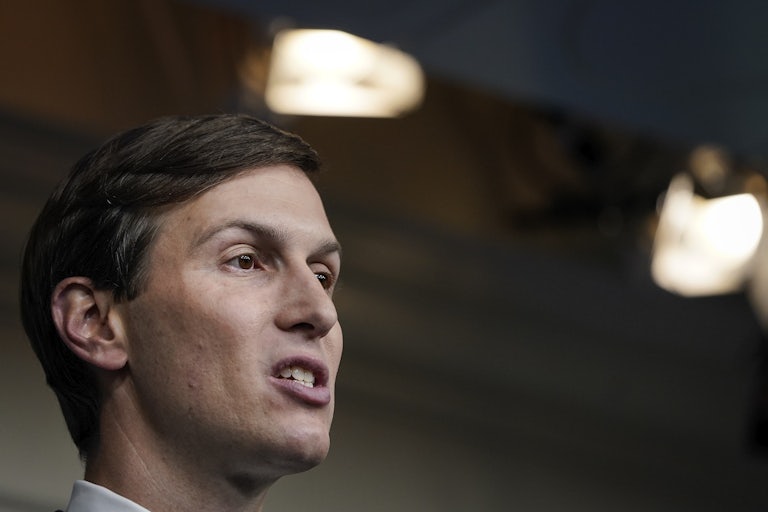
Jared Kushner speaking (it's not a flattering photo)
Drew Angerer/Getty Images

Jared Kushner’s Saudi Arabia–funded investment firm is finally being seriously examined. Senate Democrats have launched an investigation into Kushner’s firm, Affinity Partners, seeking information about the company’s investments—after it received $2 billion of its $2.5 billion in investments from Saudi Arabia.

Senate Finance Committee Chair Ron Wyden is leading the investigation, noting the peculiarities of nepobaby Kushner’s involvement in business dealings he has next to no experience doing. In a letter Wednesday asking Kushner’s firm to respond to queries about its investors, Wyden wrote:

Mr. Kushner’s limited track record as an investor, including his nonexistent experience in private equity or hedge funds, raise questions regarding the investment strategy behind the seeding investments and lucrative compensation that Affinity received from the Saudi PIF and other sovereign wealth funds.

Virginia Canter, former Treasury Department chief ethics counsel, told Salon that Kushner’s shady business dealings with Saudi Arabia, so soon after he and his father-in-law left the White House, raise serious national security concerns. “It’s one of the most egregious situations I’ve ever seen in decades of working in the federal government as an ethics official,” she said. “It appears to be a payoff as much as a potential investment.”

Kushner’s firm launched in 2021 and immediately received a majority of its funds from Saudi Arabia’s crown prince, with a whopping 99 percent coming from foreign sources. Kushner defended the flood of cash by pointing out that Crown Prince Mohammed bin Salman’s fund also invests in Nintendo, Uber, and Microsoft—which is more of an insult to those companies than it is a vouch for Kushner.

“The Saudi PIF’s decision to invest $2 billion in Affinity so soon after Kushner’s departure from the Trump White House raises concerns that the investment was a reward for official actions Kushner took to benefit the Saudi government, including preventing accountability for the Saudi government ordering the brutal murder of journalist and American citizen Jamal Khashoggi,” Wyden wrote.

In 2018, MBS oversaw the brutal assassination of Washington Post journalist Jamal Khashoggi. Trump’s White House paid no mind to the murder, instead releasing a shocking statement expressing support for Saudi Arabia and sowing doubt that MBS ordered Khashoggi’s murder, despite a CIA analysis finding that was certainly the case. Trump himself has curious ties to MBS, which during his presidency raised concerns of foreign influence.

This isn’t the first time Congress has sought answers about Kushner’s firm. In 2023, the stench of corruption was so putrid, Congress subpoenaed the company over its ties to Saudi Arabia, with even Republican James Comer saying Kushner’s Saudi blood money “crossed the line of ethics.”

Mike Johnson Weaponizes Government in Fight Against Biden

The House speaker insisted Merrick Garland’s situation is different from that of Republicans who refused to testify in front of the January 6 committee.

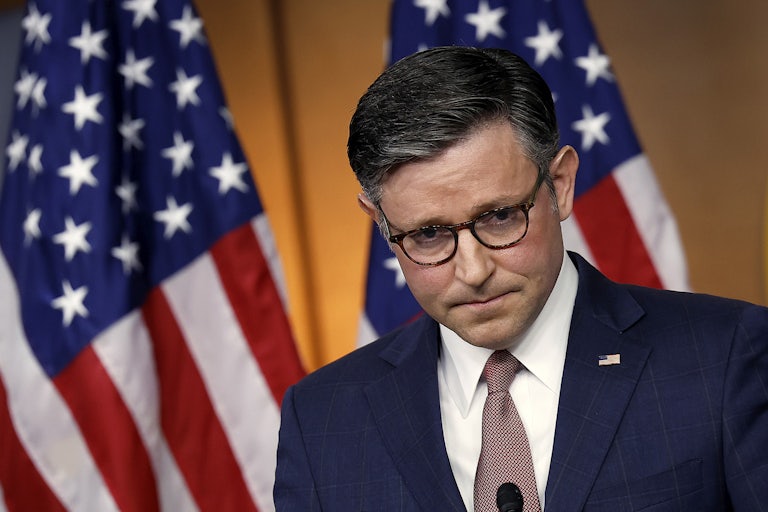
Mike Johnson looks dow
Kevin Dietsch/Getty Images

House Speaker Mike Johnson has a tendency to think that when things go bad for his party, it’s the product of gross legislative mismanagement, judicial weaponization, and a vast executive conspiracy. But when his party wants to do something, it’s because justice is swift and everything is proceeding according to plan. House Republicans’ efforts to hold Attorney General Merrick Garland in contempt are no exception to this trend.

The GOP quest to hold Garland in contempt of Congress for refusing to respond to a subpoena was not dampened by any sense of irony, even though the Judiciary Committee is chaired by Representative Jim Jordan. Jordan famously refused to comply with requests from the House committee investigating the January 6 insurrection, alongside Representatives Scott Perry, Kevin McCarthy, Andy Biggs, and Mo Brooks.

During a press conference Wednesday, a reporter asked Johnson if he was concerned the run of rogue Republicans would undermine his argument for holding Garland in contempt. Apparently, he doesn’t think the two cases are alike at all.

“Oh, I’m so glad you brought up the January 6 committee. We’ll be talking a lot more about that in the coming weeks. There’s been a lot of investigation about that committee, I don’t think it was properly constituted, I don’t think it was properly administered, and now we know that apparently, some of the evidence was hidden, and some maybe even destroyed,” he said.

“You talk about apples to oranges, there couldn’t be a more clear contrast between that and what we’re talking about here,” Johnson continued. “This is the Judiciary Committee. This is the weaponization committee.” He went on to laud Jordan’s leadership and “extraordinary” work.

With this statement, Johnson makes it clear there are different rules for Republicans in Congress, special exceptions that prevent them from facing the consequences of their actions. Those who break the rules to defend Donald Trump are doing so bravely, while those who break the rules to defend Joe Biden are subject to the most serious condemnation.

Johnson did not elaborate on how he could so casually call the GOP-led committee the “weaponization” committee, a conspiracy theory buzzword Republicans have adopted to discredit the federal government.

Johnson’s logic, or lack thereof, mirrors his untethered reframing of the guilty verdicts of Trump and Hunter Biden. One is evidence of a “two-tiered” justice system; the other, which would disprove it, is a “separate instance” not worthy of consideration in Johnson’s ongoing weaponization case study.

The House Judiciary and Oversight and Accountability Committees had demanded the audio from Biden’s interview with special counsel Robert Hur, who described the president as a “well meaning, elderly man with a poor memory,” be turned over by the end of April. Their attempt to obtain the audio was blocked by the White House, which invoked executive privilege. The move summoned the ire of House Republicans, who became set on holding Garland in contempt.

Trump V.P. Wannabe J.D. Vance Introduces Extreme Bill on DEI

Trump V.P. wannabe J.D. Vance has introduced an “anti-woke” bill seeking to completely gut DEI.

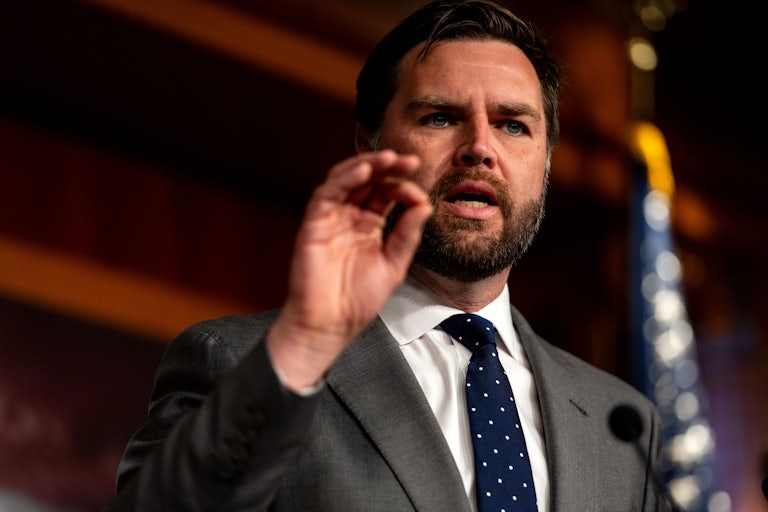
Senator J.D. Vance speaks at a lectern and gestures with his hand
Kent Nishimura/Getty Images

Senator J.D. Vance doesn’t like diversity, equity, and inclusion principles, and he’s sponsoring a bill to ban them from all federal offices and contracting.

On Wednesday, Vance and Representative Michael Cloud introduced the Dismantle DEI Act, which bans all DEI positions in the government and also bans diversity initiatives from receiving federal grant money. The bill would bar school accreditation agencies from requiring DEI in schools, and stop financial agencies like Nasdaq and the New York Stock Exchange from implementing diversity requirements for corporate boards.

“It has no place in our federal government or anywhere else in our society,” Vance said. “I’m proud to introduce this legislation, which would root out DEI from our federal bureaucracy by eliminating such programs and stripping funding for DEI policies anywhere it exists. Americans’ tax dollars should not be co-opted to spread this radical and divisive ideology—this bill would ensure they are not.”

The bill takes aim at an executive order President Biden issued in 2021 promoting DEI in the federal workforce, and would drastically cut funding to several government agencies, including NASA, the National Institutes of Health, and even the military.

The bill is not likely to gain traction beyond the Republican-controlled House, if it can even get past the narrow GOP majority. Attacking DEI is like catnip for the right wing, and conservative media has been fanning the flames on the supposedly “woke” principles, even going so far as to blame natural disasters on DEI.

The bill is unlikely to pass the Senate, and instead it appears more likely that it’s all for show, possibly to help Vance move up on Donald Trump’s short list to be his running mate. Vance continuously professes his loyalty to the convicted felon and Republican presidential nominee, even saying that if he was in Mike Pence’s place as vice president in 2021, he would have subverted the 2020 election results to help Trump be reelected. This bill is also a disturbing preview of what Republicans plan to do if Trump wins in November, as the former president has already promised to take on what conservatives think is the “real” prejudice in America: anti-white racism.

Clarence Thomas’s “Son” Breaks Silence From Jail

Mark Martin, the man raised by Supreme Court Justice Clarence Thomas as a “son,” is speaking out on the sad truth of their relationship.

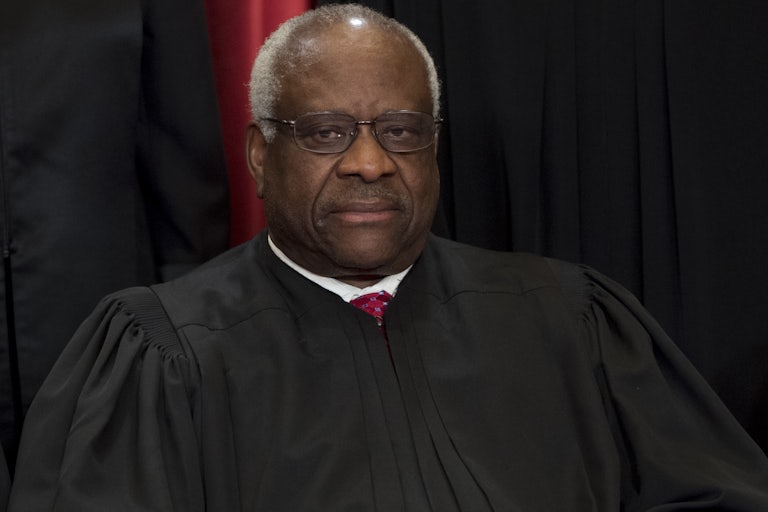
Supreme Court Justice Clarence Thomas in his robe
SAUL LOEB/AFP/Getty Images

The man Clarence Thomas said he once considered like a “son” now says that Thomas doesn’t want much to do with him.

Mark Martin, the grandson of Thomas’s sister Emma Mae Martin, spoke to Business Insider from a jail cell in South Carolina and said that the Supreme Court justice and his wife, Ginni, don’t have a relationship with him anymore, despite being his legal guardians from age 6 to 19.

Martin, who is awaiting trial on drug and weapons charges after he was arrested last summer, benefited from gifts Thomas received from conservative billionaire Harlan Crow, which the Supreme Court justice initially failed to include in financial disclosures.

“I haven’t really heard much from them in a long time,” Martin said of his adoptive parents. “I tried to communicate with them a couple of times, but I’ve never gotten any response.”

In 2007, Thomas said in an interview with C-Span that he and his wife were raising Martin, then 16, “as a son.” Martin would attend military prep school Randolph-Macon Academy and Hidden Lake Academy, a residential therapeutic treatment center plagued by allegations of abuse, thanks to Crow, a Randolph-Macon alumnus, paying the tuition at both schools. Thomas did not report these payments on his financial statements.

“I guess they looked into Randolph-Macon Academy because Harlan Crow actually graduated from there, so I guess that was behind their decision to send me there—and then apparently he helped finance the HLA trip, too,” Martin told Business Insider, saying that he didn’t know at the time that Crow paid for his education.

ProPublica reported last year that Thomas had enjoyed luxury vacations on Crow’s dime almost every year, and Thomas failed to report those trips until just last week. In addition, the publication reported on Crow funding the renovation of the home where Thomas’s mother still lives as well as Martin’s private school tuition, estimating that the school fees likely exceeded $150,000.

Martin told Business Insider that he enjoyed a privileged childhood, traveling to more than 20 countries and spending summers wakeboarding or waterskiing. He also remembers babysitting Crow’s son when their families went on vacation together. But Martin said that when he began high school, Clarence and Ginni Thomas “just didn’t have time to deal with” him anymore and sent him away to boarding schools. After his freshman year of high school began, Martin said he rarely saw his great-uncle and great-aunt.

According to Martin, he was expelled from Randolph-Macon Academy after his junior year for failing a drug test, and he said the Thomases then sent him back to his mother’s house in Georgia. He said he has rarely heard from them since. Last year, Martin was arrested and charged with drug trafficking and weapons possession. According to Business Insider, Martin’s car was stopped as part of a juvenile-sex-trafficking investigation, but he doesn’t face any charges related to that.

Martin also faces charges pending from 2021 on allegedly trafficking meth and heroin, Business Insider reported, citing arrest records. Martin faces at least 25 years in prison over the drug charges and five more years for illegal gun possession.

“I actually don’t know if they know that I’m locked up—I’m not sure they’d care too much,” Martin said. “I’ve seen—I’ve probably seen them two times, maybe three times, over the last 14 years.”

“I just wish they’d at least communicate with me—get to know my children,” Martin added. “They raised me like another mother and father, so I wanted my children to know who raised me into the person that I became. I want them to be around for that, at least—to see my kids grow up.”

Thomas didn’t respond to Business Insider’s request for comment, but it’s not likely that he would have offered any acceptable justification for his and his wife’s treatment of someone they have referred to as a son. Thomas still refuses to speak about the unethical gifts he has received and adamantly refuses to resign from the Supreme Court despite all of his ethics scandals. Sadly, it seems that Martin’s life has been a casualty of Clarence and Ginni Thomas’s service to the conservative movement.

More on corruption on the highest court: