Breaking News
Breaking News
from Washington and beyond

Georgia’s Republican Governor Reveals He Didn’t Vote for Trump—Yet

Brian Kemp says he didn’t vote for Donald Trump during the Georgia primary, but things will be different come November.

Brian Kemp speaks
Stefan Wermuth/Bloomberg/Getty Images

Georgia Governor Brian Kemp admitted that he didn’t vote for Donald Trump in the state’s primary elections last week, only one day before the presumptive Republican nominee takes the stage in a presidential debate in Atlanta.

While Kemp had previously condemned Trump’s claims of election fraud in the 2020 presidential election, and even supported his subsequent indictment, the spineless conservative governor said he will still vote for Trump in November.

Now it seems his voting record is equally contradictory: Kemp couldn’t be bothered to back Trump in June. But he didn’t exactly take a stand, either.

“I didn’t vote for anybody. I voted, but I didn’t vote for anybody,” Kemp told CNN’s Kaitlan Collins on The Source Wednesday, noting that the race “was already over when the primary got here,” as Trump is already the party’s presumptive nominee.

It seems that Kemp has been suffering from the same lack of enthusiasm many voters are experiencing in the lead-up to November. Backing a convicted felon who you believe attempted to overthrow the results of your state’s democratic election will do that.

“I always try to go vote and, you know, play a part in it, but look, at that point, it didn’t really matter,” Kemp said.

The governor maintained, though, that he would “support the ticket” come November. To Kemp, it seems the only thing that matters is turning Georgia red again.
Sotomayor Torches Supreme Court’s Short-Sightedness in SEC Ruling

Justice Sonia Sotomayor called out her conservative colleagues for ignoring a “mountain of precedent.”

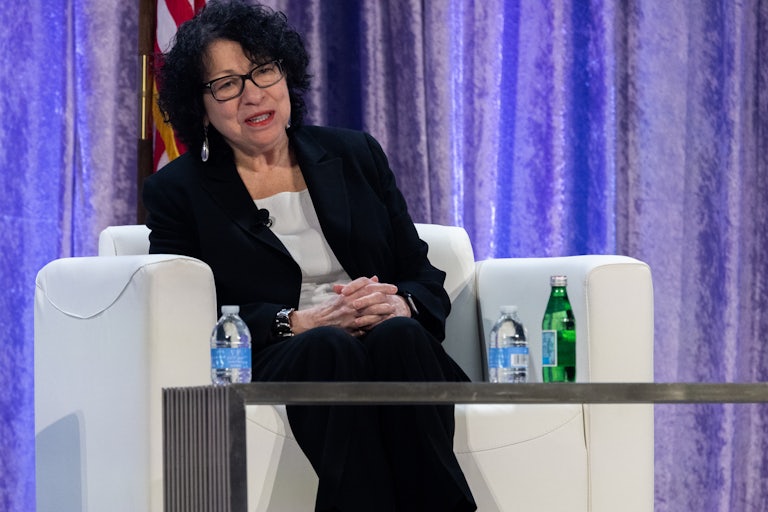
Supreme Court Justice Sonia Sotomayor speaks while sitting in a chair
Nathan Posner/Anadolu/Getty Images

U.S. Supreme Court Justice Sonia Sotomayor wrote a scathing dissent Thursday, arguing that the court’s decision to gut the Security and Exchange Commission’s power to seek civil penalties was a threat to the separation of powers.

In a 6–3 majority opinion penned by Chief Justice John Roberts, the Supreme Court held that when the SEC seeks civil penalties, the defendant is entitled to a jury trial in federal court.

This decision was a major hit to a provision of the Dodd-Frank Act, which allowed the SEC to impose civil penalties during administrative proceedings against those who break the law. Justices Clarence Thomas, Samuel Alito, Neil Gorsuch, Brett Kavanaugh, and Amy Coney Barrett joined Roberts.

In her dissent, Sotomayor brutally rebuffed the majority opinion as “plainly wrong” and slammed her conservative colleagues for undermining Congress’s authority to impose rules that entitle the government to civil penalties. She warned that the decision came as a result of ignoring a “mountain of precedent against it.”

“Beyond the majority’s legal errors, its ruling reveals a far more fundamental problem: This Court’s repeated failure to appreciate that its decisions can threaten the separation of powers,” she wrote. “Here, that threat comes from the Court’s mistaken conclusion that Congress cannot assign a certain public-rights matter for initial adjudication to the Executive because it must come only to the Judiciary.”

“The majority today upends longstanding precedent and the established practice of its coequal partners in our tripartite system of Government. Because the Court fails to act as a neutral umpire when it rewrites established rules in the manner it does today, I respectfully dissent.”

The decision has the potential to significantly weaken the ability of federal agencies, including the National Labor Relations Board, the Federal Trade Commission, and the Federal Communications Commission, to enforce fines against those who break laws, as those agencies lack the resources to pursue complaints in federal court. Functionally, the court’s decision will allow financial fraudsters to get off scot-free.

Trump’s Hush-Money Gag Order Win Could Backfire—And Land Him in Jail

Donald Trump secured a small victory in his hush-money case, but a legal analyst predicts it might still doom him.

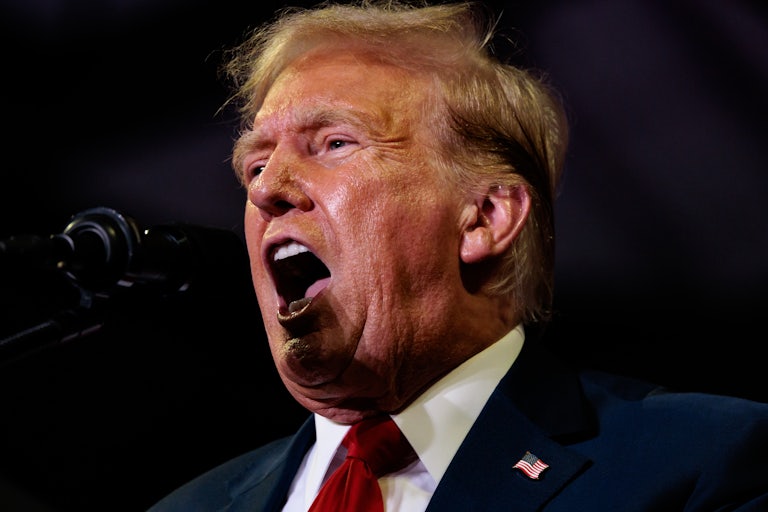
Donald Trump speaks into a microphone
Hannah Beier/Bloomberg/Getty Images

Donald Trump may be happy that the gag order in his hush-money case has been partially lifted as he awaits sentencing, but it could backfire on him, one legal expert says.

Glenn Kirschner, a former federal prosecutor, said Tuesday night that the gag order change “may and probably will come back to bite” the former president and convicted felon. It could even lead to prison time.

Judge Juan Merchan altered the gag order Tuesday, allowing Trump to talk about the witnesses and jurors in the case. Trump is still barred from speaking about the prosecutors, court staff, and their families, though.

During the latest episode of his YouTube series Justice Matters, Kirschner said that the order’s changes are “in accordance with the law,” but he noted that there is a legitimate fear for the safety of the witnesses and jurors now that Trump can speak freely about them. Still, he believes that there could be a “silver lining.”

“How many of you think Donald Trump will begin posting and saying things about the witnesses that are harassing and intimidating and threatening and perhaps even violence-inducing?” Kirschner asked. In the likely event that Trump does this, it could result in a harsher sentence.

Even before the gag order was lifted, Trump attempted to skirt it in different ways. He had his political allies act as surrogates to criticize the people he couldn’t, even editing their words at times. Some politicians, such as Representatives Bob Good and Lauren Boebert, even admitted that they traveled to Trump’s Manhattan trial for this reason. Trump also criticized one of the prosecutors in the case without mentioning his name. And there are the 10 documented violations of the gag order, which Merchan has already punished Trump for to the tune of $10,000 in fines.

Trump was found guilty of 34 felony counts in May for allegedly falsifying business records with the intent to further an underlying crime in the first degree for paying off adult film actress Stormy Daniels to cover up their affair before the 2016 election. The crime carries a sentence of up to four months in prison, and sentencing is scheduled for July 11, only four days before the Republican National Convention begins in Milwaukee, Wisconsin.

Merchan already has some alleged gag-order violations to consider before Trump’s sentencing hearing. The question is whether Trump will add to them between Thursday’s debate and July 11.

Supreme Court Confirms Overturning of Extreme Abortion Ban—for Now

After an earlier leak, the Supreme Court confirmed its ruling on emergency abortions in Idaho.

Supreme Court
Tierney L. Cross/Bloomberg/Getty Images

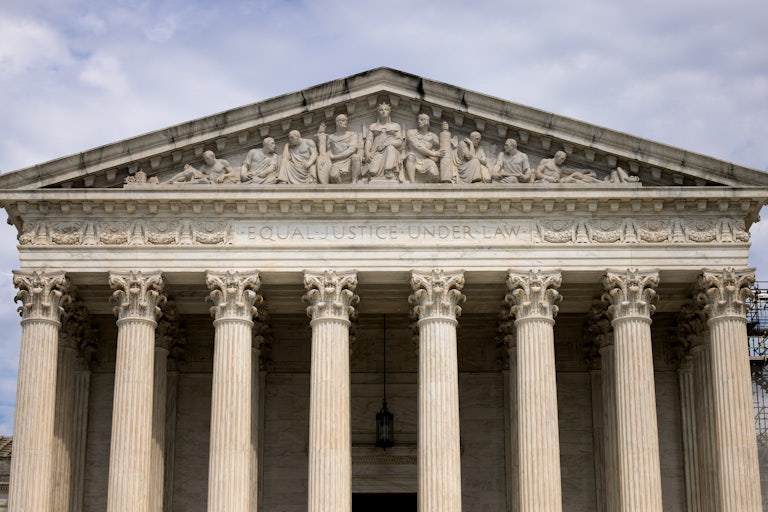
The Supreme Court on Thursday officially dismissed a challenge to Idaho’s medical emergency abortion clause, noting that it was “improvidently granted,” meaning that the high court should never have accepted the case in the first place.

The decision, which comes after the ruling was accidentally posted to the court’s website on Wednesday, restores the right to emergency abortion in Idaho—but only for now. The ruling will send the case back to a lower appeals court to be retried.

The case, Moyle v. United States, concerned whether pregnant people in the Gem State were allowed to get abortions when receiving lifesaving, critical care at hospitals—as required by federal mandate under the Emergency Medical Treatment and Active Labor Act, or EMTALA—or whether they and their fetus would have been considered two separate people.

Idaho already has a near-total abortion ban, but the Alliance Defending Freedom, the far-right Christian legal advocacy group that argued the lawsuit on behalf of the state, utilized the case to advance the idea of fetal personhood. Under the stipulation, doctors would have been legally required to treat a fetus—no matter how underdeveloped—with the same medical care as the person carrying it, even if it posed a potentially life-threatening medical risk to the pregnant patient.

But drafting a state law that directly conflicts with medical care considered to be a minimum for Medicare-funded hospitals around the country was outside the realm of legal possibilities, wrote Justice Elena Kagan in a concurring opinion joined by Justices Sonia Sotomayor and Ketanji Brown Jackson.

“EMTALA requires hospitals to provide abortions that Idaho’s law prohibits. When that is so, Idaho’s law is preempted,” Kagan wrote. “The Court’s ruling today follows from those premises.”

Justice Samuel Alito, joined in a dissenting opinion by Justices Clarence Thomas and Neil Gorsuch, plainly disagreed with Kagan’s description, arguing that EMTALA does not “unambiguously” require Medicare-funded hospitals to provide abortions. The conservative justices also claimed that EMTALA, a federal statute, does not supersede state law or its control of local medical practices—even if that local restriction has skyrocketed the rate at which pregnant women are airlifted from hospitals to receive out-of-state care, increasing the burden and cost of care on neighboring states.

“Idaho never consented to any conditions imposed by EMTALA and certainly did not surrender control of the practice of medicine and the regulation of abortions within its territory,” Alito wrote.

In her own opinion, Jackson disagreed with the court’s decision to duck a final say on the matter, especially after allowing a stay that prevented critical abortion access to linger in the state while it deliberated its decision.

“It is too little, too late for the Court to take a mulligan and just tell the lower courts to carry on as if none of this has happened,” Jackson wrote. By failing to make a decisive ruling on EMTALA’s protections, Jackson warned that “storm clouds loom ahead.”

This story has been updated.

House GOPer Takes Biden Debate Conspiracy to Next Level With New Bill

Republican Representative Andy Ogles has introduced an idiotic bill ahead of the Biden-Trump debate.

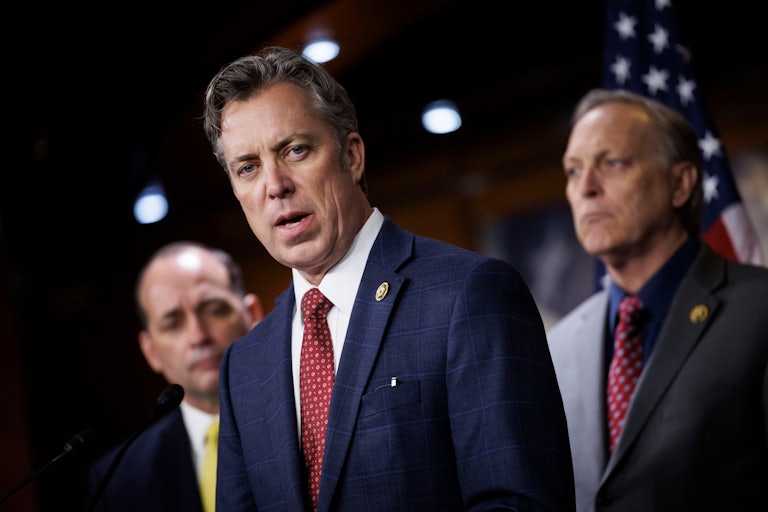
Representative Andy Ogles speaks at a lectern. Two other Republican representatives stand behind him.
Ting Shen/Bloomberg/Getty Images

Republicans are still working to buffer the impact of President Joe Biden’s performance in Thursday’s debate, expanding the conspiracy that the executive leader is relying on “mind-altering” drugs in case he hits hard against Donald Trump.

On Wednesday, Tennessee Representative Andy Ogles took the inane idea a step further, touting his recently introduced bill dubbed “No Juicing Joe Act,” which his office said would require the White House to inform Congress any time Biden takes a drug “that could alter his alertness, judgment or mood.”

“‘No Juicing Joe’ would require him to divulge, to report to the American people, every time he takes a mind-altering stimulant like we know he’s gonna have to do before this debate,” Ogles told Newsmax’s Joe Pinion Wednesday. “They’re gonna have him juiced up and jacked up on some sort of cocktail so he can be lucid and take on or at least try to debate Donald Trump.”

Republicans have aggressively pushed the idea in recent weeks, attempting to frame Biden as the weaker, more feeble-minded option of the two. But that goes against myriad reports of Trump’s cognitive decline, dozens of examples of the former president nonsensically rambling at rallies, and a Pentagon report that Trump’s White House medical unit operated like a pill mill, indiscriminately doling out large prescriptions of modafinil, Adderall, fentanyl, morphine, and ketamine to staffers, with insiders claiming it was “awash in speed.”

Presidential prescriptions aren’t exactly unusual: John F. Kennedy, Jr. used his White House doctors to fight off back pain, and Richard Nixon relied on his doctors to treat bad moods. But no previous administrations have matched the level of debauchery of Trump’s, when in-office pharmacists unquestioningly handed out highly addictive substances to staffers who needed pick-me-ups or energy boosts—no doctor’s exam, referral, or prescription required.

In another attempt to superficially broaden the conspiracy’s credibility, Trump pressed the teetotaler president to take a drug test prior to the debate. But it wasn’t the first time that Trump has baselessly accused his opponents of drugging up before their debates. In 2016, Trump levied similar accusations against Hillary Clinton, and in 2020 he called on Biden to take a drug test after he told a North Carolina rally crowd that Biden gets a “big fat shot in the ass,” a claim that he revived this week.