Breaking News
Breaking News
from Washington and beyond

Supreme Court’s Trump Immunity Ruling Decimates Jack Smith’s Case

The court’s decision on Donald Trump’s immunity doesn’t just delay his trial. It guts the entire case against him.

A person holds an anti-Donald Trump protest sign outside the Supreme Court
Al Drago/Bloomberg/Getty Images

The U.S. Supreme Court’s ruling Monday that the president is entitled to presumptive immunity from all official acts has severely undermined the case against Donald Trump for seeking to overturn the results of the 2020 presidential election, making it even less likely he will face justice for his actions.

In his majority opinion granting sweeping protections to the president, Chief Justice John Roberts wrote that part of the Department of Justice’s indictment against the former president “alleges that Trump and his co-conspirators ‘attempted to enlist the Vice President to use his ceremonial role at the January 6 certification proceeding to fraudulently alter the election results.’”

“In particular, the indictment alleges several conversations in which Trump pressured the Vice President to reject States’ legitimate electoral votes or send them back to state legislatures for review,” Roberts continued.

“Whenever the President and Vice President discuss their official responsibilities, they engage in official conduct,” wrote Roberts, meaning that Trump can no longer be prosecuted for outright demanding that his former Vice President Mike Pence not certify the 2020 election results.

“Presiding over the January 6 certification proceeding at which Members of Congress count the electoral votes is a constitutional and statutory duty of the Vice President,” Roberts said. “The indictment’s allegations that Trump attempted to pressure the Vice President to take particular acts in connection with his role at the certification proceeding thus involve official conduct, and Trump is at least presumptively immune from prosecution for such conduct.”

The ruling established that the president may not be indicted on conduct that is immune to prosecution, specifically including conversations between the president and his allies, nor can those acts be considered when trying to prove guilt.

“Testimony or private records of the President or his advisers probing such conduct may not be admitted as evidence at trial,” the ruling stated—a surprising new precedent in the face of 1974’s United States v. Nixon, which required then-President Richard Nixon to deliver tapes of his conversations in the Oval Office to a district court, a ruling that ultimately paved the way for his resignation.

A major part of special counsel Jack Smith’s case against Trump hinges on the allegation that Trump knew he had lost the election but continued to urge his supporters to subvert it via unlawful means. This includes demanding Pence delay certifying the nation’s votes, which Trump’s lawyer John Lauro essentially admitted in August was illegal. But now, those conversations cannot be used as evidence in the case.

Monday’s decision has effectively gutted Trump’s January 6 trial, which would have been overseen by U.S. District Judge Tanya Chutkan. Trump has already started celebrating, and it’s clear it also would’ve made Nixon pretty happy.

Trump Celebrates Supreme Court Giving Him Total Power in Immunity Case

Donald Trump can’t wait for what comes next.

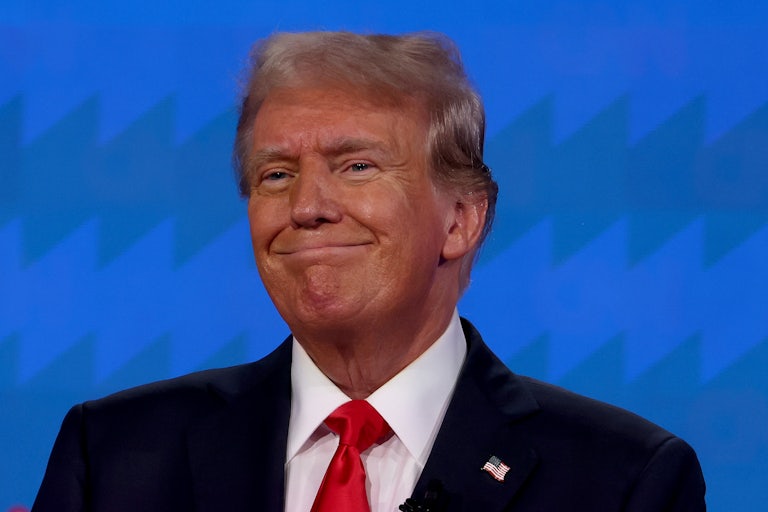
Donald Trump smiles weirdly
Justin Sullivan/Getty Images

Donald Trump is celebrating after the Supreme Court ruled Monday morning on partisan lines that presidents have “presumptive immunity from prosecution for all of his official acts.”

On Truth Social, the former president and convicted felon immediately posted, “BIG WIN FOR OUR CONSTITUTION AND DEMOCRACY. PROUD TO BE AN AMERICAN!”

Of course Trump would be happy with this ruling. On Sunday night, Trump was practically begging the Supreme Court for a favorable ruling, and that is what he got from the six conservative justices on the court. The ruling throws into question whether there are any lines that a president can cross while in office. It also throws the federal trial over Trump’s attempts to intervene in the certification of the 2020 election into jeopardy, and allows him to breathe easier yet again regarding the criminal cases against him.

Currently, the only criminal verdict against him is his conviction on hush-money charges in New York. Trump’s Georgia election interference case against him is currently held up as his legal team attempts to get prosecutor Fani Willis thrown off of the case. His classified documents case has been continuously delayed by Judge Aileen Cannon, whom he appointed.

And now, if Trump were to return to the White House as president, he can in theory do whatever he wants and never have to fear prosecution. Those actions could be quite dangerous: Trump’s allies have spoken of retribution against those who sought to hold him accountable in the first place, and use the Justice Department against his opponents. He’s poised to give Christian nationalists a bigger role in his administration the second time around, and to clamp down on immigration with mass deportation camps. There’s also his general anti-democracy activities.

With Monday’s Supreme Court ruling, it’s not just Trump who is celebrating, it’s all of his allies and bad actors who are eyeing November’s election as an opportunity to push their agendas without fear from the law. 

Donald Trump Jr. Mocks Jack Smith Over Supreme Court Ruling

The younger Trump celebrated his father essentially receiving absolute immunity.

Donald Trump Jr. raises his fists above his head
Jeff Kowalsky/AFP/Getty Images

Donald Trump Jr. cheered his father’s massive victory on presidential immunity that essentially puts him above the law.

The Supreme Court handed Donald Trump a seismic win in his immunity case Monday, giving his legal team more than they asked for in terms of what qualifies as prosecutable official acts of the presidency while effectively killing Trump’s January 6 criminal trial.

But that wasn’t enough for Trump’s eldest son, who was quick to amplify the news that the former president can’t be held accountable for some of his actions related to the effort to overturn the 2020 election results. And Don Jr. couldn’t resist throwing another dig at special counsel Jack Smith, whose January 6 case against the presumptive Republican presidential nominee is now in tatters.

“Solid SCOTUS ruling today,” posted Don Jr. “I’m sure the corrupt prosecutors and DC judge will work overtime to continue their lawfare. It’s all they have left.”

Sotomayor Slams Supreme Court Immunity Ruling in Terrifying Dissent

The three liberal Supreme Court justices, led by Sonia Sotomayor, warn democracy is at risk after the Supreme Court’s Trump presidential immunity case.

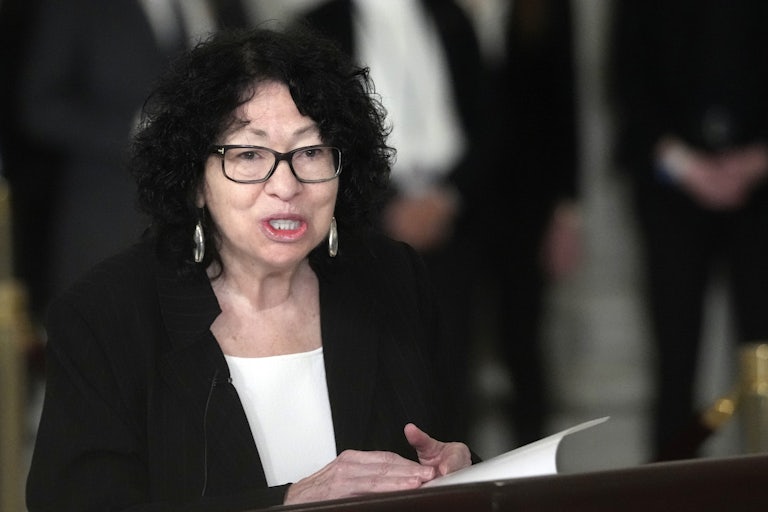
Supreme Court Justice Sonia Sotomayor speaks
Jacquelyn Martin/Pool/Getty Images

In a devastating 6–3 decision issued Monday, the conservative supermajority of the Supreme Court did what it was installed by Trump to do and twisted the Constitution to shield Trump from criminal liability for crimes he committed in office. The case was brought to the Supreme Court by Trump in an attempt to evade prosecution for his alleged attempts to overturn the results of the 2020 presidential election.

The decision effectively gives a green light to all future presidents to commit as many crimes as they want while in office. As Justice Sonia Sotomayor put it, “the President is now a king above the law.”

Sotomayor led in the chilling dissent, joined by liberal justices Elena Kagan and Ketanji Brown Jackson. Sotomayor’s dissent is charged with fierce criticisms of the decision, noting that the conservative majority “invents an atextual, ahistorical, and unjustifiable immunity that puts the President above the law” and “makes a mockery of the principle, foundational to our Constitution and system of Government, that no man is above the law.

Sotomayor shredded the conservative decision by examining the intentions laid out by the Founding Fathers in contrast to the current ambitions of Trump and the justices aligned with him—a seemingly originalist examination refuting the conservative justices’ recent trend of augmenting the law to come to a politically advantageous decision.

“Relying on little more than its own misguided wisdom about the need for ‘bold and unhesitating action’ by the President, the Court gives former President Trump all the immunity he asked for and more.”

“The President of the United States is the most powerful person in the country, and possibly the world,” Sotomayor wrote. “When he uses his official powers in any way, under the majority’s reasoning, he now will be insulated from criminal prosecution. Orders the Navy’s Seal Team 6 to assassinate a political rival? Immune. Organizes a military coup to hold onto power? Immune. Takes a bribe in exchange for a pardon? Immune. Immune, immune, immune.”

“Let the President violate the law, let him exploit the trappings of his office for personal gain, let him use his official power for evil ends. Because if he knew that he may one day face liability for breaking the law, he might not be as bold and fearless as we would like him to be. That is the majority’s message today. Even if these nightmare scenarios never play out, and I pray they never do, the damage has been done.”

Sotomayor’s dissent cast dark clouds over the fate of the country, writing, “The relationship between the President and the people he serves has shifted irrevocably. In every use of official power, the President is now a king above the law.”

“Never in the history of our Republic has a President had reason to believe that he would be immune from criminal prosecution if he used the trappings of his office to violate the criminal law,” wrote Sotomayor. “Moving forward, however, all former Presidents will be cloaked in such immunity. If the occupant of that office misuses official power for personal gain, the criminal law that the rest of us must abide will not provide a backstop,” she added.

“With fear for our democracy, I dissent,” Sotomayor concluded.

Ketanji Brown Jackson Blasts Supreme Court Ruling That “Wreaks Havoc”

The Supreme Court justice ripped her conservative colleagues’ “flawed” decision to kneecap the federal government.

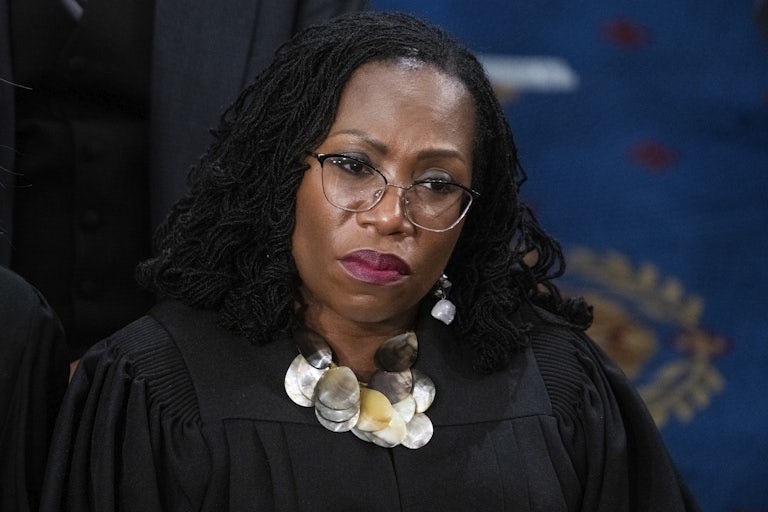
Supreme Court Justice Ketanji Brown Jackson looks forward
Tom Williams/CQ-Roll Call, Inc/Getty Images

U.S. Supreme Court Justice Ketanji Brown Jackson railed Monday against the decision in Corner Post, Inc. v. Board of Governors of the Federal Reserve System, arguing in her dissent that the “flawed reasoning and far-reaching results” of the majority opinion “[wreak] havoc on Government agencies, businesses, and society at large.”

In a 6–3 ruling along ideological lines, the court decided that the clock on a statute of limitations for complaints against an agency regulation doesn’t begin when the regulation is put in place, but when the plaintiff is injured. The majority opinion was delivered by Justice Amy Coney Barrett, with all three liberal justices dissenting.

In her dissent, Jackson explained that this decision makes way for a torrent of litigation challenging long-settled statutes, in what could potentially be a massively destabilizing ruling against the federal government.

“After today, even the most well-settled agency regulations can be placed on the chopping block,” she wrote.

Under the new doctrine, for a regulation to be challenged, all one needs to do is create a new entity that is “injured” by the regulation. The plaintiff then has six years to pursue a legal challenge against the supposedly injurious rule. As easily as a new entity can form, a new challenge can be levied, culminating in a torrent of litigation that could overwhelm federal capacities, handing over all power to the judiciary.

“Any established government regulation about any issue—say, workplace safety, toxic waste, or consumer protection—can now be attacked by any new regulated entity within six years of the entity’s formation. A brand new entity could pop up and challenge a regulation that is decades old; perhaps even one that is as old as the APA itself,” Jackson wrote, referencing the Administrative Procedure Act, which was passed in 1946. “No matter how entrenched, heavily relied upon, or central to the functioning of our society a rule is, the majority has announced open season.”

While some agency actions rely on more specific statute of limitations rules, which could potentially shield them from the court’s ruling, it’s also likely that plaintiffs will be able to seek out far-right district court judges who will be more likely to rule in their favor against federal agencies.

In explaining the ramifications of the majority decision, Jackson referred to Friday’s decision obliterating the Chevron deference, severely undermining administrative law by requiring that challenges to ambiguous doctrine in agency statutes be heard in court.

“Seeking to minimize the fully foreseeable and potentially devastating impact of its ruling, the majority maintains that there is nothing to see here, because not every lawsuit brought by a new industry upstart will win, and, at any rate, many agency regulations are already subject to challenge,” Jackson wrote. “But this myopic rationalization overlooks other significant changes that this Court has wrought this Term with respect to the longstanding rules governing review of agency actions.”

“The discerning reader will know that the Court has handed down other decisions this Term that likewise invite and enable a wave of regulatory challenges—decisions that carry with them the possibility that well-established agency rules will be upended in ways that were previously unimaginable. Doctrines that were once settled are now unsettled, and claims that lacked merit a year ago are suddenly up for grabs.”

One clear example of this is the mifepristone ruling, when the court ruled earlier this month to temporarily preserve access to the abortion pill. But the case hinged not on whether people have a right to bodily autonomy but whether the plaintiffs had standing to challenge a federal agency’s decision. And that same question has already been applied to gun control in a lower court.

“The tsunami of lawsuits against agencies that the Court’s holdings in this case and Loper Bright have authorized has the potential to devastate the functioning of the Federal Government,” Jackson warned, and she urged Congress to pass protections “to address this absurdity and forestall the coming chaos.”

“It can opt to correct this Court’s mistake by clarifying that the statutes it enacts are designed to facilitate the functioning of agencies, not to hobble them,” she wrote.

More about the Supreme Court’s attacks on federal agencies: