Breaking News
Breaking News
from Washington and beyond

Voters Defy Republicans to Overwhelmingly Protect Abortion Rights

Ten states voted on whether to protect abortion access. Only three failed to do so.

People hold up pro-abortion rights signs
Valerie Plesch/Bloomberg/Getty Images

Nearly every state that placed abortion on the ballot this year successfully enshrined the procedure in their state constitutions.

A record-breaking 10 states placed abortion access in the hands of the popular vote on Tuesday, handing citizens—not elected representatives—the ability to decide whether or not their state should meddle in an individual’s reproductive rights.

Arizona, Colorado, Maryland, Missouri, Montana, Nevada, and New York all passed constitutional amendments codifying the right to abortion. Meanwhile, Florida, Nebraska, and South Dakota—a small handful of states with already draconian abortion restrictions—failed to pass their respective measures to protect the medical procedure.

The majority of the initiatives sought to protect abortion access up until the point of fetal viability, which typically occurs during the second trimester between 23 and 24 weeks of pregnancy.

More than 61 percent of Arizona voters chose to codify abortion access in the state constitution. The Arizona Abortion Access Act will also enshrine the right to an abortion to protect the life and health of pregnant people.

The amendment to the Arizona Constitution offers every Arizonan the “fundamental right” to an abortion, and makes illegal any policy or program that restricts or interferes with an eligible abortion, or penalizes any person or group for aiding or assisting in an abortion within state bounds. It’s a seismic shift from the state’s current law, which restricts abortion access 15 weeks after a person’s last menstrual period.

Maryland, Missouri, Montana, and Nevada also had similar efforts on the ballot. They voted in favor of protecting the procedure up until the point of fetal viability, some by double-digit margins. Maryland had the strongest turnout of the group, with 74 percent of the vote going toward protecting an individual’s right to make their own reproductive decisions regarding abortion. Missouri passed its ballot measure by more than 51 percent, becoming the first state to overturn a total abortion ban.

Meanwhile, Montana passed its measure by 57 percent, and Nevada by 63 percent.

Colorado, which already has no gestational limit on the right to an abortion, put an amendment to a vote that sought to formally recognize the right to an abortion. Approximately 61 percent of the state voted in favor of the initiative, simultaneously stripping a conflicting constitutional amendment that prohibited the use of state funds for abortion care.

New York, which protects abortion up until the point of fetal viability under current law, put a vote to anti-discrimination efforts around access to the procedure as well as to more general reproductive health care. Sixty-two percent of voting New Yorkers sided in favor of the amendment. Advocates described it as a sideways effort that could thwart future constitutional attacks on abortion access by the state legislature, but the initiative drew criticism from voters across the board—including those in favor of it—who claimed that the proposition’s vague language failed to convey its connection to reproductive rights.

South Dakota, where abortion is completely banned, sought to prevent the state from interfering with a person’s right to choose before the second trimester. But just 40 percent of voting South Dakotans actually sided in favor of the constitutional amendment, flouting efforts that would have prohibited that state government from regulating a pregnant person’s decision to access an abortion.

The Mount Rushmore State’s ballot initiative would have protected abortion during the first trimester, or the first 13 weeks of pregnancy. It also baked in protections during emergency circumstances, including in the event that a third-trimester pregnancy poses a risk to the life of a pregnant person. The measure would have restricted the regulations capable of being imposed on second-trimester pregnancies, specifying that the government could only intervene in a way “reasonably related to the physical health of the pregnant woman.”

Nebraska had two simultaneous abortion-related measures on their ballot, one for and one against. In the early hours of Wednesday, the Associated Press called the race in favor of the ban, reporting that state denizens voted in favor of an amendment prohibiting abortion after the first three months of pregnancy—effectively affirming state law—while shooting down a proposition that would have guaranteed the right to an abortion until viability.

The trio of states that failed to pass abortion initiatives on Tuesday hint at a small shift toward an increasingly conservative outlook across the nation. In the two years since the Supreme Court overturned Roe v. Wade, abortion efforts have won in every state where the issue has appeared on the ballot. But Florida’s effort, in particular, faced dire odds: In order to be amended into the state constitution, it needed 60 percent of the vote in order to succeed.

More than six million Floridians voted in favor of Amendment 4—approximately 57.1 percent—with more than 96 percent of the expected votes in, according to a projection by NBC News. But despite the overwhelming majority of the state supporting the measure, it fell short of that 60 percent threshold.

The Amendment to Limit Government Interference With Abortion sought to protect an individual’s right to an abortion up to the point of viability, which typically occurs between 23 and 24 weeks of pregnancy. The measure also would have safeguarded the right to an abortion in the event that the procedure is deemed medically necessary in order to preserve a pregnant person’s health.

As it stands on the books, Florida’s law restricts abortion access after just six weeks. That law, signed by Governor Ron DeSantis during his campaign for president, went into effect in May. DeSantis’s decision was viewed as a strategic move that could have proved popular with some voters in swing states such as Iowa, but that bid fell apart when DeSantis announced in January that he would be withdrawing from the race—leaving Floridians holding the bag.

Florida’s law prohibits abortions well before a lot of people even realize they’re pregnant, and just one week before drugstore pregnancy tests can detect pregnancy hormones in their earliest, and least reliable, window. It has also forced some patients in need of the procedure to seek treatment outside the state—such as in North Carolina, where abortion is banned after 12 weeks—or even further afield.
Dana White Reveals Dark MAGA Future at Trump Victory Speech

Donald Trump’s election night speech was chaotic for more reasons than one.

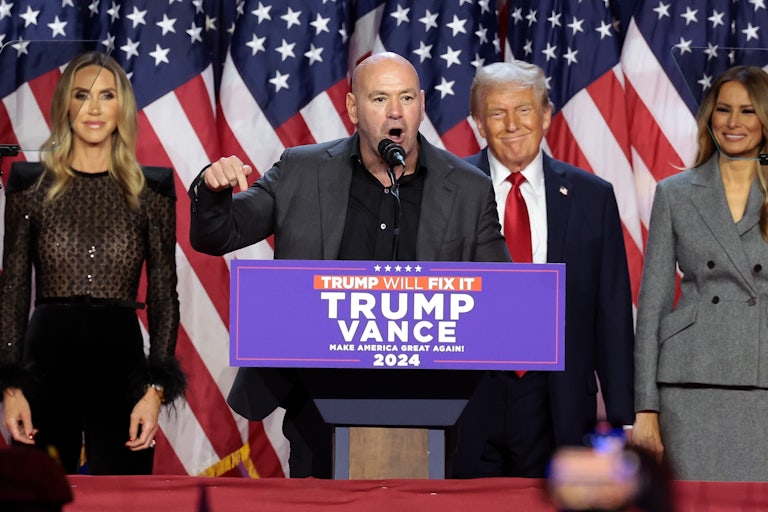
Dana Bash speaks at Trump's victory rally as he looks on and smiles
Win McNamee/Getty Images

On an election night as bleak as it was long, Ultimate Fighting Championship CEO and hardcore Trump supporter Dana White used his stage time at the Trump victory rally to paint an especially grim vision of the future.

There was a palpable joy at the Trump headquarters in the early hours of Wednesday morning as polls nationwide all but guaranteed a Trump victory. Trump brought what looked like his entire team onstage during his nearly 3 a.m. victory speech, even giving White the floor for an outlandish speech in which he heaped praise on Trump.

“This is what happens when the machine comes after you. What you’ve seen over the last several years, this is what it looks like,” said White. “Couldn’t stop him, he keeps going forward, he doesn’t quit, he’s the most resilient, hardworking man I’ve ever met in my life.… This is karma, he deserves this.”

White went on to shout out major manosphere influencers, many of whom are thought to have had a direct impact on the men who voted for Trump.

“I want to thank the Nelk Boys, Adin Ross, Theo Von, Bussin’ With the Boys, and last but not least, the mighty and powerful Joe Rogan.”

Adin Ross’s streams have been a safe place for sexism and general, lowbrow bigotry for some time now. The 24-year-old has been banned from Twitch eight separate times for using a homophobic slur and for “hateful conduct.” Earlier this year, Trump joined Ross’s livestream, per Barron Trump’s suggestion, and was gifted a Rolex live on stream. The Nelk Boys have similarly used their podcast to platform right-wing demagogues like Tucker Carlson to young men. Theo Von and Bussin’ With the Boys are slightly tamer versions of these acts. And the infamous Joe Rogan is the forefather of them all.

This strange lineup of famous podcasters with dubious ties to the alt-right is just a sign of how dangerous and unserious a future Trump Cabinet could be.

Here Are the States That Voted for Labor Rights—and, Bizarrely, Trump

Three red states voted for ballot measures expanding protections for workers.

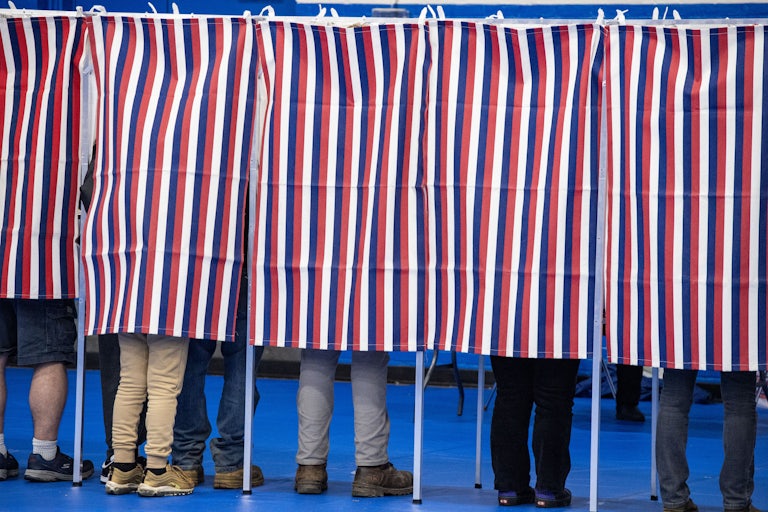
People vote in voting booths
Joseph Prezioso/AFP/Getty Images

Despite victories for Donald Trump across the country, several states that went red also chose to raise the minimum wage and ensure paid sick leave for their workers.

In Missouri, where Trump captured 58 percent of the voters, the same number of Missourians voted to raise the state’s minimum wage to $13.75 per hour starting in 2025 and to $15 per hour starting in 2026.

Alaskans also appear to have voted to raise the minimum wage to $15 per hour by 2027 while securing paid sick leave for workers. Fifty-six percent of Alaskans supported the measure as of Wednesday morning, with 76 percent of voters reported. Meanwhile, Trump won the state and Democratic Representative Mary Peltola lost her House seat.

Similarly, in Arizona, where the presidential race has still yet to be called, voters shot down a ballot measure to reduce the wages of tipped employees nearly three to one. In Nebraska, where Trump handily beat Kamala Harris, voters approved a measure to ensure paid sick leave by similar numbers, with 74 percent voting in favor of allowing workers to accrue paid sick time hours at both large and small companies. Nebraska’s union man, independent candidate Dan Osborn, however, did not win. The Senate candidate, who led a strike against Kellogg’s in 2021, lost to Republican incumbent Deb Fischer Tuesday night.

Strangely enough, similar ballot measures in Arizona and Massachusetts had opposite results. While Arizonans voted down the proposal to “pay up to 25% per hour less than the minimum wage” for tipped workers in Proposition 138, Massachusetts voters appear to have voted down their Question 5, which would have increased the minimum wage for tipped workers. This decision means that Massachusetts workers will continue to make a subminimum wage for tipped work, rather than be brought up to the state’s minimum wage of $15 an hour by 2029. At the same time, Massachusetts residents may have voted to give ride-share drivers the right to join a union.

Though most of California’s ballot measures are too early to call, the results as of Wednesday morning are disappointing. Californians voted to essentially keep slavery legal by voting down Proposition 6, which would have amended the state constitution to end involuntary labor for people in prisons and jails. Moreover, the state also most likely will strike down a proposal to increase the minimum wage.

Meanwhile, Harris won over union members with 57 percent of their vote, compared to Trump’s 39 percent, according to the Associated Press, after she picked up endorsements from most major unions this fall.

Though the results for workers are a mixed bag, it’s clear that Americans care deeply about the economy and their material conditions and that populist proposals that better people’s working lives can win, even in red states.

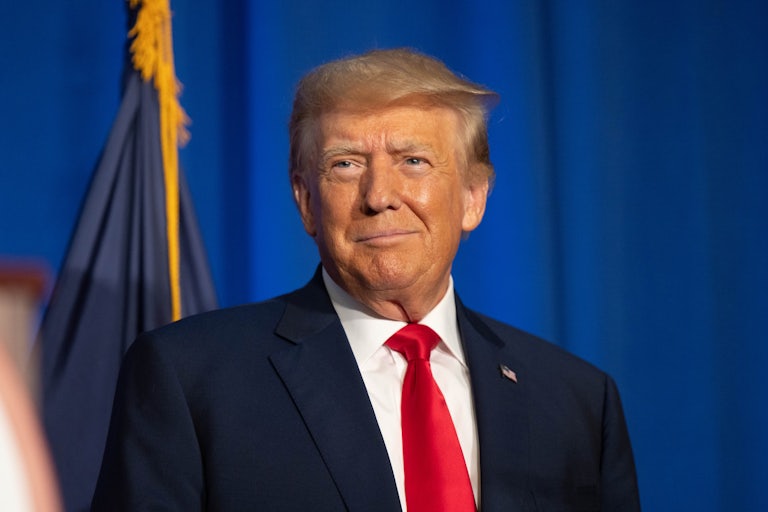
Here’s How Easily Trump Can Make All His Legal Troubles Disappear

Donald Trump can get rid of all the legal cases against him—no questions asked.

Donald Trump
Scott Eisen/Getty Images

Now that he will be returning to the White House, Donald Trump is going to make the federal cases against him disappear.

Trump is now the first convicted felon to become president, and so he has the authority to dismiss special counsel Jack Smith, who was appointed by Attorney General Merrick Garland specifically to investigate Trump’s attempt to overturn the 2020 election and lead the January 6 insurrection, as well as his mishandling of classified documents. Trump has already threatened to not just fire Smith, but have him deported. Though deporting Smith would be hard, given that he’s a natural-born citizen, it’s still easy for Trump to get rid of all the cases against him.

Trump is certain to appoint an attorney general who will not only dismiss cases against him but protect him from any new cases and target his enemies. Among the possible names being discussed is Judge Aileen Cannon, who already dismissed Trump’s classified documents case on the grounds that the appointment of Smith was invalid. Trump said he would consider appointing Texas Attorney General Ken Paxton to the role, who not only has his own legal cases against him but also tried to overturn the 2020 election results.

The charges Trump faces in Georgia for overturning the 2020 election results in that state will also go away, and the sentence for his felony conviction in New York over his hush-money payments to Stormy Daniels is delayed at the very least. The protection of the office of the president will also shield Trump from the civil judgments and penalties against him, such as the fraud judgment against him in New York and E. Jean Carroll’s defamation cases against him.

The Justice Department won’t just be headed by a Trump loyalist, but it will also be filled with a right-wing legal army set to bulldoze any obstacle or measure of accountability against the president, whether that means firing civil servants who object to Trump’s outlandish decrees or ensuring that the conservative fever dreams in Project 2025 are implemented.

The Supreme Court’s ruling on presidential immunity already put many of the cases against Trump in jeopardy, but now that he’ll be entering the Oval Office again, the president-elect will consider himself bulletproof. Trump will eagerly be counting the days until he is sworn in January 20, 2025, when he can be a “dictator on day one” with few, if any, consequences.

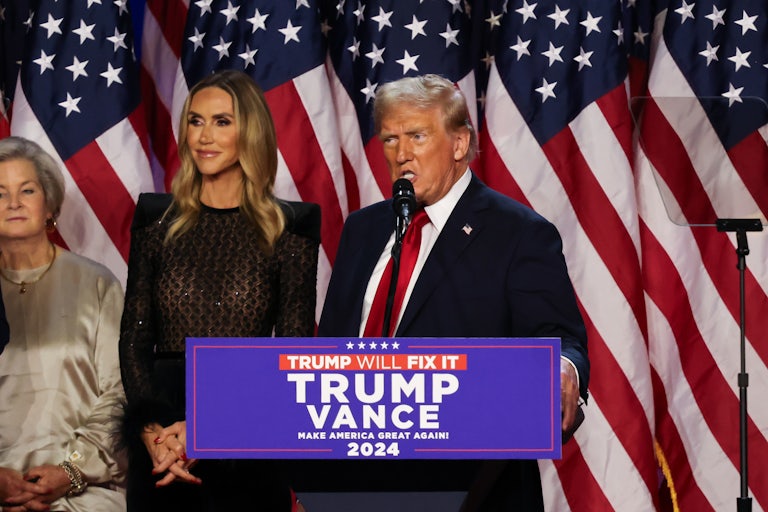
Trump’s First Election Promise Is Making Us Sick (Literally)

Donald Trump is already promising to put RFK Jr. in charge of public health.

Donald Trump looks to the side while speaking at a podium
Brendan Gutenschwager/Anadolu/Getty Images

Donald Trump is already musing about repainting the walls of the federal government post-inauguration—and it appears to involve allowing notorious vaccine skeptic Robert F. Kennedy Jr. free rein over the nation’s health policies.

Delivering his first speech after being declared the winner of the 2024 presidential election, Trump promised a cheering crowd that Kennedy’s name would have a place in his second administration.

“​​He’s going to help make America healthy again,” Trump said as the crowd began to chant “Bobby.”

“He’s a great guy, he really means it, he wants to do some things, and we’re going to let him go to it,” he continued. “I just said, but, Bobby, leave the oil to me. We have more liquid gold—oil and gas—we have more liquid gold than any country in the world. More than Saudi Arabia.”

“Bobby, stay away from the liquid gold. Other than that, go have a good time, Bobby,” Trump added.

During an interview with NBC News’s Dasha Burns on Monday, Trump refused to promise that he wouldn’t ban vaccines, instead outlining his intentions to talk to Kennedy and “talk to other people” and make a decision. “He’s a very talented guy and has strong views,” Trump said of Kennedy.

During the same interview, Trump signaled that he would be open to removing fluoride from all public water systems—a 1945 public health decision that has reduced cavities and tooth decay in adults and children by as much as 25 percent, according to the American Dental Association.

Last week, Trump transition co-chair Howard Lutnick insisted that vaccines are “not proven” and shared that he had a more than two-hour conversation with Kennedy, a notorious vaccine conspiracy theorist who has been promised “control” of several federal agencies, including the Department of Health and Human Services, under a second Trump administration.

Lutnick claimed that Kennedy—who has admitted that his brain has been eaten by worms and who had to apologize for tying vaccine conspiracies to what happened in Germany during the Holocaust—has plans to strip even long-standing vaccines from the market.

Vaccines have proven to be one of the greatest accomplishments of modern medicine. The jabs are so effective at preventing illness that they have practically eradicated some of the worst diseases from our collective culture, from rabies to polio and smallpox, a fact that has possibly fooled some into believing that the viruses and their complications aren’t a significant threat for the average, health-conscious individual.