Breaking News
Breaking News
from Washington and beyond

Elon Musk Is Already Driving Everyone Insane

Less than two weeks after Trump’s victory, the tech baron is clashing with multiple members of his team.

Elon Musk, wearing a fedora and an "Occupy Mars" t-shirt and otherwise looking like a character in a Tim Robinson sketch, stands next to Kid Rock.
Chris Unger/Zuffa LLC
Elon Musk and Kid Rock at UFC 309 on Saturday

Elon Musk is starting to clash with Donald Trump’s team on some of the president-elect’s key issues, especially tariffs. 

The Washington Post reports that Musk is trying to persuade Trump regarding Cabinet picks and economic policy, drawing the ire of the president-elect’s other advisers. On Saturday, Musk praised Argentine President Javier Milei in a post on X for cutting tariffs in his country. The central pillar of Trump’s economic program is raising tariffs. 

In another post later on Saturday, Musk endorsed Howard Lutnick, co-chair of Trump’s transition team and CEO of financial services firm Cantor Fitzgerald, for the post of treasury secretary over hedge fund manager Scott Bessent, who is in the running for the position. Both posts from Musk aren’t going over well with the rest of Trump’s team. 

“People are not happy,” one person in contact with campaign officials told the Post anonymously. Musk’s posts seemed to reflect that the tech CEO and world’s richest man was acting like a “co-president” and beginning to overstep his role, the person added.

Musk’s praise of Lutnick, for example, came before any public statements from the campaign or any announcements from Trump. Musk also called on his followers to weigh in with their opinion on the Cabinet position, which might send a message that he thinks Trump needs some convincing—or pressure.

There is also friction between Musk and Trump adviser Boris Epshteyn, with Axios reporting that the tech mogul thinks Epshteyn, who has pushed for appointments such as Matt Gaetz as attorney general, has too much influence over Trump’s choices. Musk has questioned the qualifications of Epshteyn’s preferred candidates, irking the longtime Trump adviser.  

These disagreements reportedly came to a head last Wednesday at Trump’s Mar-a-Lago estate, where Musk and Epshteyn had an angry exchange at a dinner table. Musk even accused Epshteyn of leaking details about the Trump transition to the media, which Epshteyn denied.  

If Musk gets into a turf war with other members of Trump’s team as Trump’s new presidential administration takes shape, he already has a big advantage. The tech CEO pumped hundreds of millions of dollars into Trump’s campaign, and the president-elect has already included Musk in many important meetings, as well as a phone call to Ukrainian president Volodymyr Zelenskiy just after the election. Last week, Musk even took part in a private meeting with Iran’s ambassador to the United Nations in New York, raising questions of whether it was on Trump’s orders.   

Musk has been photographed with members of Trump’s family too, making it look like he has become part of Mar-a-Lago’s furniture and irking Trump’s advisers and staff. It seems that the world’s richest man has bought his way into Trump’s inner circle and won’t be leaving for the foreseeable future.  

Trump’s War With the Press Takes a Terrifying Turn

Donald Trump has nominated a Project 2025 author to lead the Federal Communications Commission.

Brendan Carr gestures while speaking
Celal Gunes/Anadolu/Getty Images

Donald Trump has announced that the next Federal Communications Commission chair would be Brendan Carr, the senior-most Republican on the FCC and a contributor to Project 2025.

“Commissioner Carr is a warrior for free speech, and has fought against the regulatory lawfare that has stifled Americans’ freedoms, and held back our economy,” Trump said in a statement Sunday. The president-elect did not mention Carr’s involvement in Project 2025.

In his Project 2025 chapter, Carr outlined his agenda for the FCC. Carr wrote that one of the goals for Trump’s administration should be reining in Big Tech’s “attempts to drive diverse political viewpoints from the digital town square,” according to Business Insider. Carr suggested that companies be unable to censor content unless it is illegal, allowing consumers to choose their own content filters and fact-checking services.

Carr’s intentions for social media are perhaps best demonstrated by X, which has been transformed into a MAGA misinformation echo chamber by its owner, Elon Musk, who seems to have permanently attached himself to Trump’s side.

Carr also pushed to ban TikTok if its parent company, ByteDance, does not sell its U.S. operations, warning that Americans were receiving their news and information from China.

In addition to addressing Big Tech, Carr also wrote that the FCC should focus on “promoting national security, unleashing economic prosperity, and ensuring FCC accountability and good governance.”

House Democrats previously called for an investigation into Carr over his partisan activity, but it did not result in formal action, according to NPR. Carr said he received approval from FCC ethics officials to contribute to the right-wing playbook.

Trump spent months on the campaign trail disavowing Project 2025, an authoritarian policy road map cooked up by the right-wing think tank Heritage Foundation, only to now welcome its architects into the fold.

Last month, Carr railed against Kamala Harris’s surprise appearance on NBC’s Saturday Night Live, calling it “a clear and blatant effort to evade the FCC’s Equal Time rule” and “biased and partisan conduct.” Trump was offered equal time on NBC, and the FCC said they had “not made any determination regarding political programming rules, nor have we received a complaint from any interested parties.”

Still, Carr took up the bullhorn on behalf of the president who’d appointed him to the FCC in 2017.

FCC rules dictate that only three commissioners can be affiliated with the same political party at any given time, and none can have a financial interest in any commission-related business. The FCC is responsible for regulating interstate and international communications by radio, television, wire, satellite, and cable. Under Trump’s first administration, the FCC repealed net neutrality rules, which were then reinstated this year.

Trump’s Plans for Government Efficiency Keep Getting More Extreme

Vivek Ramaswamy is preparing to go further than even Project 2025.

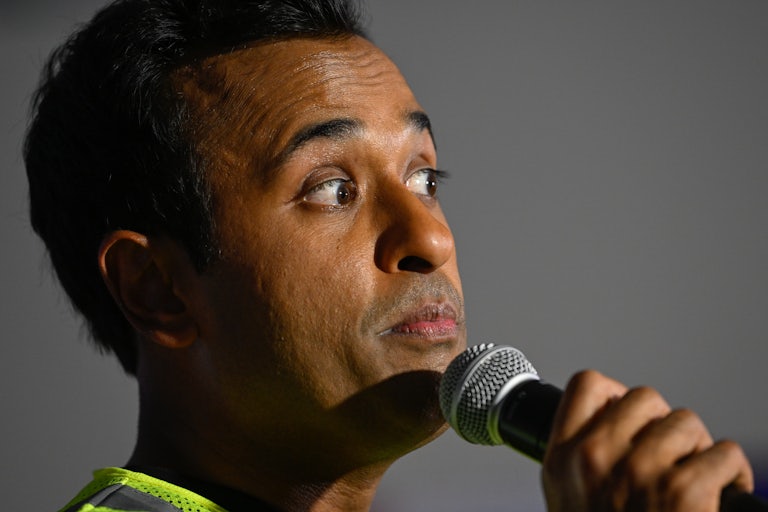
Vivek Ramaswamy raises his eyebrows and holds a microphone up to his face
Peter Zay/Anadolu/Getty Images

Donald Trump has sweeping plans for his second term, and they include slashing and gutting large parts of the executive branch.

Speaking with Fox News’s Maria Bartiromo on Sunday, Trump’s nominated co-chair for the Department of Government Efficiency, or DOGE, Vivek Ramaswamy outlined the massive agenda, revealing that the plan is akin to—or possibly more extreme than—the road map offered by Project 2025. Ramaswamy proposed that several government agencies under his helm would be “deleted outright.”

“Are you expecting to close down entire agencies? Like, President Trump has talked about the Department of Education, for example. Are you going to be closing down departments?” Bartiromo asked.

“We expect mass reductions,” said Ramaswamy. “We expect certain agencies to be deleted outright. We expect mass reductions enforced in areas of the federal government that are bloated. We expected massive cuts of our federal contractors and others who are overbilling the federal government.”

And Ramaswamy believes that he and his fellow departmental co-chair, world’s richest man Elon Musk, can expedite those changes by leaning on the highest rungs of the third branch of government: the Supreme Court.

“I think people will be surprised by how quickly we’re able to move with some of those changes, given the legal backdrop the Supreme Court has given us,” Ramaswamy told Fox.

From the Trump administration’s perspective, the executive branch can overstep Congress entirely to swiftly remove agencies such as the Department of Education since they were first enacted by executive action.

“It’s the unelected bureaucrats in the administrative state that was created through executive action,” Ramaswamy said. “It’s going to be fixed through executive action.”

“Think about the Supreme Court’s environment,” he continued. “Over the last several years, they’ve held that many of those regulations are unconstitutional at a large scale. Rescind those regulations, pull those regs back, and then that gives us the industrial logic to then downsize the size of that administrative state.”

After that, DOGE (the agency) would begin examining cuts to the budget. Reminder: Musk promised to trim $2 trillion from the federal budget, which constitutes more than Congress has in discretionary spending, a move that would practically defund the entire executive branch, which doles out funding for the military, national security, and federal agencies.

“And the beauty of all of this is that [it] can be achieved just through executive action without Congress,” Ramaswamy added. “Score some early wins, and then you look at those bigger portions of the federal budget that need to be addressed one by one.”

This Unqualified MAGA Addict Might Become Trump’s FBI Director

Kash Patel is an intellectual lightweight who spends all his time trying to please Dear Leader.

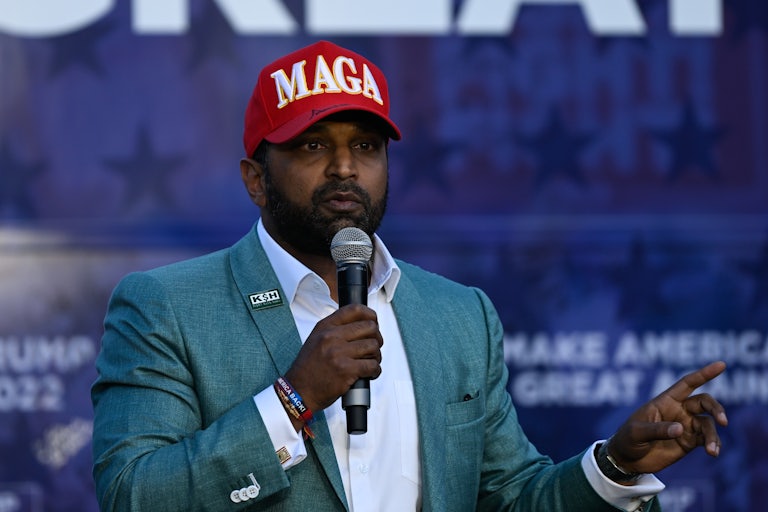
Kash Patel in Charlotte
Peter Zay/Anadolu/Getty Images
Kash Patel in Charlotte in October

Donald Trump has his eye on yet another unqualified lightweight to lead a key agency, as the president-elect reportedly is considering loyalist Kash Patel to head the FBI. 

CNN reported Friday that Trump’s right-wing allies are trying to convince him to fire Christopher Wray, whom Trump appointed in 2017 after firing James Comey for allegedly mishandling the investigation into Hillary Clinton’s private email server. 

During his presidential campaign, the president-elect expressed his displeasure at Wray, who drew his ire after Trump’s Mar-a-Lago estate was searched in 2022 due to alleged mishandling of classified documents. FBI directors are supposed to serve a single 10-year term, but Patel’s appointment would make him the third FBI director in seven years. 

Patel is a vehement defender of Trump, showing up regularly on Fox News, at conservative events, and even at Trump’s hush-money trial in New York. In the waning days of his first term, Trump pushed to appoint Patel deputy director of the CIA or FBI but backed down only after receiving pushback from CIA Director Gina Haspel and Attorney General Bill Barr. 

“Patel had virtually no experience that would qualify him to serve at the highest level of the world’s preeminent law enforcement agency,” Barr would later write in his memoir. Or, as CNN put it, “Even among Trump loyalists, Patel is widely viewed as a controversial figure and relentless self-promoter whose value largely derives from a shared disdain for the so-called deep state.”

Patel has said he wants to go after government employees who leak information to the press, as well as journalists themselves. On Steve Bannon’s podcast in December, he said that he and other Trump loyalists “will go out and find the conspirators not just in government but in the media. 

“We’re going to come after the people in the media who lied about American citizens who helped Joe Biden rig presidential elections,” Patel said to Bannon. “We’re going to come after you, whether it’s criminally or civilly. We’ll figure that out. But yeah, we’re putting you all on notice.” 

If Trump installs Patel at the FBI, it would certainly further Trump and his MAGA allies’ goal of purging the federal workforce of disloyal employees. It also would raise eyebrows for the next FBI director to have three years working in the Department of Justice as his only law enforcement experience. But Patel has demonstrated loyalty to Trump, which might be enough to win over Republicans in Congress.  

Republicans Are Already Trying to Grant Trump Dangerous Powers

The Stop Terror-Financing and Tax Penalties on American Hostages Act, defeated once this week, is already back from the dead.

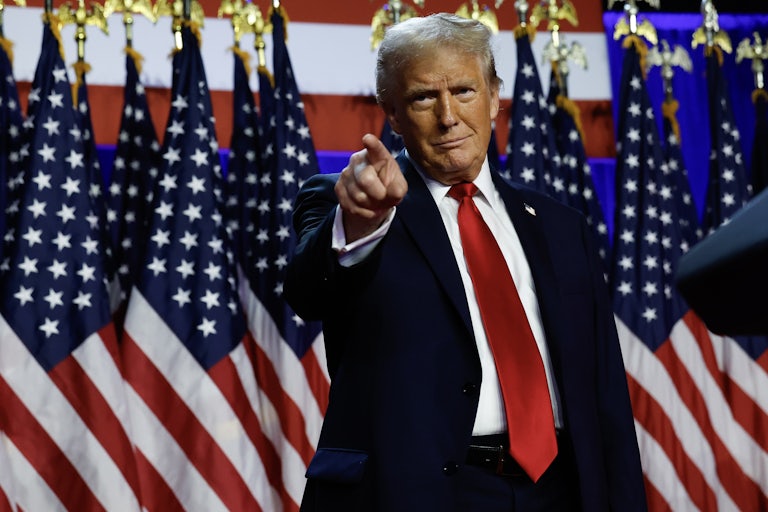
Donald Trump points a finger
Chip Somodevilla/Getty Images
Donald Trump shortly after winning the 2024 presidential election

House Republicans are trying to push through a bill that would give President-elect Donald Trump powers as president to designate nonprofit organizations as “terrorist-supporting,” even after it was seemingly defeated earlier this week.

The Stop Terror-Financing and Tax Penalties on American Hostages Act would allow the secretary of the treasury the ability to revoke any nonprofit organization’s tax-exempt status by branding it with a terrorism label. Earlier this week, the bill failed to receive the necessary two-thirds majority in the House to advance to the Senate.  

But on Monday, the House Rules Committee plans to hold a hearing that could set up a new vote on the bill, which initially had the support of all but one Republican and 52 Democrats. With the GOP only holding a seven-seat majority in the chamber, they would need the support of more Democrats to advance the bill, which was introduced to combat protests against Israel’s war on Gaza.  

Under any circumstances, the bill would threaten First Amendment rights to free speech, but after Trump’s election last week, there are now fears that the president-elect could use these new powers to crack down on his enemies with little recourse. In addition to activist groups, many universities and news outlets are nonprofit organizations.

After the bill’s initial failure on Tuesday, the American Civil Liberties Union celebrated the rejection of “new broad and easily abused powers.”  

“The freedom to dissent without fear of government retribution is a vital part of any well-functioning democracy, and now is not the time to grant the executive branch new powers to investigate and functionally shut down and silence its critics,” said Kia Hamadanchy, senior policy counsel for the ACLU, in a statement.

Now the bill could be given a retooling and sent up for a vote again, giving a president who has already threatened to use the military against his critics even more sweeping powers. The question is if Democrats will recognize the bill as granting dangerous powers to the presidency or see it as a chance to clamp down on protesters they have tried to ignore at their peril for the past year.