Breaking News
Breaking News
from Washington and beyond

Hypocrite Mitch McConnell Complains That Democrats Are Too Partisan

McConnell, who has done more to undermine the integrity of the legislative branch than anyone in the last half-century, thinks judges who are unretiring after Trump’s win lack integrity. Good grief!

Mitch McConnell does a creepy toothless grin as he looks down
Drew Angerer/Getty Images
Mitch McConnell

Senator Mitch McConnell is upset that two Democratic judges are reversing their decisions to retire, complaining Monday that “this sort of partisan behavior undermines the integrity of the judiciary.”

After Donald Trump was elected to his second term as president last month, two judges appointed by Democratic presidents changed their minds about retiring. U.S. District Judge Max Cogburn, appointed by President Obama, announced that he would remain active on the court for the Western District of North Carolina after previously saying he would move to part-time status in 2022.

Before Cogburn, U.S. District Judge Algenon Marbley, a Clinton appointee, changed his mind about moving to senior status on the court for the Southern District of Ohio. To McConnell, this “exposes bold Democratic blue where there should only be black robes.

“It’s hard to conclude this is anything other than open partisanship,” the former Senate majority leader added, before offering a warning to Democrats: “It would be especially alarming if either of the two circuit judges whose announced retirements created the vacancies currently pending before the Senate—in Tennessee and North Carolina—were to follow suit.”

Democratic Senator Dick Durbin, who chairs the Senate Judiciary Committee, highlighted McConnell’s hypocrisy in his complaints about partisanship, pointing out that McConnell blocked President Obama’s appointment of Merrick Garland for one year in 2016. The Kentucky senator’s delay tactic allowed Republican Donald Trump to appoint Justice Neil Gorsuch immediately upon taking office.

“When I hear the senator come to the floor, from Kentucky, and talk about whether there is any gamesmanship going on, I don’t know but I can tell. We saw it at the highest possible level in filling the vacancy on the Supreme Court when Antonin Scalia passed away,” Durbin said.

McConnell made it his personal mission to confirm as many conservative federal judges as possible when his party controlled the Senate during Trump’s first term. The appointees generally signed off on whatever Republicans and Trump wanted and were younger and less qualified than previous judicial appointments. They also gave the GOP favorable decisions in restricting voting rights to help Republican candidates.

It was all part of McConnell’s legacy of serving the interests of powerful conservative billionaires. He’s crying foul now because Democrats are using tactics that he pioneered when he was in power. In fact, he probably would have far exceeded them. While McConnell has now ceded leadership of Senate Republicans, and by extension the Senate, to his ally John Thune, it remains to be seen if the next Senate majority leader will pursue Republican goals as brazenly as McConnell.
Shocking Exit Poll Reveals Why Trump Beat Harris

Voters were most concerned with these three issues.

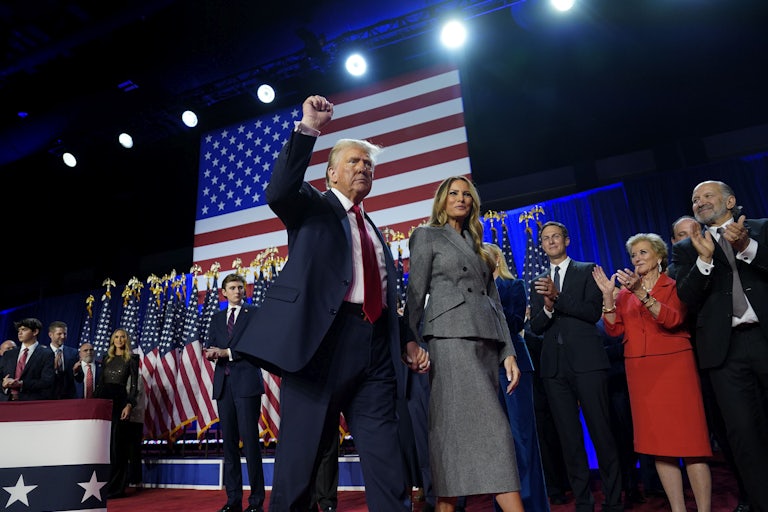
Donald Trump raises his fist during an Election Night party
Jabin Botsford/The Washington Post/Getty Images

When it came time to hit the voting booths, Americans sided with Donald Trump on their top three biggest concerns.

A poll published Tuesday by Navigator Research revealed that Trump’s stance on—and his ability to elevate—three key issues drastically swayed American voters at the ballot box. Those issues included inflation and the cost of living, immigration and the border, and jobs and the economy. Navigator Research surveyed 5,000 voters in the 2024 general election, some of whom self-reported as new Trump voters.

Across the survey pool, 43 percent of voters ranked inflation as their top priority, followed by a tie between immigration and the economy for second and third place with 31 percent of the vote. Swing voters and first-time Trump voters were even more concerned by those same issues, with approximately 45 percent of swing voters ranking inflation as their first priority and 55 percent of new Trump voters doing the same.

And Trump’s messaging resonated with those voters, with the president-elect winning by double digits on those issues over Vice President Kamala Harris. On the issue of inflation, voters sided with Trump by a matter of 34 points. He won by 31 points with voters who ranked jobs and the economy as one of their most important issues and by a massive 71 points with voters who prioritized immigration and border policies.

Harris won on the next four issues most significant to voters, though the significance of the issues was obviously relatively minimal. Those included abortion, Social Security and Medicare, health care, and threats to democracy—the last of which Harris won by 60 points.

The Democratic candidate also won on guns and climate by 43 and 70 points, respectively, though voters ranked those issues much lower on the totem pole.

Stunning Memo Exposes Which SCOTUS Justices Want to Keep Being Crooks

Supreme Court Justices Samuel Alito and Clarence Thomas weren’t alone in opposing an ethics code.

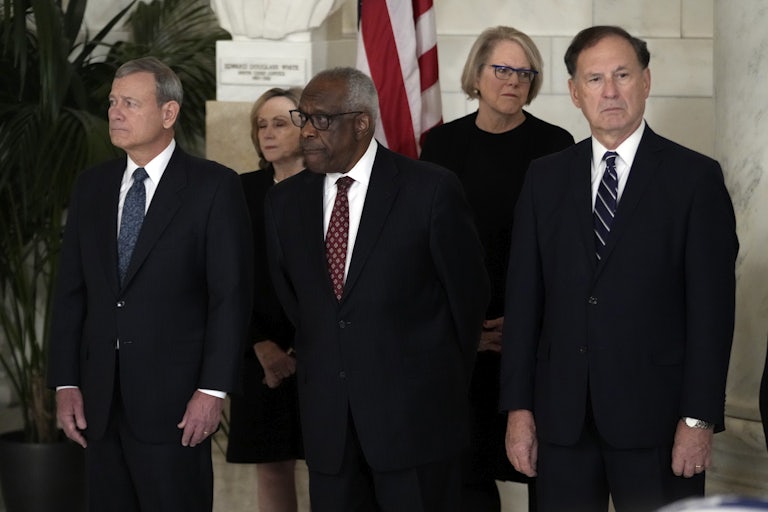
Chief Justice John Roberts and Justices Clarence Thomas and Samuel Alito stand next to each other
Jacquelyn Martin/Pool/Getty Images

A few Supreme Court justices went out of their way to fight back against enforcing the court’s new ethics rules, The New York Times reported Tuesday—and it’s not that surprising.

In a series of secret offline memos and meetings, the justices toiled away over how they would formulate their code of ethics, and—crucially—whether it could actually be enforced.

Justices Sonia Sotomayor, Elena Kagan, and Ketanji Brown Jackson all supported enforcement rules for the court’s code of ethics. Kagan even pitched a panel of “safe harbor” judges that justices could go to about ethics concerns. Her proposal failed to gain wider support.

Meanwhile, Justice Neil Gorsuch railed against enforcement of the ethics code, essentially arguing that not abusing his seat of power should be voluntary. One of his memos raising concerns over enforcement stretched to more than 10 pages, according to the Times.

Gorsuch warned that ethics enforcement would threaten the court’s independence, and Justice Samuel Alito echoed his concerns, the Times reported. Justice Clarence Thomas, who has failed to report that he accepted exorbitant gifts and trips from conservative megadonors such as Harlan Crow, argued that the court’s critics could not be appeased.

Gorsuch, Thomas, and Alito compromised and agreed to some enforcement mechanisms—but only ones that couldn’t reasonably be enforced. Ultimately, the court decided to place no real restrictions on accepting gifts, travel, or real estate.

Angela Merkel Slams Trump’s “Fascination” with Dictators Like Putin

The former German chancellor had some choice words for Donald Trump.

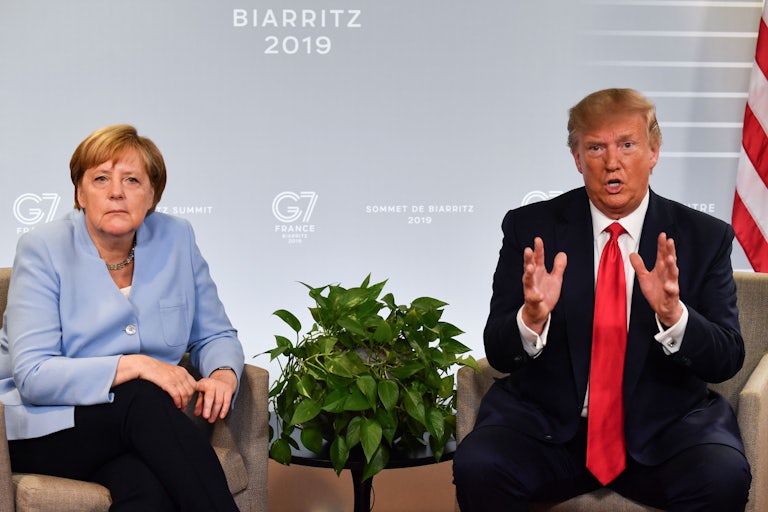
Angela Merkel sits next to Donald Trump while he gestures and speaks
Nicholas Kamm/AFP/Getty Images

Donald Trump has an obsession with total power, and America’s greatest democratic allies have taken notice.

In an interview with CNN published late Monday, former German Chancellor Angela Merkel recalled that her first impression of the MAGA leader was his “fascination with the sheer power” of authoritarian leaders such as Russian President Vladimir Putin and North Korean dictator Kim Jong Un.

“My impression always was that he dreamt of actually overriding maybe all those parliamentary bodies that he felt were in a way an encumbrance upon him, and that he wanted to decide matters on his own,” Merkel told CNN. “In a democracy—well, you cannot reconcile that with democratic values.”

The wide-ranging interview with CNN’s Christiane Amanpour covered Merkel’s upcoming memoir, Freedom, and her fears for liberal democracy as it comes “under pressure” from international threats.

“The way he spoke about Putin, the way he spoke about the North Korean (leader)—obviously apart from critical remarks he made—there was always a kind of fascination with the sheer power of what these people could do,” Merkel said.

In that vein, Trump has threatened to weaponize the Federal Communications Commission to punish media organizations that are critical of him, referred to his political opposition as the “enemy from within,” and claimed that the military should be deployed to help him retain power.

Merkel isn’t the only person to raise alarm bells over Trump’s disturbing veer toward authoritarianism. Ex-members of Trump’s inner circle, including his longest-serving chief of staff, retired Marine Gen. John Kelly, have condemned their former boss as a “fascist.” In a shocking October interview with The New York Times, Kelly warned that Trump had—on multiple occasions—praised Adolf Hitler, and reportedly said that he “needed the kind of generals that Hitler had,” which Kelly said Trump defined as “people who were totally loyal to him, that follow orders.

“Certainly the former president is in the far-right area, he’s certainly an authoritarian, admires people who are dictators—he has said that. So he certainly falls into the general definition of fascist, for sure,” Kelly said at the time.

Surprise: Trump’s Latest Appointment Has Conflicts of Interest

Steve Feinberg, tapped to be a key leader in the Pentagon, has extensive business ties to the defense industry.

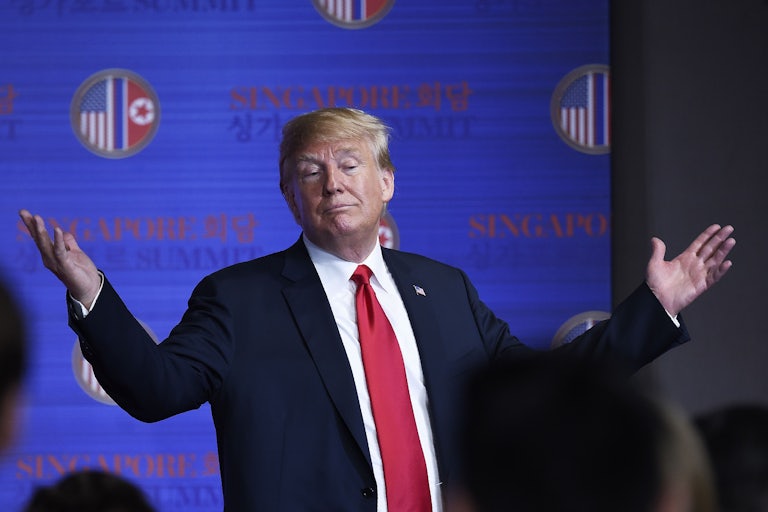
Donald Trump holds out his arms, making a big shrug
SAUL LOEB/AFP/Getty Images
Donald Trump in 2019

Donald Trump’s pick for the number two position in the Department of Defense, Steve Feinberg, is a billionaire with business ties to the defense industry.

The Washington Post, citing unnamed sources, reports that the president-elect has chosen Feinberg for the post of deputy secretary of defense, which requires confirmation from the Senate. Feinberg is co-CEO of Cerberus Capital Management, which has invested in hypersonic missiles and once owned private military contractor DynCorp.

In Trump’s first term, Feinberg was the head of the President’s Intelligence Advisory Board, which gives advice to the president on intelligence estimates and assessments, as well as counterintelligence. The deputy secretary of defense post comes with much more responsibility, with day-to-day management of the massive department’s three million civilian employees and service members among its duties.

Like Trump’s choice for secretary of defense, Pete Hegseth, Feinberg does not have experience running a large organization or working in the Pentagon. Plus, Feinberg’s investments and business activities would create multiple conflicts of interest if his appointment to the DOD survives the Senate.

Unlike Hegseth, Feinberg doesn’t have a long list of sexual misconduct, as well as scandals running veterans organizations (that we know of). His appointment could convince senators that there’s someone competent actually running things as the deputy to a Christian nationalist who envisions the military taking sides in a civil war scenario.

Feinberg is not the only Trump appointee with conflicts of interest: The president-elect’s pick to run Medicare and Medicaid, Mehmet Oz, has multiple ties to the pharmaceutical industry. But Feinberg’s defense industry ties could affect his view of the role of the U.S. military, as the Trump administration is already stocked with pro-war and pro-intervention advisers. A man who stands to profit when the U.S. military is deployed doesn’t bode well for peace.