Breaking News
Breaking News
from Washington and beyond

Dr. Oz Exposed for Colossal, Multimillion-Dollar Conflict of Interest

Donald Trump wants Dr. Oz to head Medicare and Medicaid. Here are just some of the ways that could be a disaster.

Dr. Oz smiles
Mark Makela/Getty Images

Dr. Mehmet Oz, the daytime television host Donald Trump has picked to run the Centers for Medicare and Medicaid Services, or CMS, may have a direct financial stake in three companies that would do business with the agency he intends to run.

A review of Oz’s 2022 tax disclosure by Accountable.US revealed that the Trump ally owned up to $26 million stake in Sharecare, a digital health company co-founded by Oz that operates CareLinx, the “exclusive in-home care supplemental benefit program” used by 1.5 million Medicare Advantage enrollees. The company went private in 2024, so it’s unknown whether Oz still owns a stake in the company.

Novo Nordisk, which produces Ozempic and Wegovy among other drugs, is also a client of Sharecare. As head of CMS, Oz has considerable impact on the pharmaceutical industry—but with business ties like these, it’s equally likely that these drug companies could have a profound impact on him.

Oz’s transition team spokesperson, Nick Clemens, told USA Today Friday that Oz had sold off his stake in Sharecare, but did not speak to the other stocks Oz owned with ties to the insurance industry.

In 2022, Oz also owned a stake valued at between $280,000 and $600,000 in UnitedHealth Group and between $50,000 and $100,000 in CVS Health, both of which provide insurance plans for roughly 41 percent of all Medicare Advantage enrollees as of 2024.

Oz also disclosed owning a stake valued at up to $25 million in Amazon and up to $5 million in Microsoft, which operate CMS’s “two primary cloud service providers,” according to its most recent budget.

Accountable.US did not find any indication that Oz had sold these stocks, and it was not confirmed by his spokesperson.

Elon Musk and His Nemesis Have One Thing in Common

Sam Altman and Musk are currently engaged in a bitter, protracted feud over OpenAI, the artificial intelligence company they co-founded in 2015. But they both are bankrolling Donald Trump.

a stock image of Sam Altman on the left, in the middle a hand holds a mobile screen showing the logo of OpenAI, on the right a stock image of Elon Musk
Korkutata/Anadolu/Getty Images
Sam Altman, Elon Musk, and the logo of OpenAI, the company they co-founded in 2015

Sam Altman has joined the growing list of billionaires genuflecting before Donald Trump.

Fox Business reported Friday that the tech founder will personally be donating $1 million to the presidential inaugural committee. “President Trump will lead our country into the age of AI, and I am eager to support his efforts to ensure America stays ahead,” Altman said in a statement.

We’ll have to see if the donation smooths over Altman’s rocky relationship with fellow OpenAI co-founder and President-elect Trump’s self-styled “first buddy,” Elon Musk.

Musk left OpenAI in 2018, reportedly after his fellow founders shot down a proposal to let him run the company himself. Musk has since taken shots at Altman (and launched his own AI company), but their feud has heated up in recent months. Musk sued OpenAI in March, alleging it violated its nonprofit principles, and his criticisms of Altman have taken on a distinctly Trumpish flavor: The world’s richest man and unofficial Trump co-president recently dubbed Altman “Swindly Sam.”

But with a second Trump administration on the horizon, plutocrats’ past beefs with Trumpworld are magically disappearing. The announcement of Altman’s $1 million donation to the upcoming inauguration follows reports of Mark Zuckerberg and Jeff Bezos doing the same, despite their past run-ins with Trump.

Zuckerberg, who has called Trump “badass” even as Trump threatened him with imprisonment for supposed election interference as the owner of Facebook, will donate to the inauguration fund through Meta. Jeff Bezos—who has long been lampooned by Trump as the owner of The Washington Post—tanked the Post’s 2024 endorsement of Kamala Harris at the last minute in November. He will be donating his million via Amazon.

Texas Expands Its Horrific Anti-Abortion Crusade Beyond State Lines

Texas Attorney General Ken Paxton is taking his war on abortion to the next level.

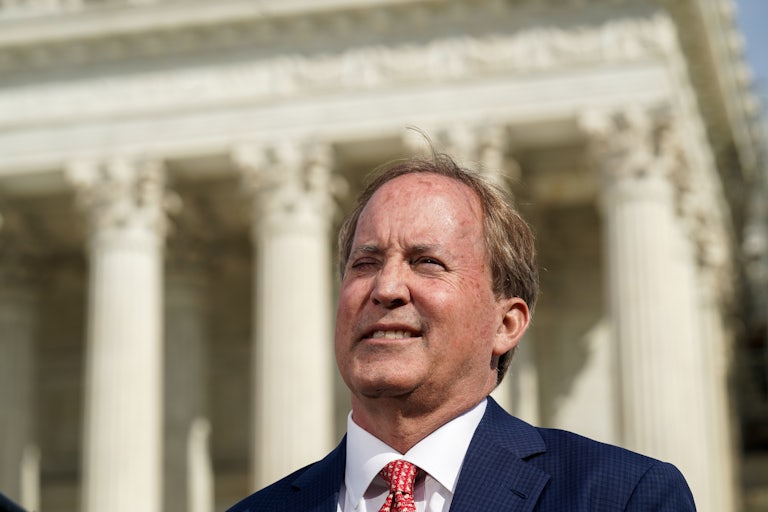
Texas Attorney General Ken Paxton smiles outside the Supreme Court
Jahi Chikwendiu/The Washington Post/Getty Images

Texas Attorney General Ken Paxton has taken the Lone Star State’s abortion battle to the national stage, suing a New York doctor for prescribing the abortion pill to an in-state resident.

New York’s state law protects doctors and providers providing abortion care from out-of-state investigations and prosecutions, making the Empire State a home base for companies shipping out the abortion pill to consumers around the country.

Paxton has accused Dr. Margaret Carpenter of mailing the pills to a Collin County resident who allegedly consumed the medication when she was nine weeks pregnant, reported The Texas Tribune. The lawsuit does not mention if the woman was successful in terminating her pregnancy.

Now Paxton is asking the county court to order Carpenter to pay $100,000 for every violation of the state’s near-total abortion ban. (Violators of the draconian abortion law could also serve up to life in prison and have their Texas medical license revoked.) The lawsuit is the first attempt to enforce a state abortion ban beyond its borders.

“Abortion is, and will continue to be, legal and protected in New York. As other states move to attack those who provide or obtain abortion care, New York is proud to be a safe haven for abortion access,” wrote New York Attorney General Letitia James in a statement responding to Paxton’s lawsuit. “We will always protect our providers from unjust attempts to punish them for doing their job and we will never cower in the face of intimidation or threats. I will continue to defend reproductive freedom and justice for New Yorkers, including from out-of-state anti-choice attacks.”

The two-drug prescription commonly referred to as the “abortion pill” is a mixture of mifepristone and misoprostol. The procedure accounts for more than half of all the abortions in the United States, according to a 2022 report by the Guttmacher Institute, and has become a crucial tool as abortion restrictions limit access to in-person medical visits. It is more than 95 percent effective at ending pregnancies when used before 10 weeks of pregnancy, according to statistics by the American College of Obstetricians and Gynecologists.

Access to mifepristone has become an increasingly fraught political issue in the years since the Supreme Court overturned Roe v. Wade in 2022. In October, the attorneys general of Kansas, Missouri, and Idaho—a cohort of states with some of the most draconian abortion restrictions in the nation—sued the federal government to limit access to the drug, arguing that the medication should be illegal for minors (misoprostol is fully legal as it is used for other treatments).

The suit also accused the Food and Drug Administration of having “unlawfully removed its prohibition against mailing abortion drugs,” allowing what the attorneys general described as a “a 50-state abortion drug mailing economy” to undermine their states’ abortion laws.

But their moral ground for pushing the ban was seemingly less focused on protecting children’s health than it was on actually creating more children, with the lawsuit detailing the (apparently) unfortunate ramifications that abortion access has on an (apparently) desirable conundrum: teenage pregnancy.

“This study thus suggests that remote dispensing of abortion drugs by mail, common carrier, and interactive computer service is depressing expected birth rates for teenaged mothers in Plaintiff States, even if other overall birth rates may have been lower than otherwise was projected,” the suit read on page 190.

The Supreme Court unexpectedly saved mifepristone access in June, when it unanimously ruled that a group of different plaintiffs, represented by the right-wing Christian legal group Alliance Defending Freedom, did not have legal standing to sue the FDA and that the legal organization had failed to demonstrate how its clients were personally harmed by the drug’s existence on the market.

By and large, most Americans support abortion access. In a 2023 Gallup poll, just 12 percent of surveyed Americans said that abortion should be illegal in all circumstances. Meanwhile, 69 percent believe that it should be legal in the first trimester of pregnancy.

This article has been updated.

Trump Prepares to Wreck Economy With Alarming Bank Regulator Plan

The Trump team is asking potential nominees some shocking questions about government cuts.

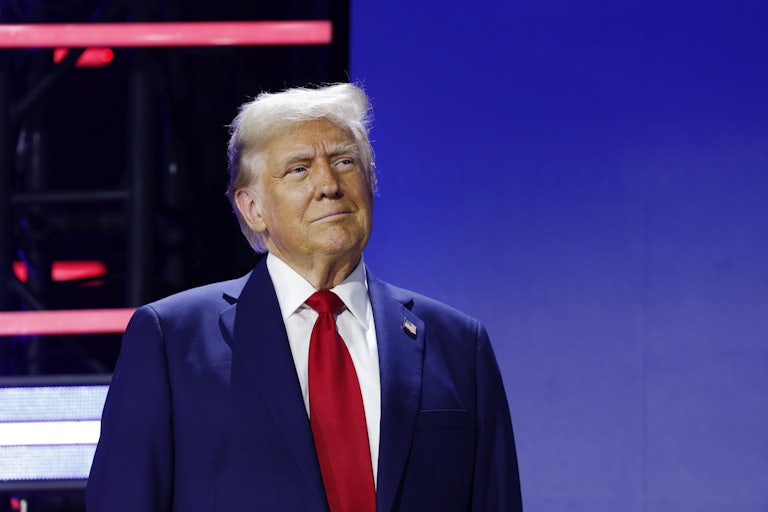
Donald Trump smiles
Anna Moneymaker/Getty Images

In an effort to shrink the size of the federal government, Donald Trump’s transition team is considering different plans to abolish a crucial financial regulatory agency—a move that could have far-reaching effects on the economy.

While interviewing potential nominees for positions heading up government financial agencies, Trump advisers have floated whether it would be worth dissolving some agencies, like the Federal Deposit Insurance Corporation, or FDIC, according to The Wall Street Journal.

The team is considering moving the responsibilities of the FDIC, which include providing deposit insurance for banks, to the Treasury Department, some people familiar with the matter told the Journal.

Potential nominees have also been meeting with DOGE co-chairs technocrat troll Elon Musk and failed presidential candidate Vivek Ramaswamy, as well as hedge fund manager Scott Bessent, the major Trump donor tapped to lead the Treasury, according to sources.

The FDIC is key to financial stability and security because it insures funds in depositors’ checking and savings accounts. To threaten that insurance would almost certainly cause customers to fear that their money is no longer safe. It could potentially lead to a run on the banks, which might result in banks failing in a major financial collapse.

But if a cut makes the wiley DOGE czars feel like they’re reducing bureaucratic redundancies, it must be worth it, right?

Sheila Bair, who previously served as chair of the FDIC, warned about the plan to dissolve the essential regulator.

“Eliminating the FDIC is so out there, not sure it needs response,” Bair wrote in a post on X Friday. “FDIC has a perfect record of protecting insured deposits for over 90 years. Strong consumer confidence in the brand, providing stability during crises. During the [Great Financial Crisis], money was running INTO banks.”

Bair, who also served as the former assistant secretary for financial institutions, explained that the Treasury Department was not well suited to take on the responsibilities of the FDIC.

“As a former Treasury official, big supporter of the Department, but it would not be a good home for deposit insurance. Deposit insurance is funded by bank premiums, not taxpayers. Treasury has no expertise in handling bank failures. Changing the guarantor would create confusion among depositors who are comforted by the ‘FDIC Insured’ sign at their banks,” she added in a separate post.

UnitedHealth CEO Sparks Uproar After Unbelievable New York Times Op-Ed

The New York Times has published the most inane op-ed after the shooting of the UnitedHealthcare CEO.

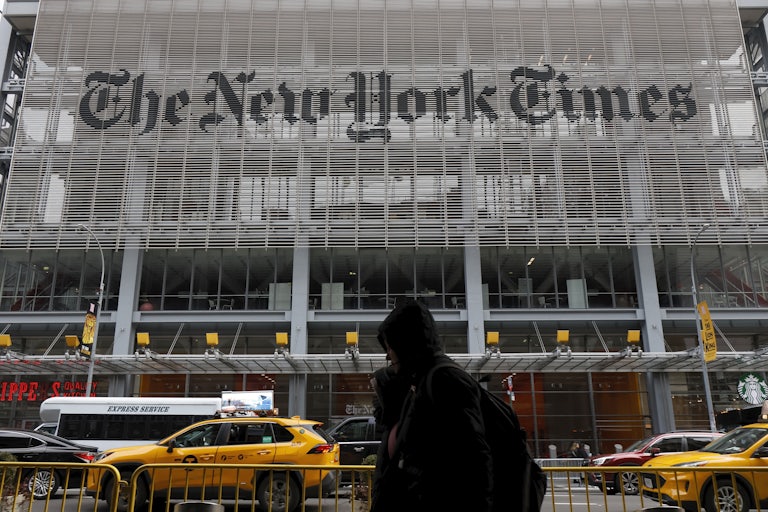
New York Times building
Gary Hershorn/Getty Images

Critics are torching a New York Times op-ed Friday by the chief of UnitedHealthcare’s parent company, arguing that the $23.5 million-salaried executive’s message overwhelmingly ignored the failures actively perpetuated by his company in the American health care system.

UnitedHealth Group CEO Andrew Witty condemned the American public’s gleeful response to the death of UnitedHealthcare CEO Brian Thompson, who was assassinated by a masked gunman last week on the streets of New York City just hours before an investor meeting.

In roughly 600 words, he also attempted to deflect his insurance network’s responsibility in the growing inequity in America’s health care system, vaguely pointing to a “patchwork” of failures decades in the making while swearing that his corporate network—which reported $22 billion in profits in 2023 alone, nearly three times the figure reported by CVS, the second-most-profitable health insurance company that year—was consistently fighting to “deliver high-quality care and lower costs.”

But readers weren’t buying it.

Instead, they swarmed the Times with negative feedback, piling on more than 2,500 comments within hours of the article’s publication, temporarily disabling its Comments section. Users shared their own horrible experiences with the health insurance industry, deriding Witty’s vapid analysis as a “self-serving essay” that did nothing to address UnitedHealthcare’s role in a system that prioritizes shareholder profits over successful medical outcomes for its clients.

X screenshot Ken Klippenstein @kenklippenstein LOL, NYT just disabled comments on the UnitedHealth CEO op-ed [screenshot of notifications that the comments section is closed]

Federal data from 2022 compiled by the personal finance website ValuePenguin found that UnitedHealthcare far outpaced its competitors when it came to denying coverage, rejecting 32 percent or roughly one in three claims. In 2024, the insurer’s parent group spent more than $5.8 million lobbying Congress on health care–related issues.

Meanwhile, Americans are paying more than ever for health insurance, with costs far outpacing the rate of inflation. A Kaiser Family Foundation report published earlier this year found that the vast majority of U.S. adults are worried about being able to afford a major medical expense, regardless of their financial position.