Breaking News
Breaking News
from Washington and beyond

Trump Confirms Dark Call With Netanyahu on Next Steps in Gaza

The two leaders reportedly spoke about what “victory” in Gaza would look like.

Donald Trump, standing behind the White House lectern, and Benjamin Netanyahi standing side by sid
Sarah Silbiger/Getty Images

President-elect Donald Trump confirmed Monday that he spoke with Israeli Prime Minister Benjamin Netanyahu recently, and warned that “all hell is gonna break out” if Israelis held hostage by Hamas aren’t returned by January 20, the day he reenters the White House.

“We had a very good talk. We discussed what will happen.… As you know, I gave warning that if these hostages aren’t back home by that date, all hell’s gonna break out,” Trump said, doubling down on threats he made earlier this month.

Netanyahu on Sunday said he had a phone call with Trump over the weekend, during which the two spoke about Israel’s next steps in Gaza and Syria.

“It was a very friendly, very warm, and very important conversation,” the Israeli prime minister said in a video on Sunday. “We discussed the need to complete Israel’s victory, and we also spoke at length about the efforts we are making to free our hostages.

“We will continue to act relentlessly to return home all of our hostages, the living and the deceased,” he added.

Around 250 Israelis were abducted and 1,200 killed by Hamas during their attack on October 7, 2023. At least 154 have been released, rescued by the Israel Defense Forces, or recovered dead. In the last year, Israel has responded by killing more than 45,000 Palestinian adults, children, journalists, and aid workers in the Gaza Strip, doing irreversible damage to the region.
Trump Announces Dangerous New Lawsuit After ABC Settlement

Donald Trump is feeling emboldened in his war on journalism.

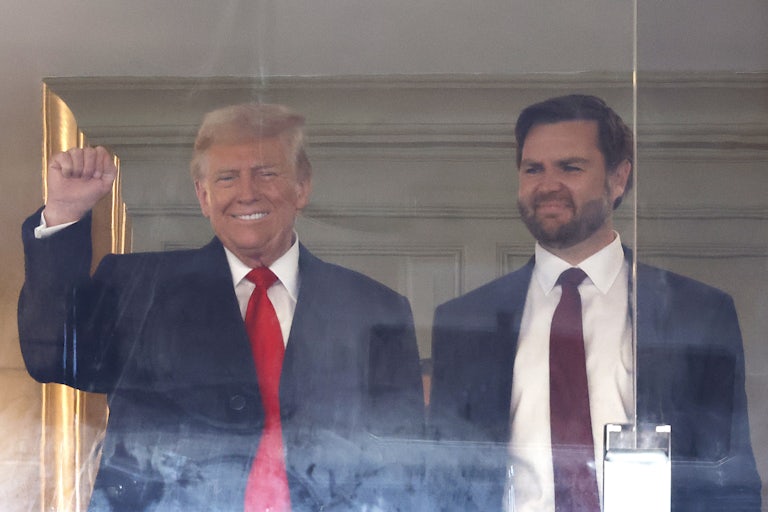
Donald Trump smiles and raises his fist while standing next to JD Vance
Kevin Dietsch/Getty Images

Donald Trump promised Monday to launch a lawsuit against The Des Moines Register over a preelection poll that found Vice President Kamala Harris had “leapfrogged” the Republican candidate, in a state he went on to handily win.

During a press conference at Mar-a-Lago, one journalist asked Trump about his ongoing defamation cases, asking, “Could you see moving that to other people with individual platforms, social media influencers, people that—”

“Or newspapers, yeah.” Trump interrupted.

“Yeah, oh, I do. I think you have to do it, because they’re very dishonest,” Trump continued. “We need a great media, we need a fair media. We need, uh, it’s very important. And we need borders, we need walls, but we need borders and we need fair elections.”

Trump went on rambling on about how they were still counting votes in California, which is not true. The weave eventually wove itself back, and the president-elect continued his pledge to sue newspapers over alleged defamation.

“I have a few others that I’m doing, uh, I’m gonna, as an example, we’re bringing—I’m doing this not because I want to, I’m doing this because I have an obligation to—I’m gonna be bringing one against the people in Iowa, their newspaper, which had a very, very good pollster, who got me right all the time. And then just before the election, she said I was gonna lose by three or four points, and it became the biggest story all over the world … because I was gonna win Iowa by 20 points. The farmers love me, and I love the farmers,” he said.

Trump was speaking about pollster Ann Selzer, whose Iowa poll anticipated that Harris would lead Trump by three points in the state. In reality, he won Iowa by 13 points, making for a 16-point error. Selzer & Co. had previously been considered the gold standard of polling in the country.

Crucially, it wasn’t the “biggest story” all over the world, but it’s one that has been bothering Trump for more than a month now. In a post on Truth Social last month, Trump called out Selzer by name and said that an investigation into her poll was “fully called for!”

As far off as Selzer’s poll was, it’s not illegal to publish a poll that doesn’t accurately predict something. Trump’s obsession with Selzer appears to be part of the president-elect’s penchant for targeting those who publish unflattering things about him.

Buried in Trump’s incoherent rambling Monday, he pledged to make good on that threat and claimed that Selzer’s poll constituted “fraud” and “election interference.” He promised to file “a major lawsuit against them, either today or tomorrow.”

Trump also mentioned his other ongoing media lawsuits against CBS News’s 60 Minutes, journalist and author Bob Woodward, and the Pulitzer Center for giving prizes to journalists who wrote about Russian interference in the 2016 election, which Trump falsely claims was a “hoax.”

Trump’s newest threat against the media comes on the heels of a $15 million settlement with ABC News in a defamation lawsuit he brought against the network—a settlement that has baffled media experts, who believe that ABC could have won the suit, and consider the network’s sudden surrender to be obedience in advance of Trump’s coming presidential term.

Trump Manages to Make Ukraine War All About Himself

Donald Trump had a shocking comparison for Russia’s war in Ukraine.

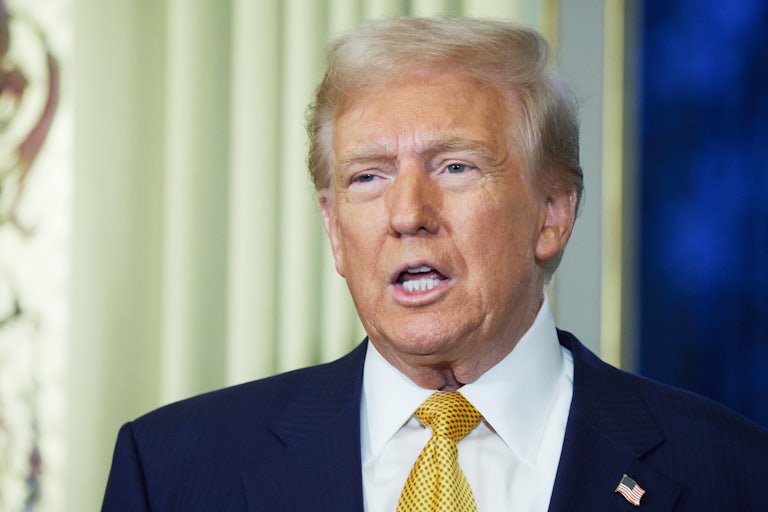
Donald Trump speaks
Oleg Nikishin/Getty Images

More than 43,000 Ukrainian soldiers have been killed since Russia invaded the Eastern European nation in February 2022. Cities have been leveled, and 370,000 injuries have been reported, according to Ukrainian President Volodymyr Zelenskiy.

But the scope and scale of that devastation is apparently easily comprehended by Donald Trump, who has refused to visit the country. Speaking with reporters at Mar-a-Lago on Monday, Trump repeated several times that Ukraine had been “flattened like a pancake” while comparing the war to his lucrative Manhattan real estate career.

The president-elect took a detour while responding to a question about whether he believed Ukraine should cede territory to Russia, describing areas of the country as more akin to “demolition sites” than recognizable cities.

“A lot of that territory, when you look at what’s happened to those—there are cities where there’s not a building standing. It’s a demolition site. There’s not a building standing,” Trump said. “People can’t go back to those cities.”

But that’s when the president-elect’s answer took a turn for the worse, suddenly conflating the controlled demolitions carried out by his multimillion-dollar real estate development company to the near-constant barrage of bombs dropped by Russian forces on Ukrainian cities.

“Just like when I knock down a building in Manhattan, which is actually, this is worse actually, because we do it step by step,” he continued. “This thing, this is—and by the way, in those buildings are many people. Many people are in those buildings.

“Big buildings—this is what I did, very well—these are very long buildings, 15 to 20 stories high, and they’re flattened like a pancake.

“It’s gotta be stopped, and I’m doing my best to stop it,” he added.

Trump’s other answers about his international relationships were similarly befuddling. At one point, the president-elect insisted that Chinese President Xi Jinping had not yet decided if he would attend Trump’s inauguration (Xi has reportedly declined the invitation) and claimed that leaders of hundreds of nations had phoned him to attend, dryly remarking that “you wouldn’t believe how many countries there are.”

Ultimately, any attendance by a world leader at Trump’s inauguration would be historically unprecedented. State Department records dating back to 1874 indicate that no foreign heads of state have ever shown up to the ceremony, typically over security concerns.

One of Trump’s biggest and boldest campaign promises was that he would immediately end the Russian invasion of Ukraine—though his philosophy on how to achieve that was suspiciously scant of details and, at times, veered toward solutions that would invariably aid Russia.

In June, Trump said he would be open to an increase in U.S. weapons aid to Ukraine so long as it shows up for peace talks with Russia.

Trump’s advisers envisioned that the peace talks—which Trump promised to facilitate upon winning in November—would also quietly include Ukraine ceding part of the country that is currently occupied by Russian forces. The concept was drawn up by retired Lt. Gen. Keith Kellogg and Fred Fleitz, both former chiefs of staff in Trump’s National Security Council.

Trump has also threatened to initiate U.S. withdrawal from NATO, the strategic Western military and trade alliance that opposes Russia. In February, Trump claimed he once told a European leader that he’d allow Russia to “do whatever the hell they want” to NATO allies if other members didn’t “pay” their “bills.”

Read what else Trump’s allies think about Ukraine:

CNN Under Fire for Sketchy Syrian Prisoner Story

CNN is investigating its own video story about a man supposedly being freed from a Syrian prison.

Clarissa Ward holds a microphone up to her face
Lou Benoist/AFP/Getty Images

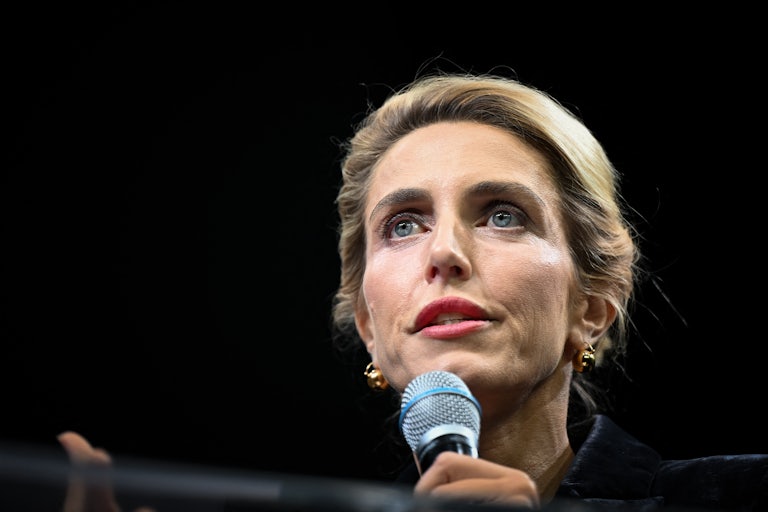
CNN announced Sunday that it has begun investigating the identity of a man who the network had claimed in a recent report was a prisoner of the ousted Syrian government, according to The Wrap.

In a story published last week, chief CNN international correspondent Clarissa Ward and her crew, escorted by Syrian rebels, discovered a man hiding under a blanket in what was the “only locked cell” in a “secret prison” at a Syrian air force intelligence base in Damascus.

The man identified himself as a civilian named Adel Gharbal from Homs, and claimed that he had been in solitary confinement for three months. He appeared surprised to learn that Bashar Al Assad’s regime had fallen.

“In nearly twenty years as a journalist, this was one of the most extraordinary moments I have witnessed,” Ward wrote in a post on X.

When asked by CNN’s Anderson Cooper what is known “about this man and how he ended up in the prison,” Ward admitted that “we don’t know that much because you can see from the report, Anderson, that he’s in a deep state of shock.”

However, some concerns have surfaced about the veracity of the report.

A website called Verify-Sy, which states that it fact-checks stories about Syria, said that residents of a neighborhood called Al Bayyada had identified the man as Salama Mohammad Salama, or “Abu Hamza,” a first lieutenant in Syrian air force intelligence.

Verify-Sy also pointed out that the man’s behavior did not seem to match his reported conditions of confinement and torture, as he did not flinch when exposed to light and appeared well groomed and physically unharmed.

Now CNN is looking into the possibility that the man wasn’t a prisoner at all.

“We reported the scene as it unfolded, including what the prisoner told us, with clear attribution. We have subsequently been investigating his background and are aware that he may have given a false identity. We are continuing our reporting into this and the wider story,” CNN said in a statement to The Wrap.

“No one other than the CNN team was aware of our plans to visit the prison building featured in our report that day. The events transpired as they appear in our film,” CNN said in the statement. “The decision to release the prisoner featured in our report was taken by the guard—a Syrian rebel.”

UnitedHealthcare CEO Death Sparks Outrageous Complaint from TV Host

Apparently, America is not sufficiently mourning the UnitedHealthcare chief.

Police investigate outside the hotel where UnitedHealthcare CEO Brian Thompson was shot dead
Kyle Mazza/Anadolu/Getty Images

CNN can’t seem to spot the difference between the assassination of a health insurance executive who made his money denying millions of Americans health care access and the death of innocent people at the hands of police.

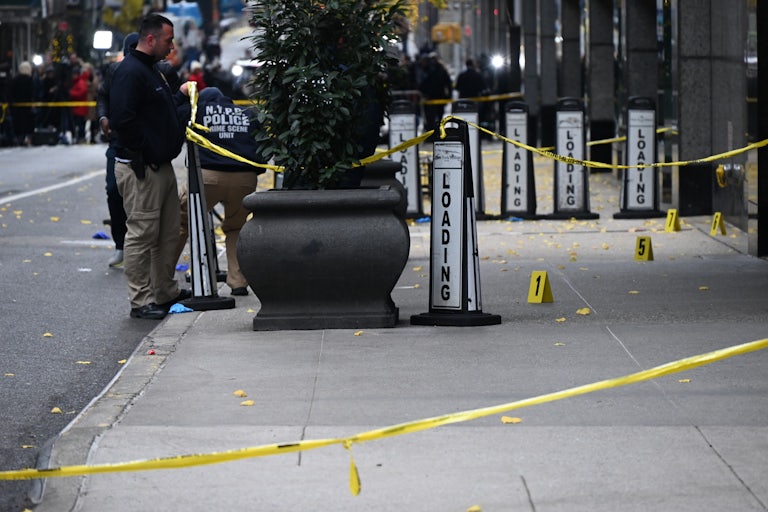
On Sunday, CNN host Michael Smerconish lamented that the American public hadn’t rushed to memorialize the outside of the midtown Manhattan Hilton Hotel where UnitedHealthcare CEO Brian Thompson was assassinated earlier this month.

“I slowed my gait as I passed a side entrance to the Hilton Hotel, realizing that this was the same day in the same early morning hour in the precise location where, one week prior, a 50-year-old father of two was assassinated,” Smerconish monologued on air. “But something was missing. Any sign whatsoever of the tragedy that occurred right here, and which has captivated the nation.”

“We’ve all seen the crime scene that’s been shown many times in the media. But a week later, here’s what was left: a lone piece of NYPD crime tape affixed to a barrier. No memorial of the kind that often appears spontaneously after a similar tragedy.”

Smerconish then went on to compare Thompson’s death to some of the most tragic cultural touchstones in the nation’s recent history, including the murders of John Lennon, George Floyd, Heather Heyer, and Rust cinematographer Halyna Hutchins.

“But there was no sign of any makeshift memorial on 51st Street,” Smerconish added in a segment with the on-screen banner “a sad, new normalcy.”

What Smerconish seems to be missing, however, is the sad role that Thompson played in a system that increasingly prioritizes shareholder profits over successful medical outcomes for its clients. The public’s response to the executive’s death should be studied, not condemned, as an indictment on the sorry state and exploitative nature of America’s health care industry.

Federal data from 2022 compiled by the personal finance website ValuePenguin found that UnitedHealthcare far outpaced its competitors when it came to denying coverage, rejecting 32 percent, or roughly one in three claims. In 2024, the insurer’s parent group spent more than $5.8 million lobbying Congress on health care–related issues.

Meanwhile, Americans are paying more than ever for health insurance, with costs far outpacing the rate of inflation. A Kaiser Family Foundation report published earlier this year found that the vast majority of U.S. adults are worried about being able to afford a major medical expense, regardless of their financial position.

Read more about the response to the UHC CEO’s death: