Breaking News
Breaking News
from Washington and beyond

Republican Rep. Kicks Off New Speaker Drama Over Spending Bill

Is Mike Johnson about to lose his job?

Representative Thomas Massie speaks during a hearing
Allison Bailey/AFP/Getty Images
Representative Thomas Massie

It looks like House Speaker Mike Johnson might be at risk of losing his job.

Republican Representative Thomas Massie said Wednesday that he would not vote for Johnson in the upcoming House speaker election in January, according to Punchbowl News’s Melanie Zanona.

Johnson came under fire Tuesday after introducing a 1,547-page continuing resolution to keep the government open until March. The behemoth bill, which includes $100 billion for disaster relief and opens the door to a pay bump for members of Congress, invited a firestorm from the small-government people, including technocrat billionaire Elon Musk and a slate of sycophantic Republicans.

That latter group includes Massie. The Kentucky Republican has seemingly become preoccupied by the potential goings-on of the Department of Government Efficiency, which plans to slash government spending in the trillions (while leaving the military budget completely untouched).

“DOGE is like the U.S. Constitution. It’ll be great … if you can get my fellow lawmakers to follow it,” Massie wrote in a post on X last week. When DOGE co-czar Vivek Ramaswamy said he’d “welcome” Massie’s help, the representative replied, “Count me in!”

Depending on how Johnson proceeds, and how willing Republican lawmakers are to jump off the bridge that is a government shutdown, the House speaker could find that he has trouble shoring up support to keep his gavel in the new year.

If the Republicans fail to select a House speaker in a timely manner, that could mean trouble for anyone actually interested in certifying the results of the presidential election on January 6, which the chamber is legally required to do—resulting in a constitutional crisis.

Johnson’s leadership team began discussing a second plan Wednesday, a “clean” bill that would cut many of the provisions of the massive stopgap measure, including funding for disaster relief, according to Politico.
Conservatives Introduce Radical DOGE Act in Battle Over Spending Bill

Members of the House Freedom Caucus are pissed about Speaker Mike Johnson’s spending bill—and have introduced another extreme plan instead.

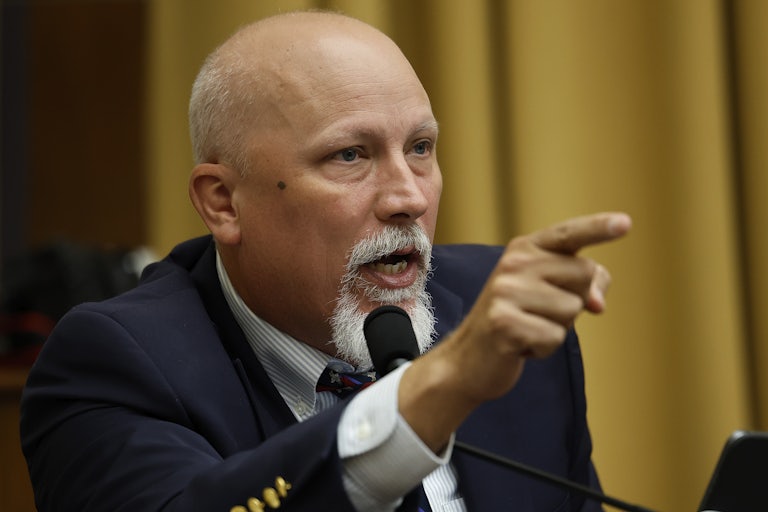
Chip Roy points his finger and speaks in a congressional hearing
Chip Somodevilla/Getty Images

With a Friday deadline to fund the government looming and Republican lawmakers at loggerheads over House Speaker Mike Johnson’s proposed stopgap spending bill, the conservative House Freedom Caucus is touting a plan to slash federal spending that conveniently leaves the bloated Pentagon budget untouched.

On Tuesday night, the House Freedom Caucus lampooned Johnson’s bill in a post on X, calling it a “Cramnibus” and enumerating demands that include a vote on the Disaster Offset and Government Efficiency Act, or DOGE Act: a piece of legislation introduced Tuesday evening by Republican Representative Chip Roy of Texas.

The DOGE Act would cut nondefense discretionary spending—which, per the Congressional Budget Office, “funds an array of federal activities in areas such as education, transportation, income security, veterans’ health care, and homeland security”—by roughly $114 billion, from just over $710 to $597 billion.

Stephen Semler, a policy analyst and co-founder of the Security Policy Reform Institute, posted that the proposed DOGE Act would shrink these necessary programs, but curiously “reduces Pentagon spending by $0.”

On Wednesday afternoon, Roy appeared on Fox to criticize Johnson’s spending bill, which he said was too expensive.

“How is that a signal to the world that we’ve pulled our financial thing together as a country? It’s not,” Roy said, before promoting the DOGE Act as the solution. “We’ve offered all sorts of opportunities,” he added. “For example, we have a bill that I filed yesterday—it’s called the DOGE Act—that would cut nondefense spending by 13 percent to pre-Covid levels. That’s $113 billion. That would pay for all of this. We just wanted to get a vote on that.”

Responding to the DOGE Act, the antiwar organization Code Pink wrote on X, “Republicans are suddenly interested in ‘government efficiency,’ but they refuse to touch the Pentagon budget. The Pentagon is the ONLY government agency that has never passed an audit and can’t account for TRILLIONS in public resources.”

Elon Musk Is Bullying Mike Johnson to Drive Government Into Shutdown

Musk is now cyberbullying the speaker of the House.

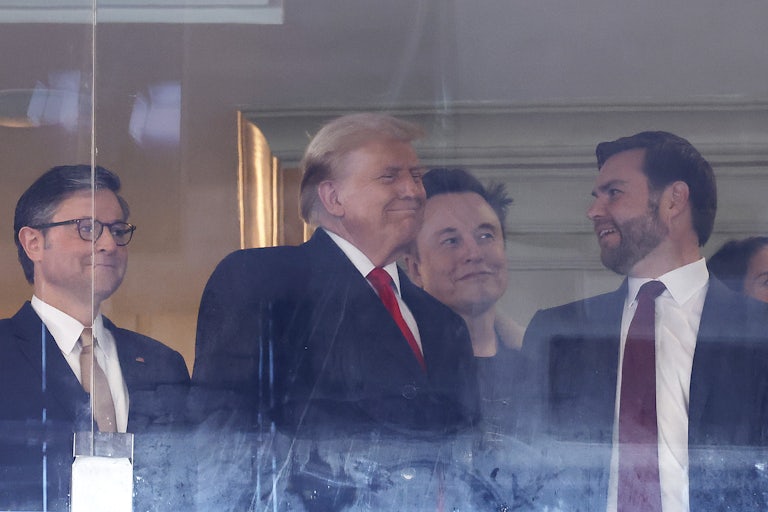
Donald Trump smiles while flanked by Mike Johnson, Elon Musk, and JD Vance
Kevin Dietsch/Getty Images

House Speaker Mike Johnson appears to be getting cyberbullied by “efficiency” czar Elon Musk, over his continuing resolution.

Johnson’s resolution, which was released Tuesday, grants $10 billion in economic assistance for farmers, $100 billion for disaster relief, and enough money to keep the government open until March. It also opens the door for pay raises for members of Congress, among a slate of other things buried in the 1,547-page bill.

But not everyone is happy, especially Musk, the unelected billionaire who wants to slash government funding for pretty much everything except the military through the so-called Department of Government Efficiency.

“Any member of the House or Senate who votes for this outrageous spending bill deserves to be voted out in 2 years!” Musk wrote in a post on X Wednesday.

The right-wing technocrat’s threat is no joke, as his deep pockets and misinformation efforts were essential to Donald Trump’s victory in November. “Stop the steal of your tax dollars! Call your elected representatives now. They are trying to railroad this thing through today!” a miffed Musk posted on X an hour later.

Musk’s threats didn’t stop coming Wednesday, as he descended into a deluge of hysterics over what some internet trolls dubbed the “omnibus” bill, and Republicans have already begun cheering Musk on.

“In five years in Congress, I’ve been awaiting a fundamental change in the dynamic. It has arrived,” wrote North Carolina Representative Dan Bishop in a post on X. Bishop lost a bid to become his state’s attorney general but was rewarded for loyalty when Trump nominated him for a position in the Office of Management and Budget.

“By now, they should know that I mean what I say,” Musk replied.

From his slew of pissed-off posts, it seems that Musk is mostly mystified by the bill’s length and the fact that it may allow a pay bump for members of Congress.

“This is insane! This is NOT democracy! How can your elected representatives be asked to pass a spending bill where they had no input and not even enough time to read it!!??” Musk wrote in another post. Musk, the unelected bureaucrat, sure has a lot of opinions about what democracy is.

Did Musk have an alternative? No, of course not. His answer to the government funding running out is just to wait until Trump can arrive to save the day.

“No bills should be passed Congress until Jan 20, when @realDonaldTrump takes office. None. Zero,” Musk wrote, as if Trump’s very presence in the White House would magically fund the essential services the government offers.

Musk shared a post from one account called Wall Street Mav, which advocated to “just close down the govt until January 20th. Defund everything. We will be fine for 33 days.”

“YES,” Musk wrote in response. And so the wannabe co-president openly advocated for a government shutdown. Of course, it makes sense. Why struggle to cut government funding when you could simply advocate that the government stop funding itself?

During an interview with Newsmax Wednesday morning, Johnson had gushed over his direct line with Musk and co-efficiency czar Vivek Ramaswamy and indicated that they were all on the same page about the measure.

“I was on a text chain last night with Elon and Vivek about DOGE, cause I’m super excited about that, and I said, ‘Guys, these are the necessary things.’ They don’t like spending either, they said, ‘We know this is not you personally, Mr. Speaker,’ and we got to get through this,” Johnson said.

“Everybody understands the necessity,” he said. Do they? Because Musk seems to be doing his best to tank the stopgap measure via a major social media meltdown.

In Massive Twist, Trump’s Georgia Case Might Not Be Dead Yet

Donald Trump could still face consequences in Georgia for election interference.

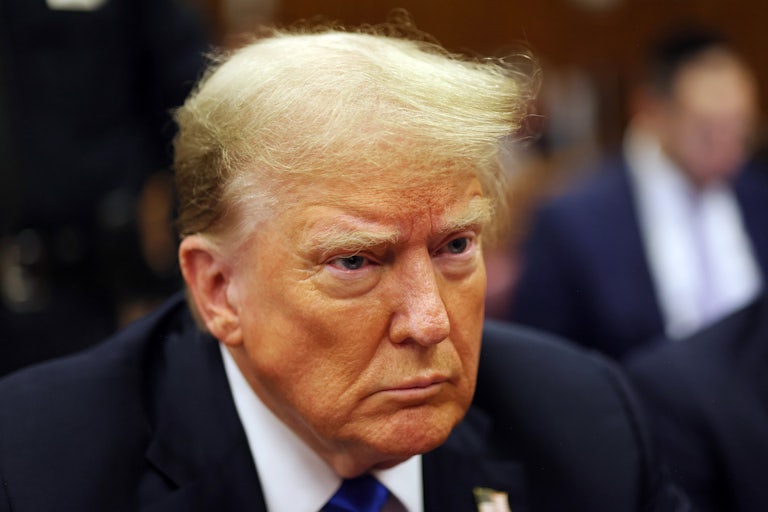
Donald Trump sits in a courtroom
Michael M. Santiago/Getty Images

Donald Trump’s forthcoming presidency might not hinder the proceedings surrounding his Georgia election interference charges, according to an attorney for Fulton County District Attorney Fani Willis.

In documents filed to the court on Wednesday, Willis’s office urged an appeals court to reject the president-elect’s request to throw out the case in light of the Supreme Court’s July ruling on presidential immunity. But the filing also suggested that state prosecution isn’t necessarily beholden to federal statute. The lawyer argued that Trump’s legal representation had failed to demonstrate why state prosecution should be subject to a Justice Department mandate preventing the prosecution of sitting presidents, reported ABC News.

“Appellant does not specify or articulate how the appeal—or indeed, any other aspect of this case—will constitutionally impede or interfere with his duties once he assumes office,” Fulton County Chief Senior Assistant District Attorney F. McDonald Wakeford wrote.

“The notice makes mention of these concepts without actually examining them or applying them to the present circumstances,” Wakeford continued in the filing. “In other words, Appellant has not done the work but would very much like for this Court to do so.”

Willis’s office believes they have wiggle room to proceed, due to a lack of legal precedent related to court proceedings against sitting presidents.

“Given these vague statements, to simply invoke the phrase ‘federalism and comity concerns,’ without more, offers nothing of substance,” the filing said.

Trump and 18 of his allies face racketeering charges in Georgia for their participation in the fake elector conspiracy, including ex-Trump attorney Rudy Giuliani and former white House Chief of Staff Mark Meadows. Four individuals have already pleaded guilty, including the architect of the scheme Kenneth Chesebro, though he has since attempted to withdraw his plea.

SCOTUS Takes Case That Could End Planned Parenthood as We Know It

The Supreme Court has agreed to hear a case that could kick Planned Parenthood off Medicaid.

A Planned Parenthood clinic
Patrick T. Fallon/AFP/Getty Images

Planned Parenthood’s public funding is, once again, on the line.

The Supreme Court Wednesday agreed to hear South Carolina’s case against the reproductive health nonprofit. Prosecutors argue that Planned Parenthood’s locations in Charleston and Columbia should not be able to participate in the state Medicaid program.

Those locations currently service hundreds of patients covered by Medicaid and offer many more services than just abortion care, including physicals, cancer screenings, STI testing, and birth control access, reported Reuters. The organization does not use the public funds for abortions but rather for family planning, according to the Associated Press. The case is scheduled to be argued in the spring.

“Pro-life states like South Carolina should be free to determine that Planned Parenthood and other entities that peddle abortion are not qualified to receive taxpayer funding through Medicaid,” John Bursch, an attorney with the right-wing Christian legal group Alliance Defending Freedom, which is representing the state, told the Associated Press.

This is the latest abortion-related case picked up by SCOTUS since the court overturned nationwide abortion access provided by Roe v. Wade in 2022. It could also be another win for conservative-leaning states who want to see Planned Parenthood stripped of all government money.

It’s the third time that South Carolina’s defunding case has reached the Supreme Court. The state initially moved to cut off Planned Parenthood from funding in 2018. In 2020, the nation’s highest judiciary rejected the state’s appeal. Three years later, the justices intervened in a lower court’s ruling, ordering it to reconsider the case after a relevant ruling had been issued by the nine-judge bench.

South Carolina has one of the most prohibitive abortion policies in the nation, restricting access after just six weeks, before most individuals know they’re pregnant and just one week before drug store pregnancy tests can detect pregnancy hormones in their earliest, and least reliable, window.

Planned Parenthood has said it gets less than $100,000 in South Carolina, and that Medicaid does not pay for abortions except in emergency events that compromise a pregnant person’s life or if the pregnancy is the result of rape or incest.