Breaking News
Breaking News
from Washington and beyond

Trump Begs Supreme Court to Let Him Get Away With Hush-Money Payments

Donald Trump has turned to his top ally to bail him out.

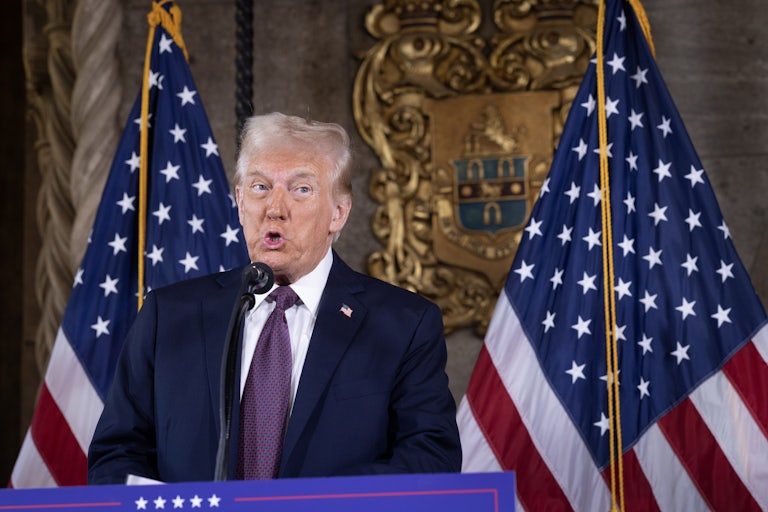
Donald Trump gestures while speaking at a podium
Scott Olson/Getty Images

Donald Trump is asking the Supreme Court to intervene in his New York hush-money case.

The president-elect requested an administrative stay Wednesday on the sentencing for his sole criminal conviction, claiming that the high court’s July immunity ruling should prevent him from having to face consequences. Trump’s sentencing is currently scheduled for Friday.

A jury of his peers unanimously decided in May that Trump was guilty on all 34 counts for falsifying business records with the intent to further an underlying crime in the first degree.

Trump has skirted sentencing since July, leveraging the nation’s legal system to invoke delay after delay until now, when the clock could realistically run out on the case just 12 days before he is set to retake the White House.

But the stay—which will once again delay Trump’s sentencing—would only nix an already pared-down and toothless conviction.

Last week, Judge Juan Merchan dealt the final blow to any suggestions of serious consequences for the president-elect. Merchan wrote in his Friday order that “unconditional discharge” had become the “the most viable solution” for Trump, indicating that the incoming president would not be hampered down with fines, court-appointed supervision, or incarceration.

In the wake of Merchan’s order, former U.S. District Attorney Joyce Vance argued in her legal column Civil Discourse that there could still be a light at the end of the legal tunnel for Trump’s sentencing. Rather than forcing Trump to face the music before his inauguration, she argued that Merchan’s decision to release Trump with “unconditional discharge” could effectively take the wind out of Trump’s sails should he try to do away with the criminal conviction altogether. It would also help delay Trump’s sentencing until he’s out of office again, in which case, all bets are off.

It’s unclear if the Supreme Court will grant Trump’s request. As reporter Steven Mazie noted on X, “several justices will be so inclined,” but that doesn’t mean a majority will be.

This story has been updated.
Trump to Face (Symbolic) Consequences for (Some of) His Crimes

Trump’s efforts to halt his sentencing for hush-money payments made to Stormy Daniels have failed.

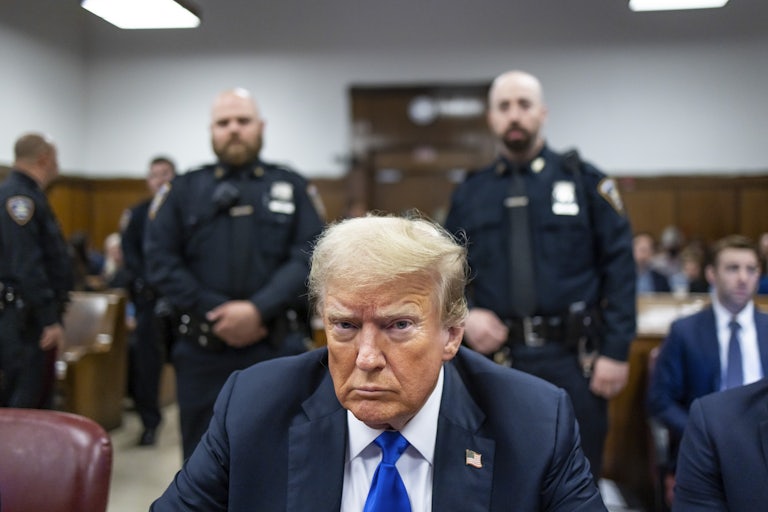
Donald Trump in court
Justin Lane/Pool/Getty Images

Donald Trump’s bid to halt sentencing for his felony conviction in his hush-money case in New York hit a setback Tuesday when a state appeals court denied his request.

The president-elect is scheduled to be sentenced on Friday, barring a last-minute appeal in federal court, or even the Supreme Court. On Tuesday, Judge Ellen Gesmer listened to arguments in a brief court hearing before ruling against the president-elect 30 minutes later.

During the hearing, she asked Trump’s lawyer Todd Blanche if he had “any support for a notion that presidential immunity extends to president-elects.”

“There has never been a case like this before,” Blanche replied, admitting that he did not have an answer. He tried to claim that sitting presidents had immunity, only for Gesmer to remind him that Trump was not yet president.

If Trump’s sentencing for his 34 felony convictions ultimately goes through, however, he will likely be spared jail time, the judge presiding over his case, Juan Merchan, signaled last week. Trump was accused of using his former fixer Michael Cohen to sweep an affair with porn star Stormy Daniels under the rug ahead of the 2016 presidential election.

But after the Supreme Court ruled in July that presidents have near-total immunity, the prospect of Trump facing any real consequences for his conviction basically evaporated. Trump’s election in November also didn’t help matters, and his other criminal cases never made it to trial before the Supreme Court and the election rendered them moot. Now, with less than two weeks left until Trump is sworn in as president, he might not even get a slap on the wrist.

Donald Quixote Keeps Tilting at Windmills

Trump’s war on alternative energy keeps growing.

Donald Trump does a mischievous little smirk
Chip Somodevilla/Getty Images

Read Trump’s lips: No new windmills.

The president-elect took time out of his rambling press conference on Tuesday to remind everyone just how much disdain he has for popular, efficient energy alternatives.  

“They turn to garbage … the only people that want them are the people getting rich off windmills, getting massive subsidies from the U.S. government.… They’re many many times more expensive than clean natural gas,” Trump said. “We’re gonna try and have a policy where no windmills are being built.”

Regardless of what Trump says, demand for wind energy is increasing—especially in red states. Last year wind farms created 22 percent of electricity generated in Texas and 59 percent of electricity  produced in Iowa. It’s an expanding, low-cost industry that employs 125,000 people.  

But the president-elect chooses to create his own narratives rather than engage with reality. “You see what’s happening up in the Massachusetts area with the whales.… They had two whales wash ashore in a 17-year period, and now they have 14 this season,” Trump said at the same press conference. “The windmills are driving the whales crazy … obviously.”

There is no scientific evidence to support that claim. 

The 48 Democrats Who Voted to Deport Nonviolent Undocumented Offenders

The bill could lead to undocumented immigrants who were arrested—but not convicted or even charged—for nonviolent offenses being deported.

Marie Gluesenkamp Perez walks in Washington DC
Bill Clark/CQ-Roll Call, Inc/Getty Images
Marie Gluesenkamp Perez, one of several Democrats to vote for a bill targeting undocumented immigrants on Tuesday, in September

If a bill that the House of Representatives passed Tuesday becomes law, undocumented immigrants arrested for nonviolent crimes will be targeted for deportation.

The bill was named after Laken Riley, a 22-year-old nursing student killed last year in Georgia by an undocumented immigrant who was arrested and charged with shoplifting but wasn’t detained. It passed in the House Tuesday by a 264–159 margin, with every Republican voting for it.

They were joined by 48 Democrats, despite the fact that the bill doesn’t require a conviction or charge, but merely an arrest, to target an undocumented immigrant. These Democrats appear to be supporting the GOP’s rhetoric demonizing all undocumented immigrants, seeking to penalize them merely for being suspected of a crime.

With Donald Trump’s promised mass deportations likely coming soon after his inauguration in less than two weeks, the 48 Democrats who voted for the Laken Riley Act appear to be surrendering early. Seven of them even voted against the bill in March, only to vote for it Tuesday. Here is the list of all 48 Democrats, with the seven who changed their votes in bold:

  • Brendan Boyle—Pennsylvania
  • Nikki Budzinski—Illinois
  • Janelle Bynum—Oregon
  • Jim Costa—California
  • Joe Courtney—Connecticut
  • Angie Craig—Minnesota
  • Henry Cuellar—Texas
  • Sharice Davids—Kansas
  • Don Davis—North Carolina
  • April McClain-Delaney—Maryland
  • Chris Deluzio—Pennsylvania
  • Shomari Figures—Alabama
  • Laura Gillen—New York
  • Marie Gluesenkamp Perez—Washington
  • Jared Golden—Maine
  • Vicente Gonzalez—Texas
  • Maggie Goodlander—New Hampshire
  • Adam Gray—California
  • Josh Harder—California
  • Jahana Hayes—Connecticut
  • Steven Horsford—Nevada
  • Val Hoyle—Oregon
  • Marcy Kaptur—Ohio
  • Greg Landsman—Ohio
  • Susie Lee—Nevada
  • Mike Levin—California
  • Stephen F. Lynch—Massachusetts
  • John Mannion—New York
  • Lucy McBath—Georgia
  • Kristen McDonald Rivet—Michigan
  • Dave Min—California
  • Joseph Morelle—New York
  • Jared Moskowitz—Florida
  • Frank J. Mrvan—Indiana
  • Chris Pappas—New Hampshire
  • Josh Riley—New York
  • Hillary J. Scholten—Michigan
  • Kim Schrier—Washington
  • Terri A. Sewell—Alabama
  • Eric Sorensen—Illinois
  • Greg Stanton—Arizona
  • Suhas Subramanyam—Virginia
  • Tom Suozzi—New York
  • Emilia Sykes—Ohio
  • Dina Titus—Nevada
  • Ritchie Torres—New York
  • Derek Tran—California
  • George Whitesides—California

You’ll Never Guess Who Tried to Interfere in the 2020 Election

Actually, you might.

Donald Trump speaks at a podium
Scott Olson/Getty Images

A report from the inspector general’s office alleges that three senior Justice Department officials under Donald Trump had “partisan political motivation” for publicizing certain department activities ahead of the 2020 election.

Inspector General Michael Horowitz’s 53-page report, which was published by ABC News Tuesday as the result of a Freedom of Information Act request, detailed the efforts of senior officials to target states with Democratic governors ahead of the 2020 elections. That could potentially violate the Hatch Act, which forbids federal employees from engaging in certain political activities in their official capacities.

In August 2020, the Department of Justice published a press release announcing that it had requested information about government-run nursing homes in Michigan, Pennsylvania, New Jersey, and New York, “despite having been provided data indicating that the nursing homes with the most significant quality of care issues were in other states,” according to the report.

While no one complained about the press release at the time, more recently, current and former officials described it as “unusual and inappropriate.”

As the election approached, the DOJ’s Civil Rights Division pressured individuals in the department’s Civil Division to send a letter to New York officials seeking data on Covid-19 related deaths in private nursing homes.

The report said that individuals in the Civil Division were “led to believe” that the order to make information about this letter public had come straight from then–Attorney General Bill Barr.

In October 2020, a senior official with the DOJ’s Public Affairs Department texted colleagues that they wanted to leak information about the letter, as well as other information about an investigation into state-run nursing homes in New Jersey.

“I’m trying to get [them] to do letters to [New Jersey and New York] respectively on nursing homes. Would like to package them together and let [a certain tabloid] break it. Will be our last play on them before election but it’s a big one,” the official wrote, according to the report.

Then, a week before the election, information about the letter was provided to a New York–area tabloid and published, accusing New York authorities of undercounting deaths in nursing homes—which, to be clear, they actually had done, according to the report.

On October 27, 2020, the New York Post published an exclusive article titled “DOJ seeks more NY nursing home data after finding COVID death undercount.”

“The then upcoming 2020 election may have been a factor in the timing and manner of those actions and announcing them to the public,” Horowitz wrote in the report. He concluded that the three officials had violated the DOJ’s media contacts policy, and referred his findings to the U.S. Office of Special Counsel.