Breaking News
Breaking News
from Washington and beyond

Even Neil Gorsuch Isn’t Sure a TikTok Ban Will Really Work

As the Supreme Court voted to uphold the TikTok ban, Justice Neil Gorsuch chimed in with one giant asterisk.

Supreme Court Justice Neil Gorsuch
Alex Wong/Getty Images

As the Supreme Court unanimously voted to uphold the government’s impending ban on TikTok, Justice Neil Gorsuch made an interesting observation in his concurring opinion.

“Whether this law will succeed in achieving its ends, I do not know. A determined foreign adversary may just seek to replace one lost surveillance application with another. As time passes and threats evolve, less dramatic and more effective solutions may emerge. Even what might happen next to TikTok remains unclear,” Gorsuch wrote, but he then added a caveat.

“But the question we face today is not the law’s wisdom, only its constitutionality. Given just a handful of days after oral argument to issue an opinion, I cannot profess the kind of certainty I would like to have about the arguments and record before us. All I can say is that, at this time and under these constraints, the problem appears real and the response to it not unconstitutional,” Gorsuch continued.

Gorsuch, a conservative appointed to the court by Donald Trump in 2017, cast doubt on how much the ban may be able to achieve, national security concerns or not. Even some Democratic lawmakers who voted for the ban seem to be trying to backtrack in the final days before the deadline takes effect, a confusing about-face.

Meanwhile, while the right had previously pushed for banning TikTok, Trump now opposes it, likely because the app altered its algorithm to make his content perform better and because one of his wealthy allies, Jeff Yass, has a large stake in its parent company. However, there’s another major reason that politicians on the right and left wanted to ban the app: the proliferation of pro-Palestine content.

Biden, with just days left in office, has said it will be up to Trump to decide how to enforce the ban. It’s anyone’s guess what he’ll decide to do, although he’s never had a high opinion of anything supporting the Palestinians.
Trump’s Homeland Security Pick Is Happy to Start War on Disaster Aid

Kristi Noem wouldn’t commit to stopping Donald Trump from conditioning disaster funds.

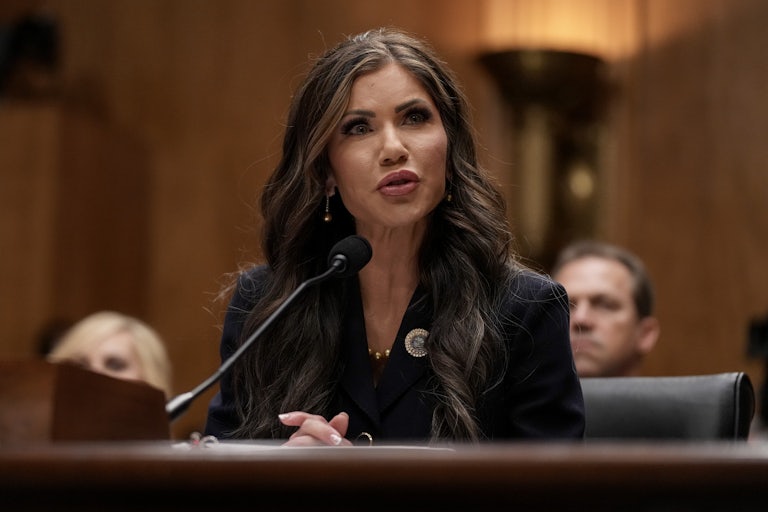
Kristi Noem speaks during her Senate confirmation hearing
Eric Thayer/Getty Images

South Dakota Governor Kristi Noem struggled to commit to giving disaster relief to all Americans during her confirmation hearing Friday, because it wasn’t exactly what Donald Trump had said.

Senator Richard Blumenthal pressed Noem on Trump’s recent statements threatening to withhold disaster relief from California as it suffers from devastating wildfires in Los Angeles County.

“I am really disappointed with some of the statements that President-elect Trump has made,” Blumenthal said. He cited the president-elect’s own words when he claimed that if California Governor Gavin Newsom failed to reinstate Trump-era policies in his state, “we won’t give him money to put out all his fires, and we don’t give him the money to put out his fires. He’s got problems.”

“The spectre is there of potential discrimination based on politics,” Blumenthal explained. “Withholding money from California or other states. It’s not an unfounded fear. In the last administration there were public reports about President Trump withholding money from the state of Washington because of his disagreements with Governor Inslee.”

Blumenthal said he was also concerned about his own Democratic-led state, Connecticut, which had suffered from intense floods, noting that “these natural disasters are going to become more frequent.

“I assume you will agree with me that withholding disaster relief, by President Trump or any other chief executive of the United States, is a violation of his duty, and of law?” Blumenthal asked, testing to see if Noem was willing to speak against Trump.

She was not.

“Well Senator, leadership has consequences, and looking at the tragedy that’s happening in California is—” Noem started.

“I want to ask you, uh ‘yes or no,’ with all due respect. It’s an easy—” Blumenthal interjected.

“What’s happening in California is the ramification of many decisions over many years,” Noem continued, though it is still unclear what amount of the destruction was the result of alleged government and resource mismanagement. “But under my leadership at the Department of Homeland Security, there will be no political bias to how disaster relief is delivered to the American people.”

Blumenthal then asked whether Noem would stand up to Trump if he decided he didn’t want to allocate money because he didn’t like the governor or the politics of that state, such as Connecticut.

“Senator, in three days President Trump will take an oath to uphold the Constitution and the rule of law in this country, and I’ll be glad to have him back,” Noem said. “I don’t speak to hypotheticals, which is what you’re asking me to do. But what I will tell you is as secretary, I will do the same, I will deliver the programs as the laws dictate—”

“Well, it’s more than a hypothetical, with all due respect,” Blumenthal said, before apologizing for interrupting her.

“It’s more than a hypothetical. It’s based on experience with President Trump withholding money from Washington state and elsewhere. I need to know from you, will you stand up to the president and say no?” Blumenthal pressed, asking about the fate of the hundred billion dollars that had been appropriated for disaster relief during the last session of Congress. “Would you say no to the president if he withholds that money?”

“Sir, I don’t know about the scenarios that you’re referencing with President Trump, but I will tell you is that if given the chance to be secretary of homeland security that I will deliver the programs according to the law and that it will be done with no political bias,” Noem said.

“So you pledge to allocate and distribute that hundred billion dollars?” Blumenthal asked.

“According to how the program is written with no political bias,” Noem confirmed. “Every American deserves to be there and have disaster relief the same as their neighbors.”

Blumenthal confirmed that this was “basically following the law.”

Biden Just Gave Away Netanyahu’s Whole Game. And It’s Bad.

Joe Biden tried to joke about Benjamin Netanyahu “carpet bombing” Gaza.

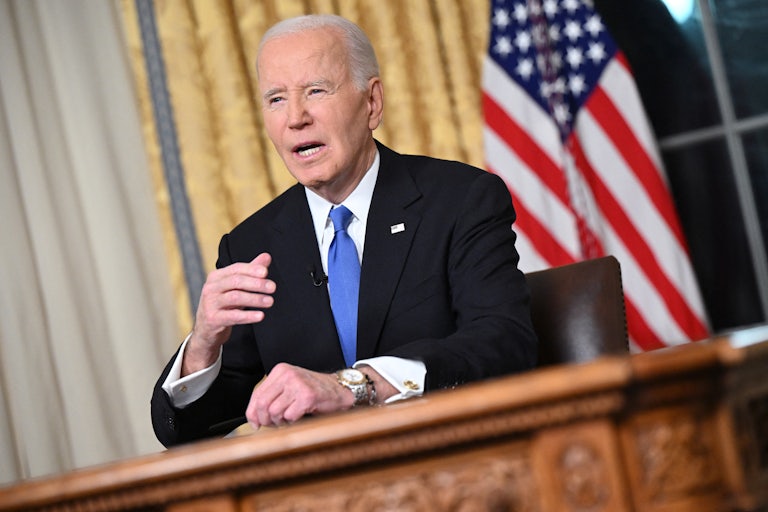
Joe Biden sits in the Oval Office and speaks
Mandel Ngan/AFP/Getty Images

President Joe Biden shared a tidbit of one of his conversations with Israeli Prime Minister Benjamin Netanyahu regarding the war on Palestine, though the revelation didn’t leave either country in a particularly good light.

In his final interview in the Oval Office Thursday night, Biden recalled one of Netanyahu’s retorts for refusing to end his country’s war on Palestine. He claimed that the Israeli leader told him in the early days of the conflict that the United States shouldn’t be policing other nations’ warfare strategies in light of the country’s long trail of devastation.

“When I went to Israel immediately after the attack led by Hamas, eight days later or whatever it was, I told him that we were going to help,” Biden told MSNBC’s Lawrence O’Donnell. “And I said, ‘But Bibi, you can’t be carpet bombing these communities.’ And he said to me, ‘Well you did it. You carpet bombed Berlin. You dropped a nuclear weapon. You killed thousands of innocent people because you had to in order to win a war.’”

“I said, ‘But that’s why we came up with the [United Nations],’” Biden continued with a smirk. “New deals by which—how what we do relative to civilians and military.”

“So he was comparing twenty-first-century war tactics, battle tactics, with World War II?” asked O’Donnell.

“Well, what he was really doing was going after me for saying, ‘You can’t indiscriminately bomb civilian areas. Even if the bad guys are there. Even if the bad guys are there, you can’t take out two, 10, 1,500 innocent people in order to get one bad guy,” Biden replied.

“And he made the legitimate argument, his perspective—‘Look, these are the guys that killed my people. These are the guys that are all over in these tunnels. Nobody has any idea of the miles of tunnels that are down there. The only way to get to them is to take out the places under which they got to the tunnels.’”

Biden then likened Israel’s ensuing assault on Palestine to America’s “war on terror” after the 9/11 terrorist attack.

Biden’s response is a particularly damning indictment of how his administration handled ceasefire negotiations. It makes it clear that Biden knew early on that Netanyahu intended to indiscriminately target Gaza—and did little to stop him.

Eric Adams Is Finally Bowing Down to Trump at Mar-a-Lago

The New York City mayor is getting desperate for a pardon.

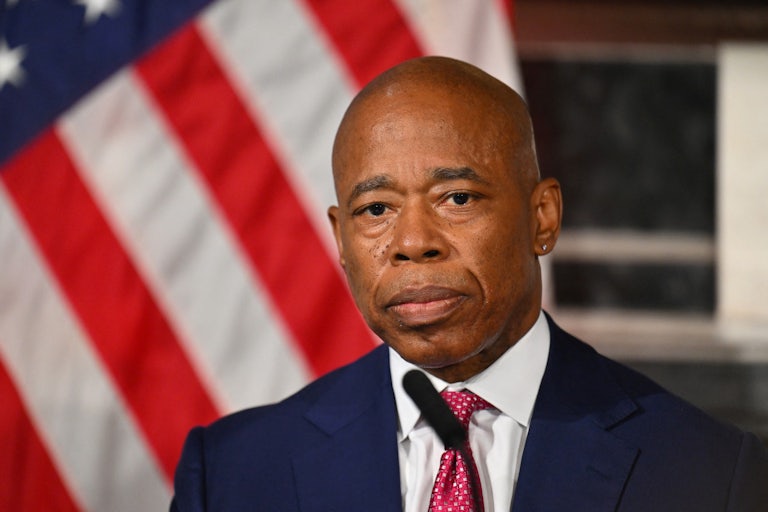
New York City Mayor Eric Adams
ANGELA WEISS/AFP/Getty Images

Eric Adams is in Mar-a-Lago today—and perhaps one step closer to that Trump pardon he’s been not-so-subtly angling for since November. 

In the midst of a reelection campaign and his own federal indictment, the New York City mayor announced, with no advance warning, that he’d be heading to Trump’s Florida property to talk about “New Yorkers’ priorities.” The mayor asked for the meeting himself, according to The New York Times. Adams is not the first Democrat to meet with the president-elect at his Florida estate, with Representative John Fetterman visiting him just last week. 

“Mayor Adams has made quite clear his willingness to work with President-elect Trump and his incoming administration on behalf of New Yorkers—and that partnership with the federal government is critical to New York City’s success,” said Adams’s spokesman Fabian Levy.”  

But anyone who’s been watching Adams can guess that some of this meeting—if not all of it—will be about a potential pardon. Adams, who is indicted on five federal corruption charges, compared himself to Hunter Biden in December, suggesting that he too was simply the target of a polarized Justice Department and worthy of a pardon. He also met with Tom Homan, Trump’s border czar, to discuss how he could help the Trump administration deport millions of people. This meeting at Mar-a-Lago is just another step toward saving himself from prison. 

Adams’s mayoral competitors have been highly critical of his surprise trip.

“No one believes that Eric Adams sneaked off to Mar-a-Lago to advocate for the needs of any New Yorkers other than his own,” mayoral candidate Zohran Mamdani posted on X. “The Mayor faces a federal trial on corruption charges in three short months and wants to appeal to the one person who can make it all go away. I fear he will sell out our city to secure that outcome.” 

“Eric Adams should state immediately that he will not seek or accept a pardon from Donald Trump,” said city comptroller and mayoral candidate Brad Lander. “New Yorkers deserve to know that their Mayor is putting their interests ahead of his own—and whether our tax dollars, or Turkish Airlines, will be financing his trip to Florida.”

Trump has yet to comment on the meeting.

Supreme Court Deals Major Blow to Free Speech With TikTok Ruling

President Joe Biden is reportedly already looking for ways to reverse the law.

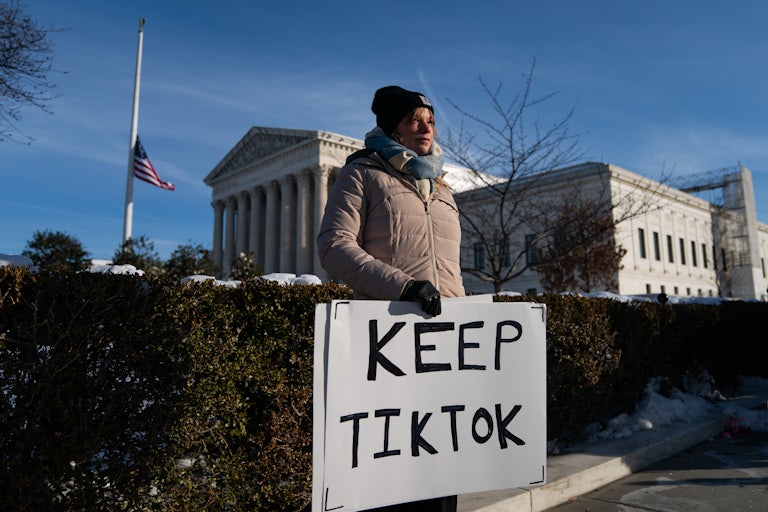
A person protests in favor of TikTok outside the U.S. Supreme Court
Allison Robbert/The Washington Post/Getty Images

The Supreme Court on Friday upheld Congress’s ban on TikTok, marking the end of the popular video-sharing platform’s presence in the United States.

“There is no doubt that, for more than 170 million Americans, TikTok offers a distinctive and expansive outlet for expression, means of engagement, and source of community,” the court wrote in its per curiam. “But Congress has determined that divestiture is necessary to address its well-supported national security concerns regarding TikTok’s data collection practices and relationship with a foreign adversary. For the foregoing reasons, we conclude that the challenged provisions do not violate petitioners’ First Amendment rights.”

In a concurring opinion, Justice Neil Gorsuch added that while the case’s expedited timeframe had left him less than certain about its details and its outcome, “the question we face today is not the law’s wisdom, only its constitutionality.”

“Whether this law will succeed in achieving its ends, I do not know,” Gorsuch wrote. “A determined foreign adversary may just seek to replace one lost surveillance application with another. As time passes and threats evolve, less dramatic and more effective solutions may emerge. Even what might happen next to TikTok remains unclear.”

TikTok is reportedly prepared to shut down its app on Sunday, when the ban is scheduled to take effect, though the actual language of the law technically only mandates that the social media platform be taken off of app stores to prevent new users from downloading it.

On Thursday, U.S. officials revealed that President Joe Biden would not enforce the ban through the end of his presidency, handing the responsibility of interpreting the law to President-elect Donald Trump.

Experts have said the app will not disappear from users’ phones, though it will be restricted from the app store, and new updates will no longer be available—eventually rendering the app unusable, reported the Associated Press.

In oral arguments before the court, TikTok said that the law banning its presence in the U.S. was a violation of the company’s First Amendment rights. The government claimed the app’s erasure from the American market was a matter of national security, arguing that its parent company, Beijing-based ByteDance, could share data with the Chinese government or spread Chinese propaganda to American consumers. But that concern belies the fact that TikTok, which is headquartered in California and Singapore, has never operated in mainland China. (A sister app to the platform, Douyin, has captured the attention of the Chinese market.)

Justices on both sides of the ideological spectrum appeared skeptical of TikTok’s arguments, pointing out that the law did not target free expression on the app itself but rather ByteDance’s foreign ownership and the residual implications of a powerful foreign algorithm in the U.S.

At one point during the proceedings, Justice Elena Kagan pressed the government on what it meant by labeling TikTok’s manipulations as “covert,” pointing out that the content algorithms fueling all social media companies are a “little bit of a black box,” and something that wouldn’t differentiate it from any other tech company operating in America.

Some members of the court acknowledged the ban was a draconian approach to firewalling information from a foreign government.

Trump has pledged to save the platform, though it’s unclear how his team intends to do so. The incoming 47th president filed a brief with the court last month, urging the bench to pass on ruling on the ban until he takes office, when his lawyers argue he could “pursue a political resolution that could obviate the Court’s need to decide these constitutionally significant questions.”

Once inaugurated, Trump could issue a 90-day pause on the ban so long as a sale is in progress. But that could be difficult, as Chinese law restricts the sale of TikTok’s proprietary algorithm, according to Bytedance’s attorneys. And Solicitor General Elizabeth Prelogar—who represented the Biden administration in the case—told the court last week that the 90-day respite isn’t a guarantee.

But Trump has not always been on TikTok’s side. Before he left office in 2020, Trump attempted to eradicate TikTok via an executive order. He claimed that the video-sharing platform “[threatened] the national security, foreign policy, and economy of the United States.”

ByteDance announced shortly after President Joe Biden signed the ban—which gave TikTok an ultimatum to either sell its IP to an American owner or stop operating within the U.S.—that the company didn’t “have any plans to sell.” But that may have changed since the law passed at the start of the year. Last month, James Lewis, director of the Strategic Technologies Program at the Center for Strategic and International Studies, told NPR that China could be willing to trade off TikTok and its proprietary algorithm to American investors in exchange for a better deal from Trump on his massive tariff proposal.

Some of Trump’s allies could be waiting in the wings for that to happen. Major Republican donor Jeff Yass reportedly owns a 15 percent stake in TikTok. Trump’s former campaign manager Paul Manafort has business ties to the Chinese media industry, and former Treasury Secretary Steven Mnuchin revealed his own plans to acquire the social media company via an investor group just a day after the ban passed with overwhelming bipartisan support in the House.

But other options remain, should TikTok never return. When the Indian government pulled the plug on the social media app due to a violent feud with China on their shared border, TikTok dropped its 200 million users. In the app’s wake, companies with format competitors to TikTok, including Youtube and Instagram, absorbed many of TikTok’s influencers onto their own platforms.

This story has been updated.