Breaking News
Breaking News
from Washington and beyond

Trump’s Inauguration Is Already Causing Havoc at the Border

Day One of Donald Trump’s presidency is off to a dreadful, heartbreaking start.

A woman cries as she leans against her head against a pole. Another woman sits in the background huddled by a fence.
HERIKA MARTINEZ/AFP/Getty Images
A woman from Colombia cries after learning of the cancellation of the CBP One application on the day of her appointment to enter through the Paso del Norte international bridge to El Paso, Texas, after Donald Trump’s inauguration on January 20.

The impact of Trump’s anti-immigrant policy at the southern border was felt the minute he reassumed the presidency.

People were sobbing at the U.S.-Mexico border Monday afternoon after an app to book appointments with Customs and Border Patrol went offline.

“Migrants in Ciudad Juárez who were waiting for their 1pm CBP1 parole appointments learned 20 minutes ago that the app has shut down & those appointments are no longer valid,” said The Washington Post’s Arelis R. Hernández, who was at the scene.

The CBP One app was a critical resource for people looking to enter the United States, allowing them to check border wait times, get their products inspected, and most importantly, schedule appointments in hopes of entering the country legally. But on Monday, the app went dark right as Trump was getting sworn in, and all the appointments afterwards were cancelled. In Biden’s term, the app helped an estimated 930,000 people schedule appointments, according to federal officials.

“Effective January 20, 2025, the functionalities of CBP One™ that previously allowed undocumented aliens to submit advance information and schedule appointments at eight southwest border ports of entry is no longer available, and existing appointments have been cancelled,” the Customs and Border Patrol website reads.

“The people losing CBP One appointments were patiently waiting in Mexico & complying with a smart process that could modernize asylum,” wrote Buzzfeed Tech’s Andrea Flores. “Eliminating CBPOne is not only deeply unfair to the human beings who were following the rules, but this move will destabilize the border.”

This kicks off Trump’s draconian immigration plans, including what he promises to be the “largest deportation program in US history.” He either already has or plans to later sign multiple executive orders regarding the border: declaring a state of emergency there, labeling drug cartels as foreign terrorist organizations, directing the military to concentrate on the southern border, and attempting to revoke birthright citizenship.

The specific result of the CBP One app’s closure remains to be seen.

“The CBP1 app is credited for moving migrants into a lawful process of entry since it created an orderly system of proof, all on the other side of the US border,” professor Juliette Kayyem wrote. “Trump argues ending it means they will stop trying to enter. History suggests many will just try unlawfully.”

The hardline shift to the right on immigration is materializing even faster than anticipated. Communities everywhere can only prepare.
A tip to Democrats in this new chapter:

Did Elon Musk Seriously Just Do a Nazi Salute at Trump’s Inauguration?

Um, why did Elon Musk repeat the same hand gesture twice?

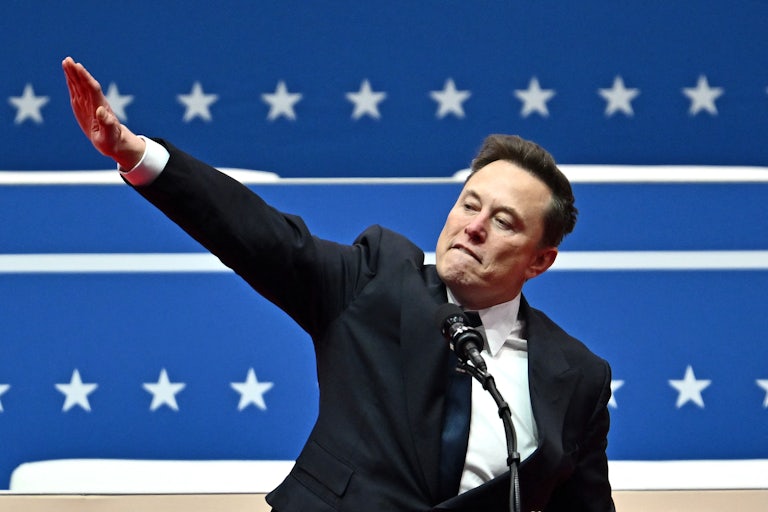
Elon Musk appears to do the Nazi salute at a lectern during Trump’s inaugural parade
ANGELA WEISS/AFP/Getty Images

During a speech at Capitol One Arena Monday following Donald Trump’s inauguration, Elon Musk appeared to deliver a Roman salute not once, but twice.

The gesture is associated with Nazi Germany, and Musk was speaking triumphantly about Trump’s election victory when he made the salute.

What was Musk thinking when he decided to point his arm unambiguously in a fascist symbol? It would seem that the billionaire tech CEO and major Trump backer doesn’t care if he is called a Nazi or racist anymore now that Trump is officially president.

Just one month ago, Musk came out in full support for the far-right Alternative for Germany (AfD) party, which has been accused of neo-Nazi sympathies. Less than two weeks ago, Musk hosted AfD leader Alice Weidel in a livestream on X, where the pair dismissed Adolf Hitler as a “communist.” Musk has also voiced his support for British neo-Nazi Tommy Robinson in an attempt to influence politics in that country. All of these would seem to suggest that despite earlier denials, Musk does seem to harbor actual Nazi sympathies.

Of course, the tech mogul is probably going to claim later that he was trolling the libs, or that the media is out to get him, or something else dismissive. He can probably count on Trump defending his gesture, claiming that he didn’t see it, or having no idea what it means. After all, Trump has defended Hitler in the past. But one thing is clear: Every Nazi sympathizer who has a soft spot for Trump is probably feeling emboldened.

These Two Planned Trump Pardons Are His Most Dangerous Yet

Donald Trump is planning to pardon a slew of January 6 protesters.

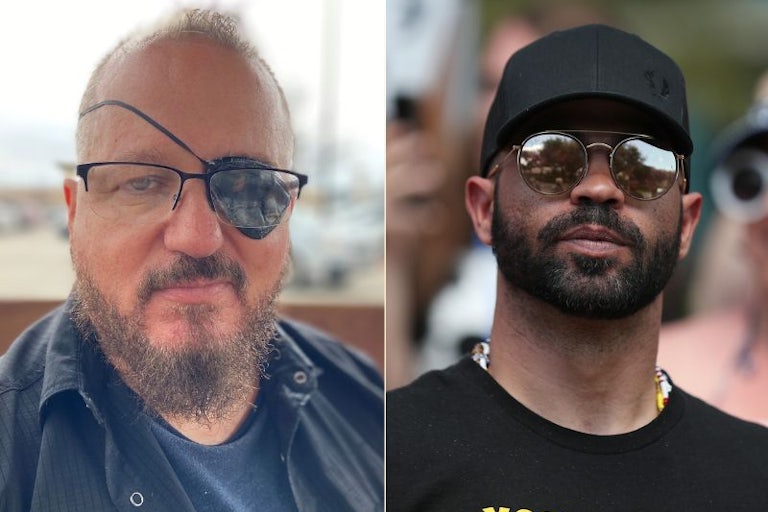
Oath Keepers leader Stewart Rhodes and Proud Boys leader Enrique Tarrio
Aaron C. Davis/Joe Raedle/Getty Images

President Donald Trump plans to pardon people convicted for participation in the January 6 Capitol riot, which may include two of its organizers: Stewart Rhodes, the founder of the Oath Keepers, and Enrique Tarrio, the former leader of the Proud Boys, ABC News reported Monday.

Rhodes and Tarrio were both convicted for seditious conspiracy, a Civil-War era charge, and were sentenced to 18 years and 22 years in prison, respectively. Tarrio’s sentence was the longest of any January 6 defendant.

Federal prosecutors previously described Tarrio as the driving force behind the masses of self-described “Western chauvinist” Proud Boys who arrived in Washington on January 6. Several of his organization’s leaders were the first to enter the U.S. Capitol. Earlier this month, Tarrio requested a pardon from prison via his lawyer.

In addition to pardoning those who have already been convicted, the Justice Department is also expected to dismiss cases that have not yet gone to trial, a Trump transition official told CNN.

This sets a disturbing precedent that the president could potentially push to dismiss any charges placed against his supporters—even the most dangerous.

Trump Uses His Real Inauguration Speech to Swear Revenge on Enemies

Donald Trump gave a dark, rambling speech after his official (and very dark) inaugural address.

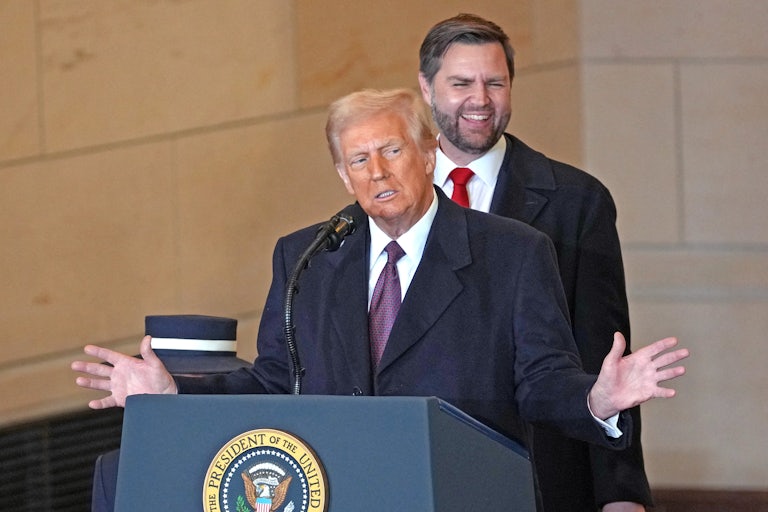
Donald Trump gestures while speaking at a podium after his inauguration
Bonnie Cash/AFP/Getty Images

Donald Trump’s inaugural address Monday showcased an unusually refined version of the MAGA leader on the cusp of his presidency: it toiled over the economy and immigration, promising to bring America into a “golden age.”

But Trump’s unscripted second speech to a throng of his supporters served as his cutting room floor, sharing all the gripes that his script writers implored him not to dish. Seemingly unrehearsed and riddled with grammatical errors, Trump’s second speech of the day was remarkably more like him.

Trump ripped into a cohort of his so-called enemies, torching former House Speaker Nancy Pelosi for supposedly allowing his supporters to tear through the Capitol Building on January 6, 2021.

“She’s guilty as hell,” Trump said, claiming he had promised to send 10,000 soldiers to the complex that day—despite the fact that multiple witnesses said Trump watched TV and stood by doing nothing as his supporters hunted and chanted death threats for Pelosi and former Vice President Mike Pence. “Maybe she wanted that to happen,” Trump wondered aloud.

“If you did that civilly, that would be a criminal offense,” Trump continued, blaming the former House speaker for failing to thwart some of his most ardent and violent supporters. (You cannot be charged with a criminal offense in a civil case, though a civil case can launch a companion criminal investigation.)

Trump also complained about former Representative Liz Cheney and other members of the House January 6 investigative committee. “Why are we helping some of the people—why are we helping Liz Cheney? She’s a crying lunatic,” Trump rambled.

And minutes after Trump was sworn in, a portrait hanging in the Pentagon of former Joint Chiefs Chairman General Mark Milley—who refused Trump’s orders to send the military to crush protesters in Washington in the wake of George Floyd’s death, and who has since referred to Trump as a “fascist” and a “wannabe dictator”—was suddenly stripped from the wall. (President Joe Biden preemptively pardoned Milley on Monday, saving him from the Trump administration’s litigious ire.)

Trump has repeatedly promised to enact revenge on individuals he deemed to be “enemies of the state.” In the weeks leading up to the election, former Trump White House Deputy Press Secretary Sarah Matthews warned that the ex-reality TV star had morphed from someone with a vision for America into a vindictive far-right ideologue “hellbent on revenge and retribution.”

Trump Promises to Rename Gulf of Mexico on Day One as President

Donald Trump plans to sign the pettiest executive order.

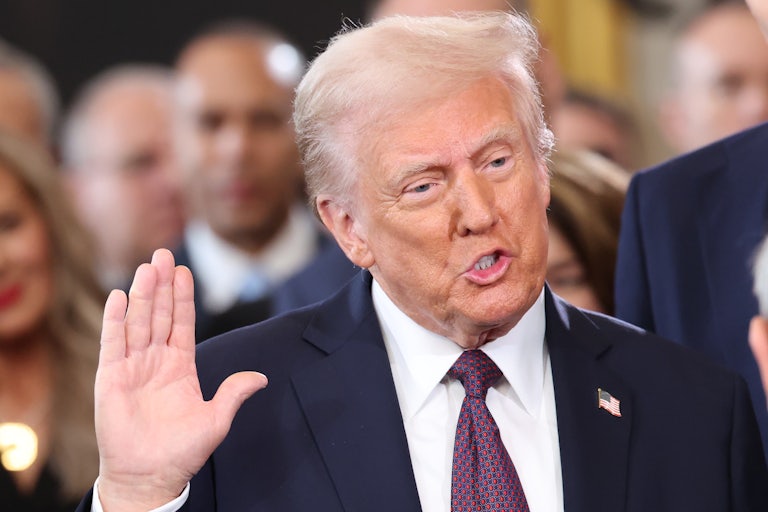
Donald Trump raises a hand as if swearing
Kevin Lamarque/Pool/Getty Images

Donald Trump will rename the Gulf of Mexico and Mount Denali by executive order in one of his first acts as president. 

The news broke shortly before he was sworn in Monday morning, and Trump confirmed it during his inaugural address. The order will rename the Gulf of Mexico to the Gulf of America, and Mount Denali to Mount McKinley, which was the official name recognized by the federal government from 1917 until 2015. 

Trump first announced his plans to rename the gulf nearly two weeks ago in a rambling press conference, saying, “We’re gonna be changing the name of the Gulf of Mexico to the Gulf of America…. What a beautiful name. And it’s appropriate…. Mexico has to stop allowing millions of people to pour into our country. They can stop them.”

Not long after that declaration, Mexican President Claudia Sheinbaum held a news conference of her own where she asked, “Why don’t we call it Mexican America? It sounds pretty, no?”

Denali is the tallest mountain in North America, and gained its name from the Koyukon Athabaskans, the original inhabitants of Alaska. A gold prospector gave it the name McKinley in 1896 as a show of support for William McKinley, who was running for president at the time, and the federal government made the name official in 1917. In 1975, the state of Alaska sought to have the name changed, only to be blocked by Ohio politicians supporting their native son McKinley. 

In 2015, President Obama officially renamed the mountain to what Alaska natives had called it for centuries. Last month, though, Trump told supporters in a speech in Arizona that he would  “bring back the name of Mount McKinley because I think he deserves it.”

Trump could also be making the move because he wants to stick it to Obama, or because he admires McKinley’s imperialism. In any case, changing both names will be costly to U.S. taxpayers, and serve no strategic purpose whatsoever. It’s the first of likely many more pointless moves in the new Trump administration.