Breaking News
Breaking News
from Washington and beyond

Tulsi Gabbard’s Secret Meeting with Syrian Dictator Exposed

Donald Trump’s pick for national intelligence secretly met with ex–Syrian President Bashar Al Assad.

Tulsi Gabbard walks in a Senate building
Kevin Dietsch/Getty Images

Tulsi Gabbard’s team scrambled to minimize the appearance of her 2017 meeting with former Syrian President Bashar Al Assad, The Washington Post reported Tuesday.

Donald Trump’s pick for director of national intelligence has repeatedly come under fire for her defense of violent authoritarians, including Assad, the brutal dictator who fled Syria for Russia after opposition forces overtook Damascus in December.

Gabbard’s two meetings with Assad during her three-day trip to Syria in January 2017 were not originally on her itinerary delivered to the Ethics Committee. In fact, her schedule included no meetings with any Syrian politician or official.

Apparently, Gabbard’s team was also kept in the dark about her meeting, according to correspondence and files reviewed by the Post. Four staffers involved in discussions about the meeting told the Post that they were surprised to learn that Gabbard had met with the Syrian president at all. One of the staffers, who opposed the meeting, said that they had a difficult time getting Gabbard to provide answers about the details of her schedule.

Gabbard has claimed that while her meeting with Assad was not originally planned, she couldn’t pass up the opportunity once it arose.

One of Gabbard’s meetings with Assad on January 16, 2017, was scheduled to begin at 12:15 p.m. Her next appointment was with Assad’s wife at 3 p.m., according to a timeline reviewed by the Post. This differs from the report delivered to Congress, which detailed that her meeting with Assad had lasted only 90 minutes and her face time with Assad’s wife began at 2 p.m.

Once her staff learned about her meeting, they knew that it looked bad. Gabbard’s deputy chief of staff had warned that her meeting with the dictator seemed “rather long” and urged that “formalities” be skipped to “cut down on the time that it appears you two sat and talked.” Gabbard’s press secretary pitched grouping her meeting with others so it could “appear more like” one of many “protocol meetings.”

One of Gabbard’s former staffers recalled that the ex-representative’s first meeting with Assad was listed as “somewhere around three hours.”

“I remember thinking, ‘That’s insane,’” the staffer told the Post. “What do you talk about for three hours in a supposed unplanned meeting?”

Gabbard’s confirmation hearing is still forthcoming, but this report draws into sharp relief the efforts of nearly 100 former U.S. diplomats and intelligence and national security officials who urged Senate leadership to review the government’s files on Gabbard behind closed doors.

Officials said in December that her past actions “call into question her ability to deliver unbiased intelligence briefings to the President, Congress, and to the entire national security apparatus.”
Trump Suddenly Doesn’t Care About Ceasefire He Claims He Brought About

Donald Trump has revealed his true feelings about Gaza.

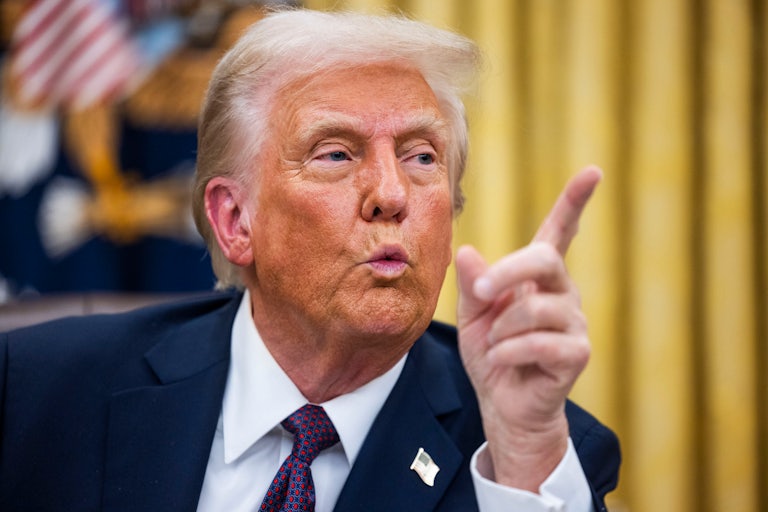
Donald Trump gestures and speaks while sitting in the Oval Office
Jim Lo Scalzo/EPA/Bloomberg/Getty Images

Now that he’s in office, Donald Trump suddenly doesn’t seem so confident in his position on Israel’s war on Palestine.

“How confident are you, Mr. President, that you can keep the ceasefire in Gaza?” asked a reporter in the Oval Office while Trump signed a flurry of executive orders Monday night.

“I’m not confident,” Trump responded. “It’s not our war. It’s their war.”

The comments stood in stark contrast to a more defiant version the forty-seventh president pitched at his inaugural address, in which Trump claimed that America’s success would be measured “not only by the battles we win but also by the wars that we end.”

And just last week, Trump—who at the time hadn’t been in office for any portion of the war—jumped to take credit for the historic and fledgling ceasefire deal between Israel and Hamas.

“This EPIC ceasefire agreement could have only happened as a result of our Historic Victory in November, as it signaled to the entire World that my Administration would seek Peace and negotiate deals to ensure the safety of all Americans, and our Allies,” Trump wrote on Truth Social. “I am thrilled American and Israeli hostages will be returning home to be reunited with their families and loved ones.”

On Sunday, Israeli Prime Minister Benjamin Netanyahu told the press that “both President Trump and President Biden gave full backing to Israel’s right to return to fighting, if Israel comes to the conclusion that negotiations on Phase B are futile.” Phase two of the ceasefire agreement would see the removal of Israeli troops from Gaza.

But Trump’s perspective on Gaza, which he freely shared on Monday, appeared tainted by his years as a real estate developer. Referring to a photo he had seen of the devastation in the region, Trump referred to Gaza as a “demolition site” before going on to suggest that the territory could be completely remade.

“It’s got to be rebuilt in a different way,” Trump said. “Gaza is interesting. It’s a phenomenal location. On the sea. The best weather. You know, everything is good. Some beautiful things could be done with it, but it’s very interesting. Some fantastic things could be done with Gaza.”

It’s not the first time that a member of the Trump family real estate empire has hinted that Palestine could be a developer’s paradise. In March, Trump’s son-in-law Jared Kushner praised Gaza’s waterfront beachfront property as “very valuable.”

“It’s a little bit of an unfortunate situation there, but from Israel’s perspective I would do my best to move the people out and then clean it up,” Kushner told his interviewer, Harvard’s Middle East Initiative faculty chair Tarek Masoud. “But I don’t think that Israel has stated that they don’t want the people to move back there afterwards.”

Republicans Suddenly Illiterate After Trump’s January 6 Pardons

Republicans are bending over backward to excuse Donald Trump’s sweeping pardons of the January 6 insurrectionists.

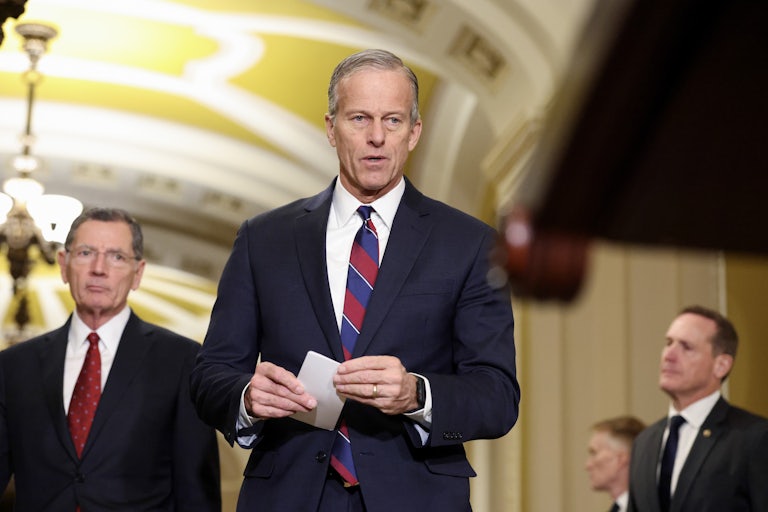
Senate Majority Leader John Thune walks in the Capitol
Kayla Bartkowski/Getty Images
Senate Majority Leader John Thune

Republican lawmakers are already shifting goalposts to justify Trump pardoning or commuting the sentences of nearly 1,600 January 6 insurrectionists—many of whom assaulted police officers, an issue Republicans hold near and dear. 

When asked about the pardons, Senate Majority Leader John Thune on Tuesday pointed the finger at Joe Biden, stating that the former president opened the floodgates by pardoning his son Hunter, according to CNN’s Manu Raju.

“We’re not looking backwards, we’re looking forward,” Thune continued. “I think they were case-by-case.” 

“I assume you’re asking me about the Biden pardons of his family,” said Senator Chuck Grassley, when asked by Semafor’s Burgess Everett. “I’m just talking about the Biden pardons, because that is so selfish.”

“I don’t know whether there were pardons given to individuals who assaulted police officers,”  said Senator Susan Collins, “or whether there were pardons given to people who damaged property, who rummaged through desks, who broke windows in the Capitol. I disagree with those pardons if they were given.”

Pardons were indeed given to individuals who assaulted police officers. Senator Tommy Tuberville told Raju that he “didn’t see it,” referring to the pardons of people who attacked police officers. 

Trump pardoned multiple Proud Boys who stormed the Capitol on January 6, 2021, including one man who pepper-sprayed a Capitol Police officer and another who swung a baseball bat at one. 

Congress Introduces New TikTok Bill in Dizzying About-Face

Congress is trying to correct a major self-own.

A phone screen displays App Store page for TikTok
Nicolas Economou/NurPhoto/Getty Images

Congress is trying desperately to undo its own TikTok ban.

Representatives Ro Khanna and Thomas Massie introduced legislation Monday to repeal the Protecting Americans from Foreign Adversary Controlled Applications Act, also known as the TikTok ban.

Preventing the TikTok ban has become a top priority for Donald Trump, even though he was the one who originally urged the app to shutter in the United States.

Trump signed an executive order Monday to delay the enforcement of the ban for 75 days, “to permit my Administration an opportunity to determine the appropriate course of action with respect to TikTok.”

When asked why he changed his mind about TikTok, Trump said that the app was “largely about kids, young kids.”

“If China is gonna get information about young kids—I think, I think, to be honest with you, we’ve got bigger problems with that,” Trump said.

Over the weekend, TikTok preemptively locked out users in the United States, only to return hours later with a message thanking Trump for “providing the necessary clarity and assurance to our service providers that they will face no penalties providing TikTok to over 170 million Americans and allowing over 7 million small businesses to thrive.”

Trump’s sudden swerve to protect the app, which Republicans had spent months railing against, has created stark divides within the party over whether the app actually threatens national security.

TikTok’s CEO Shou Zi Chew was seated on the dais at Trump’s inauguration Monday, signaling a budding alliance with the president. Massie, the Republican who co-sponsored the bill to repeal the ban, posted a photo he’d taken of Chew from the crowd on X. “Tick tock, the TikTok ban is about to end,” Massie wrote.

Former President Joe Biden signed the TikTok ban, which passed Congress with overwhelming bipartisan support, less than a year ago, in April 2024.

Elon Musk’s Efficiency Agency Turns Out to Be Just Another Scam

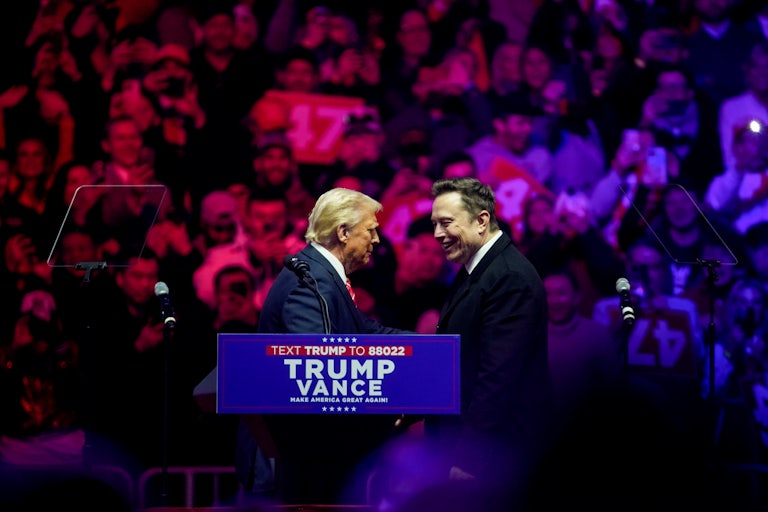
Donald Trump finally created DOGE.

Donald Trump and Elon Musk shake hands on stage the night before Trump’s inauguration
Al Drago/Bloomberg/Getty Images

The much-discussed Department of Government Efficiency is finally coming to fruition—but it’s not the stringent, $2 trillion cost-cutting agency that Elon Musk had promised.

Instead, the executive order Donald Trump signed Monday night officially actualizing the executive branch division is a simple rebrand of something that already exists: the U.S. Digital Service, which has little to do with budget cuts.

“The United States Digital Service is hereby publicly renamed as the United States DOGE Service (USDS) and shall be established in the Executive Office of the President,” the executive order reads.

Part of the mandate includes the development of a subagency, named the U.S. DOGE Service Temporary Organization, which will be “dedicated to advancing the President’s 18-month DOGE agenda.” The temporary subagency will expire on July 4, 2026. The administrator overseeing DOGE will report to White House chief of staff Susie Wiles.

And in reality, it appears that more bureaucracy will be on the agenda for the memeified division: The executive order requires the hiring of four-person “DOGE teams” for each agency (very efficient, much cost-cutting). They will include an agency-related team lead, an engineer, a human resources specialist, and an attorney, per the order, all in an effort to further advance Trump’s vague and unclear DOGE agenda.

Another executive order further grants DOGE a level of responsibility for enacting a federal hiring plan.

“The Federal Hiring Plan shall provide specific best practices for the human resources function in each agency, which each agency head shall implement, with advice and recommendations as appropriate from DOGE,” the order, titled “Reforming the Federal Hiring Process and Restoring Merit to Government Service,” reads.

The first job gutted by DOGE was apparently one of its own potential co-chairs, biotech executive Vivek Ramaswamy’s, who was ousted from Trumpworld in recent weeks for seemingly grating on the “rank and file” of the cost-cutting department. Last week, Trump personally implored Ramaswamy to consider taking Ohio’s Senate seat, recently vacated by Vice President JD Vance, if it was offered to him by Governor Mike DeWine. (Of course, it wasn’t, and the billionaire is instead expected to announce a bid to replace the term-limited governor in 2026.)

Musk has promised to trim $2 trillion from the federal budget under the helm of the agency, a sum that constitutes more than Congress has in discretionary spending. Doing so would practically defund the entire executive branch, which doles out funding for the military, national security, and all federal agencies.